
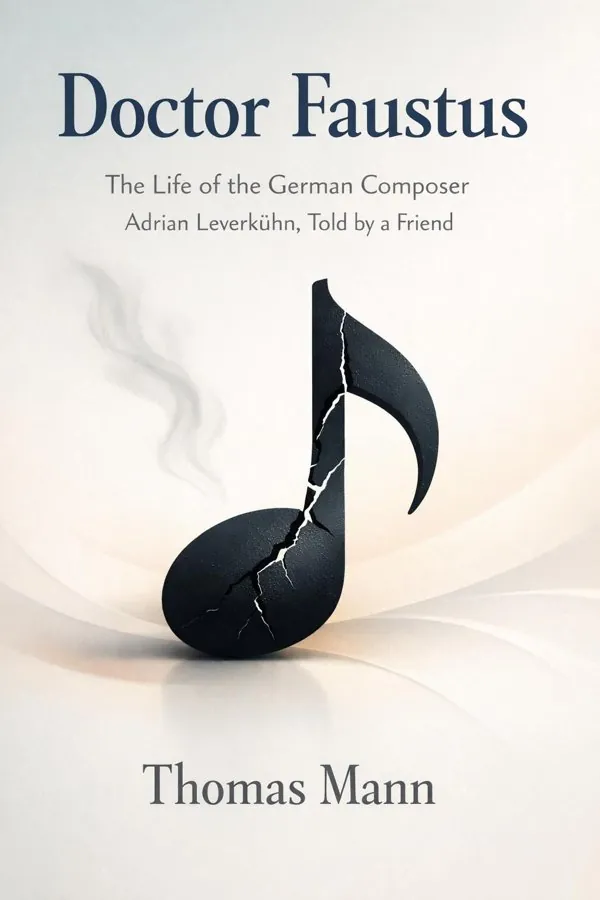
Doctor Faustus: The Life of the German Composer Adrian Leverkühn, Told by a Friend: Summary & Key Insights
by Thomas Mann
 10 min5 chaptersAudio available
What Is Doctor Faustus: The Life of the German Composer Adrian Leverkühn, Told by a Friend About?
Doctor Faustus: The Life of the German Composer Adrian Leverkühn, Told by a Friend by Thomas Mann is a classics book spanning 5 pages. Doctor Faustus is a 1947 novel by Thomas Mann that tells the story of the fictional composer Adrian Leverkühn, who makes a pact with the devil to gain creative genius. The novel intertwines Leverkühn’s personal tragedy with the intellectual and moral decline of Germany in the early 20th century, exploring themes of guilt, art, madness, and cultural decay.
This FizzRead summary covers all 5 key chapters of Doctor Faustus: The Life of the German Composer Adrian Leverkühn, Told by a Friend in approximately 10 minutes, distilling the most important ideas, arguments, and takeaways from Thomas Mann's work. Also available as an audio summary and Key Quotes Podcast.
Doctor Faustus: The Life of the German Composer Adrian Leverkühn, Told by a Friend
Doctor Faustus is a 1947 novel by Thomas Mann that tells the story of the fictional composer Adrian Leverkühn, who makes a pact with the devil to gain creative genius. The novel intertwines Leverkühn’s personal tragedy with the intellectual and moral decline of Germany in the early 20th century, exploring themes of guilt, art, madness, and cultural decay.
Who Should Read Doctor Faustus: The Life of the German Composer Adrian Leverkühn, Told by a Friend?
This book is perfect for anyone interested in classics and looking to gain actionable insights in a short read. Whether you're a student, professional, or lifelong learner, the key ideas from Doctor Faustus: The Life of the German Composer Adrian Leverkühn, Told by a Friend by Thomas Mann will help you think differently.
- ✓Readers who enjoy classics and want practical takeaways
- ✓Professionals looking to apply new ideas to their work and life
- ✓Anyone who wants the core insights of Doctor Faustus: The Life of the German Composer Adrian Leverkühn, Told by a Friend in just 10 minutes
Want the full summary?
Get instant access to this book summary and 100K+ more with Fizz Moment.
Get Free SummaryAvailable on App Store • Free to download
Key Chapters
Adrian was born in the peaceful rural stretch of Kaisersaschern, a place of quiet landscapes and stubbornly traditional values. His father, a simple yet reflective man, kept bees—a gentle metaphor, perhaps, for order and harmony—and his mother was of sweet, pious disposition. Even in the cradle of simplicity, however, Adrian was marked by strangeness. His intellect developed with disturbing rapidity; he viewed the world with an almost detached curiosity, as if he were already scrutinizing reality through the lenses of theology and music. I recall his childhood as filled with silence—a silence not of absence, but of inwardness. There was a sense that this boy, even before he spoke of God or melody, was somehow destined for solitude.
It was in his youth that the seeds of his later tragedy were planted. In a household steeped in faith and moral order, the child began to question. He grew fascinated by mathematical perfection, by the structure of sound, by metaphysical inquiries his companions could scarcely comprehend. He found beauty in abstraction, and it was in this pursuit that the first shadow fell upon him: a beauty detached from life, a desire for purity that overlooked compassion. Even his early compositions—modest as they were—spoke of a searching, almost inhuman intensity. I, from afar, admired his gift but feared the isolation that grew with it.
What does it mean, you may ask, to be born a genius? It means, I think, to be condemned to loneliness. Adrian’s early years were filled not just with promise, but with the invisible aching of one who subtly rejects the world he inhabits. In his music, he sought not comfort, but truth—truth too pure for human ears.
When Adrian entered the universities of Leipzig and Halle, the peaceful rhythms of Kaisersaschern gave way to intense intellectual ferment. Germany’s academic life was at its height, intoxicated by philosophy and theology, and there Adrian immersed himself in the study of divine mysteries and speculative thought. He debated the essence of God, the nature of evil, and the limits of human intellect. Yet beneath these scholarly pursuits flickered a growing tension—the unbearable contradiction between belief and reason.
He sought answers in scholastic theology, in Nietzsche’s denial of divine order, and in the new tonal theories of music that dismantled classical harmony. Through that search, Adrian became the perfect embodiment of a mind at war with its own conscience. Those years were his schooling in despair: he touched holiness but tasted only skepticism. To him, faith became an aesthetic rather than moral category, and truth was something to be composed, not lived.
During this period, Adrian encountered Wendell Kretzschmar, the eccentric scholar whose lectures on aesthetics were both maddening and enlightening. Kretzschmar’s talk of counterpoint, of the metaphysical nature of musical structure, enchanted Adrian utterly. He began to conceive music as a manifestation of theology—as if each fugue could stand for a metaphysical proposition. But this insight, though fruitful, also deepened his alienation. He sought not human emotion in music but divine structure, not passion but knowledge. As I observed his transformation, I sensed that Adrian’s art was ceasing to belong to human fellowship. It was becoming something chillingly pure, something that tempted fate.
+ 3 more chapters — available in the FizzRead app
All Chapters in Doctor Faustus: The Life of the German Composer Adrian Leverkühn, Told by a Friend
About the Author
Thomas Mann (1875–1955) was a German novelist and Nobel Prize laureate in Literature (1929). He is regarded as one of the most significant authors of the 20th century. His major works include Buddenbrooks, The Magic Mountain, and Doctor Faustus, known for their deep psychological and philosophical reflections on European culture and modern humanity.
Get This Summary in Your Preferred Format
Read or listen to the Doctor Faustus: The Life of the German Composer Adrian Leverkühn, Told by a Friend summary by Thomas Mann anytime, anywhere. FizzRead offers multiple formats so you can learn on your terms — all free.
Available formats: App · Audio · PDF · EPUB — All included free with FizzRead
Download Doctor Faustus: The Life of the German Composer Adrian Leverkühn, Told by a Friend PDF and EPUB Summary
Key Quotes from Doctor Faustus: The Life of the German Composer Adrian Leverkühn, Told by a Friend
“Adrian was born in the peaceful rural stretch of Kaisersaschern, a place of quiet landscapes and stubbornly traditional values.”
“When Adrian entered the universities of Leipzig and Halle, the peaceful rhythms of Kaisersaschern gave way to intense intellectual ferment.”
Frequently Asked Questions about Doctor Faustus: The Life of the German Composer Adrian Leverkühn, Told by a Friend
Doctor Faustus: The Life of the German Composer Adrian Leverkühn, Told by a Friend by Thomas Mann is a classics book that explores key ideas across 5 chapters. Doctor Faustus is a 1947 novel by Thomas Mann that tells the story of the fictional composer Adrian Leverkühn, who makes a pact with the devil to gain creative genius. The novel intertwines Leverkühn’s personal tragedy with the intellectual and moral decline of Germany in the early 20th century, exploring themes of guilt, art, madness, and cultural decay.
More by Thomas Mann


You Might Also Like






Browse by Category
Ready to read Doctor Faustus: The Life of the German Composer Adrian Leverkühn, Told by a Friend?
Get the full summary and 100K+ more books with Fizz Moment.