
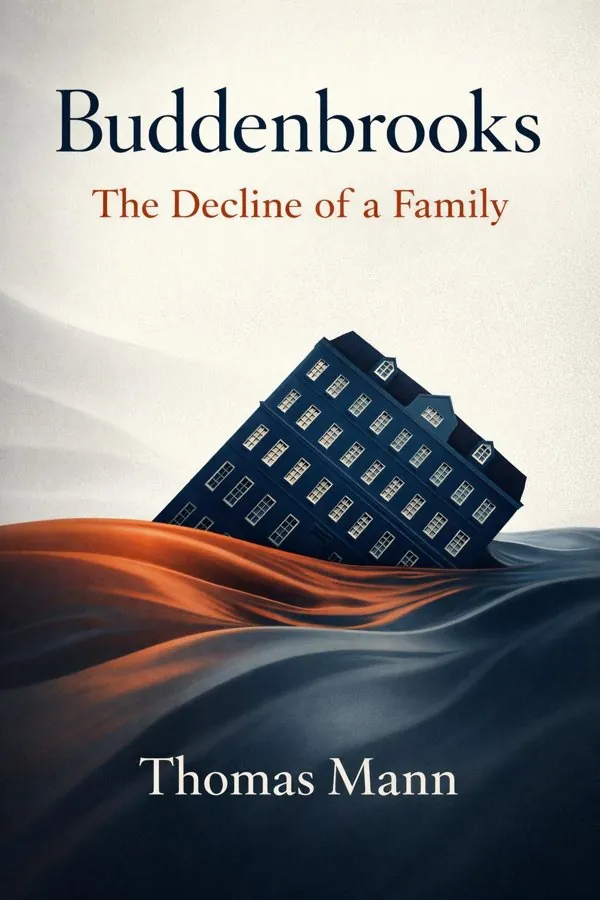
Buddenbrooks: The Decline of a Family: Summary & Key Insights
by Thomas Mann
 10 min10 chaptersAudio available
Key Takeaways from Buddenbrooks: The Decline of a Family
A family’s home can function like a public statement of faith.
Values can build a civilization, but they can also become a burden when repeated without reflection.
Decline does not arrive in one form; it appears differently in each personality.
A marriage can look respectable from the outside while quietly destroying the people inside it.
Success can be a form of self-erasure when a person is valued only for what he sustains.
What Is Buddenbrooks: The Decline of a Family About?
Buddenbrooks: The Decline of a Family by Thomas Mann is a classics book spanning 10 pages. What happens when a family builds its identity on discipline, reputation, and commercial success, only to discover that history, personality, and time quietly erode all three? Thomas Mann’s Buddenbrooks: The Decline of a Family answers that question through the story of a wealthy merchant dynasty in nineteenth-century Lübeck. Published in 1901, this sweeping first novel follows several generations of the Buddenbrook family as prosperity gives way to exhaustion, emotional fracture, and cultural change. What begins as a portrait of solid bourgeois confidence gradually becomes a meditation on mortality, inheritance, and the hidden costs of respectability. The novel matters because it turns family history into a diagnosis of an entire social class. Mann shows how business routines, marriage alliances, manners, religion, and taste are not merely private matters but structures that shape destiny. At the same time, he gives each character vivid psychological depth, making decline feel intimate rather than abstract. Mann later became one of the defining writers of twentieth-century literature and won the Nobel Prize in 1929, but Buddenbrooks already displays his signature intelligence, irony, and insight into the tensions between duty and inner life.
This FizzRead summary covers all 10 key chapters of Buddenbrooks: The Decline of a Family in approximately 10 minutes, distilling the most important ideas, arguments, and takeaways from Thomas Mann's work. Also available as an audio summary and Key Quotes Podcast.
Buddenbrooks: The Decline of a Family
What happens when a family builds its identity on discipline, reputation, and commercial success, only to discover that history, personality, and time quietly erode all three? Thomas Mann’s Buddenbrooks: The Decline of a Family answers that question through the story of a wealthy merchant dynasty in nineteenth-century Lübeck. Published in 1901, this sweeping first novel follows several generations of the Buddenbrook family as prosperity gives way to exhaustion, emotional fracture, and cultural change. What begins as a portrait of solid bourgeois confidence gradually becomes a meditation on mortality, inheritance, and the hidden costs of respectability.
The novel matters because it turns family history into a diagnosis of an entire social class. Mann shows how business routines, marriage alliances, manners, religion, and taste are not merely private matters but structures that shape destiny. At the same time, he gives each character vivid psychological depth, making decline feel intimate rather than abstract. Mann later became one of the defining writers of twentieth-century literature and won the Nobel Prize in 1929, but Buddenbrooks already displays his signature intelligence, irony, and insight into the tensions between duty and inner life.
Who Should Read Buddenbrooks: The Decline of a Family?
This book is perfect for anyone interested in classics and looking to gain actionable insights in a short read. Whether you're a student, professional, or lifelong learner, the key ideas from Buddenbrooks: The Decline of a Family by Thomas Mann will help you think differently.
- ✓Readers who enjoy classics and want practical takeaways
- ✓Professionals looking to apply new ideas to their work and life
- ✓Anyone who wants the core insights of Buddenbrooks: The Decline of a Family in just 10 minutes
Want the full summary?
Get instant access to this book summary and 100K+ more with Fizz Moment.
Get Free SummaryAvailable on App Store • Free to download
Key Chapters
A family’s home can function like a public statement of faith. In Buddenbrooks, the grand house in Lübeck is more than a residence: it is a symbol of continuity, reputation, and disciplined prosperity. From the beginning, Mann presents the household as a carefully arranged world where furniture, meals, business habits, and social rituals all announce that the Buddenbrooks belong to the secure upper bourgeoisie. Their house embodies a conviction that success can be stabilized through good breeding, careful management, and proper conduct.
Yet Mann’s deeper point is that material order often hides human fragility. The house looks durable, but the lives within it are already subject to disappointment, illness, compromise, and generational drift. The family treats domestic formality as a defense against chaos. They host dinners, maintain appearances, and preserve traditions not just because they value them, but because these practices reassure them that their world will endure. Over time, the reader sees that institutions and interiors cannot protect a family from inner weakening.
This insight applies far beyond nineteenth-century Lübeck. Many families, companies, and communities rely on visible markers of stability—property, rituals, titles, polished branding—to project permanence. But external order does not automatically produce emotional resilience or long-term adaptability. A business may have an impressive headquarters while losing its strategic edge. A family may preserve customs while avoiding difficult conversations.
Mann invites us to ask whether what looks solid is actually alive. The actionable takeaway is simple: examine the structures you depend on and ask whether they reflect genuine strength or merely the memory of it.
Values can build a civilization, but they can also become a burden when repeated without reflection. The older Buddenbrooks, especially Johann Buddenbrook and his wife Antoinette, represent a nineteenth-century merchant ethic grounded in honor, diligence, piety, and social reliability. For them, commerce is not a crude pursuit of money. It is a moral vocation. To conduct business honestly, keep one’s word, uphold family standing, and labor consistently is to participate in a meaningful social order.
Mann treats these values with both respect and irony. He recognizes their strength: they create trust, discipline, and civic coherence. The elder generation’s self-command gives the family its foundation. At the same time, the novel shows that such principles can harden into ceremonial expectations that younger family members inherit without sharing inwardly. The code remains, but the conviction behind it fades. What once felt like purpose begins to feel like performance.
This tension remains familiar today. Professional and family cultures often pass down mottos like “work hard,” “protect the name,” or “do your duty.” These ideals can inspire excellence, especially when linked to genuine meaning. But when circumstances change, inherited values may become rigid scripts. A child raised to preserve a family business may feel trapped rather than guided. An employee in a legacy firm may admire its ethics while finding its culture emotionally stifling.
Mann does not argue that honor and labor are false. He shows that every value system must be renewed inwardly if it is to remain alive. Otherwise, morality becomes theater. The actionable takeaway: revisit your guiding principles and make sure they are personally understood, not merely inherited slogans repeated out of habit.
Decline does not arrive in one form; it appears differently in each personality. Thomas, Christian, and Tony Buddenbrook represent three distinct responses to the demands of family identity. Thomas becomes the dutiful heir, disciplined, intelligent, and increasingly consumed by the responsibility of preserving the family firm. Christian drifts toward instability, irony, and self-indulgence, unable to sustain the seriousness bourgeois life requires. Tony, proud and emotionally impulsive, attaches herself passionately to the family name while repeatedly suffering through marriages shaped by social calculation rather than personal fulfillment.
Together, the siblings reveal that a powerful family culture can produce not unity but fragmentation. Thomas internalizes duty so completely that it hollows him out. Christian resists discipline and becomes a caricature of unserious modern nervousness. Tony clings to appearances even when her life repeatedly disproves the assumptions behind them. None of them can fully inhabit the stable identity their parents’ generation believed was natural.
This makes the novel psychologically rich rather than merely historical. Families still divide roles in similar ways: one child carries expectations, another becomes the eccentric outsider, another preserves tradition emotionally while lacking real power. These roles can feel natural, but they are often adaptive performances shaped by pressure. The “responsible one” may be anxious. The “comic one” may be deeply fragile. The “loyal one” may confuse family pride with personal happiness.
Mann’s insight is that family systems transmit not only assets and values but also patterns of strain. Understanding those patterns can help people step out of inherited scripts. The actionable takeaway: identify the role your family or workplace has assigned you, and ask whether it reflects your true character or a burden you have learned to carry.
Success can be a form of self-erasure when a person is valued only for what he sustains. Thomas Buddenbrook rises into leadership as the family’s most capable representative. He is intelligent, composed, politically aware, and deeply committed to preserving the firm’s standing. On the surface, he fulfills the bourgeois ideal almost perfectly. He manages accounts, maintains public dignity, and treats responsibility as a sacred task. Yet Mann gradually reveals the emotional cost of this achievement.
Thomas lives under constant pressure to embody stability. He must not only make sound decisions but perform confidence for clients, family members, and society. The gap between his public role and private exhaustion widens over time. As commercial conditions grow less favorable and the family weakens, Thomas becomes more introspective, anxious, and physically depleted. His duty gives him status, but it also isolates him. The very discipline that makes him admirable contributes to his decline.
This portrait remains strikingly modern. Leaders in family businesses, corporations, and public institutions often experience the same burden. They become symbols of continuity and competence, which means they feel unable to show uncertainty. The result can be burnout disguised as professionalism. People praise their reliability while missing the loneliness beneath it.
Mann is not criticizing duty itself. He is showing that duty without interior renewal becomes destructive. Responsibility must be accompanied by self-knowledge, emotional honesty, and the willingness to adapt. Otherwise, individuals become custodians of forms they can no longer inhabit with conviction. The actionable takeaway: if you are carrying a role of leadership, regularly ask what the role is costing you inwardly, and build practices that preserve your humanity rather than only your performance.
Not everyone collapses under duty; some simply cannot enter its logic at all. Christian Buddenbrook represents a different kind of decline from Thomas’s: not overfulfillment, but chronic incapacity. He is witty, restless, self-dramatizing, and physically preoccupied with his ailments. He struggles to sustain business discipline and drifts toward entertainment, distraction, and performative complaint. In a family built on seriousness, Christian becomes both embarrassment and symptom.
Mann does not reduce him to comic relief. Christian’s instability exposes the limits of bourgeois expectations. The Buddenbrook world assumes that a man of good family will naturally become rational, industrious, and respectable. Christian disproves this assumption. Temperament matters. Fragility matters. Desire for amusement, fear of routine, nervous sensitivity, and psychological disorganization cannot simply be corrected by moral lecture. The family interprets him as deficient, but he also reveals that its model of normality is too narrow.
Modern readers may recognize Christian in people who fail to fit institutional scripts: the employee unsuited to corporate culture, the heir incapable of managing inherited responsibility, the relative whose humor masks distress. Such figures are often dismissed as unserious. Yet their failure may illuminate a broader mismatch between individual nature and social expectation.
Christian is destructive, but he is also diagnostic. Through him, Mann suggests that families often preserve their image by labeling one member the problem, thereby avoiding questions about the rigidity of the whole system. The actionable takeaway: when someone consistently fails to meet a social role, ask not only what is wrong with the person, but whether the role itself is realistic, humane, or properly matched to the individual.
Economic decline rarely announces itself dramatically at first; it appears as subtle shifts in confidence, timing, and competitive position. Buddenbrooks is not just a family saga but also a novel about business vulnerability. The Buddenbrook firm operates in a world where reputation, prudence, and continuity once provided a stable advantage. But markets change, rivals adapt, and inherited methods begin to lose force. The family’s commercial weakening mirrors the broader transformation of the bourgeois order.
Mann is precise in showing that decline is not caused by one catastrophic mistake alone. It emerges from accumulated pressure: less favorable ventures, reduced flexibility, growing symbolic obligations, and the mismatch between old habits and new realities. The family continues to behave as if prestige itself were a guarantee of future security. Yet the discipline that built the business is no longer enough to protect it.
This is one reason the novel still speaks powerfully to modern readers. Legacy institutions often confuse past success with ongoing resilience. A respected company may rely too heavily on brand heritage, ignoring innovation. A family enterprise may preserve rituals while failing to prepare successors. Individuals, too, can mistake established competence for long-term adaptability.
Mann’s business insight is unsentimental: economic life rewards not only integrity but also timing, renewal, and responsiveness to change. Moral seriousness remains important, but it does not suspend history. Prestige must be supported by practical evolution. The actionable takeaway: treat reputation as an asset, not a strategy. Review whether the habits that once made you successful are still suited to present conditions.
The most devastating form of decline begins when a person can imagine the end more vividly than the future. As Thomas Buddenbrook grows older, the novel deepens from social chronicle into existential meditation. He becomes increasingly aware of mortality, contingency, and the instability of all the forms he has spent his life preserving. His moments of reflection suggest that decline is not only an economic or familial process but a spiritual one: the fading of belief in permanence.
Mann links this introspection to modern consciousness. Thomas does not simply suffer setbacks; he begins to understand life philosophically, and that understanding weakens the confidence required to act. The merchant ethos depends on faith in continuity, calculation, and worldly order. Once Thomas perceives the transience beneath these assumptions, his authority loses some of its inner foundation. Knowledge becomes destabilizing.
This theme has broad resonance. Many high achievers can function effectively while their world feels meaningful and coherent. But when they confront mortality, randomness, or the possibility that their efforts cannot secure lasting permanence, motivation changes. A career, institution, or family legacy may suddenly appear fragile. Such realizations can lead either to despair or to a more mature humility.
Mann does not offer easy comfort. He suggests that lucidity has a cost. Yet he also implies that facing impermanence can strip away illusion and reveal what truly matters. The actionable takeaway: do not wait for collapse to think about transience. Reflect regularly on what in your life is genuinely meaningful if status, continuity, and control cannot be guaranteed.
Sometimes the final heir to a practical family is the one least able to continue it. Hanno Buddenbrook, Thomas’s son, embodies the culmination of the family’s long movement away from robust bourgeois vitality. Frail, inward, musically gifted, and deeply sensitive, Hanno has little affinity for commerce, ambition, or public duty. He belongs to art, feeling, and inwardness rather than trade and administration. In him, the family line reaches a point where cultural refinement and biological weakening seem tragically intertwined.
Hanno is central to Mann’s larger contrast between life organized around utility and life organized around aesthetic experience. Music offers him intensity, escape, and authenticity. But it also removes him from the practical world his ancestors built. He cannot convert sensitivity into social action. The very qualities that make him spiritually compelling make him historically unfit to carry the family legacy forward.
This conflict remains deeply relevant. Families and institutions often hope that the next generation will preserve tradition, yet children may possess gifts that pull in entirely different directions. A parent may value discipline and enterprise while a child is drawn to art, contemplation, or emotional expression. The challenge is not simply career choice; it is the collision between inherited identity and individual temperament.
Mann refuses simplistic celebration of either side. Commerce without inward life becomes hollow, but sensibility without worldly capacity becomes fragile. Hanno’s fate is moving because it shows the beauty and vulnerability of a soul unsuited to the world it inherits. The actionable takeaway: honor genuine talent and temperament early, rather than forcing people into inherited molds that may crush both the individual and the legacy.
The end of a family line is not only a biological event; it is a revelation that history does not preserve human importance simply because people believed in it. By the close of Buddenbrooks, the family’s proud continuity has dissolved. Deaths, failed marriages, commercial weakening, and the loss of viable heirs bring the once-formidable household to extinction. The result is not melodramatic catastrophe but a quiet recognition that even respected names disappear.
What makes this ending powerful is Mann’s refusal to treat extinction as a moral punishment. The Buddenbrooks do not fall because they are uniquely corrupt. They decline because all human structures are vulnerable to time, temperament, illness, economic change, and historical transformation. The family believed it could convert conduct into permanence. The novel demonstrates that no such guarantee exists.
Yet Mann does not leave only emptiness. What survives is memory, form, and artistic representation. The family may vanish, but the novel preserves the textures of its life—the meals, conversations, anxieties, ambitions, and illusions. In that sense, art becomes the final vessel of continuity, not commerce or bloodline. This is one reason the book remains so moving: it transforms social disappearance into literary permanence.
For modern readers, the lesson is clarifying. We often pursue legacy as if it were a controllable outcome. But names fade, institutions change, and descendants choose their own paths. The actionable takeaway: build with care, but hold legacy lightly. Focus less on preserving your image forever and more on living and acting in ways worth remembering while they last.
All Chapters in Buddenbrooks: The Decline of a Family
About the Author
Thomas Mann (1875–1955) was a German novelist, essayist, and Nobel Prize winner whose work helped define modern European literature. Born in Lübeck into a merchant family, he drew deeply on bourgeois culture, family life, and intellectual conflict in his fiction. His first major novel, Buddenbrooks, brought him early fame with its sweeping portrayal of a merchant dynasty’s decline. He later wrote landmarks such as Death in Venice, The Magic Mountain, and Doctor Faustus, exploring themes of art, illness, morality, politics, and spiritual crisis. Mann left Germany during the Nazi era and became an important public voice against fascism. Admired for his psychological precision, irony, and philosophical depth, he remains one of the most significant literary figures of the twentieth century.
Get This Summary in Your Preferred Format
Read or listen to the Buddenbrooks: The Decline of a Family summary by Thomas Mann anytime, anywhere. FizzRead offers multiple formats so you can learn on your terms — all free.
Available formats: App · Audio · PDF · EPUB — All included free with FizzRead
Download Buddenbrooks: The Decline of a Family PDF and EPUB Summary
Key Quotes from Buddenbrooks: The Decline of a Family
“A family’s home can function like a public statement of faith.”
“Values can build a civilization, but they can also become a burden when repeated without reflection.”
“Decline does not arrive in one form; it appears differently in each personality.”
“A marriage can look respectable from the outside while quietly destroying the people inside it.”
“Success can be a form of self-erasure when a person is valued only for what he sustains.”
Frequently Asked Questions about Buddenbrooks: The Decline of a Family
Buddenbrooks: The Decline of a Family by Thomas Mann is a classics book that explores key ideas across 10 chapters. What happens when a family builds its identity on discipline, reputation, and commercial success, only to discover that history, personality, and time quietly erode all three? Thomas Mann’s Buddenbrooks: The Decline of a Family answers that question through the story of a wealthy merchant dynasty in nineteenth-century Lübeck. Published in 1901, this sweeping first novel follows several generations of the Buddenbrook family as prosperity gives way to exhaustion, emotional fracture, and cultural change. What begins as a portrait of solid bourgeois confidence gradually becomes a meditation on mortality, inheritance, and the hidden costs of respectability. The novel matters because it turns family history into a diagnosis of an entire social class. Mann shows how business routines, marriage alliances, manners, religion, and taste are not merely private matters but structures that shape destiny. At the same time, he gives each character vivid psychological depth, making decline feel intimate rather than abstract. Mann later became one of the defining writers of twentieth-century literature and won the Nobel Prize in 1929, but Buddenbrooks already displays his signature intelligence, irony, and insight into the tensions between duty and inner life.
More by Thomas Mann



You Might Also Like





Browse by Category
Ready to read Buddenbrooks: The Decline of a Family?
Get the full summary and 100K+ more books with Fizz Moment.