
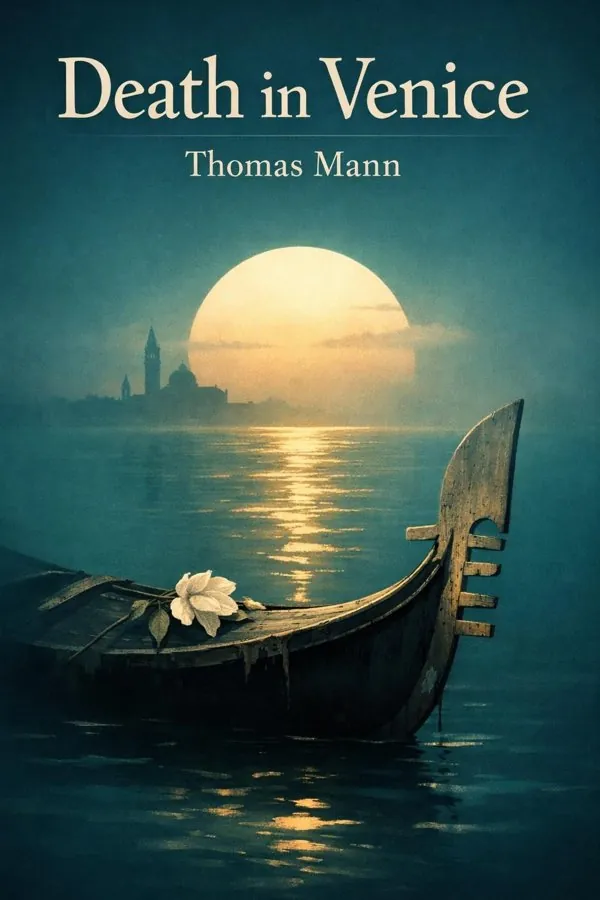
Death in Venice: Summary & Key Insights
by Thomas Mann
 10 min8 chaptersAudio available
Key Takeaways from Death in Venice
A life built entirely on discipline can look admirable from the outside and barren from within.
Some places do not merely host a story; they become its moral atmosphere.
Beauty is often praised as uplifting, but Mann asks a more dangerous question: what if beauty destabilizes the mind that seeks it?
Great art often emerges from tension, not balance.
People rarely ruin themselves in one dramatic decision; more often, they erode their own judgment by degrees.
What Is Death in Venice About?
Death in Venice by Thomas Mann is a classics book spanning 5 pages. Thomas Mann’s Death in Venice is one of the most haunting short works in modern literature: a compact novella about an aging writer, Gustav von Aschenbach, who leaves Munich for Venice in search of rest and renewal, only to be consumed by a fascination that strips away his self-command. In the shimmering, decaying beauty of Venice, Mann stages a profound drama about art, desire, discipline, aging, and the dangerous seduction of ideal beauty. What begins as a travel narrative slowly becomes a psychological descent, as Aschenbach’s cultivated dignity collapses under forces he can no longer master. First published in 1912, the novella remains powerful because it speaks to permanent human tensions: order versus impulse, reason versus obsession, public virtue versus private longing. Mann, who won the Nobel Prize in Literature in 1929, brings exceptional authority to these themes through his philosophical depth, psychological precision, and elegant prose. Death in Venice matters not simply as a story of one man’s downfall, but as a brilliant exploration of what happens when a life built on control suddenly encounters the irresistible pull of beauty.
This FizzRead summary covers all 8 key chapters of Death in Venice in approximately 10 minutes, distilling the most important ideas, arguments, and takeaways from Thomas Mann's work. Also available as an audio summary and Key Quotes Podcast.
Death in Venice
Thomas Mann’s Death in Venice is one of the most haunting short works in modern literature: a compact novella about an aging writer, Gustav von Aschenbach, who leaves Munich for Venice in search of rest and renewal, only to be consumed by a fascination that strips away his self-command. In the shimmering, decaying beauty of Venice, Mann stages a profound drama about art, desire, discipline, aging, and the dangerous seduction of ideal beauty. What begins as a travel narrative slowly becomes a psychological descent, as Aschenbach’s cultivated dignity collapses under forces he can no longer master.
First published in 1912, the novella remains powerful because it speaks to permanent human tensions: order versus impulse, reason versus obsession, public virtue versus private longing. Mann, who won the Nobel Prize in Literature in 1929, brings exceptional authority to these themes through his philosophical depth, psychological precision, and elegant prose. Death in Venice matters not simply as a story of one man’s downfall, but as a brilliant exploration of what happens when a life built on control suddenly encounters the irresistible pull of beauty.
Who Should Read Death in Venice?
This book is perfect for anyone interested in classics and looking to gain actionable insights in a short read. Whether you're a student, professional, or lifelong learner, the key ideas from Death in Venice by Thomas Mann will help you think differently.
- ✓Readers who enjoy classics and want practical takeaways
- ✓Professionals looking to apply new ideas to their work and life
- ✓Anyone who wants the core insights of Death in Venice in just 10 minutes
Want the full summary?
Get instant access to this book summary and 100K+ more with Fizz Moment.
Get Free SummaryAvailable on App Store • Free to download
Key Chapters
A life built entirely on discipline can look admirable from the outside and barren from within. Gustav von Aschenbach begins as a celebrated writer in Munich, a man whose reputation rests on self-mastery, hard work, and moral seriousness. He has achieved artistic greatness not by surrendering to inspiration, but by forcing himself into productivity through willpower. Mann presents him as the model of the respectable artist: controlled, dutiful, and publicly honored. Yet beneath that success lies fatigue. His imagination has become strained, and his rigid order has started to feel less like strength than confinement.
This first movement of the novella is crucial because it shows that collapse does not begin with scandal; it begins with inner dryness. A chance encounter with a strange traveler awakens in Aschenbach a sudden longing for elsewhere, for movement, for the unknown. What he experiences is not just a desire for vacation, but a deeper psychic disturbance: a hunger for life beyond the narrow boundaries he has imposed on himself.
In practical terms, Mann captures a problem many ambitious people face. A career can be built through discipline, but if discipline becomes an identity rather than a tool, the self begins to harden. Professionals who pride themselves on control often ignore subtle signs of exhaustion until those signs erupt as impulsive decisions, emotional dependency, or reckless escape.
Aschenbach’s journey begins the moment he mistakes restlessness for simple travel desire, rather than recognizing it as a warning from within. Actionable takeaway: pay attention to periods of unexplained restlessness—they may signal not weakness, but the need to renew your inner life before suppressed desires take control.
Some places do not merely host a story; they become its moral atmosphere. Venice in Death in Venice is not a neutral setting but a living symbol of seduction, artifice, and decay. When Aschenbach arrives, he is enchanted by the city’s shimmering waters, ornate architecture, and dreamlike light. Venice appears as beauty made visible, a place where reality softens into aesthetic experience. Yet Mann quickly reveals the city’s other face: humid air, stagnant canals, hidden filth, and the concealed spread of disease.
This doubleness matters because Venice mirrors Aschenbach himself. Outwardly, both city and man preserve elegance. Inwardly, both are undergoing decomposition. The authorities suppress news of cholera to protect commerce and appearances, just as Aschenbach suppresses moral truth to protect his private obsession. Venice becomes the perfect backdrop for self-deception because it teaches him to prefer beautiful surfaces over hard realities.
Mann’s portrayal still feels contemporary. Institutions, companies, and even individuals often conceal dysfunction behind branding, polish, or ceremony. A glamorous workplace may be emotionally toxic. A carefully curated personal image may hide loneliness or collapse. The danger comes when the surface becomes so persuasive that no one wants to name what is rotting underneath.
Aschenbach senses that something is wrong in Venice, but he repeatedly chooses not to leave. He prefers enchantment to honesty. That is one of the novella’s most unsettling insights: people rarely fall because truth is unavailable; they fall because truth is inconvenient.
Actionable takeaway: when a person, place, or situation feels both alluring and vaguely unhealthy, do not ignore the contradiction—beauty and danger often arrive together, and discernment begins by refusing to confuse one for the other.
Beauty is often praised as uplifting, but Mann asks a more dangerous question: what if beauty destabilizes the mind that seeks it? In Venice, Aschenbach encounters Tadzio, a Polish boy whose physical beauty strikes him with overwhelming force. Mann is careful to present this not as ordinary attraction but as an aesthetic and spiritual shock. Aschenbach interprets Tadzio through the language of classical idealism, seeing him as an embodiment of form, grace, and perfection. Yet this elevated language does not purify his response; it disguises and intensifies it.
The key idea here is that reason does not always defeat desire by analyzing it. Sometimes reason serves desire by giving it noble vocabulary. Aschenbach persuades himself that he is contemplating beauty in an artistic, almost philosophical way. But his contemplation becomes fixation. He watches, follows, and organizes his days around glimpsing Tadzio. His mind remains sophisticated, but its sophistication has become an accomplice to obsession.
This dynamic appears far beyond literature. People often intellectualize their compulsions: calling envy “standards,” calling control “care,” calling obsession “passion.” The more articulate and self-aware a person is, the easier it may become to justify what should instead be examined. Intelligence is not always protection; it can be a more elegant mask.
Mann’s brilliance lies in showing how beauty can blur ethical boundaries when it is treated as an absolute good. Aschenbach does not simply admire beauty—he submits to it. In doing so, he loses the inner distance that moral judgment requires.
Actionable takeaway: if you find yourself giving ever more elaborate explanations for a fixation, pause and ask whether your intelligence is serving truth—or merely decorating desire.
Great art often emerges from tension, not balance. Death in Venice explores one of Thomas Mann’s central concerns: the conflict between disciplined craftsmanship and ecstatic surrender. Aschenbach has built his career on effort, restraint, and form. He represents the artist who achieves greatness by working against impulse rather than yielding to it. Yet in Venice he begins to feel drawn toward the opposite principle: intoxication, abandon, sensuality, and the irrational energies that disciplined art usually contains.
Through this conflict, Mann challenges romantic myths about creativity. Inspiration alone is not enough; without discipline it becomes chaos. But discipline alone is also incomplete; without vitality it becomes sterile. Aschenbach’s tragedy is that he has lived too long on one side of the artistic equation. When the neglected side returns, it does not enrich him in measured form—it floods him destructively.
This insight applies to modern creative life as well. Writers, entrepreneurs, scholars, and professionals often overidentify with systems, schedules, and output. Others romanticize spontaneity and reject structure. Mann suggests that either extreme becomes dangerous. Healthy creation requires both craft and contact with living feeling. If one side is repressed, it may later reappear as burnout, impulsiveness, or self-sabotage.
Aschenbach mistakes his emotional upheaval for artistic renewal, but he cannot integrate it. He does not transform desire into art; he is consumed by it. That is the warning. Creativity demands permeability to life, but not surrender of self-command.
Actionable takeaway: whatever your craft, regularly ask whether you are overcorrecting toward control or chaos—and build habits that honor both structure and vitality before imbalance becomes crisis.
People rarely ruin themselves in one dramatic decision; more often, they erode their own judgment by degrees. In Death in Venice, Aschenbach does not suddenly become a different man. He gradually permits what he would once have condemned. He notices his fixation, then excuses it. He senses Venice is unsafe, then stays. He realizes his dignity is slipping, then rationalizes further surrender. Each compromise is small enough to defend, but together they create a moral and psychological downfall.
Mann shows that self-deception is not ignorance but collaboration with one’s own weakness. Aschenbach continually edits reality to preserve the image he has of himself. He does not want to think of himself as ridiculous, compromised, or possessed, so he reframes his behavior in aesthetic and emotional terms. This is why his decline feels so believable: he remains intelligent throughout. He simply becomes less honest.
In daily life, self-deception often appears in quieter forms. Someone stays in a destructive relationship because “things will improve.” A leader ignores ethical concerns because “the mission matters more.” A high achiever dismisses emotional instability as “just stress.” The mind prefers stories that protect identity, even when facts point elsewhere.
The novella’s power lies in its refusal to let us imagine that education, talent, or status automatically produce integrity. Aschenbach is refined, accomplished, and socially admired, but none of that saves him once he begins lying to himself. Character depends not on image, but on the willingness to face unwelcome truths.
Actionable takeaway: when you catch yourself repeatedly minimizing a concern, explain the situation in the plainest possible language—that simple act often breaks the spell of self-deception.
The body often reveals what the mind refuses to admit. As Death in Venice progresses, Mann links Aschenbach’s inner state to physical corruption, feverish atmosphere, and dream imagery. The cholera spreading through Venice is not merely a plot device; it externalizes the contamination already advancing within him. At the same time, Aschenbach experiences a disturbing dream of ecstatic, chaotic ritual—a vision of Dionysian frenzy that contrasts sharply with the orderly life he once maintained.
This dream is one of the novella’s key turning points. It dramatizes the collapse of civilized restraint and the triumph of forces Aschenbach had long repressed: sensuality, violence, intoxication, and loss of form. He awakens changed, no longer merely resisting temptation but inwardly consenting to it. After this, his decline accelerates. He neglects dignity, indulges vanity, and becomes increasingly unable to separate fantasy from reality.
Mann suggests that psychological disorder is rarely abstract. It affects perception, routine, the body, and one’s relation to the environment. In contemporary terms, prolonged denial can manifest as anxiety, compulsive behavior, physical exhaustion, and distorted thinking. What we push out of awareness does not disappear; it returns through symptoms, mood, and impaired judgment.
The epidemic also sharpens the novella’s atmosphere of fatalism. Venice is infected, but people continue their routines as if surface normalcy could cancel danger. That mirrors Aschenbach’s own condition. He remains outwardly functional even as corruption spreads inward.
Actionable takeaway: take seriously the signs—dreams, stress symptoms, compulsions, exhaustion—that suggest your inner life is becoming unmanageable; what is denied psychologically often reappears physically and behaviorally.
One of the novella’s most painful insights is that obsession is tied not only to desire, but to humiliation before time. Aschenbach is an aging man, and his fixation on youthful beauty is inseparable from his awareness of his own decline. Late in the story, he undergoes cosmetic grooming that makes him resemble the elderly fop he had earlier judged with contempt. This moment is deeply ironic: the man of dignity becomes the very caricature of vanity he once despised.
Mann uses this transformation to expose the fragility of cultivated identity. As long as Aschenbach believed himself above common weakness, his self-image remained intact. But the encounter with youth, beauty, and his own aging body creates a crisis he cannot bear. Instead of accepting mortality and limitation, he reaches for artificial restoration—surface correction in place of inner reckoning.
This remains intensely relevant. Modern culture often turns aging into a problem to conceal rather than a reality to understand. People may chase endless self-reinvention, cosmetic youthfulness, or social validation to avoid confronting change. The issue is not grooming or care in themselves, but the desperation that arises when worth becomes tied to appearing untouched by time.
Aschenbach’s vanity is tragic because it is not merely ridiculous; it reveals grief. He is mourning lost vitality, lost possibility, perhaps even unlived emotional life. But because he cannot name that grief honestly, it emerges as imitation and self-betrayal.
Actionable takeaway: when anxiety about aging appears, look beneath the surface urge to preserve appearance and ask what deeper loss you are actually grieving—clarity about that loss is more dignified than any disguise.
The end of Death in Venice is not only the death of a man but the collapse of an artistic ideal. Aschenbach had represented a vision of the artist as morally serious, disciplined, and devoted to form. By the time he dies on the beach, watching Tadzio from afar, that ideal has been hollowed out. He has not transcended desire through art, nor transformed longing into wisdom. Instead, he has been reduced to a passive spectator of the beauty that undoes him.
This ending is devastating because Mann refuses easy consolation. Aschenbach’s death has symbolic grandeur, but it is also pathetic, solitary, and degraded. The artist who once shaped experience into disciplined creation becomes unable to shape himself. In that sense, the novella is a critique of the belief that aesthetic sensitivity automatically ennobles character. To perceive beauty intensely is not the same as living well.
Yet the ending also gives the work its enduring force. Mann does not mock art; he probes its risks. Artists and intellectuals may be especially vulnerable to confusing contemplation with possession, idealization with truth, and aesthetic intensity with ethical depth. The novella asks whether art can save a person who has lost inner proportion. Mann’s answer is sobering: not if art becomes another form of self-enchantment.
For readers today, this final image speaks broadly to anyone whose identity depends on excellence, intellect, or taste. External achievement cannot substitute for inner integration.
Actionable takeaway: do not assume that talent, sophistication, or refined sensibility will protect you from collapse—build character with the same seriousness you bring to achievement.
All Chapters in Death in Venice
About the Author
Thomas Mann (1875–1955) was a German novelist, essayist, and short story writer whose work helped define modern European literature. Born in Lübeck, he first gained major recognition with Buddenbrooks, a family saga that established his reputation for psychological insight and formal mastery. Over the course of his career, he explored themes such as art, illness, morality, intellectual life, and the crises of modern civilization in works including Death in Venice, The Magic Mountain, and Doctor Faustus. Mann received the Nobel Prize in Literature in 1929. A public intellectual as well as a novelist, he spoke forcefully against fascism and spent much of the Nazi era in exile. He remains one of the most influential literary voices of the 20th century.
Get This Summary in Your Preferred Format
Read or listen to the Death in Venice summary by Thomas Mann anytime, anywhere. FizzRead offers multiple formats so you can learn on your terms — all free.
Available formats: App · Audio · PDF · EPUB — All included free with FizzRead
Download Death in Venice PDF and EPUB Summary
Key Quotes from Death in Venice
“A life built entirely on discipline can look admirable from the outside and barren from within.”
“Some places do not merely host a story; they become its moral atmosphere.”
“Beauty is often praised as uplifting, but Mann asks a more dangerous question: what if beauty destabilizes the mind that seeks it?”
“Great art often emerges from tension, not balance.”
“People rarely ruin themselves in one dramatic decision; more often, they erode their own judgment by degrees.”
Frequently Asked Questions about Death in Venice
Death in Venice by Thomas Mann is a classics book that explores key ideas across 8 chapters. Thomas Mann’s Death in Venice is one of the most haunting short works in modern literature: a compact novella about an aging writer, Gustav von Aschenbach, who leaves Munich for Venice in search of rest and renewal, only to be consumed by a fascination that strips away his self-command. In the shimmering, decaying beauty of Venice, Mann stages a profound drama about art, desire, discipline, aging, and the dangerous seduction of ideal beauty. What begins as a travel narrative slowly becomes a psychological descent, as Aschenbach’s cultivated dignity collapses under forces he can no longer master. First published in 1912, the novella remains powerful because it speaks to permanent human tensions: order versus impulse, reason versus obsession, public virtue versus private longing. Mann, who won the Nobel Prize in Literature in 1929, brings exceptional authority to these themes through his philosophical depth, psychological precision, and elegant prose. Death in Venice matters not simply as a story of one man’s downfall, but as a brilliant exploration of what happens when a life built on control suddenly encounters the irresistible pull of beauty.
More by Thomas Mann

You Might Also Like




Browse by Category
Ready to read Death in Venice?
Get the full summary and 100K+ more books with Fizz Moment.