
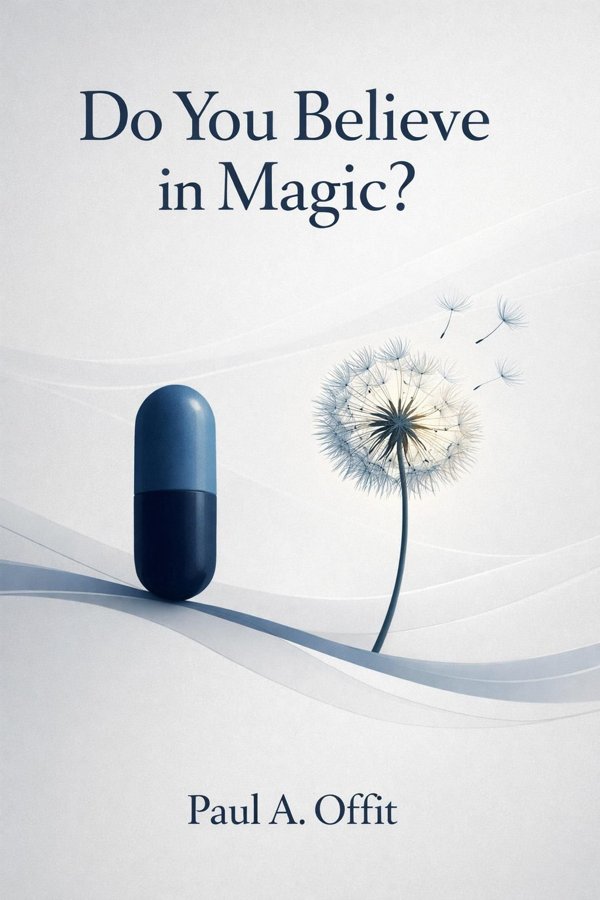
Do You Believe in Magic?: The Sense and Nonsense of Alternative Medicine: Summary & Key Insights
 10 min8 chaptersAudio available
What Is Do You Believe in Magic?: The Sense and Nonsense of Alternative Medicine About?
Do You Believe in Magic?: The Sense and Nonsense of Alternative Medicine by Paul A. Offit is a health_med book spanning 8 pages. In this book, pediatrician and vaccine expert Paul A. Offit critically examines the world of alternative medicine, exploring its claims, popularity, and potential dangers. He investigates how unproven treatments can sometimes harm patients and why many people continue to believe in them despite a lack of scientific evidence. Offit argues for the importance of evidence-based medicine and exposes the risks of pseudoscientific health practices.
This FizzRead summary covers all 8 key chapters of Do You Believe in Magic?: The Sense and Nonsense of Alternative Medicine in approximately 10 minutes, distilling the most important ideas, arguments, and takeaways from Paul A. Offit's work. Also available as an audio summary and Key Quotes Podcast.
Do You Believe in Magic?: The Sense and Nonsense of Alternative Medicine
In this book, pediatrician and vaccine expert Paul A. Offit critically examines the world of alternative medicine, exploring its claims, popularity, and potential dangers. He investigates how unproven treatments can sometimes harm patients and why many people continue to believe in them despite a lack of scientific evidence. Offit argues for the importance of evidence-based medicine and exposes the risks of pseudoscientific health practices.
Who Should Read Do You Believe in Magic?: The Sense and Nonsense of Alternative Medicine?
This book is perfect for anyone interested in health_med and looking to gain actionable insights in a short read. Whether you're a student, professional, or lifelong learner, the key ideas from Do You Believe in Magic?: The Sense and Nonsense of Alternative Medicine by Paul A. Offit will help you think differently.
- ✓Readers who enjoy health_med and want practical takeaways
- ✓Professionals looking to apply new ideas to their work and life
- ✓Anyone who wants the core insights of Do You Believe in Magic?: The Sense and Nonsense of Alternative Medicine in just 10 minutes
Want the full summary?
Get instant access to this book summary and 100K+ more with Fizz Moment.
Get Free SummaryAvailable on App Store • Free to download
Key Chapters
Before we can understand the power of alternative medicine, we need to understand where it came from. Practices like homeopathy, chiropractic, and naturopathy all emerged in the 19th century as direct reactions against a medical establishment that, to be fair, could be brutal and ineffective. Bloodletting, mercury purges, and ignorance characterized much of what passed for medicine in those days. Homeopathy’s founder Samuel Hahnemann promised a gentler way—tiny doses of substances meant to stimulate the body’s natural healing. Chiropractor D.D. Palmer claimed to manipulate invisible 'subluxations' to restore life energy. Naturopathy preached a return to earth and purity.
These ideas thrived not because they worked, but because they appealed to something deeper: the longing for meaning and control. As medicine modernized—through germ theory, vaccines, and surgery—these alternatives persisted, reinventing themselves as the 'natural' counterbalance to technology. The irony is that modern medicine has evolved beyond recognition; it has become safe, humane, and evidence-driven. Yet the romantic myth of the healing touch of nature remains ever potent.
Today’s alternative medicine industry represents this lineage. Its roots are emotional, not scientific. It tells stories, not studies. And stories—especially those promising agency and purity—convince far more powerfully than data ever could.
It would be dishonest to claim that alternative medicine never makes anyone feel better. The human body and mind are complex, and belief itself can produce real, measurable changes. This is the essence of the placebo effect—a phenomenon so powerful that every legitimate clinical trial must account for it. When someone believes that a treatment will help, their brain releases endorphins and dopamine, their pain can lessen, their anxiety can ease.
In that sense, alternative medicine often works—but not for the reasons its practitioners claim. The healing comes not from energy fields or diluted tinctures, but from the patient’s own physiologic response to expectation and care. The tragedy lies in mistaking placebo for proof. When we credit sugar pills for genuine relief, we attribute power to the wrong thing. We risk abandoning therapies that could truly heal, relying instead on illusion.
The placebo effect is, however, a powerful reminder of what modern medicine must not forget. Patients don’t just want prescriptions; they want to be understood. When alternative healers spend time listening, touching, and caring, they harness forces that medicine sometimes neglects. My argument is not that empathy should be discarded—but that empathy and evidence should coexist. The mind matters, but molecules matter too.
+ 6 more chapters — available in the FizzRead app
All Chapters in Do You Believe in Magic?: The Sense and Nonsense of Alternative Medicine
About the Author
Paul A. Offit is an American pediatrician specializing in infectious diseases, vaccines, immunology, and virology. He is a professor at the University of Pennsylvania and a co-inventor of the rotavirus vaccine. Offit is known for his advocacy of science-based medicine and his writings on vaccine safety and medical misinformation.
Get This Summary in Your Preferred Format
Read or listen to the Do You Believe in Magic?: The Sense and Nonsense of Alternative Medicine summary by Paul A. Offit anytime, anywhere. FizzRead offers multiple formats so you can learn on your terms — all free.
Available formats: App · Audio · PDF · EPUB — All included free with FizzRead
Download Do You Believe in Magic?: The Sense and Nonsense of Alternative Medicine PDF and EPUB Summary
Key Quotes from Do You Believe in Magic?: The Sense and Nonsense of Alternative Medicine
“Before we can understand the power of alternative medicine, we need to understand where it came from.”
“It would be dishonest to claim that alternative medicine never makes anyone feel better.”
Frequently Asked Questions about Do You Believe in Magic?: The Sense and Nonsense of Alternative Medicine
Do You Believe in Magic?: The Sense and Nonsense of Alternative Medicine by Paul A. Offit is a health_med book that explores key ideas across 8 chapters. In this book, pediatrician and vaccine expert Paul A. Offit critically examines the world of alternative medicine, exploring its claims, popularity, and potential dangers. He investigates how unproven treatments can sometimes harm patients and why many people continue to believe in them despite a lack of scientific evidence. Offit argues for the importance of evidence-based medicine and exposes the risks of pseudoscientific health practices.
You Might Also Like
On Immunity
Eula Biss
10 min
The Three-Body Problem
Liu Cixin
10 min
Community Health Volunteer Toolkit: Training and Practical Activities
World Health Organization
10 min
Healing Back Pain: The Mind-Body Connection
John E. Sarno
10 min
Health Literacy for All: Practical Guides to Communicate Health Information (Compilations)
World Health Organization
10 min
The Complete Guide to Sports Supplements: An Evidence-Based Review
Anita Bean
10 minBrowse by Category
Ready to read Do You Believe in Magic?: The Sense and Nonsense of Alternative Medicine?
Get the full summary and 100K+ more books with Fizz Moment.