
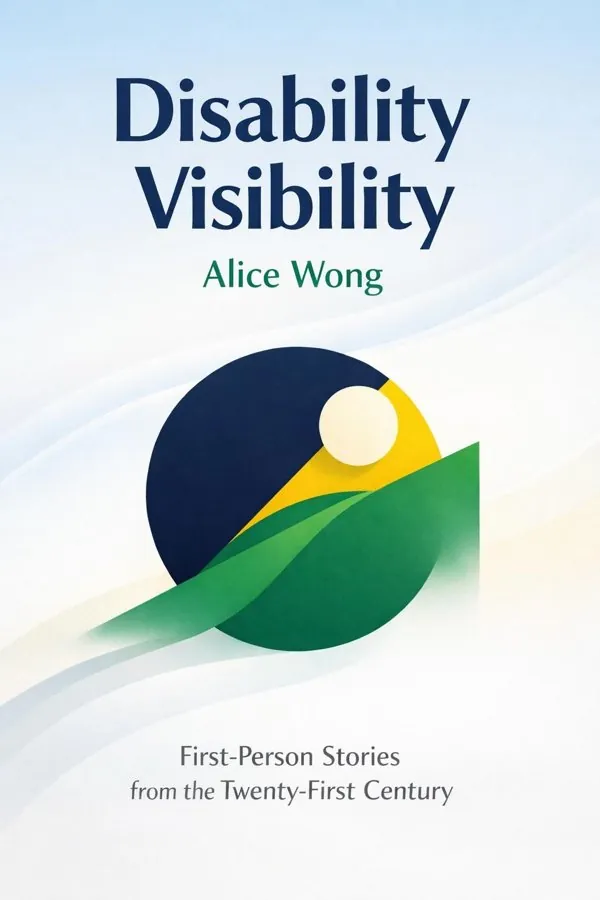
Disability Visibility: First-Person Stories from the Twenty-First Century: Summary & Key Insights
by Alice Wong
 10 min5 chaptersAudio available
What Is Disability Visibility: First-Person Stories from the Twenty-First Century About?
Disability Visibility: First-Person Stories from the Twenty-First Century by Alice Wong is a sociology book spanning 5 pages. A collection of essays, blog posts, and personal reflections by disabled people, edited by Alice Wong. The anthology amplifies the voices of disabled writers, activists, and artists, exploring the diversity of disability experiences in contemporary society. It covers topics such as identity, accessibility, ableism, and community, offering an authentic and intersectional perspective on disability culture.
This FizzRead summary covers all 5 key chapters of Disability Visibility: First-Person Stories from the Twenty-First Century in approximately 10 minutes, distilling the most important ideas, arguments, and takeaways from Alice Wong's work. Also available as an audio summary and Key Quotes Podcast.
Disability Visibility: First-Person Stories from the Twenty-First Century
A collection of essays, blog posts, and personal reflections by disabled people, edited by Alice Wong. The anthology amplifies the voices of disabled writers, activists, and artists, exploring the diversity of disability experiences in contemporary society. It covers topics such as identity, accessibility, ableism, and community, offering an authentic and intersectional perspective on disability culture.
Who Should Read Disability Visibility: First-Person Stories from the Twenty-First Century?
This book is perfect for anyone interested in sociology and looking to gain actionable insights in a short read. Whether you're a student, professional, or lifelong learner, the key ideas from Disability Visibility: First-Person Stories from the Twenty-First Century by Alice Wong will help you think differently.
- ✓Readers who enjoy sociology and want practical takeaways
- ✓Professionals looking to apply new ideas to their work and life
- ✓Anyone who wants the core insights of Disability Visibility: First-Person Stories from the Twenty-First Century in just 10 minutes
Want the full summary?
Get instant access to this book summary and 100K+ more with Fizz Moment.
Get Free SummaryAvailable on App Store • Free to download
Key Chapters
In the section I titled 'Being', the authors explore what it means to claim one’s disabled identity in a world that constantly attempts to erase or define it for you. These are stories about understanding oneself as a disabled person—not through medical labels, but through lived experience and community. Each voice in this section confronts the question: Who am I, when normalcy itself is a myth?
Writers like Keah Brown share how the journey toward self-acceptance begins with unlearning shame and embracing joy. Their words remind us that disability is not inherently tragic; society’s barriers and prejudices make it so. Essays intertwining disability with race, gender, and sexuality push against the notion that identity can be divided neatly into parts. Here, you’ll encounter Black, queer, trans, and immigrant disabled voices that illuminate the multiplicity within our communities. They expose how ableism interacts with racism, sexism, and homophobia—showing that the fight for access cannot be separated from the fight for equality.
In 'Being', vulnerability becomes power. The contributors examine how media representation and cultural myths shape self-perception. They discuss the exhaustion of being rendered either invisible or hypervisible, heroic or pitiable, but rarely human. Their reflections insist that claiming disability is both an act of resistance and liberation. When one finally says, 'I am disabled,' it ceases to be a confession and becomes a declaration of presence. The section closes with a sense of belonging that comes not from fitting in, but from realizing that one’s body and mind are already whole.
The next movement, 'Becoming', turns from identity toward transformation. Here, the essays trace how disabled people adapt, evolve, and build lives of meaning even within oppressive systems. But make no mistake—this is not about so-called inspiration. It’s about agency. The contributors describe how assistive technologies, community networks, and activism open new ways of engaging with the world.
Writers explore everything from acquiring mobility aids to discovering online spaces that offer solidarity and freedom. For many, technology and connection dissolve isolation and rewrite what independence means. Independence no longer refers to doing everything alone—it means interdependence, a radical recognition that all humans rely on one another.
Several essays discuss living through medical institutions and the struggle for self-determination. The authors challenge the expectation that they must be grateful for access or care that should be universally available. They present their lives not as stories of overcoming but of becoming—becoming outspoken, skillful navigators of systems designed without them in mind. This section pulses with momentum, illustrating that disability, far from stasis, is a dynamic process of continual change, resistance, and evolution.
+ 3 more chapters — available in the FizzRead app
All Chapters in Disability Visibility: First-Person Stories from the Twenty-First Century
About the Author
Alice Wong is an American disability rights activist, writer, and founder of the Disability Visibility Project. She advocates for disability representation in media and policy, and her work focuses on amplifying disabled voices and promoting accessibility and inclusion.
Get This Summary in Your Preferred Format
Read or listen to the Disability Visibility: First-Person Stories from the Twenty-First Century summary by Alice Wong anytime, anywhere. FizzRead offers multiple formats so you can learn on your terms — all free.
Available formats: App · Audio · PDF · EPUB — All included free with FizzRead
Download Disability Visibility: First-Person Stories from the Twenty-First Century PDF and EPUB Summary
Key Quotes from Disability Visibility: First-Person Stories from the Twenty-First Century
“In the section I titled 'Being', the authors explore what it means to claim one’s disabled identity in a world that constantly attempts to erase or define it for you.”
“The next movement, 'Becoming', turns from identity toward transformation.”
Frequently Asked Questions about Disability Visibility: First-Person Stories from the Twenty-First Century
Disability Visibility: First-Person Stories from the Twenty-First Century by Alice Wong is a sociology book that explores key ideas across 5 chapters. A collection of essays, blog posts, and personal reflections by disabled people, edited by Alice Wong. The anthology amplifies the voices of disabled writers, activists, and artists, exploring the diversity of disability experiences in contemporary society. It covers topics such as identity, accessibility, ableism, and community, offering an authentic and intersectional perspective on disability culture.
You Might Also Like
Between the World and Me
Ta-Nehisi Coates
10 min
Half the Sky
Nicholas D. Kristof, Sheryl WuDunn
10 min
Men Explain Things To Me
Rebecca Solnit
10 min
Rational Ritual
Michael Suk-Young Chwe
10 min
The New Jim Crow
Michelle Alexander
10 min
Beyond Culture
Edward T. Hall
10 minBrowse by Category
Ready to read Disability Visibility: First-Person Stories from the Twenty-First Century?
Get the full summary and 100K+ more books with Fizz Moment.