
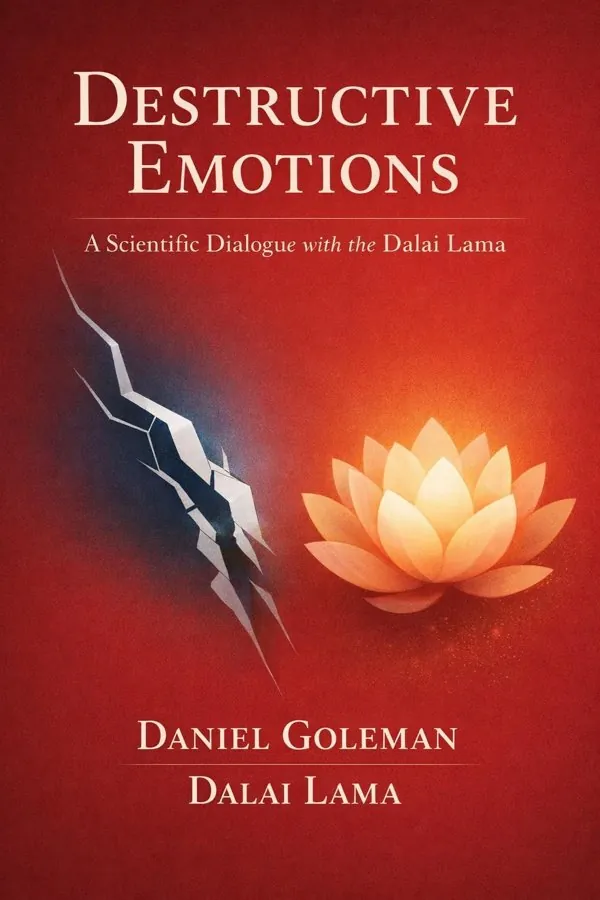
Destructive Emotions: A Scientific Dialogue with the Dalai Lama: Summary & Key Insights
 10 min9 chaptersAudio available
Key Takeaways from Destructive Emotions: A Scientific Dialogue with the Dalai Lama
Real progress often begins when two very different ways of seeing the world agree to listen instead of compete.
Many destructive emotions feel instantaneous, but they do not come from nowhere.
Not every intense feeling is destructive, and one of the book’s most important contributions is clarifying that point.
One of the book’s sharpest insights is that anger harms us long before it produces visible damage.
Fear feels deeply personal, yet the book shows it is also highly trainable.
What Is Destructive Emotions: A Scientific Dialogue with the Dalai Lama About?
Destructive Emotions: A Scientific Dialogue with the Dalai Lama by Daniel Goleman, Dalai Lama is a psychology book spanning 13 pages. What if anger, fear, and hatred are not fixed flaws in human nature, but patterns of mind that can be understood, trained, and transformed? In Destructive Emotions, Daniel Goleman brings readers inside an extraordinary series of conversations between the Dalai Lama and leading psychologists, neuroscientists, and philosophers. Set within the Mind and Life dialogues in Dharamsala, the book explores how modern science and Buddhist thought approach the same urgent question: why do destructive emotions arise, and what can we do about them? This is not a vague spiritual reflection or a technical scientific report. It is a rigorous, humane investigation into the roots of emotional suffering and the possibilities for inner change. The scientists explain the brain systems behind reactivity, stress, and aggression, while the Dalai Lama offers a disciplined contemplative framework for weakening harmful mental habits and strengthening compassion. Goleman, known worldwide for Emotional Intelligence, is uniquely suited to guide this encounter, translating both traditions into clear, practical insight. The result is a profound book about emotional mastery, ethical responsibility, and the possibility of cultivating a wiser mind.
This FizzRead summary covers all 9 key chapters of Destructive Emotions: A Scientific Dialogue with the Dalai Lama in approximately 10 minutes, distilling the most important ideas, arguments, and takeaways from Daniel Goleman, Dalai Lama's work. Also available as an audio summary and Key Quotes Podcast.
Destructive Emotions: A Scientific Dialogue with the Dalai Lama
What if anger, fear, and hatred are not fixed flaws in human nature, but patterns of mind that can be understood, trained, and transformed? In Destructive Emotions, Daniel Goleman brings readers inside an extraordinary series of conversations between the Dalai Lama and leading psychologists, neuroscientists, and philosophers. Set within the Mind and Life dialogues in Dharamsala, the book explores how modern science and Buddhist thought approach the same urgent question: why do destructive emotions arise, and what can we do about them?
This is not a vague spiritual reflection or a technical scientific report. It is a rigorous, humane investigation into the roots of emotional suffering and the possibilities for inner change. The scientists explain the brain systems behind reactivity, stress, and aggression, while the Dalai Lama offers a disciplined contemplative framework for weakening harmful mental habits and strengthening compassion. Goleman, known worldwide for Emotional Intelligence, is uniquely suited to guide this encounter, translating both traditions into clear, practical insight. The result is a profound book about emotional mastery, ethical responsibility, and the possibility of cultivating a wiser mind.
Who Should Read Destructive Emotions: A Scientific Dialogue with the Dalai Lama?
This book is perfect for anyone interested in psychology and looking to gain actionable insights in a short read. Whether you're a student, professional, or lifelong learner, the key ideas from Destructive Emotions: A Scientific Dialogue with the Dalai Lama by Daniel Goleman, Dalai Lama will help you think differently.
- ✓Readers who enjoy psychology and want practical takeaways
- ✓Professionals looking to apply new ideas to their work and life
- ✓Anyone who wants the core insights of Destructive Emotions: A Scientific Dialogue with the Dalai Lama in just 10 minutes
Want the full summary?
Get instant access to this book summary and 100K+ more with Fizz Moment.
Get Free SummaryAvailable on App Store • Free to download
Key Chapters
Real progress often begins when two very different ways of seeing the world agree to listen instead of compete. One of the most powerful aspects of Destructive Emotions is its setting: a sustained dialogue between the Dalai Lama, Buddhist scholars, and Western scientists gathered in Dharamsala. Rather than trying to prove one side right and the other wrong, the participants ask a shared question: what causes harmful emotions, and how can human beings reduce them?
This matters because science and contemplative traditions begin from different strengths. Science excels at measurement, observation, and testing. Buddhism offers a highly refined map of inner experience built through centuries of attention to the mind. The book shows that when these strengths meet, a richer understanding becomes possible. For example, neuroscientists describe the brain circuitry involved in emotional reactions, while Buddhist teachers classify mental states according to whether they increase suffering or reduce it. Together, they create both a descriptive model and a practical path.
Goleman presents this encounter as more than an intellectual exercise. It is a model for how modern societies might approach human problems with humility and curiosity. Instead of assuming that psychology alone can solve suffering, or that spirituality alone can answer every question, the dialogue suggests a more integrated future.
In daily life, this idea can be applied by combining evidence-based methods with reflective practices. A therapist might use cognitive tools while also encouraging mindfulness. A leader might rely on data but still cultivate compassion and self-awareness. The larger lesson is simple: understanding the mind requires both outer investigation and inner observation.
Actionable takeaway: When facing an emotional challenge, ask both “What does research say?” and “What does careful self-observation reveal?”
Many destructive emotions feel instantaneous, but they do not come from nowhere. The scientific participants in the book explain how emotional reactivity is rooted in brain systems that evolved to protect us. Structures such as the amygdala rapidly scan for threat, often triggering fear, anger, or defensiveness before the rational mind has fully assessed the situation. This helps explain why people can know better and still react badly.
Goleman connects these findings to a broader understanding of emotional habits. If the brain is wired to respond quickly to perceived danger, then many destructive emotions are less moral failures than poorly regulated survival responses. A sharp email from a colleague can trigger the same physiological activation that once helped humans respond to predators. The problem is not that emotions exist, but that ancient alarm systems often misfire in modern settings.
This scientific framework is freeing because it shifts the conversation from blame to skill. If emotional reactions are shaped by neural circuits, they can also be influenced by training, awareness, and context. People can learn to notice body signals earlier, create pauses before acting, and reduce stress loads that amplify reactivity. Schools can teach emotional literacy. Workplaces can design cultures that lower chronic threat and defensiveness.
A practical example is conflict at home. If a parent recognizes the rush of heat, muscle tension, and mental narrowing that accompanies anger, that parent has a chance to step away before shouting. By understanding the biology, self-control becomes more realistic. The book repeatedly emphasizes that awareness is the first intervention.
Actionable takeaway: Learn your earliest physical signs of emotional activation and treat them as cues to pause, breathe, and delay reaction.
Not every intense feeling is destructive, and one of the book’s most important contributions is clarifying that point. In the Buddhist framework discussed by the Dalai Lama, emotions are judged less by how strong they feel and more by the effects they produce. A state is considered destructive if it disturbs the mind, distorts perception, and leads to suffering for oneself or others. By contrast, states like compassion may be emotionally powerful, yet they are seen as beneficial because they foster clarity and care.
This way of thinking differs from common Western assumptions that classify emotions mainly as “positive” or “negative.” Buddhism asks a subtler question: does this state bring greater freedom and wisdom, or greater confusion and harm? Anger, for instance, narrows attention and exaggerates faults. Craving can make a person restless and dissatisfied. Hatred corrodes both judgment and well-being. Compassion, however, can be intense without being toxic, because it does not depend on hostility or delusion.
This distinction has practical value. Many people confuse suppression with maturity, believing that emotional health means feeling less. The book argues instead for discernment. The goal is not emotional numbness but reducing states that cloud the mind and strengthening those that support balance. In therapy, education, and leadership, this perspective encourages people to evaluate emotions by their outcomes rather than by their immediate force.
For example, moral outrage at injustice can become constructive if guided by wisdom and compassion, but destructive if it hardens into dehumanization. The internal tone matters. Is the mind clear or poisoned? Is action skillful or impulsive?
Actionable takeaway: When a strong emotion arises, ask not only “How do I feel?” but “What will this state make me see, say, and do?”
One of the book’s sharpest insights is that anger harms us long before it produces visible damage. We often think anger becomes a problem only when it erupts into shouting or violence. The Dalai Lama and the scientific contributors show that the more immediate danger is perceptual distortion. Anger changes what we notice, how we interpret motives, and how certain we feel about our judgments. Under its influence, another person’s complexity disappears and a simplified enemy takes shape.
This narrowing of perception is why anger can feel convincing. It gives a sense of certainty. Yet that certainty is often unreliable. A delayed reply becomes “disrespect.” A disagreement becomes “betrayal.” In families, workplaces, and politics, anger reduces nuance and makes escalation more likely. The Buddhist view adds that habitual anger leaves mental residue, making the mind more prone to future irritation. In this way, anger is both an event and a habit.
The book does not suggest that we should never oppose wrongdoing. Rather, it distinguishes between clear, firm action and hatred-driven reaction. A judge can sentence a criminal without malice. A manager can address poor performance without contempt. A citizen can resist injustice without feeding on rage. This distinction is crucial because it preserves moral courage while preventing emotional self-destruction.
A useful application is during arguments. Instead of focusing first on proving your point, notice whether your mind has collapsed into caricature. If you are mentally replaying offenses, assigning motives, or feeling pleasure at the thought of the other person losing, anger has likely taken over your perception.
Actionable takeaway: In moments of anger, delay conclusions about other people’s motives until your body and mind have settled.
Fear feels deeply personal, yet the book shows it is also highly trainable. Western psychology explains fear through conditioning, stress physiology, and threat detection systems. Buddhism examines how attachment, aversion, and distorted thinking strengthen anxious states. Together, these views reveal that fear is not merely a fixed trait but a pattern reinforced by repetition, attention, and interpretation.
The scientific side of the dialogue highlights how the brain learns fear quickly, especially when an event is painful or uncertain. Once learned, the fear response can generalize. A person embarrassed during public speaking may begin to dread meetings, social events, or any situation involving evaluation. The Buddhist perspective adds that the mind often amplifies fear through obsessive projection into the future. We suffer not only from what is happening, but from what we imagine may happen.
This combined model is especially useful because it points toward multiple interventions. Behavioral exposure can reduce avoidance. Mindfulness can help a person observe anxious thoughts without believing every one of them. Compassion practices can soften the harsh self-judgment that often accompanies anxiety. Ethical living can also reduce fear by lowering guilt and inner conflict.
Consider someone overwhelmed before a medical test. Instead of spiraling through worst-case scenarios, they might name the fear, notice the physical sensations, limit speculative thinking, and return attention to what can be done now. This does not magically erase uncertainty, but it weakens the chain reaction that turns concern into torment.
The book’s broader message is hopeful: fear may arise automatically, but our relationship to it can be transformed through training.
Actionable takeaway: When anxiety appears, separate facts from imagined futures and return attention to one concrete step you can take now.
Perhaps the most hopeful idea in Destructive Emotions is that compassion is not just a moral ideal but a skill that can be deliberately cultivated. The Dalai Lama presents compassion as a disciplined mental orientation grounded in the recognition that all beings seek happiness and wish to avoid suffering. Scientists in the dialogue explore related capacities such as empathy, caregiving, prosocial behavior, and emotional regulation, suggesting that benevolent states have measurable psychological and biological effects.
The book carefully distinguishes compassion from mere sentimentality. Compassion is not pity, weakness, or passive niceness. It includes warmth, but also courage and stability. Empathy alone can lead to overwhelm if we absorb another person’s pain without balance. Compassion adds the wish to help and the steadiness to remain present. This makes it especially relevant in caregiving professions, leadership, parenting, and conflict resolution.
The practical implications are significant. If compassion can be strengthened through repeated practice, then education and mental health should not focus only on reducing pathology. They should also build healthy capacities. A school might include loving-kindness exercises. A hospital could support clinicians with compassion training to reduce burnout. A family could establish habits of appreciative attention instead of only reacting when something goes wrong.
An everyday example is difficult conversation. Before speaking, a person might pause and remember: this other person, like me, wants respect and relief from suffering. That brief shift can change tone, word choice, and outcome. Compassion does not eliminate accountability, but it changes the emotional climate in which accountability happens.
Actionable takeaway: Spend a few minutes daily intentionally wishing well-being for yourself, loved ones, strangers, and difficult people.
A central theme of the book is that the mind can be trained much like the body. This idea may sound familiar today, but Destructive Emotions helped popularize it by placing contemplative practice in conversation with neuroscience and psychology. The Dalai Lama emphasizes that harmful emotional tendencies are not destiny. Through repeated attention, reflection, and meditation, people can weaken destructive patterns and strengthen beneficial ones.
This claim is powerful because it moves emotional development from wishful thinking to disciplined method. Buddhist practice includes techniques for stabilizing attention, observing thought patterns, analyzing distorted beliefs, and cultivating compassion. Science contributes evidence that repetition shapes neural pathways and behavior. Together, they support a model of change based on practice rather than insight alone. Knowing that anger is unhelpful is rarely enough. The mind must be retrained under real conditions.
The applications are broad. Mindfulness can help someone notice rumination earlier. Analytical reflection can challenge assumptions like “I must always win” or “This feeling will last forever.” Compassion meditation can reduce self-absorption and hostility. Even brief daily practices can accumulate over time, especially when paired with real-world intentions such as listening more patiently or speaking less harshly.
Importantly, the book avoids promising instant transformation. Training the mind requires persistence, just as physical conditioning does. There will be setbacks, old triggers, and uneven progress. But the possibility of change is itself liberating. It means a person is not condemned to repeat every inherited or habitual emotional pattern.
Actionable takeaway: Choose one daily mental practice, even for five minutes, and link it to one specific behavior you want to improve.
One of the most striking differences between the Buddhist and scientific approaches in the book is the role of ethics. Modern psychology often describes how the mind works without making strong claims about how it ought to work. The Dalai Lama insists that any serious inquiry into emotion must include ethics, because emotions matter most in terms of the suffering or well-being they produce in human relationships.
This is not presented as religious dogma. It is a practical claim about interdependence. Human beings do not suffer or flourish in isolation. Anger affects families. Greed shapes institutions. Hatred fuels violence. Compassion improves social trust. Because emotional life has consequences, the cultivation of the mind cannot be separated from responsibility toward others. This makes ethics less about rules and more about understanding cause and effect in human experience.
The relevance today is enormous. In a world of powerful technologies, political polarization, and constant stimulation, intelligence alone is not enough. A brilliant mind without ethical grounding can become manipulative or destructive. The book argues implicitly for an education of character alongside cognition. Emotional balance, empathy, and responsibility should not be treated as secondary virtues but as core capacities for collective survival.
At a personal level, ethics can reduce inner turmoil. Dishonesty breeds anxiety. Cruelty leaves residue. Self-centeredness isolates. Living with integrity simplifies the mind because there is less to defend, hide, or rationalize. In this sense, ethics supports mental health as well as moral life.
Actionable takeaway: Evaluate your emotional habits not only by how they affect your mood, but by how they affect the people who must live with you.
The book’s lasting contribution lies in showing that science and spirituality need not be rivals in understanding the mind. Too often, public debate assumes a forced choice: either trust data and dismiss contemplative traditions, or embrace spirituality and distrust science. Destructive Emotions offers a more fruitful possibility. Science can test outcomes, clarify mechanisms, and challenge unsupported claims. Spiritual traditions can contribute refined practices, long-term observations of inner life, and ethical purpose.
This collaboration is not always easy. The dialogue includes real differences in language, assumptions, and methods. Scientists ask for evidence and replicability. Buddhist thinkers draw on introspection and philosophical analysis. Yet the book shows that these differences can become complementary rather than antagonistic. Meditation practices can be studied empirically. Neuroscience can investigate attention, compassion, and emotional regulation. At the same time, science can benefit from richer models of mental training than conventional therapeutic frameworks alone might provide.
The practical result is a broader vision of human development. Mental health is not merely the absence of disorder; it can include the cultivation of wisdom, emotional balance, and compassion. This idea has influenced research into mindfulness, contemplative neuroscience, education, and trauma recovery. The book points toward a future in which laboratories, clinics, and contemplative communities learn from one another.
For readers, the lesson is to resist simplistic camps. You can value evidence without reducing life to what is measurable. You can appreciate contemplative practice without abandoning critical thinking. The healthiest approach may be intellectually rigorous and inwardly attentive at the same time.
Actionable takeaway: Build your emotional life from both tested methods and reflective practices, and be willing to revise your views in light of experience and evidence.
All Chapters in Destructive Emotions: A Scientific Dialogue with the Dalai Lama
About the Authors
Daniel Goleman is an American psychologist, science journalist, and bestselling author best known for Emotional Intelligence, the influential book that helped bring emotional skills into mainstream discussions of success, leadership, and mental well-being. Trained at Harvard and widely respected for translating complex research into accessible ideas, he has written extensively on psychology, meditation, and human performance. The 14th Dalai Lama, Tenzin Gyatso, is the spiritual leader of Tibetan Buddhism and one of the world’s most recognized advocates for compassion, nonviolence, and ethical responsibility. Living in exile after leaving Tibet in 1959, he has spent decades engaging with scientists, philosophers, and global leaders. Together, Goleman and the Dalai Lama bring rare authority to a book that unites rigorous inquiry with deep contemplative insight.
Get This Summary in Your Preferred Format
Read or listen to the Destructive Emotions: A Scientific Dialogue with the Dalai Lama summary by Daniel Goleman, Dalai Lama anytime, anywhere. FizzRead offers multiple formats so you can learn on your terms — all free.
Available formats: App · Audio · PDF · EPUB — All included free with FizzRead
Download Destructive Emotions: A Scientific Dialogue with the Dalai Lama PDF and EPUB Summary
Key Quotes from Destructive Emotions: A Scientific Dialogue with the Dalai Lama
“Real progress often begins when two very different ways of seeing the world agree to listen instead of compete.”
“Many destructive emotions feel instantaneous, but they do not come from nowhere.”
“Not every intense feeling is destructive, and one of the book’s most important contributions is clarifying that point.”
“One of the book’s sharpest insights is that anger harms us long before it produces visible damage.”
“Fear feels deeply personal, yet the book shows it is also highly trainable.”
Frequently Asked Questions about Destructive Emotions: A Scientific Dialogue with the Dalai Lama
Destructive Emotions: A Scientific Dialogue with the Dalai Lama by Daniel Goleman, Dalai Lama is a psychology book that explores key ideas across 9 chapters. What if anger, fear, and hatred are not fixed flaws in human nature, but patterns of mind that can be understood, trained, and transformed? In Destructive Emotions, Daniel Goleman brings readers inside an extraordinary series of conversations between the Dalai Lama and leading psychologists, neuroscientists, and philosophers. Set within the Mind and Life dialogues in Dharamsala, the book explores how modern science and Buddhist thought approach the same urgent question: why do destructive emotions arise, and what can we do about them? This is not a vague spiritual reflection or a technical scientific report. It is a rigorous, humane investigation into the roots of emotional suffering and the possibilities for inner change. The scientists explain the brain systems behind reactivity, stress, and aggression, while the Dalai Lama offers a disciplined contemplative framework for weakening harmful mental habits and strengthening compassion. Goleman, known worldwide for Emotional Intelligence, is uniquely suited to guide this encounter, translating both traditions into clear, practical insight. The result is a profound book about emotional mastery, ethical responsibility, and the possibility of cultivating a wiser mind.
You Might Also Like
The Body Keeps the Score
Bessel van der Kolk
10 min
Surrounded by Idiots
Thomas Erikson
10 min
Emotional Intelligence
Daniel Goleman
10 min
Attached
Amir Levine
10 min
Why Does He Do That
Lundy Bancroft
10 min
Women Who Run with the Wolves
Clarissa Pinkola Estés
10 minBrowse by Category
Ready to read Destructive Emotions: A Scientific Dialogue with the Dalai Lama?
Get the full summary and 100K+ more books with Fizz Moment.