
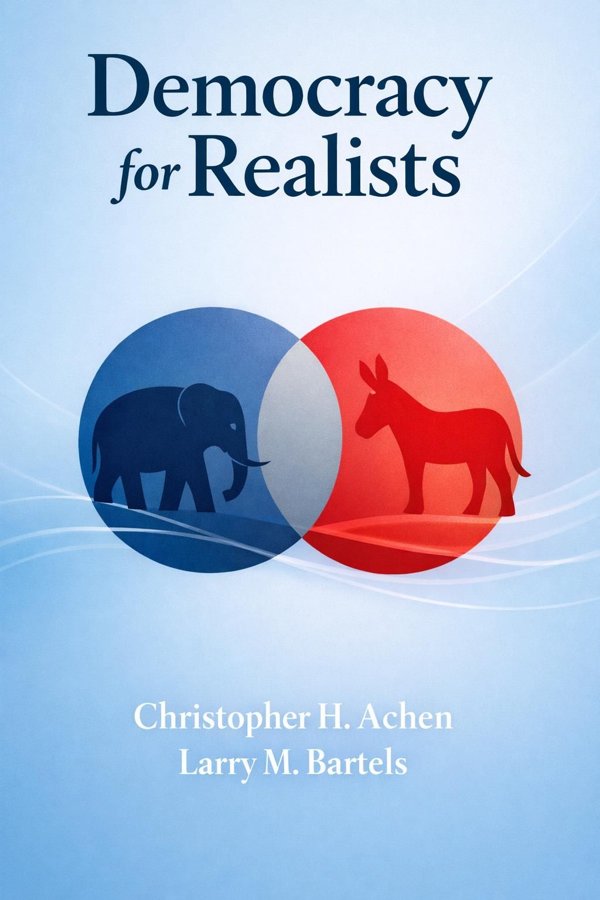
Democracy for Realists: Why Elections Do Not Produce Responsive Government: Summary & Key Insights
by Christopher H. Achen, Larry M. Bartels
 10 min10 chaptersAudio available
What Is Democracy for Realists: Why Elections Do Not Produce Responsive Government About?
Democracy for Realists: Why Elections Do Not Produce Responsive Government by Christopher H. Achen, Larry M. Bartels is a politics book spanning 10 pages. Democracy for Realists challenges the classical ideal of democracy as a system in which ordinary citizens make policy decisions based on reasoned understanding of issues. Achen and Bartels argue that voters are largely driven by social identities and partisan loyalties rather than by policy preferences or factual knowledge. Drawing on decades of empirical research, the book contends that democratic theory must be grounded in realistic models of human behavior, emphasizing group attachments and retrospective evaluations over rational choice.
This FizzRead summary covers all 10 key chapters of Democracy for Realists: Why Elections Do Not Produce Responsive Government in approximately 10 minutes, distilling the most important ideas, arguments, and takeaways from Christopher H. Achen, Larry M. Bartels's work. Also available as an audio summary and Key Quotes Podcast.
Democracy for Realists: Why Elections Do Not Produce Responsive Government
Democracy for Realists challenges the classical ideal of democracy as a system in which ordinary citizens make policy decisions based on reasoned understanding of issues. Achen and Bartels argue that voters are largely driven by social identities and partisan loyalties rather than by policy preferences or factual knowledge. Drawing on decades of empirical research, the book contends that democratic theory must be grounded in realistic models of human behavior, emphasizing group attachments and retrospective evaluations over rational choice.
Who Should Read Democracy for Realists: Why Elections Do Not Produce Responsive Government?
This book is perfect for anyone interested in politics and looking to gain actionable insights in a short read. Whether you're a student, professional, or lifelong learner, the key ideas from Democracy for Realists: Why Elections Do Not Produce Responsive Government by Christopher H. Achen, Larry M. Bartels will help you think differently.
- ✓Readers who enjoy politics and want practical takeaways
- ✓Professionals looking to apply new ideas to their work and life
- ✓Anyone who wants the core insights of Democracy for Realists: Why Elections Do Not Produce Responsive Government in just 10 minutes
Want the full summary?
Get instant access to this book summary and 100K+ more with Fizz Moment.
Get Free SummaryAvailable on App Store • Free to download
Key Chapters
The folk theory of democracy has long been the foundation of modern democratic thought. It assumes that voters hold coherent preferences, informed by knowledge and guided by consideration of the common good. Citizens, according to this view, deliberate, debate, and choose wisely among competing policies, thereby ensuring representative government.
We argue that this theory is deeply flawed because it rests on assumptions about human rationality that do not withstand scientific scrutiny. When philosophers like John Stuart Mill or contemporary proponents of deliberative democracy imagine citizens as reasoners, they imagine an idealized version of humankind rather than actual voters. Empirical studies of elections, opinion surveys, and cognitive psychology reveal a far different story.
Voters often lack the information necessary to make policy-based choices. Their views are inconsistent over time, contradict even their own interests, and rarely correspond with any ideological coherence. The notion of a ‘public will’ arising from rational deliberation collapses once we see how few people pay sustained attention to politics.
We therefore begin our critique by confronting this ideal head-on: democracy as imagined by the folk theory depends on a public that does not exist. Real citizens are moved by identity and emotion. Their understanding of public policy is fragmented, episodic, and largely shaped by cues from trusted groups, not by deep reasoning. This realization directs us toward a more honest model of political behavior — one grounded in sociology and psychology, not romanticized rationality.
Political scientists have spent decades collecting evidence about voter behavior, and the findings are unequivocal: people know surprisingly little about how their government works. Most cannot identify their representatives, describe major policy proposals, or even accurately report which party controls Congress.
Throughout the book, we examine data demonstrating that public opinions fluctuate with minimal provocation. Voters’ answers about taxes, welfare, or foreign policy often contradict their own previous responses; such shifts are less due to evolving reasoning and more to social cues and emotional triggers. Psychological limitations — confirmation bias, motivated reasoning, and selective exposure — dominate political thought.
These patterns are not isolated mistakes but systematic ones. Citizens’ political beliefs are structured around partisan identity rather than coherent values. Even when voters appear to ‘choose policies that match their preferences,’ this alignment often reflects the fact that partisan elites first define those preferences for them.
In short, the rational voter model fails because its premise — that citizens integrate information to reach reasoned conclusions — is false. The political mind is not a calculating instrument but a social compass, pointing us toward the groups and identities we trust.
+ 8 more chapters — available in the FizzRead app
All Chapters in Democracy for Realists: Why Elections Do Not Produce Responsive Government
About the Authors
Christopher H. Achen is a professor of political science at Princeton University, known for his work on political methodology and democratic theory. Larry M. Bartels is a professor of political science at Vanderbilt University, recognized for his influential research on public opinion, elections, and political inequality.
Get This Summary in Your Preferred Format
Read or listen to the Democracy for Realists: Why Elections Do Not Produce Responsive Government summary by Christopher H. Achen, Larry M. Bartels anytime, anywhere. FizzRead offers multiple formats so you can learn on your terms — all free.
Available formats: App · Audio · PDF · EPUB — All included free with FizzRead
Download Democracy for Realists: Why Elections Do Not Produce Responsive Government PDF and EPUB Summary
Key Quotes from Democracy for Realists: Why Elections Do Not Produce Responsive Government
“The folk theory of democracy has long been the foundation of modern democratic thought.”
“Political scientists have spent decades collecting evidence about voter behavior, and the findings are unequivocal: people know surprisingly little about how their government works.”
Frequently Asked Questions about Democracy for Realists: Why Elections Do Not Produce Responsive Government
Democracy for Realists: Why Elections Do Not Produce Responsive Government by Christopher H. Achen, Larry M. Bartels is a politics book that explores key ideas across 10 chapters. Democracy for Realists challenges the classical ideal of democracy as a system in which ordinary citizens make policy decisions based on reasoned understanding of issues. Achen and Bartels argue that voters are largely driven by social identities and partisan loyalties rather than by policy preferences or factual knowledge. Drawing on decades of empirical research, the book contends that democratic theory must be grounded in realistic models of human behavior, emphasizing group attachments and retrospective evaluations over rational choice.
You Might Also Like

Antifa: The Anti-Fascist Handbook
Mark Bray
10 min
Attack from Within: How Disinformation Is Sabotaging America
Barbara McQuade
10 min
Coercion, Capital, and European States, AD 990–1992
Charles Tilly
10 min
Digital Democracy: Concepts, Methodologies, Tools, and Applications
Various Authors
10 min
Fascism
Stanley G. Payne
10 min
Fire And Fury: Inside The Trump White House
Michael Wolff
10 minBrowse by Category
Ready to read Democracy for Realists: Why Elections Do Not Produce Responsive Government?
Get the full summary and 100K+ more books with Fizz Moment.