
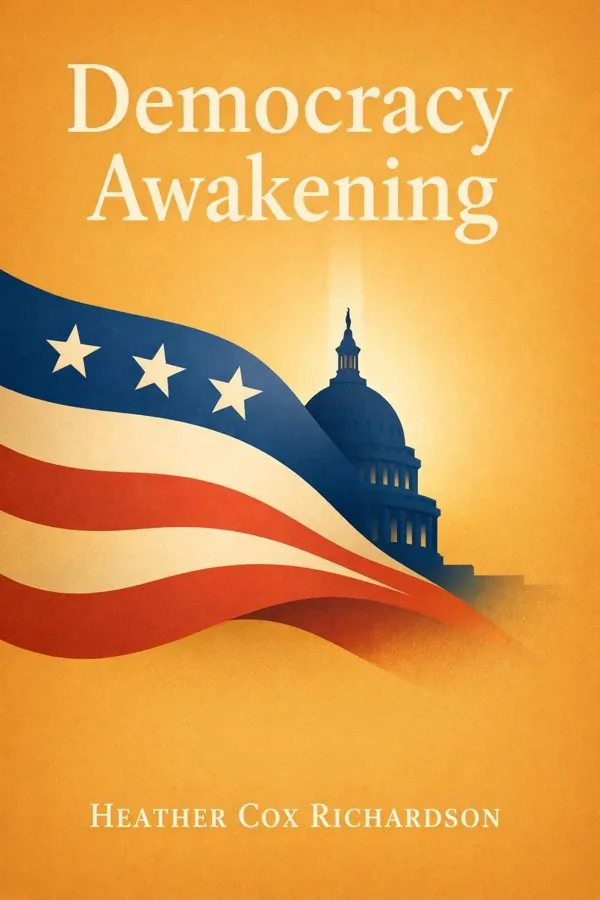
Democracy Awakening: Notes on the State of America: Summary & Key Insights
 10 min10 chaptersAudio available
What Is Democracy Awakening: Notes on the State of America About?
Democracy Awakening: Notes on the State of America by Heather Cox Richardson is a politics book spanning 10 pages. In this book, historian Heather Cox Richardson examines the historical roots and current challenges of American democracy. She traces how political, social, and economic forces have shaped the nation's democratic institutions and explores the threats facing them today. Through a clear and compelling narrative, Richardson calls on readers to understand the past in order to protect the future of democracy in the United States.
This FizzRead summary covers all 10 key chapters of Democracy Awakening: Notes on the State of America in approximately 10 minutes, distilling the most important ideas, arguments, and takeaways from Heather Cox Richardson's work. Also available as an audio summary and Key Quotes Podcast.
Democracy Awakening: Notes on the State of America
In this book, historian Heather Cox Richardson examines the historical roots and current challenges of American democracy. She traces how political, social, and economic forces have shaped the nation's democratic institutions and explores the threats facing them today. Through a clear and compelling narrative, Richardson calls on readers to understand the past in order to protect the future of democracy in the United States.
Who Should Read Democracy Awakening: Notes on the State of America?
This book is perfect for anyone interested in politics and looking to gain actionable insights in a short read. Whether you're a student, professional, or lifelong learner, the key ideas from Democracy Awakening: Notes on the State of America by Heather Cox Richardson will help you think differently.
- ✓Readers who enjoy politics and want practical takeaways
- ✓Professionals looking to apply new ideas to their work and life
- ✓Anyone who wants the core insights of Democracy Awakening: Notes on the State of America in just 10 minutes
Want the full summary?
Get instant access to this book summary and 100K+ more with Fizz Moment.
Get Free SummaryAvailable on App Store • Free to download
Key Chapters
The birth of the United States was an experiment in contradiction: a nation founded on liberty and equality that nevertheless enshrined inequality within its political structure. When the Framers gathered in Philadelphia in 1787, they sought to create a system that would protect citizens from tyranny. Yet even as they spoke of democracy, they feared the volatility of the masses and the potential for mob rule. The resulting Constitution established a balance—between representation and control, freedom and order—that has framed our political tensions ever since.
I want readers to see that the founding vision was not static. The rhetoric of equality set in motion a moral arc that future generations would stretch and test. The founders did not resolve the conflict between democracy and oligarchy; they institutionalized it. In periods of stress—economic or social—the pendulum has often swung sharply toward one side. Thus, the battles we fight today over voting access, representation, and government accountability are extensions of debates older than the Republic itself.
From the beginning, America carried the seeds of both expansion and exclusion. The promise of 'We the People' was both revolutionary and conditional. My argument is that understanding this tension is crucial: democracy has always been a process, not a destination. And that process depends upon the willingness of each generation to hold the nation accountable to its founding words.
By the nineteenth century, the nation’s contradictions had become unbearable. Slavery stood as the great moral and political fault line. Southern elites built an oligarchic order on human bondage, while Northern reformers argued that such a system mocked the very principles of the Declaration of Independence. The Civil War was not simply a clash of armies; it was a reckoning between two incompatible visions of America.
The Reconstruction era that followed briefly opened the door to an expanded democracy: formerly enslaved people voted, held office, and began to reimagine citizenship. But the backlash was swift and brutal. White supremacist terrorism, the rise of the Ku Klux Klan, and Northern fatigue led to a retreat from the egalitarian promise of Reconstruction. The Compromise of 1877 marked a political deal that effectively abandoned Black Americans to state-sanctioned oppression.
These developments established a pattern that would recur throughout American history: a moment of democratic expansion followed by reactionary retrenchment. What emerged was a politics of exclusion disguised as 'restoration.' When we confront voting suppression or racialized rhetoric in our own times, we are seeing echoes of that nineteenth-century logic—an attempt by entrenched power to reshape democracy to its advantage.
+ 8 more chapters — available in the FizzRead app
All Chapters in Democracy Awakening: Notes on the State of America
About the Author
Heather Cox Richardson is an American historian and professor at Boston College. She specializes in nineteenth-century American history, particularly political and economic developments. She is known for her accessible writing and commentary on contemporary political issues, including her widely read newsletter 'Letters from an American.'
Get This Summary in Your Preferred Format
Read or listen to the Democracy Awakening: Notes on the State of America summary by Heather Cox Richardson anytime, anywhere. FizzRead offers multiple formats so you can learn on your terms — all free.
Available formats: App · Audio · PDF · EPUB — All included free with FizzRead
Download Democracy Awakening: Notes on the State of America PDF and EPUB Summary
Key Quotes from Democracy Awakening: Notes on the State of America
“The birth of the United States was an experiment in contradiction: a nation founded on liberty and equality that nevertheless enshrined inequality within its political structure.”
“By the nineteenth century, the nation’s contradictions had become unbearable.”
Frequently Asked Questions about Democracy Awakening: Notes on the State of America
Democracy Awakening: Notes on the State of America by Heather Cox Richardson is a politics book that explores key ideas across 10 chapters. In this book, historian Heather Cox Richardson examines the historical roots and current challenges of American democracy. She traces how political, social, and economic forces have shaped the nation's democratic institutions and explores the threats facing them today. Through a clear and compelling narrative, Richardson calls on readers to understand the past in order to protect the future of democracy in the United States.
You Might Also Like

Antifa: The Anti-Fascist Handbook
Mark Bray
10 min
Attack from Within: How Disinformation Is Sabotaging America
Barbara McQuade
10 min
Coercion, Capital, and European States, AD 990–1992
Charles Tilly
10 min
Digital Democracy: Concepts, Methodologies, Tools, and Applications
Various Authors
10 min
Fascism
Stanley G. Payne
10 min
Fire And Fury: Inside The Trump White House
Michael Wolff
10 minBrowse by Category
Ready to read Democracy Awakening: Notes on the State of America?
Get the full summary and 100K+ more books with Fizz Moment.