
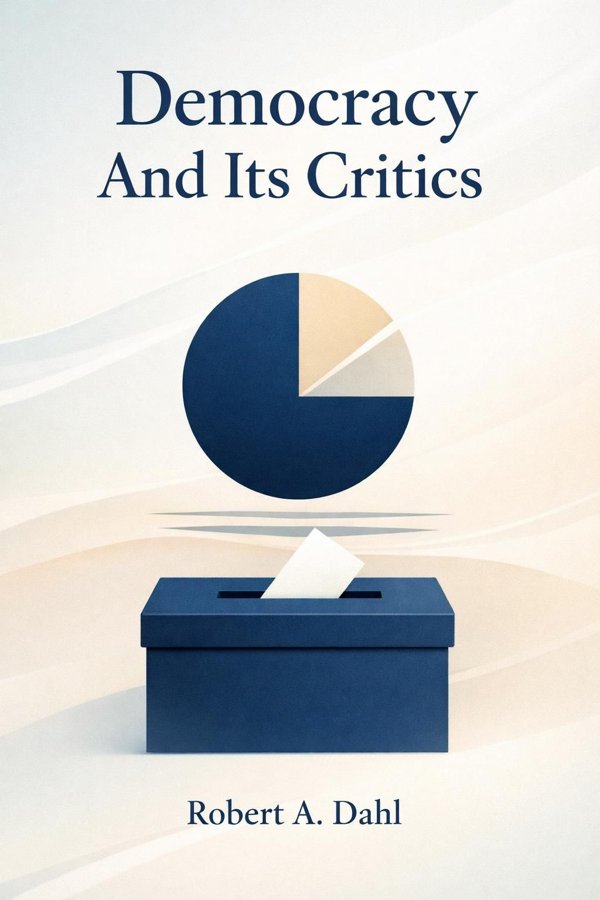
Democracy And Its Critics: Summary & Key Insights
 10 min10 chaptersAudio available
What Is Democracy And Its Critics About?
Democracy And Its Critics by Robert A. Dahl is a politics book spanning 10 pages. In this influential work, political theorist Robert A. Dahl examines the strengths and limitations of democratic governance. He explores the philosophical foundations of democracy, its practical challenges, and the criticisms it faces from both historical and contemporary perspectives. Dahl defends democracy as the most justifiable form of government while acknowledging its imperfections and the need for continual reform.
This FizzRead summary covers all 10 key chapters of Democracy And Its Critics in approximately 10 minutes, distilling the most important ideas, arguments, and takeaways from Robert A. Dahl's work. Also available as an audio summary and Key Quotes Podcast.
Democracy And Its Critics
In this influential work, political theorist Robert A. Dahl examines the strengths and limitations of democratic governance. He explores the philosophical foundations of democracy, its practical challenges, and the criticisms it faces from both historical and contemporary perspectives. Dahl defends democracy as the most justifiable form of government while acknowledging its imperfections and the need for continual reform.
Who Should Read Democracy And Its Critics?
This book is perfect for anyone interested in politics and looking to gain actionable insights in a short read. Whether you're a student, professional, or lifelong learner, the key ideas from Democracy And Its Critics by Robert A. Dahl will help you think differently.
- ✓Readers who enjoy politics and want practical takeaways
- ✓Professionals looking to apply new ideas to their work and life
- ✓Anyone who wants the core insights of Democracy And Its Critics in just 10 minutes
Want the full summary?
Get instant access to this book summary and 100K+ more with Fizz Moment.
Get Free SummaryAvailable on App Store • Free to download
Key Chapters
To understand democracy’s modern form, one must return to its ancient roots. Democracy was born in the city-states of Greece, most notably Athens, where citizens practiced a direct form of self-rule. Yet even in its birthplace, democracy was contested. Thinkers like Plato and Aristotle regarded rule by the people with suspicion, seeing it as a prelude to chaos and tyranny of the majority. Still, the ideal survived—not as a constant, but as a memory and ambition that inspired future generations.
The democratic tradition was rekindled centuries later, shaped by Christian notions of moral equality, Enlightenment reasoning, and the material transformations of industrial society. Political thinkers such as Locke, Rousseau, and Mill each reinterpreted the meaning of consent, liberty, and representation. In the modern context, democracy evolved from a direct assembly into a representative system capable of managing complex nation-states. The idea of popular sovereignty survived, but its mechanisms changed: institutions, electoral systems, and constitutional safeguards replaced the open forum of the Athenian agora.
This historical trajectory exposes a pattern of tension and innovation. Democracy’s core ideal—political equality—has remained constant, but its realization has always been negotiated through specific political conditions. The intellectual evolution from classical to modern democracy is not linear; it’s dialectical. Critics challenge, reformers respond, and through their dialogue the democratic idea expands. It was essential to me to map this debate, for only by understanding democracy’s past can we grasp its present fragility and its potential for renewal.
When I speak of democracy, I mean both an ideal and a system of practice. The ideal is simple yet profound: that all members of a political association should have equal opportunities to influence its decisions. This moral core of equality differentiates democracy from all other regimes. Yet real-world democracies are always imperfect approximations of this ideal. To study them, we must distinguish between the concept of democracy as a moral aspiration and the institutional realities I later call 'polyarchies.'
The ideal form of democracy assumes complete inclusion and full participation. Every citizen would have equal rights to propose, debate, and decide. No hierarchy of power would distort collective will. In contrast, polyarchy—democracy as it exists—acknowledges constraints. Citizens delegate authority through representatives, parties compete for power, and public discussion unfolds through institutions with unequal resources. Still, these mechanisms, when functioning properly, maintain political equality in meaningful measure.
Reflecting on this distinction helps clarify both the promise and the shortfall of democratic governance. It is futile to condemn real systems for failing to meet ideal democracy’s standards; instead, one must ask how closely our institutions approach those standards and how they may be improved. Democracy, then, is not a destination but a process of continual approximation. Its health depends on whether citizens and leaders are capable of closing the gap between ideal and experience.
+ 8 more chapters — available in the FizzRead app
All Chapters in Democracy And Its Critics
About the Author
Robert A. Dahl (1915–2014) was an American political scientist and Sterling Professor of Political Science at Yale University. He was one of the most prominent scholars in democratic theory and political analysis, known for his works on pluralism, power, and democratic institutions.
Get This Summary in Your Preferred Format
Read or listen to the Democracy And Its Critics summary by Robert A. Dahl anytime, anywhere. FizzRead offers multiple formats so you can learn on your terms — all free.
Available formats: App · Audio · PDF · EPUB — All included free with FizzRead
Download Democracy And Its Critics PDF and EPUB Summary
Key Quotes from Democracy And Its Critics
“To understand democracy’s modern form, one must return to its ancient roots.”
“When I speak of democracy, I mean both an ideal and a system of practice.”
Frequently Asked Questions about Democracy And Its Critics
Democracy And Its Critics by Robert A. Dahl is a politics book that explores key ideas across 10 chapters. In this influential work, political theorist Robert A. Dahl examines the strengths and limitations of democratic governance. He explores the philosophical foundations of democracy, its practical challenges, and the criticisms it faces from both historical and contemporary perspectives. Dahl defends democracy as the most justifiable form of government while acknowledging its imperfections and the need for continual reform.
More by Robert A. Dahl
You Might Also Like

Antifa: The Anti-Fascist Handbook
Mark Bray
10 min
Attack from Within: How Disinformation Is Sabotaging America
Barbara McQuade
10 min
Coercion, Capital, and European States, AD 990–1992
Charles Tilly
10 min
Digital Democracy: Concepts, Methodologies, Tools, and Applications
Various Authors
10 min
Fascism
Stanley G. Payne
10 min
Fire And Fury: Inside The Trump White House
Michael Wolff
10 minBrowse by Category
Ready to read Democracy And Its Critics?
Get the full summary and 100K+ more books with Fizz Moment.