
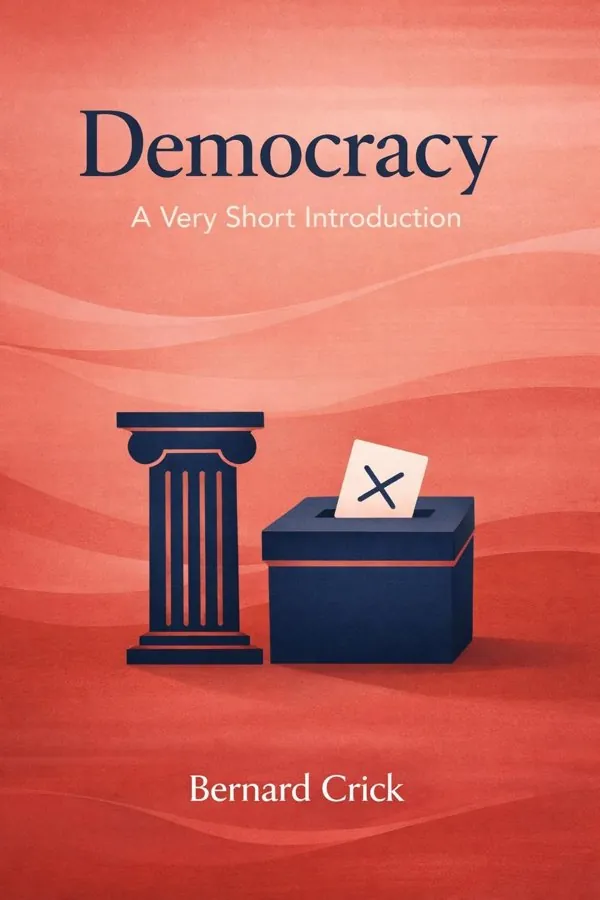
Democracy: A Very Short Introduction: Summary & Key Insights
 10 min11 chaptersAudio available
What Is Democracy: A Very Short Introduction About?
Democracy: A Very Short Introduction by Bernard Crick is a politics book spanning 11 pages. This concise introduction explores the concept, history, and practice of democracy. Bernard Crick examines its origins in ancient Greece, its evolution through modern political thought, and its challenges in contemporary society. The book discusses different forms of democracy, the relationship between democracy and liberty, and the tensions between democratic ideals and political realities.
This FizzRead summary covers all 11 key chapters of Democracy: A Very Short Introduction in approximately 10 minutes, distilling the most important ideas, arguments, and takeaways from Bernard Crick's work. Also available as an audio summary and Key Quotes Podcast.
Democracy: A Very Short Introduction
This concise introduction explores the concept, history, and practice of democracy. Bernard Crick examines its origins in ancient Greece, its evolution through modern political thought, and its challenges in contemporary society. The book discusses different forms of democracy, the relationship between democracy and liberty, and the tensions between democratic ideals and political realities.
Who Should Read Democracy: A Very Short Introduction?
This book is perfect for anyone interested in politics and looking to gain actionable insights in a short read. Whether you're a student, professional, or lifelong learner, the key ideas from Democracy: A Very Short Introduction by Bernard Crick will help you think differently.
- ✓Readers who enjoy politics and want practical takeaways
- ✓Professionals looking to apply new ideas to their work and life
- ✓Anyone who wants the core insights of Democracy: A Very Short Introduction in just 10 minutes
Want the full summary?
Get instant access to this book summary and 100K+ more with Fizz Moment.
Get Free SummaryAvailable on App Store • Free to download
Key Chapters
The concept of democracy was born in a small community that would have astounded most ancient peoples: Athens. The Athenians gave us both the name—demos kratia, the power of the people—and the first institutional form of participatory rule. Yet their democracy was hardly universal. Women, slaves, and foreigners were excluded; even so, this experiment in collective decision-making marked a profound transformation in human politics. Power, once seen as the natural right of the few, became a matter of public debate.
What fascinated me most about Athenian democracy is how self-conscious it was. The citizens knew they were attempting something unprecedented, and they did so with a constant awareness of its dangers. Thinkers like Thucydides and Plato grappled with democracy’s tendency toward instability and demagoguery, while Aristotle sought to define the conditions under which popular government could sustain itself. For Aristotle, democracy was most viable when balanced by virtue and moderation—a reminder that politics cannot thrive without education and ethical restraint.
The Greek legacy, therefore, is double-edged. On one hand, Athens laid the groundwork for civic participation, open debate, and public accountability. On the other, its decline warned later ages of democracy’s fragility when citizens yield to passion rather than reason. The Athenians taught us both the possibility and the peril of self-government, lessons we continually revisit.
After the fall of Rome, democracy seemed to vanish from the political vocabulary of Europe. The medieval world was hierarchical, structured around kingship and divine authority. Yet within these rigid forms, proto-democratic ideas survived, sometimes in unexpected places. Medieval cities developed local councils; the Church convened assemblies; and monarchs, however absolute in appearance, often ruled through consent and negotiation.
The re-emergence of representative institutions such as the English Parliament or the Estates-General of France did not spring from democratic ideals in the modern sense. They were born from practical constraints—the need for rulers to raise taxes, compel armies, and maintain legitimacy. Representation began as a means of consultation, not equality. But slowly, a political language took shape in which participation, accountability, and the consent of the governed could be argued for as moral necessities.
When we reach the early modern period, we encounter profound transformations. The Reformation shattered the unity of religious authority, while the rise of commercial societies fostered individualism. Thinkers such as Machiavelli, Hobbes, and ultimately Locke began to reinterpret the political bond, seeing government not as divine inheritance but as a contract. The soil from which modern democracy would grow was being prepared, even if the seed had not yet taken root.
+ 9 more chapters — available in the FizzRead app
All Chapters in Democracy: A Very Short Introduction
About the Author
Bernard Crick (1929–2008) was a British political theorist and writer, best known for his works on political theory and citizenship. He was a professor at Birkbeck College, University of London, and an influential commentator on democratic politics and education.
Get This Summary in Your Preferred Format
Read or listen to the Democracy: A Very Short Introduction summary by Bernard Crick anytime, anywhere. FizzRead offers multiple formats so you can learn on your terms — all free.
Available formats: App · Audio · PDF · EPUB — All included free with FizzRead
Download Democracy: A Very Short Introduction PDF and EPUB Summary
Key Quotes from Democracy: A Very Short Introduction
“The concept of democracy was born in a small community that would have astounded most ancient peoples: Athens.”
“After the fall of Rome, democracy seemed to vanish from the political vocabulary of Europe.”
Frequently Asked Questions about Democracy: A Very Short Introduction
Democracy: A Very Short Introduction by Bernard Crick is a politics book that explores key ideas across 11 chapters. This concise introduction explores the concept, history, and practice of democracy. Bernard Crick examines its origins in ancient Greece, its evolution through modern political thought, and its challenges in contemporary society. The book discusses different forms of democracy, the relationship between democracy and liberty, and the tensions between democratic ideals and political realities.
You Might Also Like

Antifa: The Anti-Fascist Handbook
Mark Bray
10 min
Attack from Within: How Disinformation Is Sabotaging America
Barbara McQuade
10 min
Coercion, Capital, and European States, AD 990–1992
Charles Tilly
10 min
Digital Democracy: Concepts, Methodologies, Tools, and Applications
Various Authors
10 min
Fascism
Stanley G. Payne
10 min
Fire And Fury: Inside The Trump White House
Michael Wolff
10 minBrowse by Category
Ready to read Democracy: A Very Short Introduction?
Get the full summary and 100K+ more books with Fizz Moment.