
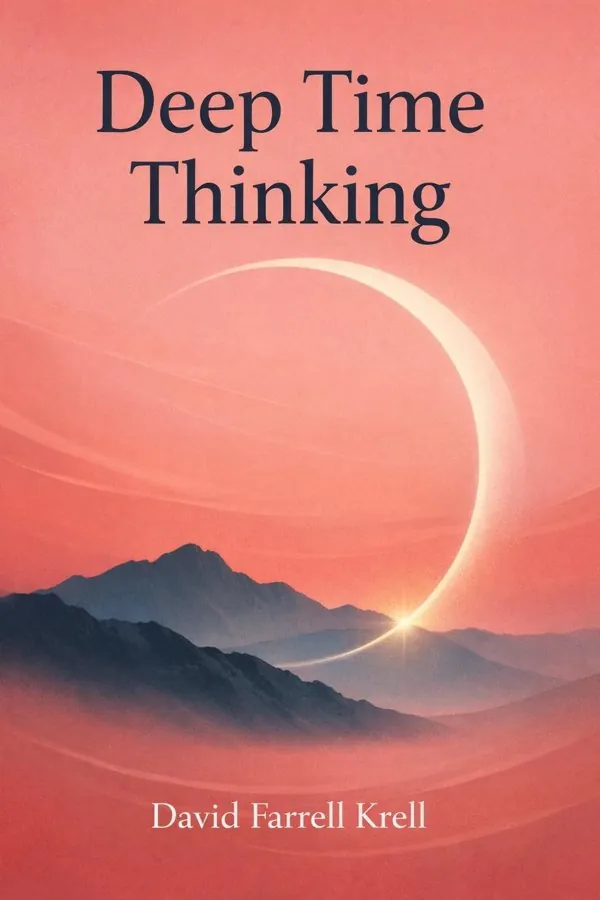
Deep Time Thinking: Summary & Key Insights
 10 min11 chaptersAudio available
What Is Deep Time Thinking About?
Deep Time Thinking by David Farrell Krell is a western_phil book spanning 11 pages. Deep Time Thinking explores the philosophical implications of geological and cosmic time, examining how the concept of 'deep time' reshapes human understanding of existence, history, and consciousness. Krell engages with thinkers such as Heidegger and Nietzsche to probe the temporal dimensions of being and the limits of human thought in relation to the vastness of time.
This FizzRead summary covers all 11 key chapters of Deep Time Thinking in approximately 10 minutes, distilling the most important ideas, arguments, and takeaways from David Farrell Krell's work. Also available as an audio summary and Key Quotes Podcast.
Deep Time Thinking
Deep Time Thinking explores the philosophical implications of geological and cosmic time, examining how the concept of 'deep time' reshapes human understanding of existence, history, and consciousness. Krell engages with thinkers such as Heidegger and Nietzsche to probe the temporal dimensions of being and the limits of human thought in relation to the vastness of time.
Who Should Read Deep Time Thinking?
This book is perfect for anyone interested in western_phil and looking to gain actionable insights in a short read. Whether you're a student, professional, or lifelong learner, the key ideas from Deep Time Thinking by David Farrell Krell will help you think differently.
- ✓Readers who enjoy western_phil and want practical takeaways
- ✓Professionals looking to apply new ideas to their work and life
- ✓Anyone who wants the core insights of Deep Time Thinking in just 10 minutes
Want the full summary?
Get instant access to this book summary and 100K+ more with Fizz Moment.
Get Free SummaryAvailable on App Store • Free to download
Key Chapters
Western philosophy traditionally conceives of time through human-centered paradigms—chronological progress, teleological history, and the linear unfolding of reason and civilization. From Augustine’s sacred linearity to Hegel’s dialectical progress toward freedom, time has often served as a mirror for the human story. Linear time gives moral comfort: there is always an origin and a destination. Yet, as I came to recognize, such narratives are provincial when juxtaposed with the temporal frameworks that geology and cosmology reveal. Earth’s history is not a moral sequence but a dynamic eruption—catastrophic, cyclic, indifferent to human meanings.
In contrast to the progressive reordering of historical consciousness, deep time fractures the anthropocentric spell. It unveils that the 'moment' is less a point along a line than a resonance within an incomprehensibly vast continuum. Thus, the historical framing of the human world must be rethought: what we call civilization stands upon a foundation of immense prehuman durations. Philosophy must learn to think not in centuries or millennia, but in epochs and cosmic aeons, where thought itself becomes geological.
Through this reframing, I wish to show how traditional metaphysics underestimated temporality. The impulse to narrate time as progress blinds us to its abyssal nature. Deep time calls for a new humility—a willingness to read human meaning against the incomparably older text of the Earth and cosmos.
Heidegger, in *Being and Time*, taught us that temporality is the horizon for understanding Being itself. Dasein—the being that we are—exists through time, projecting toward the future, remembering the past, and inhabiting the present as an open field of possibility. Yet Heidegger’s temporal horizon remains existential, tethered to human finitude. My engagement with Heidegger here is both appreciative and restless, for I want to ask: what happens when this horizon stretches beyond the human toward geological and cosmic proportion?
Heidegger’s temporal analysis lays the groundwork for thinking beyond chronological succession, but deep time reveals another layer of Being. Geological temporality, for instance, does not unfold through anticipation or memory; it accumulates, condenses, erodes. It is duration without consciousness, rhythm without narration. In contemplating deep time, we confront the strange possibility that Being precedes Dasein, that temporality itself is not anthropogenic but planetary.
To think of temporality geologically is to acknowledge time as material and stratified. The meaning of existence changes when we imagine Dasein not as the center of time’s unfolding but as one thin band among countless layers of becoming. Deep time thus radicalizes Heidegger’s project—it opens the horizon toward a cosmic dimension where the question of Being reverberates through matter, erupting from volcanic cores and drifting star systems, indifferent to human purpose yet constitutive of the very space in which thought occurs.
+ 9 more chapters — available in the FizzRead app
All Chapters in Deep Time Thinking
About the Author
David Farrell Krell is an American philosopher known for his work on phenomenology, existentialism, and continental philosophy. He has written extensively on Heidegger, Nietzsche, and Derrida, and taught philosophy at DePaul University and other institutions.
Get This Summary in Your Preferred Format
Read or listen to the Deep Time Thinking summary by David Farrell Krell anytime, anywhere. FizzRead offers multiple formats so you can learn on your terms — all free.
Available formats: App · Audio · PDF · EPUB — All included free with FizzRead
Download Deep Time Thinking PDF and EPUB Summary
Key Quotes from Deep Time Thinking
“Western philosophy traditionally conceives of time through human-centered paradigms—chronological progress, teleological history, and the linear unfolding of reason and civilization.”
“Heidegger, in *Being and Time*, taught us that temporality is the horizon for understanding Being itself.”
Frequently Asked Questions about Deep Time Thinking
Deep Time Thinking by David Farrell Krell is a western_phil book that explores key ideas across 11 chapters. Deep Time Thinking explores the philosophical implications of geological and cosmic time, examining how the concept of 'deep time' reshapes human understanding of existence, history, and consciousness. Krell engages with thinkers such as Heidegger and Nietzsche to probe the temporal dimensions of being and the limits of human thought in relation to the vastness of time.
You Might Also Like
A Little History of Philosophy
Nigel Warburton
10 min
Areopagitica
John Milton
10 min
How To Think Like A Philosopher: Essential Principles For Clear Thinking
Peter Cave
10 min
Language, Truth and Logic
A. J. Ayer
10 min
The Age of Reason
Thomas Paine
10 min
The Essays
Michel De Montaigne
10 minBrowse by Category
Ready to read Deep Time Thinking?
Get the full summary and 100K+ more books with Fizz Moment.