
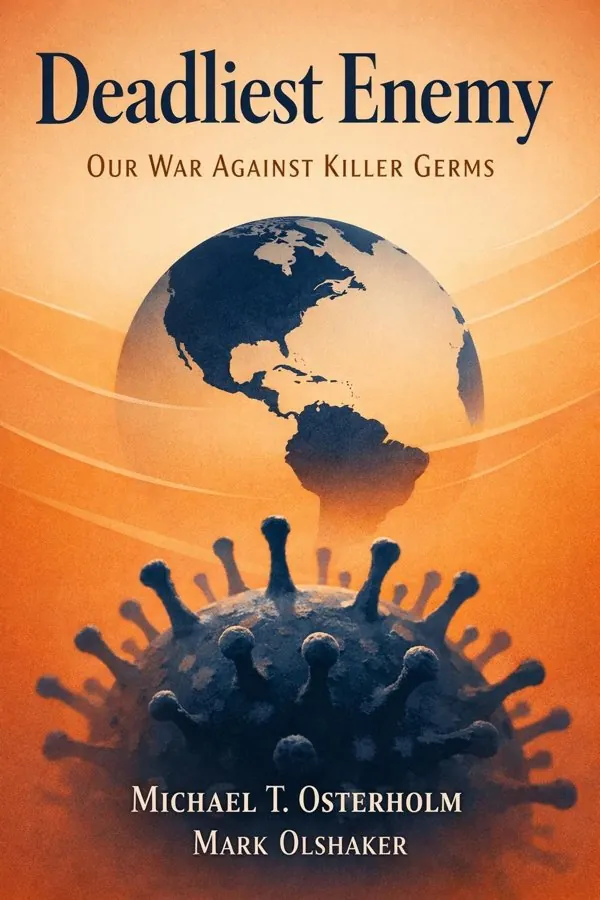
Deadliest Enemy: Our War Against Killer Germs: Summary & Key Insights
by Michael T. Osterholm, Mark Olshaker
 10 min11 chaptersAudio available
What Is Deadliest Enemy: Our War Against Killer Germs About?
Deadliest Enemy: Our War Against Killer Germs by Michael T. Osterholm, Mark Olshaker is a health_med book spanning 11 pages. In 'Deadliest Enemy: Our War Against Killer Germs', epidemiologist Michael T. Osterholm and writer Mark Olshaker explore the global threats posed by infectious diseases. Drawing on decades of public health experience, the authors analyze past outbreaks, current vulnerabilities, and the looming risk of pandemics. They propose a comprehensive strategy to prevent and mitigate future biological crises, emphasizing preparedness, scientific innovation, and international cooperation.
This FizzRead summary covers all 11 key chapters of Deadliest Enemy: Our War Against Killer Germs in approximately 10 minutes, distilling the most important ideas, arguments, and takeaways from Michael T. Osterholm, Mark Olshaker's work. Also available as an audio summary and Key Quotes Podcast.
Deadliest Enemy: Our War Against Killer Germs
In 'Deadliest Enemy: Our War Against Killer Germs', epidemiologist Michael T. Osterholm and writer Mark Olshaker explore the global threats posed by infectious diseases. Drawing on decades of public health experience, the authors analyze past outbreaks, current vulnerabilities, and the looming risk of pandemics. They propose a comprehensive strategy to prevent and mitigate future biological crises, emphasizing preparedness, scientific innovation, and international cooperation.
Who Should Read Deadliest Enemy: Our War Against Killer Germs?
This book is perfect for anyone interested in health_med and looking to gain actionable insights in a short read. Whether you're a student, professional, or lifelong learner, the key ideas from Deadliest Enemy: Our War Against Killer Germs by Michael T. Osterholm, Mark Olshaker will help you think differently.
- ✓Readers who enjoy health_med and want practical takeaways
- ✓Professionals looking to apply new ideas to their work and life
- ✓Anyone who wants the core insights of Deadliest Enemy: Our War Against Killer Germs in just 10 minutes
Want the full summary?
Get instant access to this book summary and 100K+ more with Fizz Moment.
Get Free SummaryAvailable on App Store • Free to download
Key Chapters
Every generation believes its plagues are unique, but the patterns are eerily consistent. The 1918 influenza pandemic, which killed an estimated fifty to one hundred million people, was not only the deadliest disease event in modern history—it was a lesson in how humanity amplifies its own vulnerabilities. Overcrowded camps during World War I, the movement of troops across continents, and the lack of coordinated communication turned what might have been a manageable outbreak into a planetary inferno.
Throughout the twentieth and early twenty-first centuries, new outbreaks—from SARS and MERS to Ebola and Zika—have repeated those same mistakes. Governments hesitate to act until it’s too late. Health systems crack under pressure. Misinformation spreads faster than any virus. In each case, the biology of the pathogen collides with the sociology of fear and denial.
But each pandemic also offers crucial lessons. The smallpox eradication campaign proved what global cooperation and steady scientific commitment can accomplish. The 2003 SARS outbreak demonstrated the power of rapid case tracking and quarantine when executed decisively. Meanwhile, the Ebola crisis of 2014 exposed the catastrophic consequences of weak health infrastructure and delayed international response. From these histories we can extract one essential conclusion: preparedness is not an option; it’s a perpetual responsibility.
Viruses and bacteria are master strategists. To survive, they must mutate, adapt, and exploit every ecological niche available—including the human body. Influenza and coronaviruses, for instance, maintain vast reservoirs in animals, occasionally leaping species barriers in unpredictable but devastating ways. Antibiotic-resistant bacteria, on the other hand, evolve within the very systems designed to eliminate them.
In writing this section, I wanted readers to feel both respect and humility toward these microscopic predators. They are not malevolent; they are simply efficient. What makes them deadly is how easily they capitalize on our global patterns—air travel, industrial farming, and poor infection control. Understanding their biology means understanding their opportunities.
I explain how genetic drift and shift enable influenza to reinvent itself every season, and why RNA viruses, with high mutation rates, remain the most unpredictable adversaries. I also examine how emerging pathogens like Nipah or Hendra viruses remind us that ecological disruption—deforestation, wildlife trade, urban sprawl—creates new interfaces for pathogen spillover. The takeaway is simple yet profound: we can no longer think of infectious disease as a narrow domain of medical science. It is biology, ecology, economy, and behavior intertwined.
+ 9 more chapters — available in the FizzRead app
All Chapters in Deadliest Enemy: Our War Against Killer Germs
About the Authors
Michael T. Osterholm is an American epidemiologist and director of the Center for Infectious Disease Research and Policy (CIDRAP) at the University of Minnesota. Mark Olshaker is an American author and documentary filmmaker known for his collaborations on public health and forensic science topics.
Get This Summary in Your Preferred Format
Read or listen to the Deadliest Enemy: Our War Against Killer Germs summary by Michael T. Osterholm, Mark Olshaker anytime, anywhere. FizzRead offers multiple formats so you can learn on your terms — all free.
Available formats: App · Audio · PDF · EPUB — All included free with FizzRead
Download Deadliest Enemy: Our War Against Killer Germs PDF and EPUB Summary
Key Quotes from Deadliest Enemy: Our War Against Killer Germs
“Every generation believes its plagues are unique, but the patterns are eerily consistent.”
“Viruses and bacteria are master strategists.”
Frequently Asked Questions about Deadliest Enemy: Our War Against Killer Germs
Deadliest Enemy: Our War Against Killer Germs by Michael T. Osterholm, Mark Olshaker is a health_med book that explores key ideas across 11 chapters. In 'Deadliest Enemy: Our War Against Killer Germs', epidemiologist Michael T. Osterholm and writer Mark Olshaker explore the global threats posed by infectious diseases. Drawing on decades of public health experience, the authors analyze past outbreaks, current vulnerabilities, and the looming risk of pandemics. They propose a comprehensive strategy to prevent and mitigate future biological crises, emphasizing preparedness, scientific innovation, and international cooperation.
You Might Also Like

On Immunity
Eula Biss
10 min
The Three-Body Problem
Liu Cixin
10 min
Community Health Volunteer Toolkit: Training and Practical Activities
World Health Organization
10 min
Healing Back Pain: The Mind-Body Connection
John E. Sarno
10 min
Health Literacy for All: Practical Guides to Communicate Health Information (Compilations)
World Health Organization
10 min
The Complete Guide to Sports Supplements: An Evidence-Based Review
Anita Bean
10 minBrowse by Category
Ready to read Deadliest Enemy: Our War Against Killer Germs?
Get the full summary and 100K+ more books with Fizz Moment.