
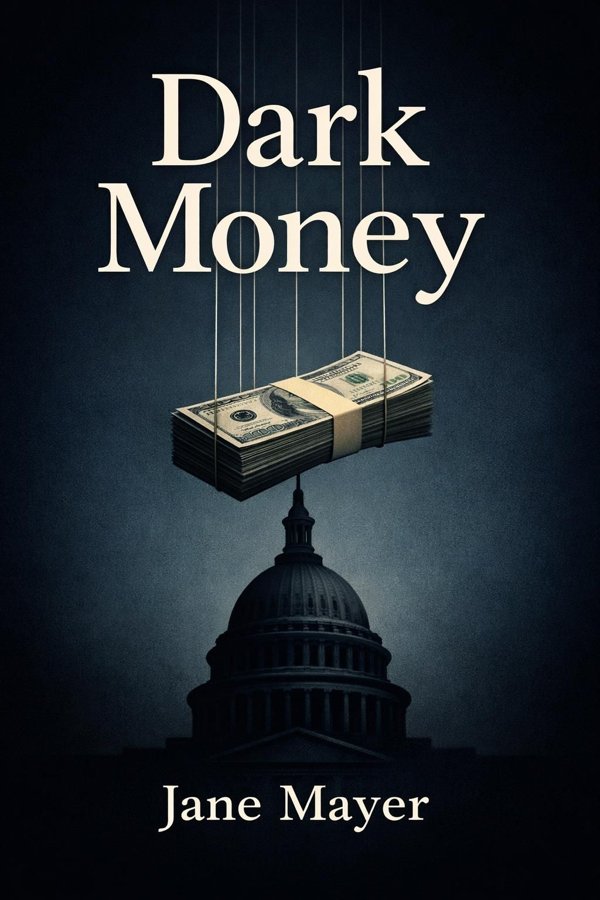
Dark Money: The Hidden History of the Billionaires Behind the Rise of the Radical Right: Summary & Key Insights
by Jane Mayer
 10 min9 chaptersAudio available
What Is Dark Money: The Hidden History of the Billionaires Behind the Rise of the Radical Right About?
Dark Money: The Hidden History of the Billionaires Behind the Rise of the Radical Right by Jane Mayer is a politics book spanning 9 pages. Dark Money is an investigative work by journalist Jane Mayer that exposes how a network of wealthy conservative donors, led by the Koch brothers, has influenced American politics. The book traces the flow of money through foundations, think tanks, and political organizations, revealing how these billionaires have shaped policy, public opinion, and elections to serve their interests. Mayer’s research uncovers the hidden infrastructure of modern political influence and the erosion of democratic transparency.
This FizzRead summary covers all 9 key chapters of Dark Money: The Hidden History of the Billionaires Behind the Rise of the Radical Right in approximately 10 minutes, distilling the most important ideas, arguments, and takeaways from Jane Mayer's work. Also available as an audio summary and Key Quotes Podcast.
Dark Money: The Hidden History of the Billionaires Behind the Rise of the Radical Right
Dark Money is an investigative work by journalist Jane Mayer that exposes how a network of wealthy conservative donors, led by the Koch brothers, has influenced American politics. The book traces the flow of money through foundations, think tanks, and political organizations, revealing how these billionaires have shaped policy, public opinion, and elections to serve their interests. Mayer’s research uncovers the hidden infrastructure of modern political influence and the erosion of democratic transparency.
Who Should Read Dark Money: The Hidden History of the Billionaires Behind the Rise of the Radical Right?
This book is perfect for anyone interested in politics and looking to gain actionable insights in a short read. Whether you're a student, professional, or lifelong learner, the key ideas from Dark Money: The Hidden History of the Billionaires Behind the Rise of the Radical Right by Jane Mayer will help you think differently.
- ✓Readers who enjoy politics and want practical takeaways
- ✓Professionals looking to apply new ideas to their work and life
- ✓Anyone who wants the core insights of Dark Money: The Hidden History of the Billionaires Behind the Rise of the Radical Right in just 10 minutes
Want the full summary?
Get instant access to this book summary and 100K+ more with Fizz Moment.
Get Free SummaryAvailable on App Store • Free to download
Key Chapters
Every story of influence has its genesis, and for the Koch political movement, the roots go back to the vision—and contradictions—of one family. Charles and David Koch inherited not only a business empire but also a worldview shaped by their father, Fred Koch, whose career began in the oil industry during the first half of the twentieth century. Fred’s early success came from licensing refining technology abroad, including partnerships that later generated controversy due to work under authoritarian regimes. But more important for the political future of his sons were the beliefs he internalized: a profound distrust of government, an admiration for self-reliant capitalist enterprise, and a fierce anti-communist ethos.
Fred Koch co-founded the John Birch Society, a group that epitomized the far-right suspicion of government as an instrument of tyranny. His household became a crucible for these convictions. Charles and David internalized not only a devotion to free markets but also a moral framework that equated government regulation with repression. Their vast wealth, derived from Koch Industries—the sprawling private conglomerate dealing in energy, chemicals, and commodities—provided the resources necessary to turn familial ideology into political power.
The early history of the Koch family reveals how money and philosophy can merge into a sustaining vision. Charles, the most ideological of the brothers, was deeply influenced by Austrian economists such as Friedrich Hayek and Ludwig von Mises. These thinkers argued that government intervention inevitably leads to inefficiency and encroaches on personal liberty. The seed planted in those readings would become the intellectual foundation for a movement devoted to shrinking the state in virtually all its functions—except those that protected private property and industry.
In this crucible of family history, the Koch political machine began forming—not as a spontaneous party campaign, but as a multigenerational project to reshape the ideological fabric of American policy and education. It was precisely this ambition, carefully cultivated through decades of quiet work, that turned inherited wealth into political infrastructure.
Libertarianism, in its purest form, promises personal freedom and minimal state interference. But when powered by vast private capital, it becomes something else: a governing philosophy that redefines public responsibility as market efficiency. Charles Koch embraced this ideal early on, seeing in it not an abstract theory but a roadmap for societal reform. Through the 1970s and 1980s, as America wrestled with inflation, environmental crises, and shifting political balances, libertarianism found an audience among those disillusioned with big government.
My research into the Koch network revealed that their commitment to libertarian principles was not simply strategic but deeply ideological. They funded scholars who could elevate their worldview to the status of intellectual orthodoxy. The Cato Institute, which they helped found, became one such platform—a sanctuary for policy-driven research that consistently advanced anti-regulatory outcomes. Universities benefited from generous endowments that came with subtle stipulations: the faculty hired, the subjects emphasized, the values framed within the parameters of “free market” excellence.
This ideological framework began to ripple outward. Through academic funding, media sponsorship, and policy papers, the Kochs and their allies blurred the line between scholarship and advocacy. The libertarian ideal—once peripheral and considered extreme—found acceptance within mainstream conservatism. This process transformed political language itself: terms like “economic freedom” and “government overreach” became tools of persuasion that masked structural agendas. The goal was not merely to win elections but to shift public consciousness so profoundly that deregulation, privatization, and austerity felt like common sense.
As I interviewed former insiders, what became clear was that the pursuit of libertarian purity often ignored its real-world consequences: worker protections dismantled, environmental safeguards weakened, and economic inequality deepened. Yet the narrative of liberty proved intoxicating. It allowed billionaires to portray themselves not as oligarchs, but as defenders of individual rights. In the marketplace of ideas, money had effectively bought both the microphone and the script.
+ 7 more chapters — available in the FizzRead app
All Chapters in Dark Money: The Hidden History of the Billionaires Behind the Rise of the Radical Right
About the Author
Jane Mayer is an American investigative journalist and staff writer for The New Yorker. She is known for her in-depth reporting on politics, money, and power in the United States. Mayer has received numerous awards for her journalism and is also the author of 'The Dark Side' and co-author of 'Strange Justice.'
Get This Summary in Your Preferred Format
Read or listen to the Dark Money: The Hidden History of the Billionaires Behind the Rise of the Radical Right summary by Jane Mayer anytime, anywhere. FizzRead offers multiple formats so you can learn on your terms — all free.
Available formats: App · Audio · PDF · EPUB — All included free with FizzRead
Download Dark Money: The Hidden History of the Billionaires Behind the Rise of the Radical Right PDF and EPUB Summary
Key Quotes from Dark Money: The Hidden History of the Billionaires Behind the Rise of the Radical Right
“Every story of influence has its genesis, and for the Koch political movement, the roots go back to the vision—and contradictions—of one family.”
“Libertarianism, in its purest form, promises personal freedom and minimal state interference.”
Frequently Asked Questions about Dark Money: The Hidden History of the Billionaires Behind the Rise of the Radical Right
Dark Money: The Hidden History of the Billionaires Behind the Rise of the Radical Right by Jane Mayer is a politics book that explores key ideas across 9 chapters. Dark Money is an investigative work by journalist Jane Mayer that exposes how a network of wealthy conservative donors, led by the Koch brothers, has influenced American politics. The book traces the flow of money through foundations, think tanks, and political organizations, revealing how these billionaires have shaped policy, public opinion, and elections to serve their interests. Mayer’s research uncovers the hidden infrastructure of modern political influence and the erosion of democratic transparency.
You Might Also Like
Antifa: The Anti-Fascist Handbook
Mark Bray
10 min
Attack from Within: How Disinformation Is Sabotaging America
Barbara McQuade
10 min
Coercion, Capital, and European States, AD 990–1992
Charles Tilly
10 min
Digital Democracy: Concepts, Methodologies, Tools, and Applications
Various Authors
10 min
Fascism
Stanley G. Payne
10 min
Fire And Fury: Inside The Trump White House
Michael Wolff
10 minBrowse by Category
Ready to read Dark Money: The Hidden History of the Billionaires Behind the Rise of the Radical Right?
Get the full summary and 100K+ more books with Fizz Moment.