
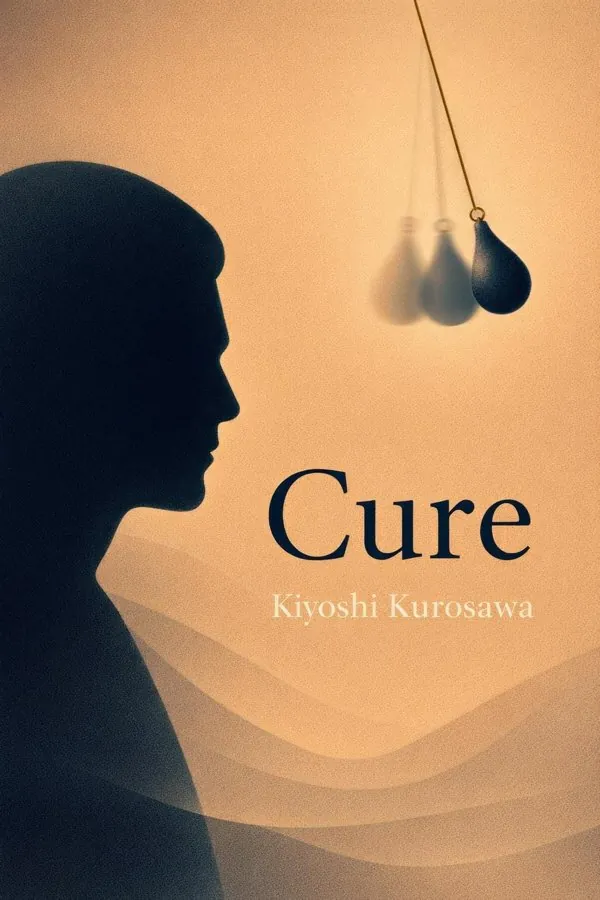
Cure: Summary & Key Insights
 10 min5 chaptersAudio available
What Is Cure About?
Cure by Kiyoshi Kurosawa is a mystery book spanning 5 pages. Cure is a novelization of the 1997 Japanese psychological thriller film directed by Kiyoshi Kurosawa. The story follows Detective Takabe as he investigates a series of bizarre murders in Tokyo, each committed by different perpetrators who all claim to have no memory of their crimes. As Takabe delves deeper, he encounters a mysterious man who uses hypnosis to manipulate others, blurring the line between sanity and madness.
This FizzRead summary covers all 5 key chapters of Cure in approximately 10 minutes, distilling the most important ideas, arguments, and takeaways from Kiyoshi Kurosawa's work. Also available as an audio summary and Key Quotes Podcast.
Cure
Cure is a novelization of the 1997 Japanese psychological thriller film directed by Kiyoshi Kurosawa. The story follows Detective Takabe as he investigates a series of bizarre murders in Tokyo, each committed by different perpetrators who all claim to have no memory of their crimes. As Takabe delves deeper, he encounters a mysterious man who uses hypnosis to manipulate others, blurring the line between sanity and madness.
Who Should Read Cure?
This book is perfect for anyone interested in mystery and looking to gain actionable insights in a short read. Whether you're a student, professional, or lifelong learner, the key ideas from Cure by Kiyoshi Kurosawa will help you think differently.
- ✓Readers who enjoy mystery and want practical takeaways
- ✓Professionals looking to apply new ideas to their work and life
- ✓Anyone who wants the core insights of Cure in just 10 minutes
Want the full summary?
Get instant access to this book summary and 100K+ more with Fizz Moment.
Get Free SummaryAvailable on App Store • Free to download
Key Chapters
When I constructed the world of *Cure*, I wanted the horror to emerge not from extravagance but from repetition. In Tokyo, a series of murders unfolds, each committed by a different person—a teacher, a nurse, a policeman—ordinary citizens with no prior motive or history of violence. Yet every victim bears the same signature: an ‘X’ carved into the throat. The symmetry of the mark is crucial. It functions as both a clue and a metaphor. For Takabe, it suggests method, perhaps ritual; for me as the author, it symbolizes crossing out, erasure—the point at which one human being cancels another’s existence. The ‘X’ also resembles a double path intersection, reflecting the tension between rational investigation and invisible compulsion.
As Takabe and his colleagues chart the pattern, their pursuit feels increasingly mechanical, as though they are themselves part of a hypnotic routine. They move from one bleak apartment to another, from the sterile light of the autopsy room to the claustrophobic interrogation chamber. At every turn, they confront perpetrators who express shock at their own acts. ‘I don’t remember,’ each says, and the line becomes like a mantra, a ritualistic refrain echoing across the city. Through these repetitions, I intended to question identity itself. If memory defines moral responsibility, what happens when memory vanishes? Can we still call a person guilty, or has the act become a kind of trance?
The police seek scientific explanations—chemical imbalances, mass psychological phenomena—but the mark hints at a deeper level, a subconscious communication that defies reason. This is the pivot where the detective story metamorphoses into psychological allegory. The investigation becomes less about catching an external culprit than about tracing the invisible threads that connect violence across minds. The ‘X,’ therefore, is not only the killer’s symbol; it is the equation of modern alienation—the self crossed by forces it cannot perceive.
Every detective story that wishes to reach the soul must carry a private wound. Takabe’s marriage to Fumie is that wound. She drifts between lucidity and confusion, her illness quietly consuming their shared space. For Takabe, the home that should be refuge becomes another site of mystery, another place where comprehension falters. He cleans, organizes, rationalizes—small acts of control that compensate for a deeper helplessness. The contrast between his professional competence and personal despair defines his humanity. I wanted readers to see his obsession with order as a defense mechanism; it is his way of warding off the chaos that threatens to infiltrate both his home and his mind.
As the murders continue, Takabe’s emotional exhaustion alters his perception. He sees patterns not only in the crimes but in Fumie’s behavior, imagining connections that may not exist. The city and his apartment begin to overlap, both haunted by unseen influences. In that overlap lies the theme I sought to convey: madness is not a separate domain to be studied or contained—it is a continuum that runs through us all. Fumie’s fragility becomes a mirror for Takabe’s slow unraveling. The boundaries between compassion and frustration blur; he wants to save her, yet fears contamination from her instability. The more he fights to protect his sanity, the more susceptible he becomes to the same disorder that consumes her.
Through Takabe’s domestic despair, the story acquires its emotional pulse. It is not spectacle but intimacy that makes the horror unbearable. His work demands logic; his life defies it. He oscillates between tenderness and repression, between fear of losing Fumie and fear of becoming like her. When Mamiya enters his life, that tension explodes, because Mamiya embodies the very thing Takabe has tried to repress—the surrender of reason to impulse. Thus, the investigation’s external threat finds its internal counterpart in his marriage. In the end, the killer and the detective may not be opposites. They are two expressions of the same human susceptibility—the need to be liberated from choice.
+ 3 more chapters — available in the FizzRead app
All Chapters in Cure
About the Author
Kiyoshi Kurosawa (born 1955) is a Japanese film director and screenwriter known for his work in horror, suspense, and psychological drama. His films, including Cure, Pulse, and Tokyo Sonata, have received international acclaim for their exploration of human psychology and societal unease.
Get This Summary in Your Preferred Format
Read or listen to the Cure summary by Kiyoshi Kurosawa anytime, anywhere. FizzRead offers multiple formats so you can learn on your terms — all free.
Available formats: App · Audio · PDF · EPUB — All included free with FizzRead
Download Cure PDF and EPUB Summary
Key Quotes from Cure
“When I constructed the world of *Cure*, I wanted the horror to emerge not from extravagance but from repetition.”
“Every detective story that wishes to reach the soul must carry a private wound.”
Frequently Asked Questions about Cure
Cure by Kiyoshi Kurosawa is a mystery book that explores key ideas across 5 chapters. Cure is a novelization of the 1997 Japanese psychological thriller film directed by Kiyoshi Kurosawa. The story follows Detective Takabe as he investigates a series of bizarre murders in Tokyo, each committed by different perpetrators who all claim to have no memory of their crimes. As Takabe delves deeper, he encounters a mysterious man who uses hypnosis to manipulate others, blurring the line between sanity and madness.
You Might Also Like


Browse by Category
Ready to read Cure?
Get the full summary and 100K+ more books with Fizz Moment.