
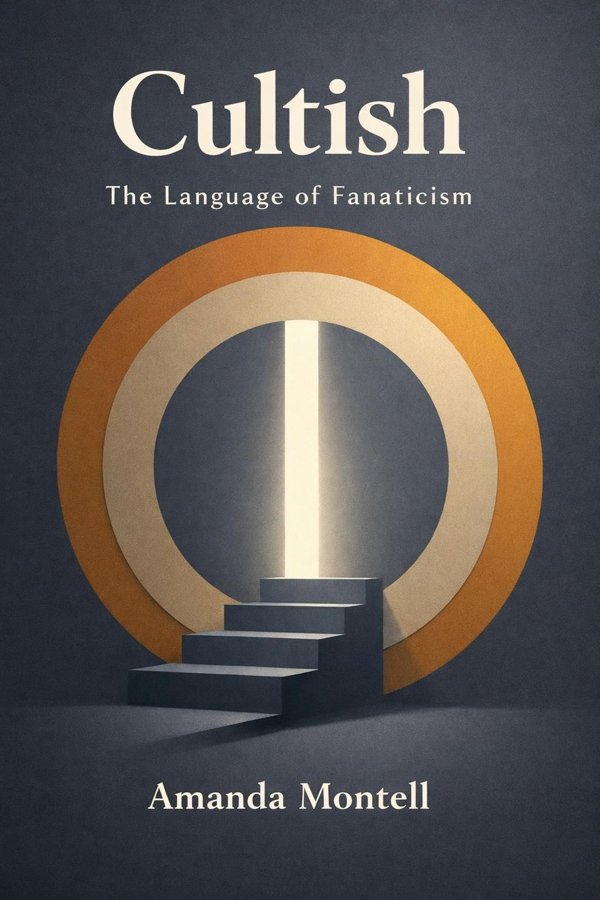
Cultish: The Language of Fanaticism: Summary & Key Insights
 10 min10 chaptersAudio available
Key Takeaways from Cultish: The Language of Fanaticism
Language has long been treated as more than a tool; in many traditions, it has been treated as power itself.
Words do not just describe reality; they build social borders.
People are rarely persuaded by logic alone; they are moved by voice, rhythm, certainty, and emotional timing.
Extreme religious groups often reveal cultish language in its clearest form because they connect words directly to salvation, purity, and cosmic meaning.
A spin studio, a clean-eating program, or a wellness brand may not look like a cult, yet Montell shows that they can borrow surprisingly similar linguistic strategies.
What Is Cultish: The Language of Fanaticism About?
Cultish: The Language of Fanaticism by Amanda Montell is a sociology book spanning 10 pages. In "Cultish: The Language of Fanaticism," Amanda Montell investigates a disquieting truth: people are often recruited, bonded, and controlled not by force alone, but by language. Drawing on her background in linguistics and cultural analysis, Montell shows how specialized vocabularies, repetitive slogans, euphemisms, loaded phrases, and charismatic speech patterns can make extreme ideas feel intimate, desirable, and normal. The book moves far beyond sensational stories of isolated religious sects. It examines how the same linguistic mechanisms appear in wellness communities, fitness brands, multi-level marketing groups, self-help programs, startup culture, and online fandoms. Montell’s central insight is not that every passionate community is a cult, but that many modern institutions use “cultish” language to manufacture belonging and shape behavior. That makes this book especially relevant in an age of algorithmic persuasion, influencer culture, and identity-driven politics. Smart, accessible, and unsettling in the best way, "Cultish" helps readers understand why words can feel like salvation, how belonging can slide into manipulation, and what warning signs to notice before devotion becomes dependence.
This FizzRead summary covers all 10 key chapters of Cultish: The Language of Fanaticism in approximately 10 minutes, distilling the most important ideas, arguments, and takeaways from Amanda Montell's work. Also available as an audio summary and Key Quotes Podcast.
Cultish: The Language of Fanaticism
In "Cultish: The Language of Fanaticism," Amanda Montell investigates a disquieting truth: people are often recruited, bonded, and controlled not by force alone, but by language. Drawing on her background in linguistics and cultural analysis, Montell shows how specialized vocabularies, repetitive slogans, euphemisms, loaded phrases, and charismatic speech patterns can make extreme ideas feel intimate, desirable, and normal. The book moves far beyond sensational stories of isolated religious sects. It examines how the same linguistic mechanisms appear in wellness communities, fitness brands, multi-level marketing groups, self-help programs, startup culture, and online fandoms. Montell’s central insight is not that every passionate community is a cult, but that many modern institutions use “cultish” language to manufacture belonging and shape behavior. That makes this book especially relevant in an age of algorithmic persuasion, influencer culture, and identity-driven politics. Smart, accessible, and unsettling in the best way, "Cultish" helps readers understand why words can feel like salvation, how belonging can slide into manipulation, and what warning signs to notice before devotion becomes dependence.
Who Should Read Cultish: The Language of Fanaticism?
This book is perfect for anyone interested in sociology and looking to gain actionable insights in a short read. Whether you're a student, professional, or lifelong learner, the key ideas from Cultish: The Language of Fanaticism by Amanda Montell will help you think differently.
- ✓Readers who enjoy sociology and want practical takeaways
- ✓Professionals looking to apply new ideas to their work and life
- ✓Anyone who wants the core insights of Cultish: The Language of Fanaticism in just 10 minutes
Want the full summary?
Get instant access to this book summary and 100K+ more with Fizz Moment.
Get Free SummaryAvailable on App Store • Free to download
Key Chapters
Language has long been treated as more than a tool; in many traditions, it has been treated as power itself. Montell traces the roots of cultish language back to early religious movements, where chants, revelations, coded scriptures, and repeated formulas helped followers enter altered states of meaning. Sacred speech did not merely describe belief. It performed belief. It separated the initiated from the uninitiated, the pure from the profane, and the saved from the lost. This historical lens matters because it shows that manipulative group language is not a bizarre modern invention. It builds on ancient human tendencies to find transcendence through repetition, rhythm, mystery, and shared symbols.
Montell explains that unusual language patterns can disrupt ordinary thinking. Archaic phrasing, insider metaphors, and seemingly profound but vague statements create a sense that something deeper is happening beneath the surface. That effect can be emotionally powerful. It can make followers feel chosen, awakened, or spiritually elevated. Religious leaders throughout history understood that language could shape not just doctrine, but experience itself.
You can see echoes of this today in everything from motivational seminars to branded wellness rituals. Repeated mantras, elevated mission statements, and ceremonial vocabulary can make ordinary activities feel morally significant or destiny-driven. None of this is automatically harmful. The danger begins when special language discourages questioning and makes obedience feel sacred.
Actionable takeaway: whenever a group uses ritualized or elevated language, ask whether it is inviting reflection or replacing it.
Words do not just describe reality; they build social borders. One of Montell’s most important ideas is that jargon creates a private world. Specialized terms, acronyms, euphemisms, and catchphrases make members feel fluent in a meaningful code. That fluency produces belonging. If you know the words, you are one of us. If you do not, you are outside, confused, or suspect.
In cultic environments, this mechanism becomes especially potent. Renaming experiences can erase complexity and replace it with group-approved interpretations. Doubt becomes “negativity.” Exhaustion becomes “resistance.” Blind conformity becomes “alignment.” Through these shifts, language narrows how members think about their own emotions. The group no longer just gives people words; it gives them the only acceptable words.
Montell shows that this process exists in less extreme settings too. Corporate teams speak of “family,” “crushing goals,” and “mission.” Fitness communities use transformation jargon that turns self-worth into discipline. Online fandoms and political subcultures create memes and terms that instantly signal loyalty. Jargon can be efficient and energizing, but it can also turn disagreement into betrayal.
A practical way to apply this insight is to notice when vocabulary simplifies morally complicated situations. If a group constantly rebrands uncomfortable realities with flattering language, that is significant. Healthy communities use shared language to clarify. Unhealthy ones use it to close off thought.
Actionable takeaway: translate insider phrases into plain everyday language and see whether they still sound reasonable.
People are rarely persuaded by logic alone; they are moved by voice, rhythm, certainty, and emotional timing. Montell explores how charismatic leaders use speech not simply to inform followers, but to enchant them. The most effective cultish communicators sound intimate and authoritative at the same time. They project certainty in uncertain times, offer simplicity in a complicated world, and deliver identity before evidence.
Charismatic communication often relies on repetition, direct address, emotional escalation, storytelling, and strategically vague promises. A leader may speak in universal truths that feel custom-made for each listener. Phrases like “you already know,” “deep down,” or “this is your calling” make followers feel recognized. At the same time, the leader’s confidence can suppress internal doubt. If someone sounds utterly convinced, listeners often borrow that conviction.
Montell’s analysis applies far beyond notorious cult leaders. Influencers, motivational speakers, startup founders, and political figures all use techniques that turn audiences into believers. Think of speeches built around a simple repeated phrase, or a leader who reframes every criticism as proof of their importance. These patterns can create emotional dependency because followers come to associate the speaker’s voice with clarity, hope, and purpose.
This does not mean charisma is inherently dangerous. Inspiring communication can mobilize good causes. But charisma becomes manipulative when style outruns substance and devotion replaces scrutiny.
Actionable takeaway: when someone’s message feels electrifying, pause and ask what concrete claims they are actually making and what evidence supports them.
Extreme religious groups often reveal cultish language in its clearest form because they connect words directly to salvation, purity, and cosmic meaning. Montell examines religious movements not to mock faith, but to show how language can become a system of total interpretation. In these settings, every event receives a doctrinal label. Suffering means growth. Criticism means persecution. Leaving means corruption. Once a community supplies all interpretive categories, members no longer evaluate experience independently.
A major tactic is loaded language: compact phrases that shut down complexity. When members are taught to respond to difficult emotions with a doctrinal slogan, genuine reflection gets replaced by automatic speech. Confession rituals, testimony formats, and repeated teachings further reinforce acceptable ways of speaking and, therefore, acceptable ways of thinking. Group members gradually internalize the voice of the institution.
Montell is careful to distinguish mainstream religion from coercive groups. Shared rituals and theological vocabulary are not themselves signs of abuse. The key issue is whether language invites moral agency or demands surrender. A healthy religious community can support doubt, interpretation, and conscience. A controlling one labels questioning as sin or disloyalty.
This framework helps readers assess any belief community. Do teachings expand your moral imagination or reduce it? Are you allowed to describe your experience in your own words? If not, language may be serving authority more than truth.
Actionable takeaway: pay attention to whether a spiritual group welcomes honest questions without punishing the people who ask them.
A spin studio, a clean-eating program, or a wellness brand may not look like a cult, yet Montell shows that they can borrow surprisingly similar linguistic strategies. The promise is often transformation: not just a better body or healthier habit, but a new identity. Language is central to that promise. Branded phrases, mantras of empowerment, and emotionally charged labels turn consumption into belonging and routine into mission.
In these communities, words like “clean,” “strong,” “committed,” or “optimized” can carry moral weight. The result is subtle but powerful. Health choices stop being practical and start becoming proof of worth. Missing a workout becomes a character flaw. Following the program becomes evidence of enlightenment or discipline. Members may even begin using group-approved language to narrate their lives, reinforcing the brand’s hold on self-perception.
Montell’s point is not that exercise or wellness practices are bad. Many people genuinely benefit from communities built around shared goals. The problem arises when emotionally persuasive language masks pressure, exclusivity, financial exploitation, or body-based shame. A company can market belonging so effectively that customers defend it as if it were family.
This insight is useful whenever a brand feels bigger than its product. If the language around a service sounds redemptive, totalizing, or morally superior, it is worth slowing down. Ask what is being sold besides the product itself.
Actionable takeaway: separate practical benefits from identity claims, and be wary when a lifestyle brand asks for loyalty rather than simply offering value.
Few environments showcase manipulative optimism better than multi-level marketing and some self-help cultures. Montell highlights how these systems rely on language that turns structural problems into personal failures. If participants struggle financially, they are told they did not “believe enough,” “manifest correctly,” or “stay in the right mindset.” This rhetorical move protects the organization by making the individual responsible for outcomes the system itself may have made unlikely.
The genius of this language is that it feels empowering at first. Terms like “abundance,” “mindset,” “hustle,” and “freedom” suggest possibility. They encourage people to imagine a transformed future and to see themselves as entrepreneurs rather than recruits. But this same vocabulary can trap people. Doubt becomes self-sabotage. Criticism becomes negativity. Loss becomes a lesson. Every disappointment gets translated back into loyalty.
Montell shows that verbal reframing is one of the most durable tools of high-control groups because it prevents reality from puncturing the dream. If every bad sign can be renamed as part of the journey, members may stay invested far longer than they otherwise would. Similar patterns appear in extreme coaching cultures and motivational ecosystems where endless positivity is treated as moral duty.
A practical application is to examine whether a system acknowledges external realities honestly. Does it allow for the possibility that the model is flawed, or does it always blame the participant?
Actionable takeaway: distrust any group that responds to valid concerns by pathologizing your attitude instead of addressing the substance of your concern.
People do not fall for cultish language because they are foolish; they respond to it because they are human. Montell emphasizes that the hunger for belonging, certainty, and meaning is universal. In times of loneliness, transition, grief, or confusion, language that offers instant identity can feel lifesaving. A group that says “you are finally understood” meets a deep psychological need long before it makes any explicit demand.
This is why cultish language is so effective. It does not begin with coercion. It begins with recognition. Members are welcomed, affirmed, and given a script that explains who they are and why they matter. Once that script becomes emotionally central, leaving the group can feel like losing a language for the self. The attachment is not merely ideological; it is relational and existential.
Montell’s framing encourages compassion instead of superiority. The right question is not “How could anyone believe this?” but “What need did this language meet?” That perspective helps us understand recruitment into fringe groups, but also our own susceptibility to intense communities at work, online, or in lifestyle culture.
Practically, this means building alternative sources of belonging. People are less vulnerable to manipulative language when they have stable relationships, diverse communities, and room for complexity in their identities. A single all-explaining group becomes dangerous when it is your only home.
Actionable takeaway: strengthen connections outside any one community so your sense of self never depends entirely on one group’s vocabulary or approval.
Not every strong community is cultish, and Montell is careful to preserve that distinction. Shared language is a normal part of human social life. Families have sayings, professions have jargon, and social movements rely on slogans. The key question is not whether a group has insider language, but what that language does. Does it deepen understanding and solidarity, or does it narrow thought and enforce obedience?
Montell offers a useful framework for spotting the difference. Healthy communities allow members to disagree without exile. Their language remains connected to reality, open to revision, and compatible with independent judgment. Unhealthy communities weaponize language to monopolize meaning. They recast criticism as betrayal, redefine harm as growth, and encourage members to distrust outsiders categorically.
This distinction matters because cultish dynamics can emerge in ordinary places: startups, activist circles, friend groups, fandoms, schools, and even families. The more a group treats its internal vocabulary as morally superior and beyond challenge, the more likely it is drifting toward control. Language is often the earliest warning sign because it reveals whether a community can tolerate complexity.
A practical test is to imagine voicing concern in plain terms. Could you say, “I am uncomfortable,” “I disagree,” or “This is hurting me,” and still remain respected? If not, the group may prize conformity over care.
Actionable takeaway: evaluate communities not by how passionate they seem, but by whether their language leaves room for dissent, nuance, and personal autonomy.
The most empowering message in Montell’s book is that awareness changes vulnerability. Once you understand the mechanics of cultish language, you can notice them in real time. Warning signs include absolute claims, emotionally loaded slogans, private jargon that replaces ordinary speech, euphemisms for harmful behavior, mandatory positivity, and language that casts outsiders as threats or fools. Especially important is the suppression of nuance. If every issue has a simple script, manipulation may be at work.
Resistance does not require cynicism. Montell does not argue that we should reject passion, community, or shared ideals. Instead, she encourages linguistic self-defense. Ask clarifying questions. Translate dramatic phrases into concrete meaning. Notice when you feel pressure to repeat words you do not fully believe. Compare the group’s language with its actual behavior. Seek perspectives outside the community’s information bubble.
Another powerful strategy is reclaiming your own vocabulary. High-control groups often colonize self-description, telling members how to name their feelings and experiences. The act of using your own words can restore autonomy. Journaling, speaking with trusted outsiders, and reading independent sources can help break the spell of loaded language.
Ultimately, resisting cultish language means preserving the ability to think in more than one voice. Freedom requires not just access to information, but access to language that remains flexible, precise, and humane.
Actionable takeaway: when a phrase feels emotionally compelling, stop and define exactly what it means, who benefits from it, and what alternative words might reveal.
All Chapters in Cultish: The Language of Fanaticism
About the Author
Amanda Montell is an American author, linguist, and cultural commentator whose work explores the hidden power of language in everyday life. Trained in linguistics, she is known for translating complex ideas about speech, identity, and persuasion into lively, accessible writing for broad audiences. Her books examine how words shape relationships, belief systems, and social behavior, often blending scholarship with pop culture analysis and personal insight. Montell has also written for major publications and built a following through her media and podcast work, where she investigates human behavior with wit and clarity. In "Cultish," she brings together sociolinguistics, psychology, and cultural criticism to show how language can foster community, intensify devotion, and, in some cases, become a powerful tool of control.
Get This Summary in Your Preferred Format
Read or listen to the Cultish: The Language of Fanaticism summary by Amanda Montell anytime, anywhere. FizzRead offers multiple formats so you can learn on your terms — all free.
Available formats: App · Audio · PDF · EPUB — All included free with FizzRead
Download Cultish: The Language of Fanaticism PDF and EPUB Summary
Key Quotes from Cultish: The Language of Fanaticism
“Language has long been treated as more than a tool; in many traditions, it has been treated as power itself.”
“Words do not just describe reality; they build social borders.”
“People are rarely persuaded by logic alone; they are moved by voice, rhythm, certainty, and emotional timing.”
“Extreme religious groups often reveal cultish language in its clearest form because they connect words directly to salvation, purity, and cosmic meaning.”
“A spin studio, a clean-eating program, or a wellness brand may not look like a cult, yet Montell shows that they can borrow surprisingly similar linguistic strategies.”
Frequently Asked Questions about Cultish: The Language of Fanaticism
Cultish: The Language of Fanaticism by Amanda Montell is a sociology book that explores key ideas across 10 chapters. In "Cultish: The Language of Fanaticism," Amanda Montell investigates a disquieting truth: people are often recruited, bonded, and controlled not by force alone, but by language. Drawing on her background in linguistics and cultural analysis, Montell shows how specialized vocabularies, repetitive slogans, euphemisms, loaded phrases, and charismatic speech patterns can make extreme ideas feel intimate, desirable, and normal. The book moves far beyond sensational stories of isolated religious sects. It examines how the same linguistic mechanisms appear in wellness communities, fitness brands, multi-level marketing groups, self-help programs, startup culture, and online fandoms. Montell’s central insight is not that every passionate community is a cult, but that many modern institutions use “cultish” language to manufacture belonging and shape behavior. That makes this book especially relevant in an age of algorithmic persuasion, influencer culture, and identity-driven politics. Smart, accessible, and unsettling in the best way, "Cultish" helps readers understand why words can feel like salvation, how belonging can slide into manipulation, and what warning signs to notice before devotion becomes dependence.
You Might Also Like

Between the World and Me
Ta-Nehisi Coates
10 min
Half the Sky
Nicholas D. Kristof, Sheryl WuDunn
10 min
Men Explain Things To Me
Rebecca Solnit
10 min
Rational Ritual
Michael Suk-Young Chwe
10 min
The New Jim Crow
Michelle Alexander
10 min
Beyond Culture
Edward T. Hall
10 minBrowse by Category
Ready to read Cultish: The Language of Fanaticism?
Get the full summary and 100K+ more books with Fizz Moment.