
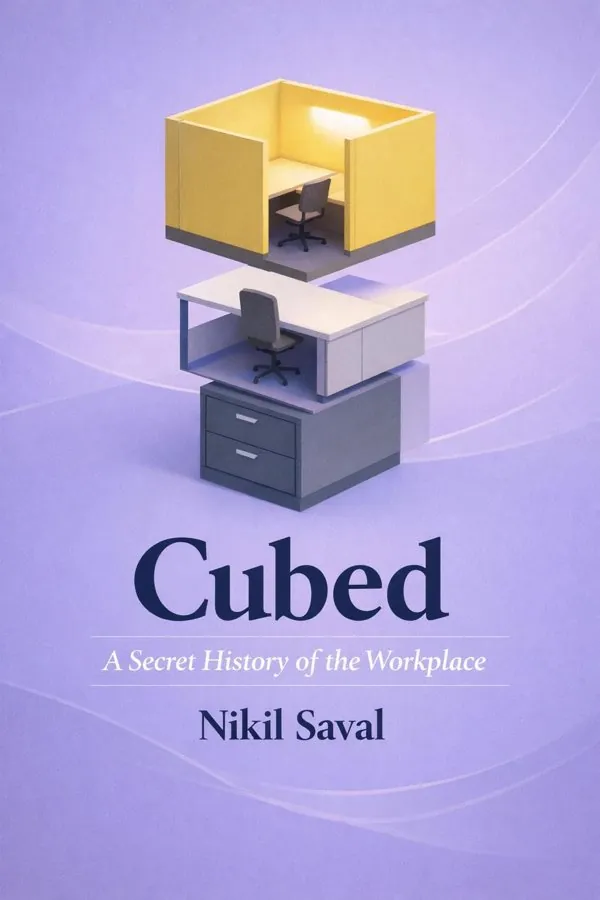
Cubed: A Secret History of the Workplace: Summary & Key Insights
by Nikil Saval
 10 min11 chaptersAudio available
What Is Cubed: A Secret History of the Workplace About?
Cubed: A Secret History of the Workplace by Nikil Saval is a sociology book spanning 11 pages. Cubed: A Secret History of the Workplace es un estudio histórico y cultural sobre la evolución de los espacios de oficina, desde los primeros escritorios de contabilidad del siglo XIX hasta los cubículos y oficinas abiertas del siglo XXI. Nikil Saval explora cómo la arquitectura, la tecnología y la cultura corporativa han moldeado la vida laboral moderna, revelando las tensiones entre eficiencia, control y creatividad en el entorno de trabajo.
This FizzRead summary covers all 11 key chapters of Cubed: A Secret History of the Workplace in approximately 10 minutes, distilling the most important ideas, arguments, and takeaways from Nikil Saval's work. Also available as an audio summary and Key Quotes Podcast.
Cubed: A Secret History of the Workplace
Cubed: A Secret History of the Workplace es un estudio histórico y cultural sobre la evolución de los espacios de oficina, desde los primeros escritorios de contabilidad del siglo XIX hasta los cubículos y oficinas abiertas del siglo XXI. Nikil Saval explora cómo la arquitectura, la tecnología y la cultura corporativa han moldeado la vida laboral moderna, revelando las tensiones entre eficiencia, control y creatividad en el entorno de trabajo.
Who Should Read Cubed: A Secret History of the Workplace?
This book is perfect for anyone interested in sociology and looking to gain actionable insights in a short read. Whether you're a student, professional, or lifelong learner, the key ideas from Cubed: A Secret History of the Workplace by Nikil Saval will help you think differently.
- ✓Readers who enjoy sociology and want practical takeaways
- ✓Professionals looking to apply new ideas to their work and life
- ✓Anyone who wants the core insights of Cubed: A Secret History of the Workplace in just 10 minutes
Want the full summary?
Get instant access to this book summary and 100K+ more with Fizz Moment.
Get Free SummaryAvailable on App Store • Free to download
Key Chapters
The story begins in the nineteenth century, when the office first took recognizable shape as a site of industrial administration. In the mercantile countinghouses of the early industrial age, clerks labored over ledgers by candlelight, recording the immense uptick in transactions brought on by trade and mechanization. Before this era, such labor had been informal and familial—merchants kept their books at home or in small shops—but now an entire class of professional clerks emerged to service the needs of expanding enterprises.
What this meant socially cannot be overstated: clerical work represented one of the earliest ladders into the emerging white-collar middle class. Yet the work itself was tightly disciplined, repetitive, and uncreative, designed to mirror the efficiency of the factory floor. Managers increasingly viewed clerks as human machinery, their effort measured in accuracy and hours rather than ingenuity. Architecture responded in kind. Offices became regimented microcosms of industrial order, with rows of desks arrayed to permit supervision and control.
If the factory disciplined bodies, the office disciplined minds. The transition from mercantile independence to bureaucratic anonymity marked a cultural turning point: work was no longer a personal craft but an impersonal duty. And yet within this constraint lay the seed of a new identity—the salaried worker as a moral, respectable figure, one who could aspire to stability in a turbulent capitalist world.
Frederick Winslow Taylor looms large over the early chapters of modern labor’s story. His theory of scientific management, first applied to factory work, soon infiltrated the office, reshaping clerical labor into something measurable and mechanized. Taylor viewed inefficiency as the great enemy of modern enterprise, and he approached work as a field of variables to be optimized.
Applied to white-collar spaces, Taylorism created the blueprint for the modern bureaucratic environment: time studies, output measurement, standardized procedures. The clerk became a cog. What mattered was no longer the individual’s discretion, but the system’s total performance. Architects and managers alike took up this ethos. Office layout became a form of management itself—the arrangement of desks, lighting, and corridors was designed not for comfort but for surveillance and coordination.
In this period, the office began to resemble the factory not merely in function but in spirit. The wallpaper of professionalism could not hide the fact that knowledge work had been rendered industrial. Yet even as efficiency became an ideology, dissent arose. Critics warned that Taylorism drained labor of meaning and detachment fostered alienation. In the tension between control and creativity that Taylorism introduced lies one of the defining paradoxes of modern office life—a paradox that remains unsolved even today.
+ 9 more chapters — available in the FizzRead app
All Chapters in Cubed: A Secret History of the Workplace
About the Author
Nikil Saval es escritor, editor y político estadounidense. Ha sido editor de la revista n+1 y sus ensayos han aparecido en The New York Times, The New Yorker y otras publicaciones. Su trabajo se centra en la historia cultural del trabajo, la arquitectura y la política urbana.
Get This Summary in Your Preferred Format
Read or listen to the Cubed: A Secret History of the Workplace summary by Nikil Saval anytime, anywhere. FizzRead offers multiple formats so you can learn on your terms — all free.
Available formats: App · Audio · PDF · EPUB — All included free with FizzRead
Download Cubed: A Secret History of the Workplace PDF and EPUB Summary
Key Quotes from Cubed: A Secret History of the Workplace
“The story begins in the nineteenth century, when the office first took recognizable shape as a site of industrial administration.”
“Frederick Winslow Taylor looms large over the early chapters of modern labor’s story.”
Frequently Asked Questions about Cubed: A Secret History of the Workplace
Cubed: A Secret History of the Workplace by Nikil Saval is a sociology book that explores key ideas across 11 chapters. Cubed: A Secret History of the Workplace es un estudio histórico y cultural sobre la evolución de los espacios de oficina, desde los primeros escritorios de contabilidad del siglo XIX hasta los cubículos y oficinas abiertas del siglo XXI. Nikil Saval explora cómo la arquitectura, la tecnología y la cultura corporativa han moldeado la vida laboral moderna, revelando las tensiones entre eficiencia, control y creatividad en el entorno de trabajo.
You Might Also Like

Between the World and Me
Ta-Nehisi Coates
10 min
Half the Sky
Nicholas D. Kristof, Sheryl WuDunn
10 min
Men Explain Things To Me
Rebecca Solnit
10 min
Rational Ritual
Michael Suk-Young Chwe
10 min
The New Jim Crow
Michelle Alexander
10 min
Beyond Culture
Edward T. Hall
10 minBrowse by Category
Ready to read Cubed: A Secret History of the Workplace?
Get the full summary and 100K+ more books with Fizz Moment.