
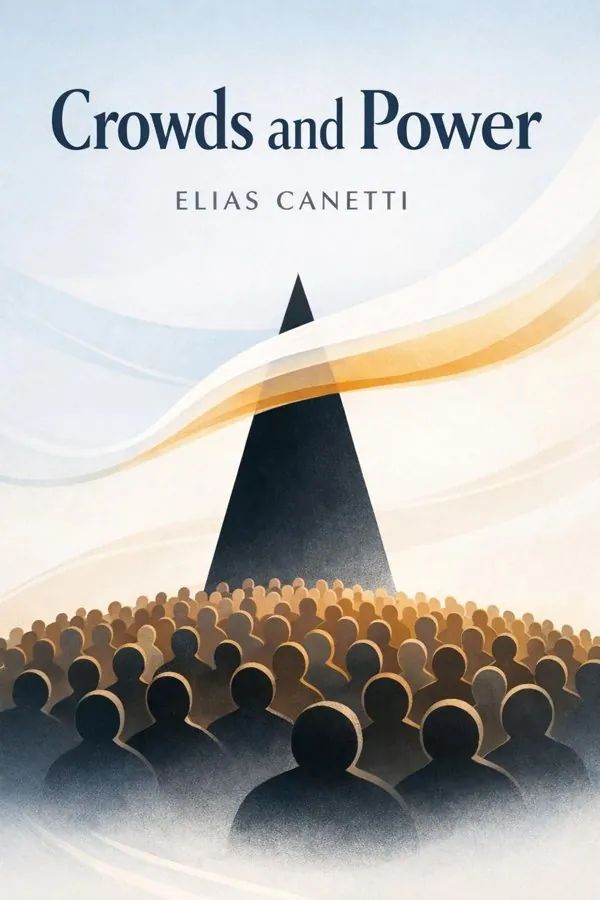
Crowds and Power: Summary & Key Insights
 10 min7 chaptersAudio available
What Is Crowds and Power About?
Crowds and Power by Elias Canetti is a sociology book spanning 7 pages. Crowds and Power is a seminal work by Elias Canetti, first published in English in 1962. The book explores the psychology and dynamics of crowds, power structures, and collective behavior. Canetti examines how individuals lose themselves in crowds, the symbolic forms that power takes, and how these mechanisms shape history and society.
This FizzRead summary covers all 7 key chapters of Crowds and Power in approximately 10 minutes, distilling the most important ideas, arguments, and takeaways from Elias Canetti's work. Also available as an audio summary and Key Quotes Podcast.
Crowds and Power
Crowds and Power is a seminal work by Elias Canetti, first published in English in 1962. The book explores the psychology and dynamics of crowds, power structures, and collective behavior. Canetti examines how individuals lose themselves in crowds, the symbolic forms that power takes, and how these mechanisms shape history and society.
Who Should Read Crowds and Power?
This book is perfect for anyone interested in sociology and looking to gain actionable insights in a short read. Whether you're a student, professional, or lifelong learner, the key ideas from Crowds and Power by Elias Canetti will help you think differently.
- ✓Readers who enjoy sociology and want practical takeaways
- ✓Professionals looking to apply new ideas to their work and life
- ✓Anyone who wants the core insights of Crowds and Power in just 10 minutes
Want the full summary?
Get instant access to this book summary and 100K+ more with Fizz Moment.
Get Free SummaryAvailable on App Store • Free to download
Key Chapters
Every crowd begins with a moment of discharge—a sudden release of difference. It is the moment when individuals, long bound by separation, shed the prickly armor of their solitude and become part of a single body. I call this event the discharge because it breaks down the barriers that usually divide one human being from another. The unease that defines ordinary life—the fear of being touched, the anxiety of distinction—gives way to an overwhelming sense of equality.
In this instant, the crowd no longer consists of separate figures but of one organism pulsing with collective energy. Joy and terror coexist. The person who moments ago feared proximity now craves it. This discharge can happen in the streets of a revolution, in the swirling masses of a religious procession, or even among spectators seized by the fervor of a game. It is the same force each time—the ecstatic erasure of boundaries.
From this moment onward, the crowd begins its life with new laws. It knows only its own mood and direction, and its growth becomes an end in itself. The discharge is dangerous because it abolishes self-control, yet it is also redemptive, for it grants the human being a brief taste of absolute equality. In the discharge lies both the seed of freedom and the germ of power.
As I observed crowds in different contexts, it became essential to distinguish their forms. Crowds can be open or closed, depending on whether they can grow endlessly or whether their membership is fixed. The open crowd strives continually to enlarge itself—it seeks new participants and new energies, drawing outsiders into its vortex. Revolutionary crowds, religious movements, and spontaneous demonstrations all belong to this type. They live through expansion, and their strength depends on the intensity of their inclusiveness.
The closed crowd, by contrast, guards its boundaries. Armies, hierarchical religious orders, and secret societies are examples. Their power lies not in growth but in preserving cohesion, in the clarity of belonging. Inside the closed crowd there is discipline and succession, a struggle to maintain form against decay.
In both types, the crowd’s desires mirror human needs. The open crowd offers ecstatic movement, a sense of unending possibility; the closed crowd offers stability, hierarchy, and the illusion of permanence. Societies oscillate between these states, never purely one or the other. The religious congregation that expands in prophecy becomes institutional and closed in its maturity; the disciplined army may dissolve into a revolutionary crowd. Understanding these types reveals how fluid and fundamental are the transitions between liberation and control, between the desire to merge and the necessity to command.
+ 5 more chapters — available in the FizzRead app
All Chapters in Crowds and Power
About the Author
Elias Canetti (1905–1994) was a Bulgarian-born writer who grew up in Vienna and later lived in the United Kingdom. He received the Nobel Prize in Literature in 1981 for his work characterized by intellectual depth and linguistic power. In addition to Crowds and Power, he is known for his novel Auto-da-Fé and his autobiographical writings.
Get This Summary in Your Preferred Format
Read or listen to the Crowds and Power summary by Elias Canetti anytime, anywhere. FizzRead offers multiple formats so you can learn on your terms — all free.
Available formats: App · Audio · PDF · EPUB — All included free with FizzRead
Download Crowds and Power PDF and EPUB Summary
Key Quotes from Crowds and Power
“Every crowd begins with a moment of discharge—a sudden release of difference.”
“As I observed crowds in different contexts, it became essential to distinguish their forms.”
Frequently Asked Questions about Crowds and Power
Crowds and Power by Elias Canetti is a sociology book that explores key ideas across 7 chapters. Crowds and Power is a seminal work by Elias Canetti, first published in English in 1962. The book explores the psychology and dynamics of crowds, power structures, and collective behavior. Canetti examines how individuals lose themselves in crowds, the symbolic forms that power takes, and how these mechanisms shape history and society.
You Might Also Like
Between the World and Me
Ta-Nehisi Coates
10 min
Half the Sky
Nicholas D. Kristof, Sheryl WuDunn
10 min
Men Explain Things To Me
Rebecca Solnit
10 min
Rational Ritual
Michael Suk-Young Chwe
10 min
The New Jim Crow
Michelle Alexander
10 min
Beyond Culture
Edward T. Hall
10 minBrowse by Category
Ready to read Crowds and Power?
Get the full summary and 100K+ more books with Fizz Moment.