
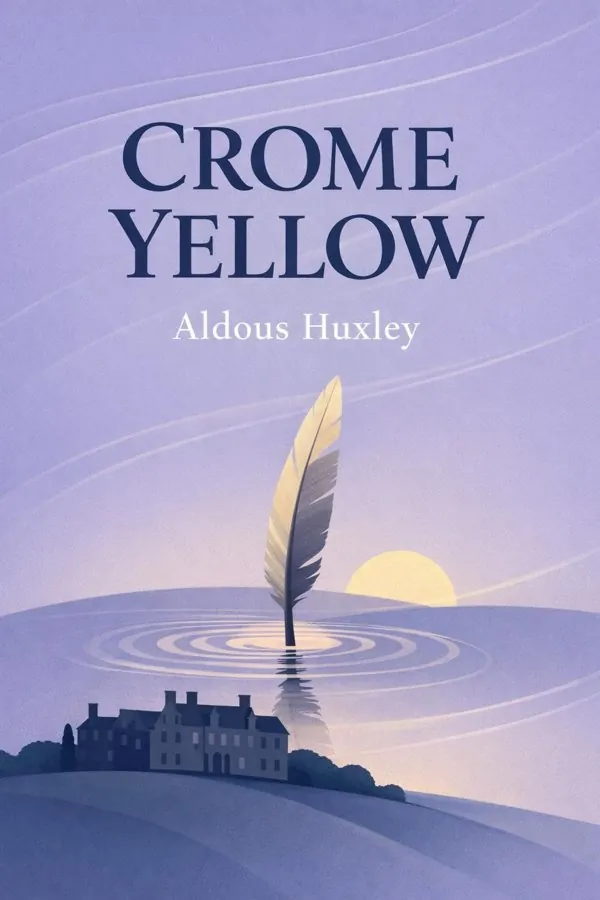
Crome Yellow: Summary & Key Insights
 10 min3 chaptersAudio available
What Is Crome Yellow About?
Crome Yellow by Aldous Huxley is a classics book spanning 3 pages. Crome Yellow is Aldous Huxley’s first novel, published in 1921. The story is a satirical portrayal of a group of upper-class intellectuals gathered at an English country house named Crome. Through witty dialogue and sharp observation, Huxley critiques the pretensions, moral vacuity, and self-absorption of post–World War I British society. The novel’s protagonist, Denis Stone, is a young poet who struggles with his artistic ambitions and romantic frustrations amid the eccentric guests of the estate.
This FizzRead summary covers all 3 key chapters of Crome Yellow in approximately 10 minutes, distilling the most important ideas, arguments, and takeaways from Aldous Huxley's work. Also available as an audio summary and Key Quotes Podcast.
Crome Yellow
Crome Yellow is Aldous Huxley’s first novel, published in 1921. The story is a satirical portrayal of a group of upper-class intellectuals gathered at an English country house named Crome. Through witty dialogue and sharp observation, Huxley critiques the pretensions, moral vacuity, and self-absorption of post–World War I British society. The novel’s protagonist, Denis Stone, is a young poet who struggles with his artistic ambitions and romantic frustrations amid the eccentric guests of the estate.
Who Should Read Crome Yellow?
This book is perfect for anyone interested in classics and looking to gain actionable insights in a short read. Whether you're a student, professional, or lifelong learner, the key ideas from Crome Yellow by Aldous Huxley will help you think differently.
- ✓Readers who enjoy classics and want practical takeaways
- ✓Professionals looking to apply new ideas to their work and life
- ✓Anyone who wants the core insights of Crome Yellow in just 10 minutes
Want the full summary?
Get instant access to this book summary and 100K+ more with Fizz Moment.
Get Free SummaryAvailable on App Store • Free to download
Key Chapters
When Denis arrives at Crome, Henry Wimbush’s grand country estate, he steps into a microcosm of post‑war English society. The sprawling house, filled with books, relics, and eccentric traditions, stands as the decaying symbol of the old order. It has witnessed centuries of propriety, moral sermons, and well‑upholstered hypocrisy—and now serves as a playground for new generations to experiment with everything from psychoanalysis to free love. Henry and his wife Priscilla preside with good‑natured detachment; their comforts are untroubled by any urge to reform the world. They embody the genteel older class, managing its decline with mild amusement.
Around them gathers a set of vivid visitors, each representing a spiritual type of the 1920s intelligentsia. Scogan, the dry rationalist, cuts through everyone’s poses with merciless clarity. His cynicism is infectious, his vision of the future chillingly prescient. He imagines a world governed entirely by scientific planners, where human emotions will be controlled for efficiency. In his playful tone you can already glimpse the embryo of my later dystopia, *Brave New World*. Gombauld, the painter, stands at another extreme: sensual, confident, and impervious. His art springs not from thought or torment, but from an animal vitality Denis can’t comprehend. Anne Wimbush, the hostess’s niece, is all modern poise—a woman who flirts with emotional depth but never allows herself to drown. And poor Mary Bracegirdle, newly ‘liberated,’ tries helplessly to translate psychoanalytic slogans into practice, mistaking self‑expression for freedom.
Each of these guests is chasing freedom in a different guise. Their conversations glisten with intelligence, their debates about science, sex, and progress are dazzling, yet through it all runs a sense of bankruptcy. The war has stripped belief of meaning, but nothing new has risen to replace it except intellectual play. Denis feels this emptiness intuitively, though he lacks the courage to name it. In him, the aspiring poet, I wanted to embody the paralysis of the reflective mind—aware of irony, terrified of simplicity. He wants love with Anne, but before every feeling stands his own self‑scrutiny. He wants great art, but his inspiration evaporates in analysis. During dinners and garden walks, he listens to his companions’ eloquence and feels both admiration and despair. Among all these clever people, to be sincere seems the only vulgarity.
Crome becomes thus an allegory for a civilization between worlds: its aristocratic elegance hollowed out, its new intellectualism unmoored. Yet within its laughter lies a strange beauty—the tragic grace of minds trying to live intelligently after faith.
At the heart of Denis’s summer at Crome lies a simple, painful lesson: that self‑awareness, so prized by modern intellect, can be the very poison of genuine experience. His love for Anne is less a living emotion than a literary project. He watches her smiles the way he would examine lines of poetry—searching for pattern, irony, significance. Every possible move he makes dissolves into introspection: ‘What do I mean? What does she mean?’ This constant interior commentary becomes his prison. Anne, with her quick laughter and merciless candor, senses it instinctively. She treats him not cruelly but with amused detachment, as one might a clever child. Her flirtation with Gombauld, on the other hand, is effortless, almost physical in its directness. To Denis, this is unbearable precisely because it exposes everything he distrusts in himself—the inability to act without analysis.
Through their dynamic I wanted to argue that our intellect, once detached from vitality, becomes sterile. Denis’s poetry fails because he seeks to express feelings he has never actually surrendered to. His verses are correct, ironic, self‑aware—but heartless. In this he mirrors the whole Crome community, a society brilliant in conversation but impoverished in meaning. The contrast with Gombauld is deliberate: the painter, though vain, lives through his senses. His art may not be profound, but it is alive. He sketches what his eyes see without apology. Denis wishes he could do the same, but his education has trained him to mistrust such immediacy. When he finally attempts to confess his love, words desert him; he listens to his own speech as though it were another’s, noticing its falsity mid‑utterance. That moment of failure—beautiful in its quiet humiliation—is his true initiation. For the first time, he perceives that understanding life is not the same as living it.
Mary Bracegirdle’s comic escapade offers a parallel farce to Denis’s tragedy. Desperate to prove her modernity, she decides to seduce a man, guided by theories she barely grasps. Her attempts end in fiasco, humbling but harmless. In her foolishness, however, lies a certain courage—she at least acts, while Denis only thinks. The irony is that both are victims of the same confusion: mistaking intellectual formulas for emotional truth. When Scogan ridicules them with his theoretical wisdom, it only deepens the void. Against such emptiness, the laughter at Crome has a nervous edge. Everyone speaks fluently, yet no one quite believes their own words.
+ 1 more chapters — available in the FizzRead app
All Chapters in Crome Yellow
About the Author
Aldous Huxley (1894–1963) was an English writer and philosopher best known for his novels, essays, and wide-ranging social commentary. A member of the prominent Huxley family, he gained early recognition for his satirical works such as Crome Yellow and later achieved international fame with Brave New World. His writings explore themes of technology, human potential, and the future of civilization.
Get This Summary in Your Preferred Format
Read or listen to the Crome Yellow summary by Aldous Huxley anytime, anywhere. FizzRead offers multiple formats so you can learn on your terms — all free.
Available formats: App · Audio · PDF · EPUB — All included free with FizzRead
Download Crome Yellow PDF and EPUB Summary
Key Quotes from Crome Yellow
“When Denis arrives at Crome, Henry Wimbush’s grand country estate, he steps into a microcosm of post‑war English society.”
“At the heart of Denis’s summer at Crome lies a simple, painful lesson: that self‑awareness, so prized by modern intellect, can be the very poison of genuine experience.”
Frequently Asked Questions about Crome Yellow
Crome Yellow by Aldous Huxley is a classics book that explores key ideas across 3 chapters. Crome Yellow is Aldous Huxley’s first novel, published in 1921. The story is a satirical portrayal of a group of upper-class intellectuals gathered at an English country house named Crome. Through witty dialogue and sharp observation, Huxley critiques the pretensions, moral vacuity, and self-absorption of post–World War I British society. The novel’s protagonist, Denis Stone, is a young poet who struggles with his artistic ambitions and romantic frustrations amid the eccentric guests of the estate.
More by Aldous Huxley
You Might Also Like

Browse by Category
Ready to read Crome Yellow?
Get the full summary and 100K+ more books with Fizz Moment.