
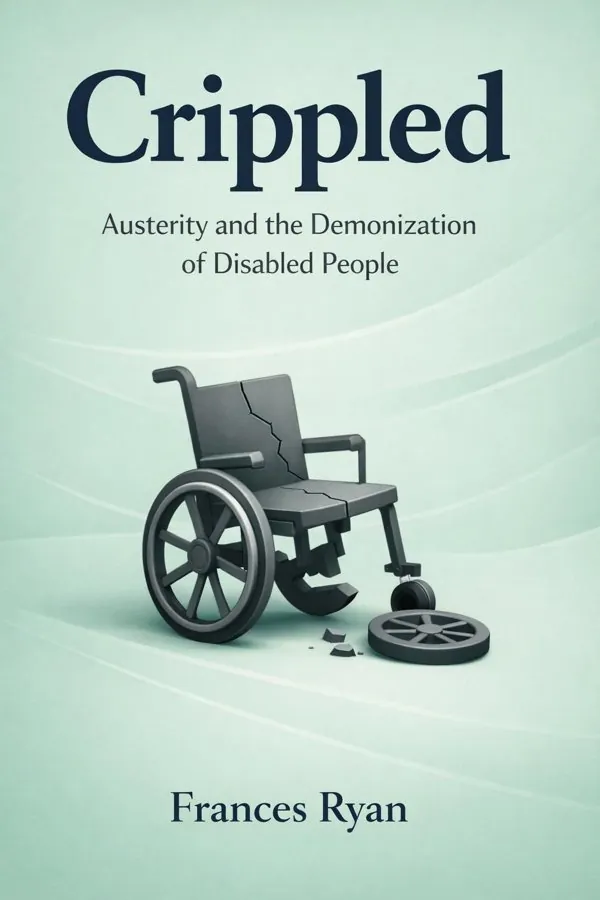
Crippled: Austerity and the Demonization of Disabled People: Summary & Key Insights
by Frances Ryan
 10 min10 chaptersAudio available
Key Takeaways from Crippled: Austerity and the Demonization of Disabled People
In Crippled, disabled people emerge not as incidental victims of wider reforms but as one of the primary groups harmed by them.
One of the book’s most important arguments is that austerity did not merely shrink the welfare state; it changed its moral meaning.
A powerful thread running through Crippled is that disability under austerity is not only about official policy; it is about the exhausting negotiations that fill ordinary days.
Few contradictions are as striking in Ryan’s account as this one: disabled people are pressured to work by a state that often fails to make work possible.
Ryan makes a compelling case that austerity was reinforced not only by policy but by story.
What Is Crippled: Austerity and the Demonization of Disabled People About?
Crippled: Austerity and the Demonization of Disabled People by Frances Ryan is a sociology book spanning 11 pages. Crippled: Austerity and the Demonization of Disabled People is a searing account of what happens when economic policy is treated as morally neutral while real human lives are pushed to the edge. In this urgent work of investigative journalism, Frances Ryan examines how austerity in the United Kingdom did not simply reduce state spending; it reshaped public attitudes, weakened social protections, and made disabled people carry a devastating share of the burden. Through personal testimonies, policy analysis, media scrutiny, and government data, Ryan shows how welfare reform, benefit sanctions, inaccessible services, and hostile rhetoric combined to create a climate of fear, poverty, and exclusion. What makes the book especially powerful is its refusal to speak about disabled people as abstract statistics. Ryan centers lived experience, revealing how cuts to care, housing, transport, and income support affect daily survival, dignity, and independence. As a journalist known for her reporting on disability rights and inequality, she brings both rigor and moral clarity to the subject. Crippled matters because it exposes the human cost of political choices and challenges readers to rethink what fairness, citizenship, and social responsibility should mean in a democratic society.
This FizzRead summary covers all 10 key chapters of Crippled: Austerity and the Demonization of Disabled People in approximately 10 minutes, distilling the most important ideas, arguments, and takeaways from Frances Ryan's work. Also available as an audio summary and Key Quotes Podcast.
Crippled: Austerity and the Demonization of Disabled People
Crippled: Austerity and the Demonization of Disabled People is a searing account of what happens when economic policy is treated as morally neutral while real human lives are pushed to the edge. In this urgent work of investigative journalism, Frances Ryan examines how austerity in the United Kingdom did not simply reduce state spending; it reshaped public attitudes, weakened social protections, and made disabled people carry a devastating share of the burden. Through personal testimonies, policy analysis, media scrutiny, and government data, Ryan shows how welfare reform, benefit sanctions, inaccessible services, and hostile rhetoric combined to create a climate of fear, poverty, and exclusion.
What makes the book especially powerful is its refusal to speak about disabled people as abstract statistics. Ryan centers lived experience, revealing how cuts to care, housing, transport, and income support affect daily survival, dignity, and independence. As a journalist known for her reporting on disability rights and inequality, she brings both rigor and moral clarity to the subject. Crippled matters because it exposes the human cost of political choices and challenges readers to rethink what fairness, citizenship, and social responsibility should mean in a democratic society.
Who Should Read Crippled: Austerity and the Demonization of Disabled People?
This book is perfect for anyone interested in sociology and looking to gain actionable insights in a short read. Whether you're a student, professional, or lifelong learner, the key ideas from Crippled: Austerity and the Demonization of Disabled People by Frances Ryan will help you think differently.
- ✓Readers who enjoy sociology and want practical takeaways
- ✓Professionals looking to apply new ideas to their work and life
- ✓Anyone who wants the core insights of Crippled: Austerity and the Demonization of Disabled People in just 10 minutes
Want the full summary?
Get instant access to this book summary and 100K+ more with Fizz Moment.
Get Free SummaryAvailable on App Store • Free to download
Key Chapters
Austerity is often presented as a technical budgetary exercise, but Ryan’s central insight is that spending cuts are never abstract when they fall on people who rely on public support to live with dignity. In Crippled, disabled people emerge not as incidental victims of wider reforms but as one of the primary groups harmed by them. What governments describe as “efficiency,” “rebalancing,” or “welfare reform” can mean losing a care worker, skipping meals, facing eviction, or being trapped indoors because accessible transport is unavailable.
Ryan shows that the issue is not simply reduced income. It is the cumulative effect of cuts across multiple systems: disability benefits, social care, legal aid, local council services, housing support, and healthcare access. A person may lose financial assistance, then lose mobility support, then lose the practical help that made work, study, or community life possible. Policies that seem separate on paper become crushing when experienced together.
A practical example is the person declared “fit for work” through a flawed assessment process, then pushed onto lower support while still facing inaccessible workplaces and extra disability-related costs. Another is a family losing respite care, causing both emotional strain and economic instability. Ryan argues that these outcomes were not random accidents but predictable consequences of policy choices.
The book invites readers to stop thinking about austerity only in terms of fiscal savings and start asking who pays the real price. Actionable takeaway: when evaluating any public policy, look beyond budget headlines and ask how it will affect disabled people’s daily independence, safety, and ability to participate in society.
One of the book’s most important arguments is that austerity did not merely shrink the welfare state; it changed its moral meaning. Britain’s postwar welfare system was founded on collective protection, the idea that society shares responsibility for supporting people through illness, unemployment, disability, and old age. Ryan explains that after 2010, this principle was increasingly replaced by suspicion, conditionality, and the demand that claimants constantly prove their legitimacy.
Under the Conservative-Liberal Democrat coalition, cuts were framed as necessary discipline and welfare reform was sold as common sense. But Ryan demonstrates how the language of “dependency” and “burden” subtly transformed disabled people from citizens entitled to support into subjects of scrutiny. The state began acting less like a guarantor of social security and more like an institution testing whether vulnerable people deserved help at all.
This ideological shift matters because systems shape culture. When officials repeatedly suggest that benefits are too generous or too easily claimed, the public becomes more receptive to punitive policies. That atmosphere then affects assessments, media coverage, and even everyday interactions. A disabled person requesting accommodation is more likely to be seen as asking for special treatment rather than equal access.
Ryan’s analysis helps readers understand that policy language is never neutral. Framing determines whose suffering is visible and whose needs are dismissed. Actionable takeaway: whenever politicians discuss welfare reform, pay close attention to the moral assumptions embedded in their language. Ask whether the policy treats disabled people as full citizens with rights or as problems to be managed.
A powerful thread running through Crippled is that disability under austerity is not only about official policy; it is about the exhausting negotiations that fill ordinary days. Ryan shows how cuts and inaccessibility turn basic activities into precarious calculations: Can I afford heating this week? Will my care worker hours be reduced again? Is the bus accessible? What happens if my reassessment letter arrives and I miss a deadline because I am in hospital?
This focus on daily life is crucial because large policy debates often hide the lived mechanics of hardship. For disabled people, the withdrawal of support can destabilize routines that are essential for health, work, and independence. Social care is not a luxury. Accessible housing is not a convenience. Reliable benefits are not a bonus. They are the infrastructure that allows life to function.
Ryan uses case studies to show how apparently minor bureaucratic changes create deep disruption. A delay in payment may mean missed rent. A cut in support hours may mean not being able to wash, cook, or leave home. An inaccessible assessment center may itself become a barrier to receiving help. These are not side effects; they are evidence of systems designed without disabled realities in mind.
The broader lesson is that independence is collective, not individual. People are often described as independent because of the support around them, not because they need nothing. Actionable takeaway: if you work in policy, management, education, or healthcare, examine whether your systems assume a “standard” body and mind. Small administrative decisions can either support autonomy or quietly destroy it.
Few contradictions are as striking in Ryan’s account as this one: disabled people are pressured to work by a state that often fails to make work possible. Crippled dismantles the simplistic political story that unemployment among disabled people is mainly the result of low motivation or overgenerous benefits. Instead, Ryan reveals the structural barriers that exclude disabled people from employment: inaccessible workplaces, inadequate transport, employer discrimination, poor support services, and assessment systems disconnected from real working conditions.
The cruelty lies in the double bind. A person may be told they are capable of employment because they can perform narrow tasks in a benefits assessment, yet in real life they face chronic pain, unpredictable symptoms, inaccessible buildings, or employers unwilling to offer flexibility. Being “fit for work” on paper does not create an accessible labor market.
Ryan also highlights the extra costs associated with disability, which make low-paid or unstable work especially risky. If taking a job jeopardizes support with care or transport, employment can actually leave someone worse off. This is not evidence that disabled people do not want to work; it shows that current systems often punish them for trying.
The practical implication extends beyond government. Employers frequently speak about inclusion while relying on rigid hours, opaque recruitment practices, and environments hostile to disabled staff. Actionable takeaway: if you lead a team or organization, audit hiring, flexibility, workplace design, and retention practices. Real inclusion means removing barriers before demanding individual resilience.
Ryan makes a compelling case that austerity was reinforced not only by policy but by story. Media narratives about “benefit scroungers,” “fraud,” and undeserving claimants helped create a public climate in which harsher treatment of disabled people seemed acceptable. When headlines focus on rare abuse rather than common need, they distort reality and encourage suspicion toward anyone receiving support.
This matters because stigma has material consequences. A hostile media environment can influence voting behavior, justify aggressive reforms, and normalize humiliation in welfare systems. It also changes everyday life. Disabled people may face intrusive questioning, public judgment, or online abuse simply for using benefits, mobility aids, or accessible services. Ryan shows how demonization moves from newspaper columns into social relations.
The book’s insight here is larger than disability politics. Societies often legitimize inequality by constructing moral hierarchies of worthiness. Once a group is framed as costly, lazy, or fraudulent, their suffering becomes easier to dismiss. Facts alone do not defeat this process; representation matters. Who gets quoted? Whose pain is believed? What kinds of lives are considered valuable?
A practical example is the difference between a report that treats a benefits claimant as a budget line and one that shows the consequences of losing income, care, or housing. The first invites abstraction; the second restores humanity. Actionable takeaway: consume media critically. Question stories that focus on isolated fraud cases or decontextualized welfare costs, and seek reporting that centers evidence, lived experience, and structural realities.
One of the most devastating effects of austerity, as Ryan describes it, is how quickly financial and social cuts produce isolation. When support services are reduced, accessible transport becomes unreliable, community programs disappear, and care hours are cut, disabled people are not merely inconvenienced; they can become trapped in their homes and separated from social life. The result is loneliness, deteriorating mental health, and a shrinking sense of personhood.
Ryan demonstrates that isolation is political, not accidental. It is produced by decisions about funding, planning, and whose participation matters. If a local authority closes day services, if an individual cannot afford internet access after benefit cuts, or if inaccessible housing prevents basic movement, then exclusion is being built into the environment. Mental distress in these conditions is not an individual failing but a rational response to abandonment.
The book is especially strong in showing how emotional harm and material deprivation reinforce each other. Anxiety rises when reassessment letters arrive. Depression deepens when social contact disappears. Relationships strain when family members must fill gaps left by the state. For many readers, this reframes mental health as inseparable from economic and social conditions.
A practical lesson follows: support networks matter, but they cannot substitute for rights-based public infrastructure. Friendship cannot replace social care; resilience cannot replace accessible systems. Actionable takeaway: in your community or workplace, treat isolation as a structural issue. Support policies and practices that increase mobility, access, social participation, and predictable care rather than assuming loneliness is purely personal.
A society can proclaim equality while denying people the means to exercise it. Ryan shows that disabled people in the UK may formally possess legal protections, yet these protections often weaken when public services are cut, legal aid is restricted, and enforcement becomes difficult. Rights on paper do not guarantee justice in practice.
Crippled explores how austerity undermines the legal and human rights framework meant to protect disabled citizens. If local authorities fail to provide adequate care, if employers discriminate, or if inaccessible systems block participation, individuals theoretically have avenues to challenge these harms. But taking legal action requires time, money, energy, and support. For many disabled people, especially those already navigating poverty or ill health, those barriers are overwhelming.
Ryan’s argument expands the meaning of rights. Equality is not simply about non-discrimination in the abstract; it requires material conditions that make participation possible. The right to live independently means little without social care. The right to work is hollow without access and accommodation. The right to dignity collapses when welfare systems operate through fear and repeated humiliation.
This has practical importance for advocates, institutions, and policymakers. Compliance alone is not enough if systems remain inaccessible or impossible to challenge. Actionable takeaway: when assessing whether a law protects disabled people, ask not only what the law says, but whether people can realistically use it. Strong rights require funding, accountability, and accessible routes to enforcement.
Although Crippled documents extensive harm, it is not only a story of victimization. Ryan also emphasizes the role of disabled activists, grassroots organizations, carers, and community networks in resisting cuts and insisting on visibility. This is one of the book’s most hopeful insights: those most affected by injustice are often also the clearest analysts of it.
Ryan highlights how disabled people have organized against benefit cuts, challenged demeaning assessments, exposed policy failures, and built solidarity across communities. Activism here is not always dramatic protest, though that matters. It also includes mutual aid, storytelling, local campaigning, legal challenges, and the slow work of making hidden suffering visible. In this sense, testimony becomes political action.
The significance of this resistance is twofold. First, it contests the stereotype of disabled people as passive recipients of care. Second, it provides a model for how social change happens: by connecting private hardship to public structures. When one person’s crisis is framed as individual misfortune, it stays isolated. When many people name the same pattern as a policy outcome, it becomes undeniable.
For readers, this chapter of the argument offers both correction and invitation. Disabled people are not merely subjects of reform; they are agents shaping the debate about justice. Actionable takeaway: support disability-led organizations and make space for disabled people to define the issues that affect them. Effective advocacy begins by following lived expertise, not speaking over it.
Ryan’s analysis becomes even more powerful when viewed through intersectionality. Disabled people are not a uniform group, and the harms of austerity are distributed unevenly across class, gender, race, immigration status, and type of impairment. A disabled woman facing domestic abuse, a Black disabled claimant encountering institutional bias, or a poor family caring for a disabled child may each experience austerity differently, though all are affected by the same broad system.
This matters because one-size-fits-all policy often misses the people under greatest pressure. Ryan shows that disability oppression overlaps with other forms of inequality, multiplying vulnerability. For example, benefit cuts may hit low-income households hardest because they have no savings to absorb delays. Women are often affected both as disabled people and as unpaid carers filling gaps left by reduced services. People with mental health conditions may face particular skepticism in assessment systems designed around visible or simplified notions of disability.
Intersectionality also sharpens political strategy. If disability is treated as separate from housing, labor rights, anti-racism, feminism, or healthcare, then the broader architecture of exclusion remains intact. Ryan’s reporting encourages readers to see disability justice as connected to economic justice and democratic accountability.
The practical lesson is to avoid generic compassion that overlooks uneven burdens. Actionable takeaway: when discussing disability policy, ask which disabled people are most affected, whose voices are absent, and how poverty, race, gender, and care responsibilities alter the impact of every reform.
Ryan does not present austerity as an unfortunate chapter that can be corrected by better messaging alone. Her deeper claim is that a fairer society requires structural change in how disability, welfare, work, and citizenship are understood. If disabled people continue to be treated as costs to contain rather than people to support, then cruelty will simply return under new labels.
The future Ryan points toward is rights-based, participatory, and materially serious. It would involve properly funded social care, humane and accurate benefits systems, accessible public infrastructure, stronger enforcement of anti-discrimination laws, and policymaking shaped by disabled people themselves. Just as importantly, it would reject the cultural logic that human worth is measured by productivity alone.
This vision has broad relevance. An accessible society is usually a better society for everyone: parents with strollers, older adults, people recovering from illness, workers needing flexibility, and communities that benefit from stronger public services. Ryan’s case suggests that disability policy is not a niche concern but a test of democratic values.
For readers, the final challenge is ethical as much as political. Do we believe support should be conditional on proving worth, or do we believe dignity is a social guarantee? The answer determines budgets, institutions, and everyday life. Actionable takeaway: support policies, employers, and public institutions that design for access, security, and dignity from the start. A humane society is built by treating disabled inclusion as foundational, not optional.
All Chapters in Crippled: Austerity and the Demonization of Disabled People
About the Author
Frances Ryan is a British journalist and author whose work focuses on disability rights, inequality, welfare policy, and social justice. Best known for her writing for The Guardian, she has become one of the most prominent public voices documenting how economic and political decisions affect disabled people in everyday life. Ryan’s reporting blends investigative rigor with sharp social analysis, often centering testimonies from people excluded from mainstream debate. She has been widely recognized for challenging stereotypes about disability and for exposing the human impact of austerity in the United Kingdom. In Crippled, she brings together years of reporting, policy knowledge, and advocacy-informed insight to produce a powerful account of how disabled citizens were marginalized by both government reforms and public rhetoric.
Get This Summary in Your Preferred Format
Read or listen to the Crippled: Austerity and the Demonization of Disabled People summary by Frances Ryan anytime, anywhere. FizzRead offers multiple formats so you can learn on your terms — all free.
Available formats: App · Audio · PDF · EPUB — All included free with FizzRead
Download Crippled: Austerity and the Demonization of Disabled People PDF and EPUB Summary
Key Quotes from Crippled: Austerity and the Demonization of Disabled People
“In Crippled, disabled people emerge not as incidental victims of wider reforms but as one of the primary groups harmed by them.”
“One of the book’s most important arguments is that austerity did not merely shrink the welfare state; it changed its moral meaning.”
“A powerful thread running through Crippled is that disability under austerity is not only about official policy; it is about the exhausting negotiations that fill ordinary days.”
“Few contradictions are as striking in Ryan’s account as this one: disabled people are pressured to work by a state that often fails to make work possible.”
“Ryan makes a compelling case that austerity was reinforced not only by policy but by story.”
Frequently Asked Questions about Crippled: Austerity and the Demonization of Disabled People
Crippled: Austerity and the Demonization of Disabled People by Frances Ryan is a sociology book that explores key ideas across 10 chapters. Crippled: Austerity and the Demonization of Disabled People is a searing account of what happens when economic policy is treated as morally neutral while real human lives are pushed to the edge. In this urgent work of investigative journalism, Frances Ryan examines how austerity in the United Kingdom did not simply reduce state spending; it reshaped public attitudes, weakened social protections, and made disabled people carry a devastating share of the burden. Through personal testimonies, policy analysis, media scrutiny, and government data, Ryan shows how welfare reform, benefit sanctions, inaccessible services, and hostile rhetoric combined to create a climate of fear, poverty, and exclusion. What makes the book especially powerful is its refusal to speak about disabled people as abstract statistics. Ryan centers lived experience, revealing how cuts to care, housing, transport, and income support affect daily survival, dignity, and independence. As a journalist known for her reporting on disability rights and inequality, she brings both rigor and moral clarity to the subject. Crippled matters because it exposes the human cost of political choices and challenges readers to rethink what fairness, citizenship, and social responsibility should mean in a democratic society.
You Might Also Like

Between the World and Me
Ta-Nehisi Coates
10 min
Half the Sky
Nicholas D. Kristof, Sheryl WuDunn
10 min
Men Explain Things To Me
Rebecca Solnit
10 min
Rational Ritual
Michael Suk-Young Chwe
10 min
The New Jim Crow
Michelle Alexander
10 min
Beyond Culture
Edward T. Hall
10 minBrowse by Category
Ready to read Crippled: Austerity and the Demonization of Disabled People?
Get the full summary and 100K+ more books with Fizz Moment.