
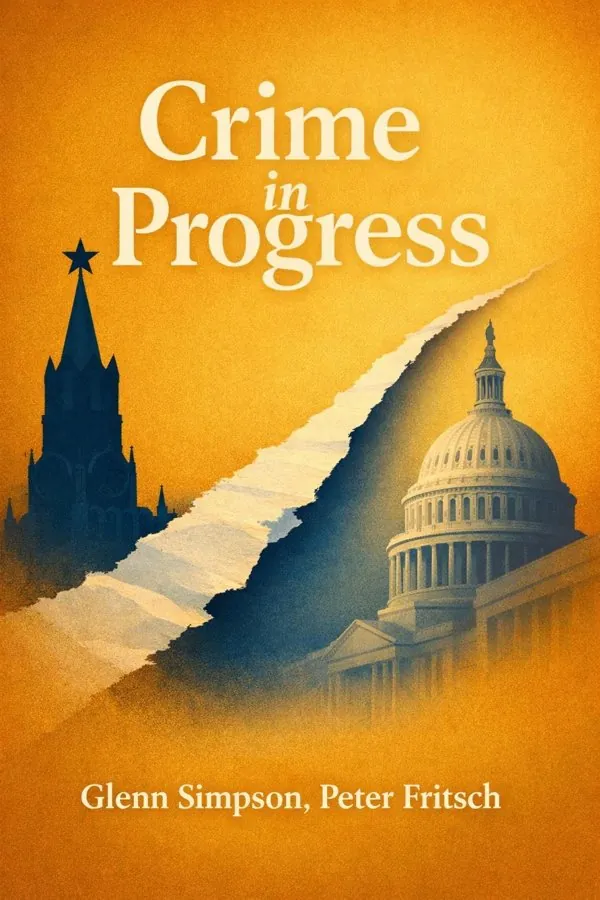
Crime in Progress: Inside the Steele Dossier and the Fusion GPS Investigation of Donald Trump: Summary & Key Insights
by Glenn Simpson, Peter Fritsch
 10 min9 chaptersAudio available
Key Takeaways from Crime in Progress: Inside the Steele Dossier and the Fusion GPS Investigation of Donald Trump
Big political stories rarely begin as grand conspiracies; they often begin with a reporter’s simple suspicion that something does not add up.
Simpson and Fritsch describe how Fusion GPS was initially retained by a conservative publication tied to anti-Trump Republicans during the 2016 primary.
Documents can reveal structure, but human sources often reveal intent.
Public debate often treated the Steele dossier as if it were supposed to function like a finished prosecutor’s brief.
The authors repeatedly argue that the dossier became a distraction from the bigger issue: Russia’s broad campaign to influence American politics.
What Is Crime in Progress: Inside the Steele Dossier and the Fusion GPS Investigation of Donald Trump About?
Crime in Progress: Inside the Steele Dossier and the Fusion GPS Investigation of Donald Trump by Glenn Simpson, Peter Fritsch is a politics book spanning 12 pages. Crime in Progress is an insider account of one of the most disputed and politically explosive investigations in recent American history. Written by Glenn Simpson and Peter Fritsch, co-founders of the research firm Fusion GPS, the book explains how routine opposition research into Donald Trump’s business and political background evolved into a deeper inquiry involving Russian connections, financial patterns, intelligence concerns, and the now-famous Steele dossier. Rather than presenting the dossier as a piece of political mythology, the authors frame it as one part of a larger mosaic of troubling evidence that deserved serious scrutiny. What makes the book matter is not only its subject, but its perspective. Simpson and Fritsch were not outside commentators watching events unfold from a distance. They were directly involved in gathering information, hiring former British intelligence officer Christopher Steele, interacting with journalists and investigators, and then enduring the backlash once the dossier became public. Their background as veteran investigative reporters gives the book a distinctive tone: part memoir, part defense, part lesson in how complex investigations actually work. For readers trying to understand the intersection of politics, media, intelligence, and disinformation in the Trump era, Crime in Progress offers a valuable and provocative firsthand narrative.
This FizzRead summary covers all 9 key chapters of Crime in Progress: Inside the Steele Dossier and the Fusion GPS Investigation of Donald Trump in approximately 10 minutes, distilling the most important ideas, arguments, and takeaways from Glenn Simpson, Peter Fritsch's work. Also available as an audio summary and Key Quotes Podcast.
Crime in Progress: Inside the Steele Dossier and the Fusion GPS Investigation of Donald Trump
Crime in Progress is an insider account of one of the most disputed and politically explosive investigations in recent American history. Written by Glenn Simpson and Peter Fritsch, co-founders of the research firm Fusion GPS, the book explains how routine opposition research into Donald Trump’s business and political background evolved into a deeper inquiry involving Russian connections, financial patterns, intelligence concerns, and the now-famous Steele dossier. Rather than presenting the dossier as a piece of political mythology, the authors frame it as one part of a larger mosaic of troubling evidence that deserved serious scrutiny.
What makes the book matter is not only its subject, but its perspective. Simpson and Fritsch were not outside commentators watching events unfold from a distance. They were directly involved in gathering information, hiring former British intelligence officer Christopher Steele, interacting with journalists and investigators, and then enduring the backlash once the dossier became public. Their background as veteran investigative reporters gives the book a distinctive tone: part memoir, part defense, part lesson in how complex investigations actually work. For readers trying to understand the intersection of politics, media, intelligence, and disinformation in the Trump era, Crime in Progress offers a valuable and provocative firsthand narrative.
Who Should Read Crime in Progress: Inside the Steele Dossier and the Fusion GPS Investigation of Donald Trump?
This book is perfect for anyone interested in politics and looking to gain actionable insights in a short read. Whether you're a student, professional, or lifelong learner, the key ideas from Crime in Progress: Inside the Steele Dossier and the Fusion GPS Investigation of Donald Trump by Glenn Simpson, Peter Fritsch will help you think differently.
- ✓Readers who enjoy politics and want practical takeaways
- ✓Professionals looking to apply new ideas to their work and life
- ✓Anyone who wants the core insights of Crime in Progress: Inside the Steele Dossier and the Fusion GPS Investigation of Donald Trump in just 10 minutes
Want the full summary?
Get instant access to this book summary and 100K+ more with Fizz Moment.
Get Free SummaryAvailable on App Store • Free to download
Key Chapters
Big political stories rarely begin as grand conspiracies; they often begin with a reporter’s simple suspicion that something does not add up. That is the spirit Simpson and Fritsch say gave birth to Fusion GPS. After long careers as investigative journalists, they saw traditional newsroom resources shrinking while complex stories about money laundering, corruption, and hidden influence were becoming harder, not easier, to uncover. Fusion GPS emerged as a research firm built on journalistic habits: following documents, comparing claims against records, and looking for patterns others ignored.
In the book, the authors emphasize that opposition research, at its best, is less about inventing attacks than about testing public narratives against verifiable facts. Their account reframes private political research as a continuation of investigative reporting by other means. Instead of treating campaigns, corporations, or legal clients as sources of truth, they describe themselves as professional skeptics who dig into court files, financial trails, corporate relationships, and foreign links.
A practical implication is that modern politics increasingly depends on researchers who can work across public records, litigation history, real estate data, and international business networks. For example, understanding a candidate today may require reviewing bankruptcies, shell companies, lawsuits, and foreign partnerships rather than simply listening to speeches. The book suggests that anyone evaluating political claims should think like an investigator: ask what evidence exists outside the campaign’s messaging.
The broader lesson is that good research begins with disciplined curiosity, not ideology. If a public figure’s story seems unusually polished, the truth may lie in the paperwork. Actionable takeaway: when assessing a major political claim, look past headlines and seek primary records, financial connections, and independent corroboration before forming a judgment.
One of the book’s most important claims is that the Trump investigation did not begin as a secret Democratic plot, but as ordinary opposition research funded first by Republican interests. Simpson and Fritsch describe how Fusion GPS was initially retained by a conservative publication tied to anti-Trump Republicans during the 2016 primary. Only later, after Trump became the presumptive nominee and the original client stepped away, did Democratic-linked funding continue the work.
This matters because it challenges the simplified narrative that the dossier sprang fully formed from partisan hostility on one side. The authors argue that concern about Trump’s background was bipartisan before it became tribal. Researchers examining his business record found a history of lawsuits, bankruptcies, dubious partnerships, and opaque financial behavior that raised obvious questions regardless of party affiliation. In their telling, the assignment broadened not because of ideology, but because the evidence kept pointing toward deeper concerns.
In practical terms, the chapter shows how investigations can evolve. A project may begin with standard political vetting and then shift once new risks appear. A company performing due diligence on a potential executive hire might likewise start by reviewing resumes and references, only to discover litigation patterns or financial irregularities that justify a larger inquiry. Initial scope does not determine final significance.
The takeaway here is methodological as much as political: the origins of an investigation do not automatically discredit its findings. What matters is the quality of the evidence and whether concerns can be independently checked. Actionable takeaway: whenever a controversy is dismissed as “partisan,” ask who first raised the issue, what evidence was found, and whether the underlying facts stand apart from the motives of those who funded the research.
Documents can reveal structure, but human sources often reveal intent. Simpson and Fritsch present Christopher Steele as the person who added that second dimension to their work. A former British intelligence officer with experience on Russia, Steele was brought in not as a political operative, they argue, but as a specialist capable of understanding Russian elites, networks of influence, and clandestine behavior. His task was to explore whether Trump’s business and political world intersected with Russian interests in ways that ordinary public-record research could not fully explain.
The authors portray Steele as credible because he had an established professional record, existing contacts, and a reputation for taking national security concerns seriously. They stress that his memos were raw intelligence reports, not polished conclusions. That distinction is central to the book’s defense. Raw intelligence is often fragmentary, incomplete, and in need of corroboration, yet it can still be valuable as an early warning signal.
This idea applies far beyond politics. In any serious investigation, there is a difference between a lead and a final proof. A compliance team inside a company might receive a tip from a trusted insider about bribery risks abroad. That tip is not automatically true in every detail, but it would be irresponsible to ignore it merely because it is unverified at the outset. The correct response is to investigate further, compare sources, and look for corroborating evidence.
The authors’ larger point is that expertise matters when dealing with opaque systems like Russia’s power structure. Not every researcher can assess such terrain responsibly. Actionable takeaway: when confronted with uncertain but potentially serious information, distinguish between allegation, intelligence, and proven fact, then evaluate whether the source and context justify further investigation.
Public debate often treated the Steele dossier as if it were supposed to function like a finished prosecutor’s brief. Simpson and Fritsch insist that this misunderstands both its purpose and its format. The dossier, as they describe it, was a series of intelligence memos containing leads, patterns, and alarming allegations that needed to be checked against other evidence. Its significance was not that every line had been publicly proved at once, but that it pointed toward a coherent risk: possible connections between Trump, his circle, and Russian interference efforts.
The book argues that the memos made sense when placed alongside broader facts that later became public: Russian hacking operations, outreach to Trump advisers, suspicious contacts, and the extensive findings of multiple investigations into election interference. In this framing, the dossier was less a stand-alone revelation than one stream feeding a larger river of concern.
A practical lesson emerges about how people consume politically charged information. Audiences often want binary answers: true or false, real or fake. But serious investigations usually move in stages. Analysts assemble fragments, cross-check timelines, and discard some claims while strengthening others. For instance, a journalist investigating corruption may begin with several inconsistent witness accounts. Some details will fail, others will align with banking records, emails, or travel logs. The result is a refined picture, not instant certainty.
Simpson and Fritsch are effectively asking readers to tolerate ambiguity without surrendering rigor. Some parts of an early inquiry may remain unconfirmed, yet the overall warning may still be valid. Actionable takeaway: when evaluating explosive reports, judge them as investigative leads within a larger evidentiary process rather than demanding that first drafts carry the burden of final legal proof.
The authors repeatedly argue that the dossier became a distraction from the bigger issue: Russia’s broad campaign to influence American politics. In their view, fixation on the dossier’s most sensational allegations allowed critics and commentators alike to sidestep the central question of why Russian operatives, intermediaries, trolls, hackers, and propaganda channels were interacting with the Trump ecosystem at all. The book widens the frame beyond one set of memos and places the investigation inside a much larger geopolitical campaign.
This broader perspective matters because political scandals are often reduced to personalities. Simpson and Fritsch urge readers to instead look at systems: cyber operations, oligarch networks, financial leverage, disinformation channels, and efforts to exploit polarization inside democratic societies. Trump, in this interpretation, was not merely an individual under suspicion but a focal point in a larger story about the vulnerability of open political systems to covert foreign influence.
The practical relevance extends beyond 2016. Democracies today face hybrid threats that mix hacking, media manipulation, legal intimidation, and financial opacity. A foreign government need not alter vote tallies to influence outcomes; it may simply flood the information environment with confusion, exploit existing divisions, and cultivate useful relationships. Organizations and citizens alike must therefore think in terms of resilience, not just scandal.
For example, a business leader worried about cyber risk must also care about reputational warfare and information leaks. Likewise, voters should evaluate not just campaign messages but who benefits from amplifying them. The book’s warning is that manipulation succeeds when audiences focus only on spectacle and ignore structure. Actionable takeaway: whenever a political controversy erupts, ask what larger system of influence, incentives, or strategic advantage may be operating behind the immediate headlines.
A recurring theme in Crime in Progress is that federal investigators were placed in an unenviable position. According to Simpson and Fritsch, once credible information suggested possible links between a presidential candidate’s circle and a hostile foreign power, the FBI and intelligence agencies could not simply look away. Yet any attempt to investigate risked charges of political interference, especially in the middle of a presidential campaign. The authors present this dilemma not as evidence of conspiracy, but as the unavoidable burden of institutions charged with protecting national security under democratic constraints.
They also push back against the idea that the dossier alone drove official action. In their account, the FBI already had multiple reasons to scrutinize Russian contacts and election interference, including separate intelligence streams and suspicious interactions involving Trump associates. The dossier was one factor among many, not the sole trigger. This distinction is vital because it shows how public narratives can flatten complex institutional decisions into a misleading single-cause story.
There is a broader lesson here about decision-making under uncertainty. Institutions often must act before all facts are settled, especially when potential harm is large. A bank’s fraud department, for example, may freeze transactions based on unusual patterns and limited corroboration, not because guilt is certain, but because waiting could worsen the damage. The challenge is to investigate with restraint, documentation, and legal oversight.
Simpson and Fritsch suggest that democratic societies should expect both caution and action from their institutions when foreign interference is suspected. Demanding paralysis until perfect proof arrives creates its own danger. Actionable takeaway: judge institutional responses not by whether controversy followed, but by whether officials had reasonable cause, proper procedures, and a proportionate response to the risks they faced.
Few things are more powerful than a story the public half understands. Simpson and Fritsch devote substantial attention to the media environment surrounding the dossier, arguing that reporters, commentators, and partisan outlets alternately sensationalized, oversimplified, and weaponized the information. Some journalists moved too cautiously, afraid of being manipulated. Others chased explosive allegations without adequately explaining the distinction between raw intelligence and confirmed reporting. Once BuzzFeed published the dossier, the public controversy intensified dramatically, and nuance largely disappeared.
The authors’ account highlights a structural problem in modern media: complex investigations unfold slowly, but the news cycle rewards instant certainty, conflict, and memorable labels. “Dossier” became a symbol that could be praised or condemned without most people ever understanding what was in it, how it was compiled, or how intelligence reporting works. This dynamic turned a complicated inquiry into a cultural Rorschach test.
The practical application is obvious for any reader navigating today’s information ecosystem. Whether the topic is politics, business, health, or war, people should ask what stage a story is in. Is this a leak, a preliminary memo, a court filing, a finding by inspectors, or a proven fact? A CEO facing a public accusation knows that early reports may contain errors without the underlying concern being baseless. Responsible interpretation requires attention to process.
The book implicitly argues for a more mature form of media literacy: neither blind belief nor cynical dismissal. Actionable takeaway: when a controversial report appears, identify the source, the evidentiary status, the incentives of those amplifying it, and what independent facts have already been established before accepting the loudest interpretation.
Investigations do not end when information becomes public; often that is when the real fight begins. Simpson and Fritsch describe how disclosure of the dossier transformed them from behind-the-scenes researchers into highly visible political targets. Lawsuits, congressional scrutiny, media attacks, reputational smears, and claims of treason or fabrication became part of the fallout. In their telling, this backlash was not merely personal. It was a strategic effort to intimidate investigators, muddy the factual record, and shift attention away from the underlying evidence.
The book is particularly revealing about how modern power defends itself. Instead of simply disproving claims, political actors may attack the motives, funding, methods, and identities of those doing the investigating. This does not mean criticism is always illegitimate; scrutiny of researchers is fair in a democracy. But the authors argue that the scale and aggressiveness of the response reflected how dangerous well-documented inquiry can be to entrenched interests.
This theme has broad relevance in law, journalism, academia, and corporate governance. Whistleblowers, auditors, and investigative teams often face retaliation designed less to win on facts than to raise the costs of speaking. A company employee exposing fraud may be accused of disloyalty; a journalist uncovering corruption may be branded partisan. The pressure can deter others from continuing the work.
Simpson and Fritsch ultimately defend persistence as a civic duty. Investigative work, they suggest, requires not only evidence-gathering skills but the resilience to withstand attacks once the evidence threatens powerful people. Actionable takeaway: when evaluating a disputed investigation, pay attention not only to alleged flaws in the research but also to whether efforts are being made to discredit, intimidate, or overwhelm the investigators themselves.
The phrase “opposition research” often sounds dirty, as if it is inherently manipulative or dishonest. Crime in Progress argues for a more nuanced view. Simpson and Fritsch acknowledge that opposition research can be abused, but they insist it can also perform a democratic function when done responsibly: uncovering information voters deserve to know about people seeking power. In this sense, the issue is not whether research is partisan, but whether it is evidence-based, transparent about its limits, and focused on matters of public consequence rather than trivial scandal.
Their defense rests on a simple proposition: campaigns market candidates, but democracies need adversarial scrutiny. If no one investigates financial entanglements, foreign connections, litigation histories, or business fraud allegations, voters are left with branding instead of accountability. The authors compare their work to the adversarial logic present throughout democratic systems, from courtroom advocacy to investigative reporting. Competing interests can still reveal truth if evidence is tested seriously.
This framework has practical value beyond elections. Boards vet executives, investors vet founders, and nonprofits vet major donors. In each case, skepticism is healthy when someone seeks trust, influence, or control over resources. The ethical line is crossed not by asking hard questions, but by fabricating claims or ignoring exculpatory evidence.
The book’s final reflection is that democracies become fragile when scrutiny itself is delegitimized. Citizens may begin to treat any unwelcome fact as partisan sabotage, making genuine accountability impossible. Actionable takeaway: evaluate opposition research by the standards you would use for any serious inquiry—quality of evidence, relevance to public interest, and openness to correction—rather than dismissing or embracing it solely because of who commissioned it.
All Chapters in Crime in Progress: Inside the Steele Dossier and the Fusion GPS Investigation of Donald Trump
About the Authors
Glenn Simpson and Peter Fritsch are veteran investigative journalists and the co-founders of Fusion GPS, a Washington, D.C.-based research and strategic intelligence firm. Before launching the company, both worked at The Wall Street Journal, where they developed expertise in financial crime, public corruption, organized money flows, and complex international investigations. Their reporting backgrounds shaped Fusion GPS’s approach, which combines document-based inquiry, source development, and deep-dive analysis of political and corporate actors. They became central public figures during the controversy over the Steele dossier because Fusion GPS commissioned Christopher Steele’s research on Donald Trump during the 2016 election. In Crime in Progress, they draw on both their journalistic training and direct involvement in the events to explain how the investigation unfolded and why they believe it mattered.
Get This Summary in Your Preferred Format
Read or listen to the Crime in Progress: Inside the Steele Dossier and the Fusion GPS Investigation of Donald Trump summary by Glenn Simpson, Peter Fritsch anytime, anywhere. FizzRead offers multiple formats so you can learn on your terms — all free.
Available formats: App · Audio · PDF · EPUB — All included free with FizzRead
Download Crime in Progress: Inside the Steele Dossier and the Fusion GPS Investigation of Donald Trump PDF and EPUB Summary
Key Quotes from Crime in Progress: Inside the Steele Dossier and the Fusion GPS Investigation of Donald Trump
“Big political stories rarely begin as grand conspiracies; they often begin with a reporter’s simple suspicion that something does not add up.”
“One of the book’s most important claims is that the Trump investigation did not begin as a secret Democratic plot, but as ordinary opposition research funded first by Republican interests.”
“Documents can reveal structure, but human sources often reveal intent.”
“Public debate often treated the Steele dossier as if it were supposed to function like a finished prosecutor’s brief.”
“The authors repeatedly argue that the dossier became a distraction from the bigger issue: Russia’s broad campaign to influence American politics.”
Frequently Asked Questions about Crime in Progress: Inside the Steele Dossier and the Fusion GPS Investigation of Donald Trump
Crime in Progress: Inside the Steele Dossier and the Fusion GPS Investigation of Donald Trump by Glenn Simpson, Peter Fritsch is a politics book that explores key ideas across 9 chapters. Crime in Progress is an insider account of one of the most disputed and politically explosive investigations in recent American history. Written by Glenn Simpson and Peter Fritsch, co-founders of the research firm Fusion GPS, the book explains how routine opposition research into Donald Trump’s business and political background evolved into a deeper inquiry involving Russian connections, financial patterns, intelligence concerns, and the now-famous Steele dossier. Rather than presenting the dossier as a piece of political mythology, the authors frame it as one part of a larger mosaic of troubling evidence that deserved serious scrutiny. What makes the book matter is not only its subject, but its perspective. Simpson and Fritsch were not outside commentators watching events unfold from a distance. They were directly involved in gathering information, hiring former British intelligence officer Christopher Steele, interacting with journalists and investigators, and then enduring the backlash once the dossier became public. Their background as veteran investigative reporters gives the book a distinctive tone: part memoir, part defense, part lesson in how complex investigations actually work. For readers trying to understand the intersection of politics, media, intelligence, and disinformation in the Trump era, Crime in Progress offers a valuable and provocative firsthand narrative.
You Might Also Like
Antifa: The Anti-Fascist Handbook
Mark Bray
10 min
Attack from Within: How Disinformation Is Sabotaging America
Barbara McQuade
10 min
Coercion, Capital, and European States, AD 990–1992
Charles Tilly
10 min
Digital Democracy: Concepts, Methodologies, Tools, and Applications
Various Authors
10 min
Fascism
Stanley G. Payne
10 min
Fire And Fury: Inside The Trump White House
Michael Wolff
10 minBrowse by Category
Ready to read Crime in Progress: Inside the Steele Dossier and the Fusion GPS Investigation of Donald Trump?
Get the full summary and 100K+ more books with Fizz Moment.