
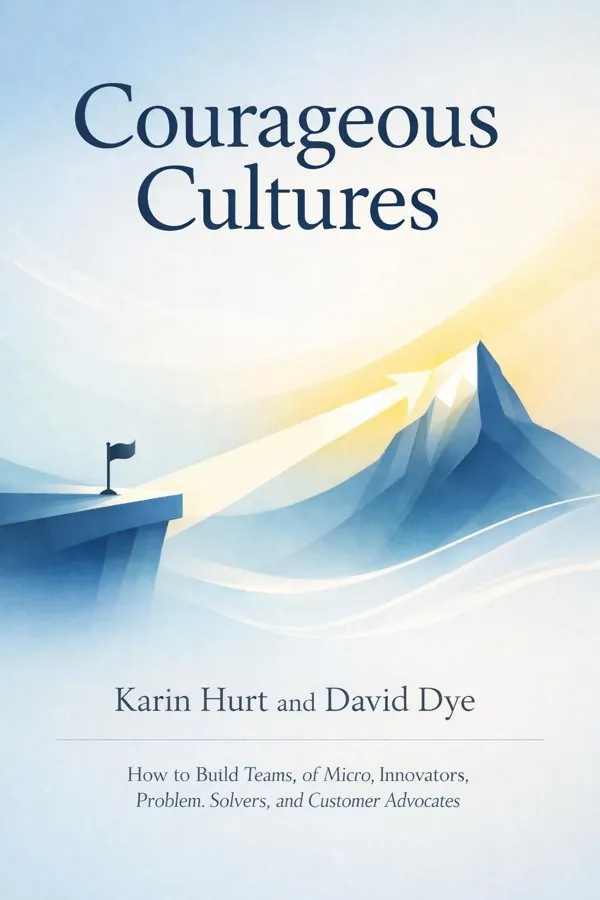
Courageous Cultures: How to Build Teams of Micro-Innovators, Problem Solvers, and Customer Advocates: Summary & Key Insights
by Karin Hurt, David Dye
 10 min11 chaptersAudio available
What Is Courageous Cultures: How to Build Teams of Micro-Innovators, Problem Solvers, and Customer Advocates About?
Courageous Cultures: How to Build Teams of Micro-Innovators, Problem Solvers, and Customer Advocates by Karin Hurt and David Dye is a leadership book spanning 11 pages. Courageous Cultures offers a practical guide for leaders who want to create workplaces where employees feel empowered to speak up, share ideas, and take initiative. Drawing on extensive research and real-world examples, Karin Hurt and David Dye show how to build a culture of psychological safety and innovation, where everyone contributes to solving problems and improving customer experience.
This FizzRead summary covers all 11 key chapters of Courageous Cultures: How to Build Teams of Micro-Innovators, Problem Solvers, and Customer Advocates in approximately 10 minutes, distilling the most important ideas, arguments, and takeaways from Karin Hurt and David Dye's work. Also available as an audio summary and Key Quotes Podcast.
Courageous Cultures: How to Build Teams of Micro-Innovators, Problem Solvers, and Customer Advocates
Courageous Cultures offers a practical guide for leaders who want to create workplaces where employees feel empowered to speak up, share ideas, and take initiative. Drawing on extensive research and real-world examples, Karin Hurt and David Dye show how to build a culture of psychological safety and innovation, where everyone contributes to solving problems and improving customer experience.
Who Should Read Courageous Cultures: How to Build Teams of Micro-Innovators, Problem Solvers, and Customer Advocates?
This book is perfect for anyone interested in leadership and looking to gain actionable insights in a short read. Whether you're a student, professional, or lifelong learner, the key ideas from Courageous Cultures: How to Build Teams of Micro-Innovators, Problem Solvers, and Customer Advocates by Karin Hurt and David Dye will help you think differently.
- ✓Readers who enjoy leadership and want practical takeaways
- ✓Professionals looking to apply new ideas to their work and life
- ✓Anyone who wants the core insights of Courageous Cultures: How to Build Teams of Micro-Innovators, Problem Solvers, and Customer Advocates in just 10 minutes
Want the full summary?
Get instant access to this book summary and 100K+ more with Fizz Moment.
Get Free SummaryAvailable on App Store • Free to download
Key Chapters
Early in our research, we asked hundreds of leaders why they often heard about issues too late. The answer was almost universal: their teams were holding back. Employees told us it was easier to stay quiet than to risk embarrassment or dismissal. Silence, we discovered, was a form of protection—a shield against frustration, rejection, and even punishment.
But the cost of this silence is immense. When people don’t speak up, leaders make decisions in the dark. Customers suffer from unresolved problems, inefficiencies persist, and innovation stalls. We call this 'the silent epidemic'—a cultural disease that spreads quickly in environments lacking psychological safety.
Employees described moments when they spoke up only to be ignored or blamed. Over time, they learned that safety meant saying nothing. Leaders often misread this silence as agreement or disengagement when in reality, it signified fear. The tragedy is that many of these withheld ideas could save time, money, and reputation.
Addressing silence begins with understanding its roots. Leaders must first recognize that fear doesn’t disappear through encouragement alone—it requires consistent proof that speaking up leads to positive outcomes. Without that proof, words of 'openness' sound hollow.
Once you face the truth about silence, you’ll see how essential courage is—not just at the top but at every level. Courage replaces fear with trust. And trust builds communication, innovation, and belonging.
We witnessed, through data and experience, that organizations with courageous cultures outperform their peers in engagement, innovation, and retention. It’s not just about morale—it’s about results. When people know their voice matters, they become active contributors. They spot opportunities, identify customer pain points, and fix problems before they escalate.
Research across industries—from healthcare to technology—shows that encouraging people to share ideas increases efficiency and reduces risk. Medical teams with open dialogue report fewer errors. Tech firms that champion curiosity develop faster solutions. Retail companies where employees are invited to improve processes deliver superior customer experiences.
Courageous cultures enable what we call 'micro-innovation'—everyday improvements driven by frontline insight rather than top-down directives. Big breakthroughs may start as small, safe experiments, born from employees empowered to act. Instead of waiting for innovation teams to lead change, everyone becomes an innovator.
The ripple effect is real. When employees feel their suggestions lead to action, engagement rises. When customers experience organizations that listen and adapt, loyalty deepens. Courage turns workplace energy into movement, aligning personal purpose with organizational success.
But here’s the crucial part: courageous cultures aren’t spontaneous. They’re architected. Leaders actively build systems and behaviors that make courage the standard rather than the exception. This means designing meetings, feedback channels, and recognition systems that reward contribution, not compliance.
+ 9 more chapters — available in the FizzRead app
All Chapters in Courageous Cultures: How to Build Teams of Micro-Innovators, Problem Solvers, and Customer Advocates
About the Authors
Karin Hurt is the CEO of Let's Grow Leaders, a leadership development firm, and a former Verizon Wireless executive. David Dye is the President of Let's Grow Leaders and a former nonprofit executive. Together, they help organizations around the world build more courageous, innovative, and engaged teams.
Get This Summary in Your Preferred Format
Read or listen to the Courageous Cultures: How to Build Teams of Micro-Innovators, Problem Solvers, and Customer Advocates summary by Karin Hurt and David Dye anytime, anywhere. FizzRead offers multiple formats so you can learn on your terms — all free.
Available formats: App · Audio · PDF · EPUB — All included free with FizzRead
Download Courageous Cultures: How to Build Teams of Micro-Innovators, Problem Solvers, and Customer Advocates PDF and EPUB Summary
Key Quotes from Courageous Cultures: How to Build Teams of Micro-Innovators, Problem Solvers, and Customer Advocates
“Early in our research, we asked hundreds of leaders why they often heard about issues too late.”
“We witnessed, through data and experience, that organizations with courageous cultures outperform their peers in engagement, innovation, and retention.”
Frequently Asked Questions about Courageous Cultures: How to Build Teams of Micro-Innovators, Problem Solvers, and Customer Advocates
Courageous Cultures: How to Build Teams of Micro-Innovators, Problem Solvers, and Customer Advocates by Karin Hurt and David Dye is a leadership book that explores key ideas across 11 chapters. Courageous Cultures offers a practical guide for leaders who want to create workplaces where employees feel empowered to speak up, share ideas, and take initiative. Drawing on extensive research and real-world examples, Karin Hurt and David Dye show how to build a culture of psychological safety and innovation, where everyone contributes to solving problems and improving customer experience.
You Might Also Like

Extreme Ownership
Jocko Willink
10 min
Dare to Lead
Brene Brown
10 min
Leaders Eat Last
Simon Sinek
10 min
The 21 Irrefutable Laws of Leadership
John Maxwell
10 min
Start With Why
Simon Sinek
10 min
How to Lead When You're Not in Charge
Clay Scroggins
10 minBrowse by Category
Ready to read Courageous Cultures: How to Build Teams of Micro-Innovators, Problem Solvers, and Customer Advocates?
Get the full summary and 100K+ more books with Fizz Moment.