
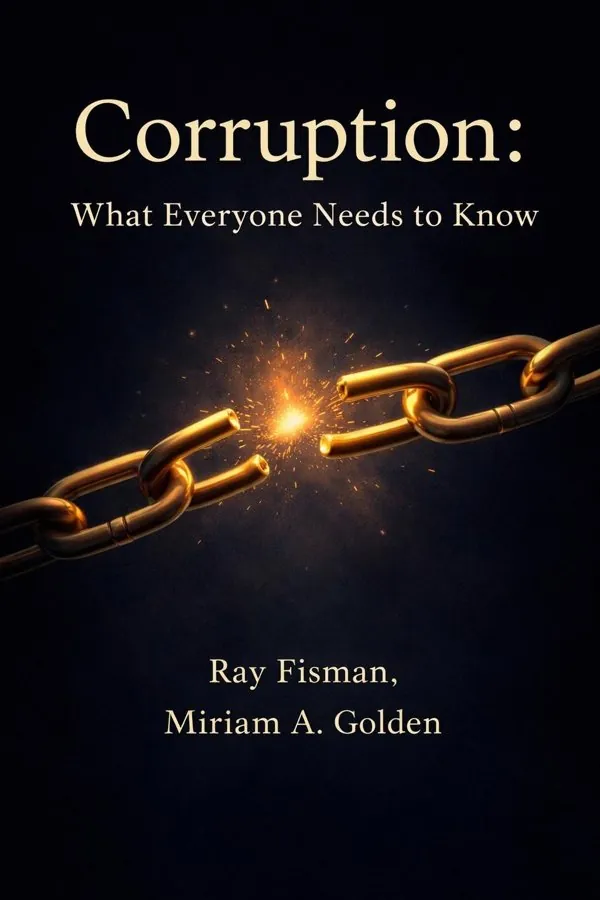
Corruption: What Everyone Needs to Know: Summary & Key Insights
by Ray Fisman, Miriam A. Golden
 10 min9 chaptersAudio available
Key Takeaways from Corruption: What Everyone Needs to Know
Corruption often begins not with evil intentions but with an opportunity structure.
Corruption is never just an economic transaction; it is also a political arrangement.
It is tempting to explain corruption by saying a society simply has a corrupt culture.
The damage caused by corruption extends far beyond stolen money.
Not all corruption works the same way, and the book carefully distinguishes between petty corruption and grand corruption.
What Is Corruption: What Everyone Needs to Know About?
Corruption: What Everyone Needs to Know by Ray Fisman, Miriam A. Golden is a politics book spanning 5 pages. Corruption is one of those problems everyone recognizes, yet few fully understand. We usually think of it as bribery, stolen public money, or backroom deals, but Ray Fisman and Miriam A. Golden show that corruption is far more complex. It is a system of incentives, institutions, social norms, and political power that shapes everyday life, from how roads are built and public services are delivered to how elections are fought and laws are enforced. In Corruption: What Everyone Needs to Know, the authors cut through slogans and moral outrage to explain what corruption actually is, why it persists, and why some countries manage it better than others. What makes this book especially valuable is the combination of accessible writing and serious scholarship. Fisman, an economist, and Golden, a political scientist, bring together research, comparative evidence, and vivid real-world examples to answer the questions citizens, students, and policymakers most often ask. The result is a clear, balanced guide to one of the most important political and economic challenges of our time. If you want to understand why corruption survives and what can realistically be done about it, this book is an excellent place to start.
This FizzRead summary covers all 9 key chapters of Corruption: What Everyone Needs to Know in approximately 10 minutes, distilling the most important ideas, arguments, and takeaways from Ray Fisman, Miriam A. Golden's work. Also available as an audio summary and Key Quotes Podcast.
Corruption: What Everyone Needs to Know
Corruption is one of those problems everyone recognizes, yet few fully understand. We usually think of it as bribery, stolen public money, or backroom deals, but Ray Fisman and Miriam A. Golden show that corruption is far more complex. It is a system of incentives, institutions, social norms, and political power that shapes everyday life, from how roads are built and public services are delivered to how elections are fought and laws are enforced. In Corruption: What Everyone Needs to Know, the authors cut through slogans and moral outrage to explain what corruption actually is, why it persists, and why some countries manage it better than others.
What makes this book especially valuable is the combination of accessible writing and serious scholarship. Fisman, an economist, and Golden, a political scientist, bring together research, comparative evidence, and vivid real-world examples to answer the questions citizens, students, and policymakers most often ask. The result is a clear, balanced guide to one of the most important political and economic challenges of our time. If you want to understand why corruption survives and what can realistically be done about it, this book is an excellent place to start.
Who Should Read Corruption: What Everyone Needs to Know?
This book is perfect for anyone interested in politics and looking to gain actionable insights in a short read. Whether you're a student, professional, or lifelong learner, the key ideas from Corruption: What Everyone Needs to Know by Ray Fisman, Miriam A. Golden will help you think differently.
- ✓Readers who enjoy politics and want practical takeaways
- ✓Professionals looking to apply new ideas to their work and life
- ✓Anyone who wants the core insights of Corruption: What Everyone Needs to Know in just 10 minutes
Want the full summary?
Get instant access to this book summary and 100K+ more with Fizz Moment.
Get Free SummaryAvailable on App Store • Free to download
Key Chapters
Corruption often begins not with evil intentions but with an opportunity structure. One of the book’s central insights is that economists view corruption as a problem of incentives, discretion, and weak monitoring. When officials control access to something valuable such as permits, contracts, public jobs, or legal exemptions, they may be tempted to exchange that access for private gain. Corruption thrives when the benefits are high, the risks of detection are low, and the penalties are weak or inconsistently enforced.
This framework helps explain why corruption is not randomly distributed. A customs officer who can delay shipments, a licensing official who can block a business, or a procurement manager who can steer contracts all occupy positions where monopoly power and opacity create fertile ground for rent-seeking. If citizens must navigate complicated rules and costly delays, paying a bribe may seem like the fastest solution. In that sense, corruption is often embedded in administrative design rather than simply personal morality.
The authors also show that reducing corruption is not only about finding better people. It is about changing the system so corrupt choices become harder and honest behavior becomes easier. Simplifying procedures, rotating staff, digitizing transactions, requiring public documentation, and increasing the probability of detection can all shift incentives in productive ways.
A practical example is online licensing systems. When applications are processed electronically with clear timelines and visible status updates, officials have fewer chances to demand unofficial payments. Citizens also gain evidence if something goes wrong.
Actionable takeaway: When evaluating corruption risks, ask where discretion, monopoly control, and secrecy intersect. Those are the pressure points where reform can have the biggest impact.
Corruption is never just an economic transaction; it is also a political arrangement. The book emphasizes that politics determines who benefits from corruption, who bears the costs, and whether abusive behavior is punished or protected. In democracies, elections can discipline corrupt leaders, but only if voters have reliable information and are willing to act on it. In authoritarian systems, corruption may be tolerated as a tool for maintaining loyalty, rewarding insiders, or holding coalitions together.
This political lens matters because corruption often survives not in spite of politics but because of it. Politicians may use patronage to distribute jobs and favors, not merely for personal enrichment but to build support networks. Voters, especially in places where public institutions are weak, may tolerate this if they believe clientelistic exchanges are the only way to secure services. In such settings, corruption becomes entangled with representation itself.
The authors also challenge the assumption that more elections automatically mean less corruption. Competitive politics can reduce abuse when watchdog institutions, independent media, and functioning courts expose wrongdoing. But competition can also increase pressure to raise campaign funds, leading candidates to rely on donors, contractors, or illicit financing. In this way, democratic systems can both check and generate corruption.
A clear example is public procurement around election cycles. Incumbents may channel contracts to allies, use public resources to strengthen political machines, or direct spending toward electorally valuable regions. These practices may not always look like classic bribery, but they distort fair governance.
Actionable takeaway: To understand corruption in any country, look beyond individual scandals and examine the political incentives around elections, party financing, oversight, and accountability.
It is tempting to explain corruption by saying a society simply has a corrupt culture. Fisman and Golden urge readers to be much more careful. Social norms do shape how people interpret bribery, favoritism, nepotism, and gift-giving. In some contexts, personal loyalty and family obligation may blur the line between moral duty and public abuse. Yet the authors resist the lazy conclusion that corruption is an unchangeable cultural trait. Instead, they argue that what looks like culture is often a response to institutions that have failed.
When citizens cannot trust bureaucracies, they rely on personal networks. When legal systems are slow or unreliable, relationships become a substitute for rules. When public employment is scarce and politically controlled, helping relatives may be seen as survival rather than corruption. These behaviors can become normalized over time, but their roots often lie in weak state capacity, inequality, and insecurity.
This distinction is crucial because cultural explanations can become excuses for inaction. If corruption is treated as part of national character, reform appears hopeless. But if norms adapt to incentives and institutions, then change becomes possible. The book points to evidence that citizens’ expectations can shift when governments improve service delivery, punish wrongdoing consistently, and reduce the need for middlemen and personal brokers.
Consider hospital systems where patients once expected to pay small informal fees to receive basic care. If wages are regularized, complaint systems become credible, and payments are standardized and transparent, informal demands can decline and social expectations can change with them.
Actionable takeaway: Be skeptical of claims that corruption is “just cultural.” Ask instead what institutional failures make corrupt behavior feel normal, necessary, or hard to avoid.
The damage caused by corruption extends far beyond stolen money. One of the book’s strongest contributions is showing how corruption distorts development itself. It weakens public trust, lowers the quality of infrastructure, diverts resources away from essential services, and discourages productive investment. A country can spend heavily on roads, schools, or hospitals, yet still end up with poor outcomes if procurement is rigged, contracts are inflated, and oversight is compromised.
Corruption can also misallocate talent. When success depends less on competence than on connections, capable people may avoid public service or redirect their energy toward cultivating influence rather than creating value. Businesses may invest in lobbying and bribery instead of innovation. Citizens may come to believe that rules are meaningless unless one has the right contacts. Over time, this erodes social trust and weakens the legitimacy of the state.
The authors note that corruption’s effects are not always immediately visible. A bridge still gets built, a permit still gets issued, a subsidy still gets distributed. But the hidden costs are substantial: inferior materials, inflated prices, unequal access, and a public increasingly convinced that the system is rigged. In poorer countries, these losses can be devastating because they directly affect access to medicine, education, electricity, and justice.
For example, if contractors win bids through bribery, they may recoup those costs by using cheaper materials or abandoning maintenance obligations. The result is not just financial waste but physical danger and public disillusionment.
Actionable takeaway: When assessing corruption, look not only for money stolen but for quality lost, trust damaged, and opportunities foregone across the whole society.
Not all corruption works the same way, and the book carefully distinguishes between petty corruption and grand corruption. Petty corruption involves small-scale abuses in everyday interactions, such as paying a clerk to speed up paperwork or bribing a traffic officer to avoid a fine. Grand corruption occurs at the top of political and economic systems, where leaders, senior officials, and major business actors manipulate laws, contracts, or state assets for enormous private gain.
This distinction matters because the causes, visibility, and solutions are different. Petty corruption often reflects low salaries, cumbersome procedures, and weak frontline supervision. It is highly visible to ordinary citizens and can make daily life humiliating and expensive. Grand corruption, by contrast, often hides behind legal complexity, shell companies, campaign finance, offshore accounts, and elite networks. It may be less visible day to day, yet its consequences are larger because it shapes policies, budgets, and institutions themselves.
The authors suggest that focusing only on petty bribery can be misleading. Governments sometimes crack down on small-scale abuses because they are easy to publicize, while leaving untouched the powerful interests that capture state resources on a much larger scale. A clean-looking administrative interface does not necessarily mean the system is fair if contracts, regulations, and tax privileges are quietly being traded among elites.
A useful example is traffic bribery versus procurement fraud. The first frustrates citizens and weakens respect for law. The second can siphon millions from public budgets and lock in substandard infrastructure for decades.
Actionable takeaway: When discussing anti-corruption reforms, ask what type of corruption is being targeted. Effective solutions must distinguish between everyday extortion and high-level institutional capture.
One of the book’s most important cautions is that corruption is inherently hard to measure. Because corrupt acts are hidden, illegal, and often mutually beneficial to the participants, there is rarely a complete record. This creates a major challenge for researchers and policymakers: how can you fight what you cannot fully observe? Fisman and Golden explain that most common corruption rankings rely on perceptions, expert assessments, or indirect indicators rather than direct counts of wrongdoing.
These measures are useful, but they have limits. Perception indexes may reflect media attention, public mood, or stereotypes as much as actual conduct. A country with a free press may appear more corrupt because scandals are reported openly, while a repressive state may seem cleaner simply because fewer facts come to light. Similarly, legal statistics such as prosecutions can indicate either more corruption or stronger enforcement.
The authors therefore encourage a more sophisticated approach. Instead of relying on one headline index, researchers increasingly use audits, procurement data, field experiments, missing expenditure analysis, and sector-specific indicators. For example, unusually narrow bidding patterns, repeated contract awards to connected firms, or inflated prices compared with market norms can signal hidden corruption in procurement. In elections, suspicious turnout spikes or strange funding flows may reveal manipulation.
Good measurement matters because bad measurement produces bad policy. If governments target what is easiest to count rather than what is most harmful, reform can become performative rather than effective.
Actionable takeaway: Treat corruption statistics as tools, not truths. Use multiple sources, compare indicators, and always ask what exactly is being measured and what might remain invisible.
Corruption is often described as a problem of government, but the book makes clear that private actors are deeply involved. Bribes require payers as well as takers. Companies may seek special treatment, favorable regulations, tax loopholes, monopolies, or inside access to public contracts. In many cases, corruption is a partnership between public authority and private profit, with both sides benefiting while the public loses.
This insight broadens the conversation. It is not enough to lecture officials about ethics if business models reward political favoritism. Firms operating in heavily regulated sectors such as construction, natural resources, defense, or telecommunications may find that influencing decision-makers is more profitable than competing on quality and price. The result is a distorted market where connected firms thrive and honest competitors are pushed aside.
The authors also highlight the international dimension. Corruption often crosses borders through multinational contracts, offshore finance, anonymous shell companies, and foreign bank accounts. Wealth stolen in one country may be hidden in another. This means anti-corruption policy must include financial transparency, corporate disclosure, and cooperation across jurisdictions, not just domestic criminal law.
A familiar example is a construction company that bribes local officials to win a public tender, then overcharges for low-quality work while disguising the payments through subcontractors or foreign entities. The corruption is public and private at once.
Actionable takeaway: When examining corruption, follow both the public decision-maker and the private beneficiary. Real reform requires cleaner incentives in markets, procurement, finance, and corporate governance.
Digital tools are often promoted as anti-corruption miracles, but the book offers a more balanced view. Technology can reduce opportunities for bribery by limiting face-to-face interactions, creating traceable records, and making information publicly accessible. Online procurement portals, e-governance platforms, biometric payment systems, and open budget databases can all make corruption riskier and harder to hide.
Yet technology is not a substitute for political will or institutional capacity. A corrupt system can adapt. Digital portals can be manipulated, data can be withheld, and opaque algorithms can create new forms of hidden favoritism. If watchdog agencies are weak, journalists are intimidated, or courts are compromised, transparency alone may not produce accountability. Information must be usable, trusted, and linked to enforcement.
The authors encourage readers to think of technology as an amplifier. In a reasonably functioning system, it can improve monitoring, expand citizen access, and reduce discretion. In a captured system, it may simply digitize old abuses or create a modern image of reform without altering power relations. The effectiveness of technology depends on implementation details, incentives, and the broader institutional environment.
For instance, publishing procurement data online is valuable only if contracts are searchable, comparable, and complete, and if civil society groups or auditors can analyze them. A PDF dump on an obscure website may satisfy a formal requirement while changing nothing in practice.
Actionable takeaway: Support digital anti-corruption reforms that are paired with independent oversight, accessible data, complaint mechanisms, and real consequences for misconduct.
The book rejects the fantasy of a single anti-corruption cure. Corruption is too varied, too adaptive, and too embedded in political systems for one law, one agency, or one campaign to solve it. Effective reform is usually incremental, targeted, and context-specific. It works best when it reduces discretion, strengthens oversight, aligns incentives, and builds coalitions that benefit from cleaner governance.
This means anti-corruption efforts must be realistic about trade-offs. Harsh penalties may look impressive but accomplish little if detection remains rare. Public shaming campaigns can raise awareness yet also deepen cynicism if elites continue acting with impunity. Independent commissions can help, but only if they are protected from political interference and connected to functioning courts, auditors, and prosecutors. In some settings, improving basic administrative competence may matter more than launching grand moral crusades.
The authors also stress that reforms must account for power. Those who benefit from corruption often have resources to block change, weaken enforcement, or redirect reform toward harmless targets. That is why successful anti-corruption strategies often rely on alliances among reformist politicians, civil society, journalists, technocrats, and sometimes businesses that lose under a rigged system.
A practical example is procurement reform that combines standardized contracts, open bidding, external audits, citizen monitoring, and blacklisting for repeat offenders. None of these tools alone is sufficient, but together they can gradually reshape expectations and behavior.
Actionable takeaway: Think less in terms of “ending corruption” and more in terms of designing reforms that shrink the most harmful opportunities, protect accountability, and can survive political resistance.
All Chapters in Corruption: What Everyone Needs to Know
About the Authors
Ray Fisman is an economist and professor whose work focuses on corruption, political economy, behavioral economics, and social networks. He has written widely for both academic and general audiences and is known for making complex economic ideas accessible to readers beyond the university. Miriam A. Golden is a political scientist recognized for her research on corruption, governance, elections, and comparative politics. Her work examines how political institutions shape accountability and public integrity across different countries. Together, Fisman and Golden bring a rare interdisciplinary perspective to the study of corruption. By combining economics and political science, they help readers see corruption not as a simple moral failure but as a structural problem rooted in incentives, institutions, and power.
Get This Summary in Your Preferred Format
Read or listen to the Corruption: What Everyone Needs to Know summary by Ray Fisman, Miriam A. Golden anytime, anywhere. FizzRead offers multiple formats so you can learn on your terms — all free.
Available formats: App · Audio · PDF · EPUB — All included free with FizzRead
Download Corruption: What Everyone Needs to Know PDF and EPUB Summary
Key Quotes from Corruption: What Everyone Needs to Know
“Corruption often begins not with evil intentions but with an opportunity structure.”
“Corruption is never just an economic transaction; it is also a political arrangement.”
“It is tempting to explain corruption by saying a society simply has a corrupt culture.”
“The damage caused by corruption extends far beyond stolen money.”
“Not all corruption works the same way, and the book carefully distinguishes between petty corruption and grand corruption.”
Frequently Asked Questions about Corruption: What Everyone Needs to Know
Corruption: What Everyone Needs to Know by Ray Fisman, Miriam A. Golden is a politics book that explores key ideas across 9 chapters. Corruption is one of those problems everyone recognizes, yet few fully understand. We usually think of it as bribery, stolen public money, or backroom deals, but Ray Fisman and Miriam A. Golden show that corruption is far more complex. It is a system of incentives, institutions, social norms, and political power that shapes everyday life, from how roads are built and public services are delivered to how elections are fought and laws are enforced. In Corruption: What Everyone Needs to Know, the authors cut through slogans and moral outrage to explain what corruption actually is, why it persists, and why some countries manage it better than others. What makes this book especially valuable is the combination of accessible writing and serious scholarship. Fisman, an economist, and Golden, a political scientist, bring together research, comparative evidence, and vivid real-world examples to answer the questions citizens, students, and policymakers most often ask. The result is a clear, balanced guide to one of the most important political and economic challenges of our time. If you want to understand why corruption survives and what can realistically be done about it, this book is an excellent place to start.
You Might Also Like
Antifa: The Anti-Fascist Handbook
Mark Bray
10 min
Attack from Within: How Disinformation Is Sabotaging America
Barbara McQuade
10 min
Coercion, Capital, and European States, AD 990–1992
Charles Tilly
10 min
Digital Democracy: Concepts, Methodologies, Tools, and Applications
Various Authors
10 min
Fascism
Stanley G. Payne
10 min
Fire And Fury: Inside The Trump White House
Michael Wolff
10 minBrowse by Category
Ready to read Corruption: What Everyone Needs to Know?
Get the full summary and 100K+ more books with Fizz Moment.