
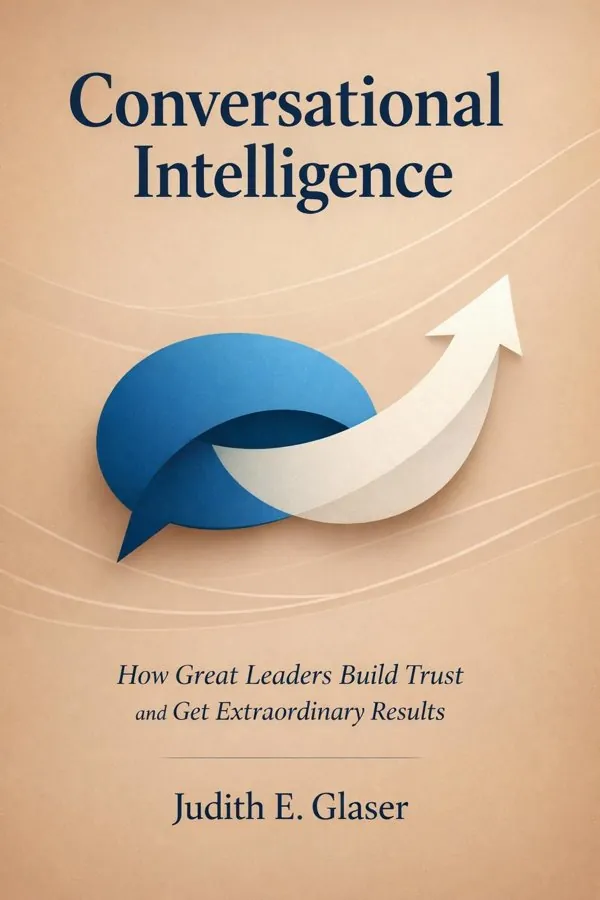
Conversational Intelligence: How Great Leaders Build Trust and Get Extraordinary Results: Summary & Key Insights
 10 min5 chaptersAudio available
What Is Conversational Intelligence: How Great Leaders Build Trust and Get Extraordinary Results About?
Conversational Intelligence: How Great Leaders Build Trust and Get Extraordinary Results by Judith E. Glaser is a leadership book spanning 5 pages. Conversational Intelligence explores how conversations shape relationships, trust, and organizational success. Judith E. Glaser integrates neuroscience and leadership research to show how leaders can use communication to foster collaboration, innovation, and high performance. The book provides practical frameworks for transforming conversations from fear-based to trust-based, enabling teams to achieve extraordinary results.
This FizzRead summary covers all 5 key chapters of Conversational Intelligence: How Great Leaders Build Trust and Get Extraordinary Results in approximately 10 minutes, distilling the most important ideas, arguments, and takeaways from Judith E. Glaser's work. Also available as an audio summary and Key Quotes Podcast.
Conversational Intelligence: How Great Leaders Build Trust and Get Extraordinary Results
Conversational Intelligence explores how conversations shape relationships, trust, and organizational success. Judith E. Glaser integrates neuroscience and leadership research to show how leaders can use communication to foster collaboration, innovation, and high performance. The book provides practical frameworks for transforming conversations from fear-based to trust-based, enabling teams to achieve extraordinary results.
Who Should Read Conversational Intelligence: How Great Leaders Build Trust and Get Extraordinary Results?
This book is perfect for anyone interested in leadership and looking to gain actionable insights in a short read. Whether you're a student, professional, or lifelong learner, the key ideas from Conversational Intelligence: How Great Leaders Build Trust and Get Extraordinary Results by Judith E. Glaser will help you think differently.
- ✓Readers who enjoy leadership and want practical takeaways
- ✓Professionals looking to apply new ideas to their work and life
- ✓Anyone who wants the core insights of Conversational Intelligence: How Great Leaders Build Trust and Get Extraordinary Results in just 10 minutes
Want the full summary?
Get instant access to this book summary and 100K+ more with Fizz Moment.
Get Free SummaryAvailable on App Store • Free to download
Key Chapters
Our conversations are haunted and illuminated by chemistry. Every word we utter triggers neurochemical reactions in the brain. When you speak with openness and appreciation, oxytocin—the bonding hormone—is released, creating a sense of safety and rapport. When your tone signals accusation or threat, cortisol floods the neural pathways, priming the body for defense and closing the prefrontal cortex where reasoning and creativity reside.
Understanding this interplay is revolutionary for leaders. It means trust and fear are not just emotional states—they are physical realities that affect cognition. A fearful conversation literally reduces the brain’s ability to access higher-order thinking and empathy. Conversely, when trust is present, people align around shared vision and feel secure enough to explore new ideas.
This insight led me to advocate for a leadership approach grounded in neuroscience rather than hierarchy. A leader’s role is not to command but to create conditions where trust can thrive—where oxytocin flows freely, and the brain’s executive functions are engaged. That’s why the most powerful conversations begin with curiosity and end with connection. When we listen without judgment, we activate brain circuits associated with bonding and cooperation; when we rush to correct or control, those circuits shut down.
Conversations that succeed neurologically are those that move us out of protection mode into growth mode. As leaders, we must learn to monitor which mode we are in: are we operating through the amygdala’s alarm system, or through the prefrontal cortex’s expansive vision? Once we become attuned to this invisible chemistry, our leadership transforms. We begin to speak not to win, but to connect. We lead not through fear, but through trust.
Through decades of organizational research, I identified three progressive levels of conversation. At Level I, we are transactional—we exchange information. The focus is on telling, asking, and getting things done. Many organizations operate almost entirely here, where people communicate efficiently but not deeply.
Level II is positional—this is where we advocate for our point of view, debate, persuade, and defend. It can generate insights but also conflict, as parties become locked into winning arguments instead of exploring shared interests. Though it feels dynamic, it is still governed by competition and control.
The breakthrough happens at Level III, the transformational level. Here conversation becomes co-creation. We open our minds and hearts to discover new realities together. This level engages our prefrontal cortex, releasing neurochemicals that promote bonding and creative insight. It’s the space of synergy—where innovation flourishes because people are not protecting their ideas but expanding them collaboratively.
Leaders capable of moving seamlessly between these levels create extraordinary performance. They understand that every conversation has a purpose, and that transforming the purpose—from control to co-creation—changes the outcome. Level III conversations require vulnerability, deep listening, and trust. It’s when we say, “Let’s explore what we don’t know together,” and mean it. The beauty of this approach is that it turns dialogue into discovery and makes people partners in imagination.
Mastering these levels is not a theory—it is a practice. Each time we shift from telling to asking, from judging to exploring, we move toward transformation. This is Conversational Intelligence in action.
+ 3 more chapters — available in the FizzRead app
All Chapters in Conversational Intelligence: How Great Leaders Build Trust and Get Extraordinary Results
About the Author
Judith E. Glaser (1946–2018) was an American organizational anthropologist, executive coach, and founder of Benchmark Communications, Inc. She was recognized as a pioneer in the field of conversational intelligence and worked with Fortune 500 companies to improve leadership and corporate culture through communication.
Get This Summary in Your Preferred Format
Read or listen to the Conversational Intelligence: How Great Leaders Build Trust and Get Extraordinary Results summary by Judith E. Glaser anytime, anywhere. FizzRead offers multiple formats so you can learn on your terms — all free.
Available formats: App · Audio · PDF · EPUB — All included free with FizzRead
Download Conversational Intelligence: How Great Leaders Build Trust and Get Extraordinary Results PDF and EPUB Summary
Key Quotes from Conversational Intelligence: How Great Leaders Build Trust and Get Extraordinary Results
“Our conversations are haunted and illuminated by chemistry.”
“Through decades of organizational research, I identified three progressive levels of conversation.”
Frequently Asked Questions about Conversational Intelligence: How Great Leaders Build Trust and Get Extraordinary Results
Conversational Intelligence: How Great Leaders Build Trust and Get Extraordinary Results by Judith E. Glaser is a leadership book that explores key ideas across 5 chapters. Conversational Intelligence explores how conversations shape relationships, trust, and organizational success. Judith E. Glaser integrates neuroscience and leadership research to show how leaders can use communication to foster collaboration, innovation, and high performance. The book provides practical frameworks for transforming conversations from fear-based to trust-based, enabling teams to achieve extraordinary results.
You Might Also Like

Extreme Ownership
Jocko Willink
10 min
Dare to Lead
Brene Brown
10 min
Leaders Eat Last
Simon Sinek
10 min
The 21 Irrefutable Laws of Leadership
John Maxwell
10 min
Start With Why
Simon Sinek
10 min
How to Lead When You're Not in Charge
Clay Scroggins
10 minBrowse by Category
Ready to read Conversational Intelligence: How Great Leaders Build Trust and Get Extraordinary Results?
Get the full summary and 100K+ more books with Fizz Moment.