
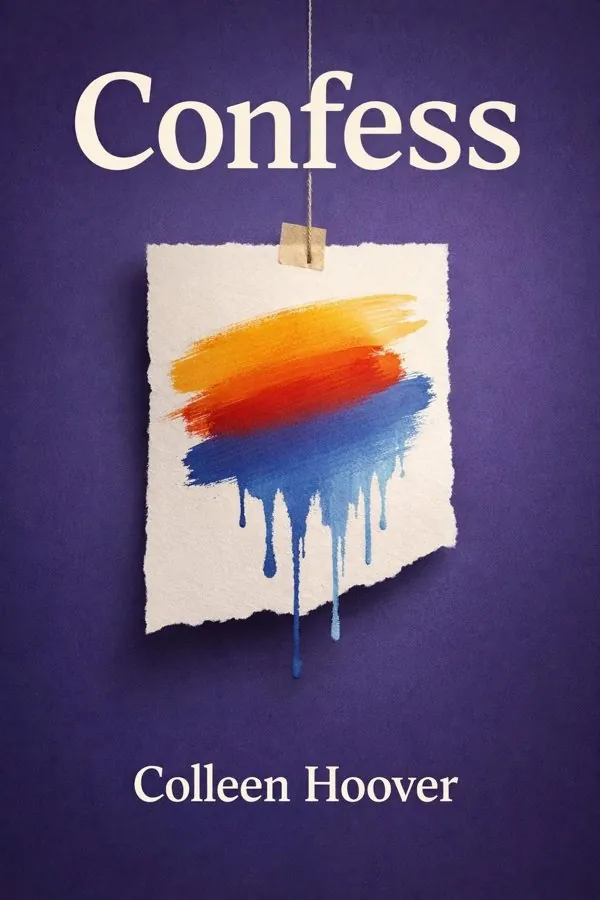
Confess: Summary & Key Insights
 10 min9 chaptersAudio available
Key Takeaways from Confess
A single loss can become the invisible architect of an entire life.
Life-changing turns rarely arrive looking important at first.
People often reveal their deepest truths before they are ready to reveal their names.
Some emotions become clearer only after they are translated.
Attraction can feel like certainty, but relationships are tested by what remains hidden.
What Is Confess About?
Confess by Colleen Hoover is a romantic_relationships book spanning 4 pages. Confess by Colleen Hoover is a contemporary romance that turns secrecy into both a wound and a bridge. The novel follows Auburn Reed, a young woman trying to keep her life under control after devastating loss, and Owen Gentry, an artist whose work is inspired by anonymous confessions left by strangers. What begins as a chance meeting in a Dallas art studio becomes an emotionally charged relationship shaped by grief, longing, custody battles, buried truths, and the terrifying risk of trusting another person. Hoover uses this premise to explore a question that feels deeply human: can love survive when honesty arrives late? More than a romance, Confess is a story about how people protect themselves with silence, and how those silences can quietly shape entire lives. It matters because it captures the messiness of adult love with unusual emotional intensity, showing that healing rarely happens in a straight line. Colleen Hoover, known for emotionally immersive fiction and bestselling relationship-driven novels, brings her signature blend of heartbreak, tenderness, and dramatic revelation to a story that asks readers to look at what we hide, why we hide it, and what it costs to finally tell the truth.
This FizzRead summary covers all 9 key chapters of Confess in approximately 10 minutes, distilling the most important ideas, arguments, and takeaways from Colleen Hoover's work. Also available as an audio summary and Key Quotes Podcast.
Confess
Confess by Colleen Hoover is a contemporary romance that turns secrecy into both a wound and a bridge. The novel follows Auburn Reed, a young woman trying to keep her life under control after devastating loss, and Owen Gentry, an artist whose work is inspired by anonymous confessions left by strangers. What begins as a chance meeting in a Dallas art studio becomes an emotionally charged relationship shaped by grief, longing, custody battles, buried truths, and the terrifying risk of trusting another person. Hoover uses this premise to explore a question that feels deeply human: can love survive when honesty arrives late? More than a romance, Confess is a story about how people protect themselves with silence, and how those silences can quietly shape entire lives. It matters because it captures the messiness of adult love with unusual emotional intensity, showing that healing rarely happens in a straight line. Colleen Hoover, known for emotionally immersive fiction and bestselling relationship-driven novels, brings her signature blend of heartbreak, tenderness, and dramatic revelation to a story that asks readers to look at what we hide, why we hide it, and what it costs to finally tell the truth.
Who Should Read Confess?
This book is perfect for anyone interested in romantic_relationships and looking to gain actionable insights in a short read. Whether you're a student, professional, or lifelong learner, the key ideas from Confess by Colleen Hoover will help you think differently.
- ✓Readers who enjoy romantic_relationships and want practical takeaways
- ✓Professionals looking to apply new ideas to their work and life
- ✓Anyone who wants the core insights of Confess in just 10 minutes
Want the full summary?
Get instant access to this book summary and 100K+ more with Fizz Moment.
Get Free SummaryAvailable on App Store • Free to download
Key Chapters
A single loss can become the invisible architect of an entire life. In Confess, Auburn Reed’s story begins long before she meets Owen, with the death of Adam, her first love, when she is still very young. That grief does not remain in the past as a sad memory; it becomes a force that shapes how she thinks about loyalty, guilt, responsibility, and love. Auburn learns early that life can collapse without warning, so she responds by trying to control everything she can. She becomes disciplined, cautious, and almost severe with herself. Her plans are not just ambitions; they are emotional survival strategies.
This matters because Hoover shows that unresolved grief often disguises itself as practicality. Auburn is not merely organized or ambitious. She is trying to build a life so structured that pain cannot break in again. Many readers will recognize this pattern in themselves or others: after betrayal, illness, or heartbreak, people often become hyper-responsible, emotionally reserved, or obsessed with stability. On the surface, these habits look admirable. Underneath, they can signal fear.
Auburn’s grief also explains why her later choices feel so conflicted. She is not only choosing between two men, or between truth and deception. She is choosing between a life governed by loss and a life open to uncertainty. In real life, this can look like someone refusing a promising relationship because it feels risky, or staying in a harmful arrangement because it seems predictable.
The practical lesson is simple but difficult: when your present choices feel unusually rigid, ask what old pain may be directing them. Actionable takeaway: identify one decision in your life that feels driven by fear of repeating past loss, and ask what a healthier, more hopeful version of that choice would look like.
Life-changing turns rarely arrive looking important at first. Auburn’s meeting with Owen happens when she walks into his art studio looking for work, not romance or revelation. She is trying to solve a practical problem, earn money, and maintain control over her future. Yet this ordinary step becomes the doorway to the most transformative relationship in the novel. Hoover uses this encounter to remind us that fresh starts do not always announce themselves dramatically. Sometimes they begin as errands, detours, or reluctant decisions.
This idea gives the novel much of its emotional realism. Auburn is not a heroine waiting for destiny. She is exhausted, burdened, and focused on immediate needs. That makes the connection with Owen feel believable. We often imagine personal renewal arriving only after we have healed, planned, or become fully ready. Confess argues the opposite: healing often begins while we are still messy, grieving, or uncertain.
The studio itself symbolizes possibility. It is unlike Auburn’s tightly managed life. It is creative, unpredictable, and open to emotional mess. Stepping into that space means stepping into a different way of being. In everyday life, people often experience similar moments when they enter environments that challenge their usual identities: a new workplace, a class, a volunteer role, or even a conversation with a stranger. These settings can reveal capacities we had no room to discover before.
What makes accidental beginnings powerful is not luck alone, but willingness. Auburn could have dismissed the job, ignored Owen, or kept herself emotionally closed. Instead, however cautiously, she engages. That small openness changes everything.
Actionable takeaway: treat one ordinary opportunity this week as if it might matter more than it seems. Say yes to a conversation, application, visit, or invitation you would normally dismiss, and notice what new possibility it creates.
People often reveal their deepest truths before they are ready to reveal their names. Owen’s art is built around anonymous confessions submitted by strangers, and this device becomes one of the novel’s most original emotional engines. The confessions are raw, messy, painful, shameful, and deeply human. They expose desires, regrets, betrayals, and grief that people cannot say aloud in ordinary life. By turning them into paintings, Owen transforms secrecy into shared experience.
For Auburn, working in the studio means entering a world where hidden emotion is not avoided but displayed. This changes her. The confessions show her that nearly everyone is carrying something unspoken. Shame loses some of its isolating power when seen as universal rather than personal. That recognition also deepens her connection with Owen, because she sees that he is drawn not to polished appearances but to emotional truth.
There is a practical insight here about relationships and vulnerability. Many people believe trust must come first and honesty later. Confess suggests that, in some cases, vulnerability is what creates the conditions for trust. This does not mean oversharing with unsafe people. It means recognizing that emotional closeness grows when someone risks being real. In everyday life, this could look like admitting fear in a relationship instead of pretending confidence, acknowledging burnout at work instead of masking competence, or telling a friend you are struggling rather than disappearing.
The confessions also highlight the difference between privacy and secrecy. Privacy protects dignity. Secrecy often protects pain, shame, or manipulation. The novel keeps asking which kind of silence a character is practicing.
Actionable takeaway: share one honest but manageable truth with someone you trust this week, something you usually hide behind politeness or control. Notice how naming it changes the relationship and your sense of isolation.
Some emotions become clearer only after they are translated. In Confess, Owen’s paintings are more than decorative background; they are a language for experiences that people cannot articulate directly. He takes anonymous confessions and creates visual interpretations of them, giving shape to feelings that would otherwise remain private and formless. This makes art an active force in the novel rather than a symbolic accessory. It helps strangers feel seen, and it gives Auburn another way to understand Owen and herself.
Hoover uses this artistic process to show that expression is not limited to literal explanation. Many people struggle to describe grief, guilt, desire, or regret in tidy sentences. They may need metaphor, music, movement, images, or storytelling to process what has happened to them. Owen’s work validates forms of truth-telling that do not depend on perfect clarity. A painting can hold contradiction. It can be beautiful and painful at once, just like love.
This idea has strong real-life application. Emotional health does not always begin with direct verbal insight. Journaling, drawing, playlists, photography, prayer, and creative hobbies can all help people externalize what feels overwhelming internally. Someone grieving a breakup may understand their emotions better through a song than through analysis. A parent under stress may process burnout through a sketchbook or a walk with voice notes. The important step is expression, not artistic mastery.
Art in Confess also creates connection. Auburn sees how Owen listens to the inner lives of strangers, and that deepens her trust in his sensitivity. Creativity becomes evidence of empathy.
Actionable takeaway: choose one creative medium this week, however simple, and use it to express a feeling you have not been able to explain. Do not aim for quality; aim for honesty and see what becomes clearer.
Attraction can feel like certainty, but relationships are tested by what remains hidden. Auburn and Owen share immediate emotional and physical chemistry, and Hoover writes that connection with intense tenderness. Yet the novel refuses to romanticize chemistry as enough. Their bond grows in meaningful ways, but it is undermined by secrets that make trust unstable. Owen is not deceptive because he feels nothing; he hides truth precisely because he feels too much and fears the consequences of disclosure.
This creates one of the novel’s central tensions: can a relationship be genuine if crucial information is missing? Confess does not offer an easy answer. It shows that people can love each other sincerely and still cause profound damage through omission. Good intentions do not cancel the effects of secrecy. This is an important distinction, especially in romance narratives where passion is sometimes treated as moral proof.
In real life, many relationships fail not because affection is absent, but because honesty is delayed until trust has already been compromised. A person may hide financial trouble, family conflict, unresolved attachment, or legal complications out of fear. They may believe they are protecting the other person or waiting for the right moment. Usually, the delay increases the eventual harm. Emotional closeness built on partial truth becomes fragile.
At the same time, Hoover allows empathy. She shows how shame, fear, and complicated histories can make honesty difficult. The point is not that love should be coldly rational, but that love becomes sustainable only when it can survive reality.
Actionable takeaway: if there is an important truth you are withholding in a close relationship, ask yourself whether silence is genuinely protective or simply postponing discomfort. Choose one respectful, timely conversation that moves the relationship toward fuller honesty.
What looks like responsibility can sometimes be captivity. Auburn spends much of Confess trying to hold her life together through discipline and self-denial. She makes practical choices, suppresses desire, and tolerates painful circumstances because she believes control is the only way to protect what matters most. Yet Hoover reveals the dark side of this coping strategy: control can narrow a person’s life until survival replaces living.
This is especially evident in Auburn’s external struggles, where power, dependency, and legal pressure shape her choices. She is not free to act only on emotion. She must think strategically. That complexity makes the novel stronger, because it shows that many people remain in unhealthy dynamics not out of weakness, but because real stakes are involved. Financial need, family pressure, custody concerns, housing insecurity, and emotional blackmail can all create conditions where “just leave” is not simple advice.
The novel’s deeper insight is that oppressive systems often work best when they convince people they have no alternatives. Auburn internalizes that logic. She tells herself what she must do, what she cannot risk, and what she has to sacrifice. Readers can recognize similar patterns in workplaces, families, or relationships where fear masquerades as necessity. Someone may stay silent to keep peace, overwork to feel secure, or remain attached to a manipulative person because the cost of freedom seems too high.
Confess does not dismiss the reality of these pressures. Instead, it shows that reclaiming agency begins internally, with the refusal to let fear define the entire future. Action comes later, but imagination comes first.
Actionable takeaway: write down one area of your life where you feel trapped, then list three options you usually dismiss immediately. Even if none are possible today, naming alternatives begins to weaken the story that you have none.
Sometimes the deepest proof of love is not pursuit but restraint. One of the most moving aspects of Confess is how it explores timing as a moral force within relationships. Auburn and Owen are not simply two people who fall in love and must overcome obstacles. They are two people whose feelings develop under conditions that make acting on those feelings complicated and sometimes costly. Their choices are measured not only by desire, but by what each is willing to risk, protect, or postpone.
Hoover uses this to challenge a common romantic fantasy: that true love should overcome everything immediately. In reality, love often collides with circumstance. A person may need to heal first, escape a controlling situation, tell a painful truth, or protect a child before a relationship can become healthy. Timing is not always evidence that love is wrong; sometimes it is evidence that love alone is not enough yet.
This theme matters because readers often judge relationships too quickly, both in fiction and in life. We ask, if they care, why don’t they act? Confess answers by showing that loving someone can include waiting, sacrificing personal happiness, or making choices that look cold from the outside. Owen’s actions, especially once his motives are better understood, show that care can be expressed through painful restraint as well as closeness.
In everyday life, mature love may require similar patience. It may mean refusing to force commitment from someone in crisis, stepping back until trust is restored, or choosing long-term well-being over short-term emotional relief. Sacrifice is not automatically noble, but in healthy relationships it is oriented toward protection rather than control.
Actionable takeaway: in one important relationship, ask whether your current approach is driven by urgency or wisdom. Choose the next step that supports long-term trust, even if it feels slower than your emotions prefer.
Revelation is often romanticized, but real truth-telling is disruptive. In Confess, when hidden histories and motives come to light, they do not create instant relief. They create pain, confusion, anger, and re-evaluation. Hoover is honest about this. Secrets may be burdensome, but uncovering them can be equally destabilizing because truth forces people to reinterpret everything that came before. Auburn does not just learn facts; she has to revisit memories, judgments, and emotional investments through a new lens.
This reflects a difficult psychological reality. When an important truth emerges in a relationship, the issue is rarely the information alone. The deeper wound is often the realization that one has been living inside an incomplete story. That can produce grief even when the truth ultimately leads to something better. People may feel foolish, betrayed, or unsure of their own instincts. Healing therefore requires more than disclosure. It requires repair.
The novel handles this well by showing that truth has consequences. Saying “I had reasons” does not erase the impact of concealment. Accountability matters. So does the willingness to give the hurt person space to respond honestly. In practical terms, this applies widely: when confessing a mistake, revealing debt, disclosing a family issue, or admitting emotional conflict, people often hope honesty will immediately restore closeness. More often, honesty begins the real work rather than ending it.
Yet Confess remains hopeful. Truth is painful, but it is also the only foundation on which genuine reconciliation can stand. Illusion may preserve calm; it cannot build intimacy.
Actionable takeaway: when you need to tell a hard truth, prepare not just the confession but the repair. Be ready to listen, answer questions, accept emotional consequences, and demonstrate change rather than expecting instant forgiveness.
Healing does not require pretending the damage never happened. In the latter emotional movement of Confess, Hoover explores reconciliation in a way that is tender but not simplistic. Characters do not move forward because pain was minor. They move forward because they confront what happened, understand it more fully, and decide what kind of future they still want. Forgiveness here is not blind absolution. It is a deliberate act that emerges from truth, empathy, and earned trust.
This distinction matters because many people confuse forgiveness with passivity. They think forgiving means excusing behavior, minimizing harm, or erasing boundaries. Confess presents a healthier model. Auburn’s path toward healing involves feeling anger, recognizing manipulation, and reassessing whom she can trust. Forgiveness becomes meaningful only after she has honored the reality of her hurt. In that sense, it is an act of strength rather than surrender.
The novel also connects forgiveness to self-liberation. Holding pain can feel like proof that what happened mattered, but over time that pain can become another form of bondage. Letting go does not rewrite the past; it stops giving the past total authority over the future. This applies not just to romance but to family wounds, friendships, and even self-forgiveness. Many people remain trapped not because they cannot understand another person’s failure, but because they cannot release their own shame or regret.
A practical example might be someone acknowledging a partner’s past dishonesty while also requiring new standards of transparency, or forgiving a parent internally while maintaining boundaries externally. Reconciliation and closeness are related but separate choices.
Actionable takeaway: think of one old hurt and ask two questions separately: what boundary does wisdom still require, and what resentment am I ready to stop carrying? Write down both answers so forgiveness does not become confusion.
All Chapters in Confess
About the Author
Colleen Hoover is an American author widely known for her emotionally intense novels that blend romance, family conflict, loss, and redemption. Born in Sulphur Springs, Texas, she rose to prominence after self-publishing her early work, quickly building a devoted readership through her accessible style and high-impact storytelling. Her books frequently explore complicated relationships, moral ambiguity, and the emotional consequences of hidden truths, which has made her one of the most recognizable voices in contemporary commercial fiction. Many of her novels have appeared on bestseller lists, and several have found enormous popularity through online reading communities. Hoover’s appeal lies in her ability to pair fast-paced, page-turning plots with deeply personal emotional stakes. In Confess, she brings those strengths together in a story about grief, art, secrecy, and the difficult path toward trust.
Get This Summary in Your Preferred Format
Read or listen to the Confess summary by Colleen Hoover anytime, anywhere. FizzRead offers multiple formats so you can learn on your terms — all free.
Available formats: App · Audio · PDF · EPUB — All included free with FizzRead
Download Confess PDF and EPUB Summary
Key Quotes from Confess
“A single loss can become the invisible architect of an entire life.”
“Life-changing turns rarely arrive looking important at first.”
“People often reveal their deepest truths before they are ready to reveal their names.”
“Some emotions become clearer only after they are translated.”
“Attraction can feel like certainty, but relationships are tested by what remains hidden.”
Frequently Asked Questions about Confess
Confess by Colleen Hoover is a romantic_relationships book that explores key ideas across 9 chapters. Confess by Colleen Hoover is a contemporary romance that turns secrecy into both a wound and a bridge. The novel follows Auburn Reed, a young woman trying to keep her life under control after devastating loss, and Owen Gentry, an artist whose work is inspired by anonymous confessions left by strangers. What begins as a chance meeting in a Dallas art studio becomes an emotionally charged relationship shaped by grief, longing, custody battles, buried truths, and the terrifying risk of trusting another person. Hoover uses this premise to explore a question that feels deeply human: can love survive when honesty arrives late? More than a romance, Confess is a story about how people protect themselves with silence, and how those silences can quietly shape entire lives. It matters because it captures the messiness of adult love with unusual emotional intensity, showing that healing rarely happens in a straight line. Colleen Hoover, known for emotionally immersive fiction and bestselling relationship-driven novels, brings her signature blend of heartbreak, tenderness, and dramatic revelation to a story that asks readers to look at what we hide, why we hide it, and what it costs to finally tell the truth.
More by Colleen Hoover




You Might Also Like

Rebel
Beverly Jenkins
10 min
The Last Letter
Rebecca Yarros
10 min
A Thousand Boy Kisses
Tillie Cole
10 min
Aflame
Penelope Douglas
10 min
After The Bite
Lynsay Sands
10 min
Alchemised
SenLinYu
10 minBrowse by Category
Ready to read Confess?
Get the full summary and 100K+ more books with Fizz Moment.