
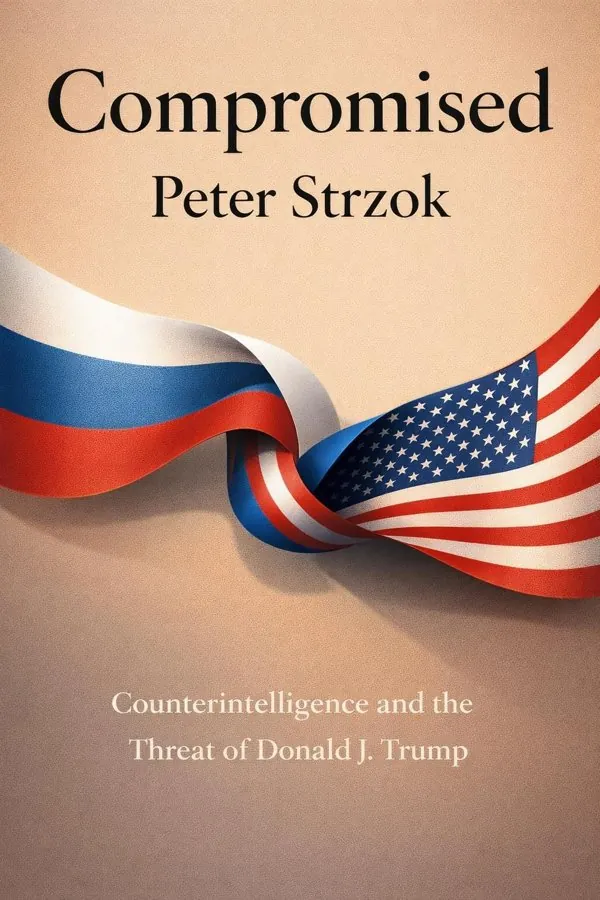
Compromised: Counterintelligence and the Threat of Donald J. Trump: Summary & Key Insights
by Peter Strzok
 10 min8 chaptersAudio available
What Is Compromised: Counterintelligence and the Threat of Donald J. Trump About?
Compromised: Counterintelligence and the Threat of Donald J. Trump by Peter Strzok is a politics book spanning 8 pages. In this memoir and analysis, former FBI counterintelligence agent Peter Strzok recounts his experiences investigating Russian interference in the 2016 U.S. presidential election and the conduct of Donald J. Trump. The book explores the challenges of protecting national security amid political pressure and disinformation, offering insight into the inner workings of American intelligence and the erosion of institutional integrity.
This FizzRead summary covers all 8 key chapters of Compromised: Counterintelligence and the Threat of Donald J. Trump in approximately 10 minutes, distilling the most important ideas, arguments, and takeaways from Peter Strzok's work. Also available as an audio summary and Key Quotes Podcast.
Compromised: Counterintelligence and the Threat of Donald J. Trump
In this memoir and analysis, former FBI counterintelligence agent Peter Strzok recounts his experiences investigating Russian interference in the 2016 U.S. presidential election and the conduct of Donald J. Trump. The book explores the challenges of protecting national security amid political pressure and disinformation, offering insight into the inner workings of American intelligence and the erosion of institutional integrity.
Who Should Read Compromised: Counterintelligence and the Threat of Donald J. Trump?
This book is perfect for anyone interested in politics and looking to gain actionable insights in a short read. Whether you're a student, professional, or lifelong learner, the key ideas from Compromised: Counterintelligence and the Threat of Donald J. Trump by Peter Strzok will help you think differently.
- ✓Readers who enjoy politics and want practical takeaways
- ✓Professionals looking to apply new ideas to their work and life
- ✓Anyone who wants the core insights of Compromised: Counterintelligence and the Threat of Donald J. Trump in just 10 minutes
Want the full summary?
Get instant access to this book summary and 100K+ more with Fizz Moment.
Get Free SummaryAvailable on App Store • Free to download
Key Chapters
My career began in an era when counterintelligence work demanded both patience and principle. I joined the FBI after graduate studies in international relations, drawn to its unique mix of mission and meaning. Early on, I learned that the essence of counterintelligence was not the dramatic capture of spies, but the quieter work of understanding human motivation. In the 1990s and 2000s, our focus was largely on classic espionage: foreign officers posing as diplomats, recruiting Americans to betray classified secrets. Each investigation was a chess match — subtle, psychological, and often invisible to those outside the Bureau.
Through field offices and overseas assignments, I saw how Russia, above all others, remained the most persistent and creative threat. Long after the Cold War’s ideological fire cooled, Moscow’s intelligence services — the SVR, FSB, and GRU — maintained their obsession with penetrating American institutions. We watched as they adapted, trading dead drops for cyber operations, human sources for online proxies. My mentors in the Bureau instilled in me the rigor of building a case: documentation above conjecture, procedure above politics. Those principles would later collide violently with the political reality of 2016.
These early years shaped my understanding of loyalty. True loyalty, as I came to believe, is owed not to a person or a party but to the oath itself — to the Constitution and the protection of the United States against foreign threats. That view made what came later — the accusations of personal bias and betrayal — not only painful, but deeply ironic. My grounding in the fundamentals of counterintelligence prepared me for what was to come, but nothing could have prepared me for how truth itself would become a casualty.
To understand what unfolded in 2016, one must first understand how Russian intelligence operates. Russia’s approach to espionage is not merely about stealing secrets; it is about shaping perceptions and sowing divisions. Under Vladimir Putin, a former KGB officer, the state’s tradecraft evolved from traditional spying into hybrid warfare — a mix of cyber operations, propaganda, and psychological manipulation. The goal was simple yet profound: to weaken the West from within.
In counterintelligence, we categorize foreign threats by motivation and capability. Russia checks both boxes with alarming consistency. Its intelligence services exploit openness and dissent — weaknesses inherent to democracy. They are patient, often measuring success not in years but in generational shifts. I saw firsthand how Russian operatives cultivated American targets, slowly, through flattery or ideology, until they gained influence over decisions that mattered.
When you’re in counterintelligence, your primary job is to identify—quietly—when that line has been crossed, when legitimate contact turns into manipulation. The tragedy of 2016 is that for the first time, those dangers played out not in some shadowy network of spies, but in public view, intertwined with our political process. The patterns were familiar: cutouts, disinformation, kompromat, and exploitation of personal ambition. But their reach was unprecedented, precisely because social media had turned every citizen into a potential amplifier of foreign deception.
The Russian playbook never changed; only the technology did. And yet, what made the United States vulnerable was not the sophistication of Moscow’s tactics, but our collective inability to believe that it was happening at all.
+ 6 more chapters — available in the FizzRead app
All Chapters in Compromised: Counterintelligence and the Threat of Donald J. Trump
About the Author
Peter Strzok is a former FBI agent who served as Deputy Assistant Director of the Counterintelligence Division. He played a key role in investigations related to Russian espionage and election interference. After his dismissal from the FBI, he became an author and commentator on national security and intelligence issues.
Get This Summary in Your Preferred Format
Read or listen to the Compromised: Counterintelligence and the Threat of Donald J. Trump summary by Peter Strzok anytime, anywhere. FizzRead offers multiple formats so you can learn on your terms — all free.
Available formats: App · Audio · PDF · EPUB — All included free with FizzRead
Download Compromised: Counterintelligence and the Threat of Donald J. Trump PDF and EPUB Summary
Key Quotes from Compromised: Counterintelligence and the Threat of Donald J. Trump
“My career began in an era when counterintelligence work demanded both patience and principle.”
“To understand what unfolded in 2016, one must first understand how Russian intelligence operates.”
Frequently Asked Questions about Compromised: Counterintelligence and the Threat of Donald J. Trump
Compromised: Counterintelligence and the Threat of Donald J. Trump by Peter Strzok is a politics book that explores key ideas across 8 chapters. In this memoir and analysis, former FBI counterintelligence agent Peter Strzok recounts his experiences investigating Russian interference in the 2016 U.S. presidential election and the conduct of Donald J. Trump. The book explores the challenges of protecting national security amid political pressure and disinformation, offering insight into the inner workings of American intelligence and the erosion of institutional integrity.
You Might Also Like
Antifa: The Anti-Fascist Handbook
Mark Bray
10 min
Attack from Within: How Disinformation Is Sabotaging America
Barbara McQuade
10 min
Coercion, Capital, and European States, AD 990–1992
Charles Tilly
10 min
Digital Democracy: Concepts, Methodologies, Tools, and Applications
Various Authors
10 min
Fascism
Stanley G. Payne
10 min
Fire And Fury: Inside The Trump White House
Michael Wolff
10 minBrowse by Category
Ready to read Compromised: Counterintelligence and the Threat of Donald J. Trump?
Get the full summary and 100K+ more books with Fizz Moment.