
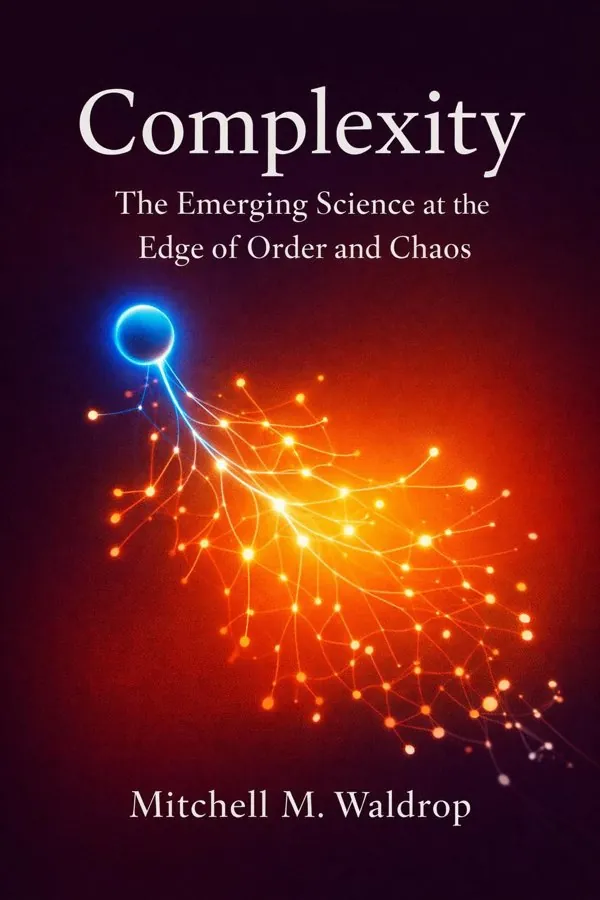
Complexity: The Emerging Science at the Edge of Order and Chaos: Summary & Key Insights
 10 min7 chaptersAudio available
What Is Complexity: The Emerging Science at the Edge of Order and Chaos About?
Complexity: The Emerging Science at the Edge of Order and Chaos by Mitchell M. Waldrop is a popular_sci book spanning 7 pages. This book explores the birth and development of complexity science, tracing how researchers from physics, biology, economics, and computer science began to uncover universal principles governing complex adaptive systems. Waldrop narrates the story of the Santa Fe Institute and the scientists who sought to understand how order and chaos coexist in nature, society, and technology.
This FizzRead summary covers all 7 key chapters of Complexity: The Emerging Science at the Edge of Order and Chaos in approximately 10 minutes, distilling the most important ideas, arguments, and takeaways from Mitchell M. Waldrop's work. Also available as an audio summary and Key Quotes Podcast.
Complexity: The Emerging Science at the Edge of Order and Chaos
This book explores the birth and development of complexity science, tracing how researchers from physics, biology, economics, and computer science began to uncover universal principles governing complex adaptive systems. Waldrop narrates the story of the Santa Fe Institute and the scientists who sought to understand how order and chaos coexist in nature, society, and technology.
Who Should Read Complexity: The Emerging Science at the Edge of Order and Chaos?
This book is perfect for anyone interested in popular_sci and looking to gain actionable insights in a short read. Whether you're a student, professional, or lifelong learner, the key ideas from Complexity: The Emerging Science at the Edge of Order and Chaos by Mitchell M. Waldrop will help you think differently.
- ✓Readers who enjoy popular_sci and want practical takeaways
- ✓Professionals looking to apply new ideas to their work and life
- ✓Anyone who wants the core insights of Complexity: The Emerging Science at the Edge of Order and Chaos in just 10 minutes
Want the full summary?
Get instant access to this book summary and 100K+ more with Fizz Moment.
Get Free SummaryAvailable on App Store • Free to download
Key Chapters
The roots of complexity science stretch back to the intellectual ferment of the late twentieth century, a period when computers began reshaping not only technology but also scientific imagination. Physicists who once prided themselves on their ability to reduce nature to clear equations began facing phenomena that slipped through the cracks — turbulent fluids, biological evolution, social behavior. These systems seemed to defy prediction, behaving as if they were alive.
In this climate of curiosity, a few brave thinkers sought a new synthesis. The Santa Fe Institute emerged as a crucible for that vision. Born in the mid-1980s in the hills of New Mexico, it brought together Nobel laureates, mathematicians, economists, and biologists who shared one conviction: that the greatest mysteries of science were to be found not in isolated parts of nature, but in the connections between them.
I recall the excitement of those founding days — when physicist George Cowan, together with Murray Gell-Mann and Philip Anderson, imagined an institute that would function like a living organism: small, flexible, adaptable, interdisciplinary. No bureaucracy, no hierarchy. Just brilliant minds engaged in conversation across boundaries. The early gatherings were lively debates on everything from particle physics to artificial intelligence, economics to genetics, each feeding into the emerging idea that beneath life’s diversity lay shared principles of adaptation and emergence.
It was during these formative discussions at Santa Fe that the term “complex adaptive systems” began to crystallize. We were beginning to ask whether the dynamics of evolution, innovation, and learning could be expressed in mathematical models — and whether computers could simulate the very process of life itself. The institute was more than a research center; it became a new way of doing science, one that valued interaction as much as insight.
The birth of the Santa Fe Institute thus marked not just an organizational milestone but the dawn of a paradigm. It signaled the moment when scientific inquiry began to turn toward systems thinking, toward a new appreciation of interconnectedness, and toward an understanding of how patterns of complexity might be the foundation of all living and social phenomena.
Every movement has its visionaries, and the story of complexity is shaped by individuals whose insights pushed the boundaries of science. Murray Gell-Mann brought to this new field not only the prestige of his Nobel Prize but a restless curiosity. He had spent his life seeking the underlying patterns of the universe — from quarks in particle physics to ecosystems in biology. What intrigued him was the idea that simplicity and complication might be two sides of the same coin: that laws of information could bridge the atoms and the biosphere.
Philip Anderson, another towering figure, famously wrote that 'more is different.' With those words, he challenged reductionism itself, arguing that when components assemble into a system, entirely new behaviors arise that cannot be predicted from the properties of the parts alone. His vision laid the philosophical foundation for complexity science — the recognition that emergence, rather than reduction, defines the natural world.
John Holland, meanwhile, translated evolution into computation. His genetic algorithms simulated natural selection, enabling computer systems to learn through adaptation and competition. Holland’s work was a revelation: it showed that evolution itself could be understood as a universal mechanism of learning, applicable to anything from microorganisms to economic agents.
Brian Arthur extended these ideas into the realm of economics, asking whether markets were really in equilibrium, as classical theories assumed. Through his pioneering models, he revealed that economies do not settle into static states but continually evolve, exuding creativity and unpredictability akin to living systems. Arthur’s work was more than just economic theory; it pointed toward a deeper truth — that economics, biology, and computation could be unified under the notion of complex adaptive behavior.
Each of these thinkers contributed not just insights but courage — the courage to question deeply held assumptions. Their ideas converged at Santa Fe, transforming that small community into a vibrant arena where reductionism gave way to holism, where physicists conversed with biologists, and where economics was reborn under the light of complexity.
+ 5 more chapters — available in the FizzRead app
All Chapters in Complexity: The Emerging Science at the Edge of Order and Chaos
About the Author
Mitchell M. Waldrop is an American science writer and journalist known for his works on complexity science and innovation. He has written for Science magazine and authored several influential books on scientific and technological revolutions.
Get This Summary in Your Preferred Format
Read or listen to the Complexity: The Emerging Science at the Edge of Order and Chaos summary by Mitchell M. Waldrop anytime, anywhere. FizzRead offers multiple formats so you can learn on your terms — all free.
Available formats: App · Audio · PDF · EPUB — All included free with FizzRead
Download Complexity: The Emerging Science at the Edge of Order and Chaos PDF and EPUB Summary
Key Quotes from Complexity: The Emerging Science at the Edge of Order and Chaos
“The roots of complexity science stretch back to the intellectual ferment of the late twentieth century, a period when computers began reshaping not only technology but also scientific imagination.”
“Every movement has its visionaries, and the story of complexity is shaped by individuals whose insights pushed the boundaries of science.”
Frequently Asked Questions about Complexity: The Emerging Science at the Edge of Order and Chaos
Complexity: The Emerging Science at the Edge of Order and Chaos by Mitchell M. Waldrop is a popular_sci book that explores key ideas across 7 chapters. This book explores the birth and development of complexity science, tracing how researchers from physics, biology, economics, and computer science began to uncover universal principles governing complex adaptive systems. Waldrop narrates the story of the Santa Fe Institute and the scientists who sought to understand how order and chaos coexist in nature, society, and technology.
You Might Also Like

Structures: Or Why Things Don"t Fall Down
J.E. Gordon
10 min
The Road to Wigan Pier
George Orwell
10 min
Bonk: The Curious Coupling of Science and Sex
Mary Roach
10 min
First Bite: How We Learn to Eat
Bee Wilson
10 min
In Pursuit Of The Unknown: 17 Equations That Changed The World
Ian Stewart
10 min
Napoleon's Buttons: 17 Molecules That Changed History
Penny Le Couteur and Jay Burreson
10 minBrowse by Category
Ready to read Complexity: The Emerging Science at the Edge of Order and Chaos?
Get the full summary and 100K+ more books with Fizz Moment.