
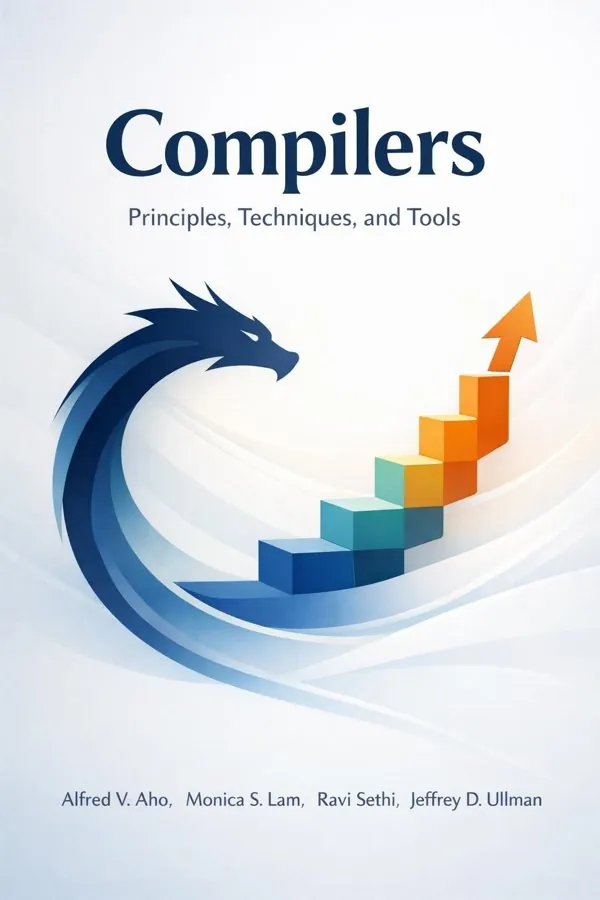
Compilers: Principles, Techniques, and Tools: Summary & Key Insights
by Alfred V. Aho, Monica S. Lam, Ravi Sethi, Jeffrey D. Ullman
 10 min4 chaptersAudio available
What Is Compilers: Principles, Techniques, and Tools About?
Compilers: Principles, Techniques, and Tools by Alfred V. Aho, Monica S. Lam, Ravi Sethi, Jeffrey D. Ullman is a programming book spanning 4 pages. This foundational textbook in computer science, often referred to as the 'Dragon Book', provides a comprehensive introduction to compiler design. It covers lexical analysis, syntax analysis, semantic analysis, optimization, and code generation, offering both theoretical foundations and practical techniques for building compilers.
This FizzRead summary covers all 4 key chapters of Compilers: Principles, Techniques, and Tools in approximately 10 minutes, distilling the most important ideas, arguments, and takeaways from Alfred V. Aho, Monica S. Lam, Ravi Sethi, Jeffrey D. Ullman's work. Also available as an audio summary and Key Quotes Podcast.
Compilers: Principles, Techniques, and Tools
This foundational textbook in computer science, often referred to as the 'Dragon Book', provides a comprehensive introduction to compiler design. It covers lexical analysis, syntax analysis, semantic analysis, optimization, and code generation, offering both theoretical foundations and practical techniques for building compilers.
Who Should Read Compilers: Principles, Techniques, and Tools?
This book is perfect for anyone interested in programming and looking to gain actionable insights in a short read. Whether you're a student, professional, or lifelong learner, the key ideas from Compilers: Principles, Techniques, and Tools by Alfred V. Aho, Monica S. Lam, Ravi Sethi, Jeffrey D. Ullman will help you think differently.
- ✓Readers who enjoy programming and want practical takeaways
- ✓Professionals looking to apply new ideas to their work and life
- ✓Anyone who wants the core insights of Compilers: Principles, Techniques, and Tools in just 10 minutes
Want the full summary?
Get instant access to this book summary and 100K+ more with Fizz Moment.
Get Free SummaryAvailable on App Store • Free to download
Key Chapters
At its core, a compiler is a translator—a bridge between two worlds. One speaks in the comfortable rhythms of a high-level programming language; the other in the rigid precision of machine code. As I introduce this, imagine a process much like translating poetry: every phrase carries meaning, syntax, and nuance, all of which must survive and be reborn in a different tongue. The compiler faithfully performs that transformation, phase by phase.
When we break down compilation, we reveal a pipeline: lexical analysis extracts meaningful tokens from raw text; syntax analysis organizes them into grammatical structures; semantic analysis ensures that meaning is consistent; and then optimization and code generation translate those meanings into efficient machine instructions. Each phase hands its result to the next, forming a symphony of transformation—each stage refining, validating, and optimizing.
In modern software systems, compilers are not merely passive translators; they are architects of correctness and performance. Consider how languages like C++ and Java rely on compilers to enforce type safety, optimize execution paths, and even assist in parallel execution. Compilers embody the intelligence of language design—they are the operational mirror of linguistic theory.
Translators come in different forms: assemblers convert simple symbolic instructions to machine code; interpreters process code line by line, executing immediately; but compilers perform deeper translation and restructuring, optimizing before execution. The distinction matters because compilers embody foresight—they prepare code for optimal performance even before execution occurs.
To understand the role of compilers in programming language implementation is to recognize that a well-constructed compiler is also a teacher. It enforces the language’s rules and makes errors explicit; it bridges theory and practice. When designing new languages or evolving existing ones, compiler principles ensure continuity—the ideas of lexical structure, parsing, and type discipline remain foundational no matter how modern the syntax becomes. This understanding sets the stage for every chapter that follows.
The lexical analyzer—or scanner—is the compiler’s first encounter with human language. It reads the source program as a stream of characters and extracts the most fundamental units of meaning: tokens. These tokens represent identifiers, keywords, operators, and literals—the vocabulary of computation.
The process might seem mechanical, but it is deeply logical. Through regular expressions, we describe the patterns that identify tokens, and finite automata bring those patterns to life. Regular languages form the backbone of this analysis, making it possible to describe input sequences precisely and transform them efficiently.
Building a lexical analyzer involves constructing deterministic or nondeterministic finite automata (DFAs or NFAs), optimizing transitions, and systematically scanning input. The scanner recognizes that `if` is a keyword, whereas `identifier` is a more general construct—it must distinguish between them quickly and correctly. Efficiency matters; even a small delay in lexical analysis cascades through the compilation process since every character of every source file passes through this stage.
Tools like lex automated this process, showing how theory becomes practice. By describing token rules with regular expressions, developers can generate scanners that manage complex pattern recognition without manual code. This marriage of formal language theory and automation exemplifies what compiler design is truly about: making precision effortless.
Lexical analysis, though seemingly simple, determines the compiler’s foundation of correctness. All subsequent phases rely on these tokens being accurate representations of the programmer’s intent. The process not only recognizes words—it begins the act of understanding language in structured form.
+ 2 more chapters — available in the FizzRead app
All Chapters in Compilers: Principles, Techniques, and Tools
About the Authors
Alfred V. Aho, Monica S. Lam, Ravi Sethi, and Jeffrey D. Ullman are renowned computer scientists known for their contributions to programming languages, compilers, and algorithms. Their collective work has shaped modern computer science education and compiler theory.
Get This Summary in Your Preferred Format
Read or listen to the Compilers: Principles, Techniques, and Tools summary by Alfred V. Aho, Monica S. Lam, Ravi Sethi, Jeffrey D. Ullman anytime, anywhere. FizzRead offers multiple formats so you can learn on your terms — all free.
Available formats: App · Audio · PDF · EPUB — All included free with FizzRead
Download Compilers: Principles, Techniques, and Tools PDF and EPUB Summary
Key Quotes from Compilers: Principles, Techniques, and Tools
“At its core, a compiler is a translator—a bridge between two worlds.”
“The lexical analyzer—or scanner—is the compiler’s first encounter with human language.”
Frequently Asked Questions about Compilers: Principles, Techniques, and Tools
Compilers: Principles, Techniques, and Tools by Alfred V. Aho, Monica S. Lam, Ravi Sethi, Jeffrey D. Ullman is a programming book that explores key ideas across 4 chapters. This foundational textbook in computer science, often referred to as the 'Dragon Book', provides a comprehensive introduction to compiler design. It covers lexical analysis, syntax analysis, semantic analysis, optimization, and code generation, offering both theoretical foundations and practical techniques for building compilers.
You Might Also Like
ANSI Common Lisp
Paul Graham
10 min
Automate the Boring Stuff with Python: Practical Programming for Total Beginners
Al Sweigart
10 min
Black Hat Python: Python Programming for Hackers and Pentesters
Justin Seitz
10 min
Building Microservices: Designing Fine-Grained Systems
Sam Newman
10 min
C++ Primer
Stanley B. Lippman, Josée Lajoie, Barbara E. Moo
10 min
Clean Code: A Handbook of Agile Software Craftsmanship
Robert C. Martin
10 minBrowse by Category
Ready to read Compilers: Principles, Techniques, and Tools?
Get the full summary and 100K+ more books with Fizz Moment.