
Thinking Fast and Slow vs Sapiens: Which Should You Read?
A detailed comparison of Thinking Fast and Slow by Daniel Kahneman and Sapiens by Yuval Noah Harari. Discover the key differences, strengths, and which book is right for you.
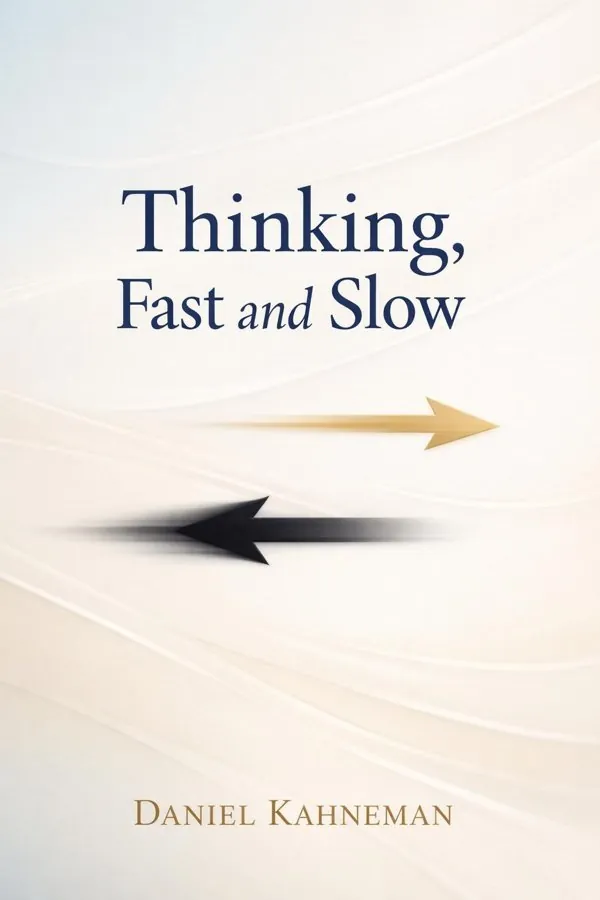

Thinking Fast and Slow
Sapiens
In-Depth Analysis
Daniel Kahneman’s "Thinking Fast and Slow" and Yuval Noah Harari’s "Sapiens" are both ambitious works, but their ambitions lie in different territories. Kahneman, a Nobel laureate in economics, distills decades of research into the mechanics of human thought. His central thesis is the dual-process theory: System 1, which is fast, intuitive, and automatic, and System 2, which is slow, deliberative, and effortful. Through experiments such as the famous "Linda problem" and explorations of heuristics like anchoring and availability, Kahneman meticulously demonstrates how our minds systematically err. For instance, he details how people overestimate the frequency of dramatic events due to the availability heuristic, or how professional predictions often fall prey to overconfidence and hindsight bias. Each chapter builds on empirical evidence, often referencing controlled experiments or field studies, grounding his insights in scientific rigor.
In contrast, Harari’s "Sapiens" is panoramic in scope. It moves from the dawn of Homo sapiens through the Cognitive Revolution (roughly 70,000 years ago), the Agricultural Revolution, and the Scientific Revolution. Harari’s argument is that what sets humans apart is our ability to cooperate flexibly in large groups, thanks to shared myths and imagined realities, from religious beliefs to the concept of money. He provocatively suggests that the Agricultural Revolution, often seen as progress, actually led to longer working hours and worse health for most individuals. His discussion of the Scientific Revolution reframes humanity’s pursuit of knowledge as a relatively recent and disruptive force, enabling unprecedented technological and social change.
Methodologically, the books diverge sharply. Kahneman’s approach is micro-analytical, often focusing on how individuals make choices in controlled settings. For example, his discussion of prospect theory—developed with Amos Tversky—upends classical economic models of rationality, showing that people value losses more than equivalent gains. This insight has profound implications for economics, policy, and everyday life, such as understanding why people are reluctant to sell losing stocks. Kahneman’s tone is measured, often self-critical, and he is transparent about the limitations of psychological experiments, such as the problem of replicability.
Harari, meanwhile, synthesizes anthropology, biology, and economics to tell a grand narrative. He is less concerned with experimental detail and more with interpretive breadth, drawing on disparate sources to advance provocative arguments. For example, his exploration of the Cognitive Revolution is rooted in speculative anthropology: he suggests that gossip and storytelling enabled Sapiens to outcompete other hominins like Neanderthals. Harari’s treatment of the Agricultural Revolution as a "trap"—one that locked societies into rigid hierarchies and diets—is a compelling reinterpretation of conventional wisdom. Later chapters tackle the role of capitalism, imperialism, and scientific progress, often challenging readers’ assumptions about what constitutes "improvement."
Philosophically, Kahneman’s work is grounded in skepticism about human rationality. He emphasizes the limits of intuition and the pervasiveness of bias, inviting readers to question their confidence in their own judgments. Harari, on the other hand, is interested in the collective fictions that bind societies. His thesis is not simply that myths are false, but that shared beliefs—whether religions, nations, or corporations—are the foundation of cooperation at scale.
Practically speaking, "Thinking Fast and Slow" is a manual for self-understanding and better decision-making. Readers can directly apply concepts like recognizing when they are operating in System 1 versus System 2, or guarding against the planning fallacy in project management. Kahneman’s insights are immediately useful for professionals in business, medicine, law, and beyond.
"Sapiens" is less a manual and more a lens. It shapes how readers think about the human condition, the origins of inequality, and the stories we tell ourselves. Its impact is less about concrete action and more about changing the questions we ask—about progress, happiness, and the future of our species.
Ultimately, both books challenge readers to reconsider what they take for granted: Kahneman unpacks the mind’s hidden machinery, while Harari deconstructs the stories that have propelled our species. Their methodologies, philosophical commitments, and practical implications differ profoundly, but both offer transformative insights into what it means to be human.
Side-by-Side Comparison
| Aspect | Thinking Fast and Slow | Sapiens |
|---|---|---|
| Core Philosophy | Thinking Fast and Slow focuses on the dual-process model of the human mind, exploring how intuitive and deliberate thinking shape judgments and decisions. | Sapiens presents a sweeping narrative of human history, arguing that Homo sapiens’ unique ability to create and believe in shared myths underpins our dominance. |
| Writing Style | Kahneman’s prose is precise and analytical, often structured around experiments and psychological studies, with a pedagogical tone. | Harari’s writing is narrative-driven, accessible, and often provocative, blending storytelling with big-picture analysis and philosophical musings. |
| Practical Application | Offers actionable insights into decision-making, critical thinking, and recognizing cognitive biases, directly relevant to personal and professional contexts. | While not directly prescriptive, Sapiens provides a framework for understanding societal development and human behavior on a macro scale. |
| Target Audience | Ideal for readers interested in psychology, behavioral economics, and cognitive science, especially those seeking to improve personal decision-making. | Aimed at general readers curious about history, anthropology, and the origins of modern society. |
| Scientific Rigor | Deeply grounded in empirical research, referencing decades of experiments and peer-reviewed studies. | Synthesizes research across disciplines, but often prioritizes broad narrative coherence over exhaustive scientific detail. |
| Emotional Impact | Provokes introspection and can challenge readers’ self-perception, but remains largely intellectual in tone. | Evokes awe, wonder, and sometimes discomfort as it questions foundational beliefs about humanity and progress. |
| Actionability | Readers can immediately apply concepts like System 1 vs. System 2, or recognize biases such as anchoring in daily life. | Encourages broad reflection on societal values and historical narratives, though practical takeaways are less explicit. |
| Depth of Analysis | Meticulously dissects psychological processes and biases, often illustrating points with detailed experimental evidence. | Covers immense temporal and thematic ground, offering synthesis and speculation rather than granular analysis. |
| Long-term Value | Serves as a reference for understanding human behavior and making better decisions over a lifetime. | Provides a mental model for interpreting humanity’s past and future, shaping readers’ worldview. |
| Readability | Clear but occasionally dense, especially in sections heavy with psychological terminology or experiment details. | Highly readable and engaging, with a storytelling approach that appeals to a broad audience. |
Key Differences
Focus and Scope
'Thinking Fast and Slow' zooms in on individual cognition, using controlled experiments to dissect mental processes. 'Sapiens' covers the entire human story, from evolutionary origins to the present, focusing on collective behavior and societal change.
Methodological Approach
Kahneman relies on empirical psychology, often presenting data and experimental results to support his claims. Harari synthesizes across disciplines, weaving historical, anthropological, and philosophical threads into a unified narrative, sometimes at the expense of scientific detail.
Practical Utility
'Thinking Fast and Slow' offers specific cognitive tools and warnings about biases, ready to be applied in daily life. 'Sapiens' provides conceptual frameworks for interpreting history and culture, but lacks direct, actionable strategies.
Narrative Style
Kahneman’s tone is didactic and analytical, often pausing to explain statistical concepts or experimental setups. Harari’s prose is more conversational and provocative, using storytelling and big questions to engage the reader.
Emphasis on Myth and Story
'Sapiens' is centered on the power of collective myths—religion, money, nation-states—as drivers of cooperation and conflict. 'Thinking Fast and Slow' is largely agnostic about culture, focusing instead on universal psychological mechanisms.
Temporal Perspective
'Thinking Fast and Slow' deals with the present moment of thought and decision, while 'Sapiens' traverses millennia, situating human psychology within an evolutionary and historical context.
Who Should Read Which?
The Busy Professional
→ Thinking Fast and Slow
Professionals who need to make quick, high-stakes decisions will benefit from Kahneman’s clear frameworks for identifying and mitigating cognitive errors. The book’s actionable insights directly enhance workplace judgment and leadership.
The Curious Generalist
→ Sapiens
If you crave a panoramic understanding of humanity’s journey—blending science, history, and philosophy—'Sapiens' will satisfy your curiosity and challenge your worldview with engaging, thought-provoking narratives.
The Student of Human Nature
→ Thinking Fast and Slow
For readers fascinated by why people think and act the way they do, Kahneman’s deep dive into cognitive psychology provides a rigorous, research-based foundation that is essential for further exploration in any social science.
Which Should You Read First?
The best reading order depends on your interests and background. If you are new to psychology or behavioral sciences, start with 'Thinking Fast and Slow'—its insights into decision-making, biases, and mental shortcuts are foundational and will inform your understanding of human nature. Grasping these concepts first can sharpen your critical thinking as you encounter the broad historical claims in 'Sapiens'. Alternatively, readers with a strong interest in history, anthropology, or the grand sweep of human development may benefit from beginning with 'Sapiens'. Harari’s big-picture approach can provide context for why certain cognitive traits (such as belief in fictions) evolved, creating a richer background for Kahneman’s more focused exploration of those traits in action. For multidisciplinary learners, reading both—starting with Kahneman for depth, then Harari for breadth—offers the most intellectually rewarding journey.
Want the full summary?
Get instant access to this book summary and 100K+ more with Fizz Moment.
Get Free SummaryAvailable on App Store • Free to download
Frequently Asked Questions
Is 'Thinking Fast and Slow' better than 'Sapiens' for beginners in psychology?
For beginners specifically interested in psychology or behavioral economics, 'Thinking Fast and Slow' is the foundational text. Kahneman introduces key concepts—such as cognitive biases and the dual-process theory—using accessible examples, though some chapters delve into technical detail. By contrast, 'Sapiens' touches on psychology more tangentially, focusing on historical and anthropological themes. Beginners seeking to understand how the mind works will benefit more from Kahneman’s in-depth, research-based approach.
Which book, 'Thinking Fast and Slow' or 'Sapiens', is more applicable to daily decision-making?
'Thinking Fast and Slow' is far more applicable to everyday choices. Kahneman’s exploration of mental shortcuts, biases, and errors in judgment directly informs how readers can improve decision-making in work, finance, and relationships. While 'Sapiens' offers broad perspectives on societal evolution, it does not provide specific tools for daily life. Readers looking for actionable insights should start with Kahneman.
Does 'Sapiens' provide more historical context than 'Thinking Fast and Slow'?
Absolutely. 'Sapiens' is designed as a grand tour of human history, from prehistoric times to the present. Harari explains how revolutions in cognition, agriculture, and science have shaped societies and cultures. In contrast, 'Thinking Fast and Slow' is focused on psychological mechanisms and rarely ventures into historical narrative. Readers interested in the big-picture history of humanity will find 'Sapiens' much more informative.
How do the writing styles of 'Thinking Fast and Slow' and 'Sapiens' compare for casual readers?
'Sapiens' is generally more accessible for casual readers, with a flowing narrative style, engaging anecdotes, and provocative questions. Harari writes for a broad audience, making complex ideas relatable. 'Thinking Fast and Slow', while clear, often presents dense material rooted in academic research, which may require more concentration and patience from readers unfamiliar with psychological terminology.
Which book should I read if I'm interested in understanding why people believe in myths and stories?
'Sapiens' is the better choice for exploring why humans create and believe in myths, religions, and collective narratives. Harari’s central argument is that shared fictions enable large-scale cooperation and social organization. He traces the development of belief systems from animism to modern ideologies, providing a historical and anthropological lens that 'Thinking Fast and Slow' does not offer.
Is 'Thinking Fast and Slow' or 'Sapiens' more scientifically rigorous?
'Thinking Fast and Slow' is more scientifically rigorous in its methodology. Kahneman meticulously cites experiments, peer-reviewed studies, and statistical evidence to support his claims about cognitive processes. While 'Sapiens' is well-researched and draws from multiple fields, it prioritizes narrative and synthesis over detailed empirical validation.
The Verdict
Both 'Thinking Fast and Slow' and 'Sapiens' are modern classics, but their strengths serve different needs. Kahneman’s work is indispensable for anyone seeking to understand—at a granular level—how human thought operates, why we make predictable errors, and how we can guard against them. It is especially valuable for professionals in fields that demand sound judgment, such as business, law, or medicine, and for readers who appreciate deep dives into experimental psychology. 'Sapiens', by contrast, is a sweeping narrative ideal for those curious about the grand arc of human development. Harari’s synthesis of biology, history, and philosophy provides context for contemporary issues, from nationalism to capitalism, and invites readers to question the stories underpinning modern society. If your goal is to improve decision-making, self-awareness, or critical thinking, start with 'Thinking Fast and Slow'. If you seek a transformative perspective on humanity’s past and future—with an eye toward the big questions of meaning and progress—read 'Sapiens'. Both books reward careful reading, but each is best suited to different intellectual appetites.
Related Comparisons


Want to read both books?
Get AI-powered summaries of both Thinking Fast and Slow and Sapiens in just 20 minutes total.