
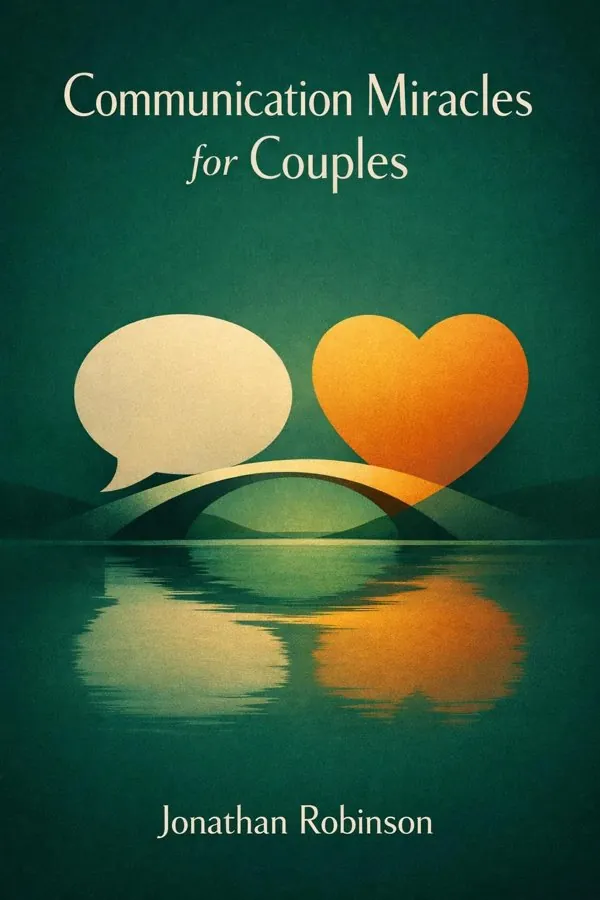
Communication Miracles for Couples: Easy and Effective Tools to Create More Love and Less Conflict: Summary & Key Insights
 10 min9 chaptersAudio available
Key Takeaways from Communication Miracles for Couples: Easy and Effective Tools to Create More Love and Less Conflict
Many couples assume that if they love each other enough, communication should happen naturally.
People do not open their hearts when they feel attacked.
Being heard is one of the deepest emotional needs in a relationship.
Criticism often sounds stronger than vulnerability, but it is usually less effective.
Conflict is not the enemy of love; unmanaged conflict is.
What Is Communication Miracles for Couples: Easy and Effective Tools to Create More Love and Less Conflict About?
Communication Miracles for Couples: Easy and Effective Tools to Create More Love and Less Conflict by Jonathan Robinson is a relationships book spanning 8 pages. Great relationships rarely fail because two people stop caring. More often, they suffer because love gets buried under defensiveness, misunderstandings, resentment, and repeated arguments that never truly resolve. In Communication Miracles for Couples, psychotherapist Jonathan Robinson argues that better communication is not a vague ideal but a practical skill set that can be learned quickly and used immediately. His goal is simple: help couples replace conflict habits with small, effective tools that create safety, empathy, and closeness. What makes this book especially useful is its directness. Robinson does not rely on abstract theory alone; he offers concrete phrases, structured exercises, and realistic dialogue examples that couples can try in the middle of everyday tensions. Drawing on years of counseling experience, along with insights from psychology and relationship work, he shows how to listen more deeply, speak more honestly, and respond with less blame. The result is a relationship guide that feels compassionate, realistic, and highly actionable. For couples who want more love and less friction, this book offers a practical roadmap back to connection.
This FizzRead summary covers all 9 key chapters of Communication Miracles for Couples: Easy and Effective Tools to Create More Love and Less Conflict in approximately 10 minutes, distilling the most important ideas, arguments, and takeaways from Jonathan Robinson's work. Also available as an audio summary and Key Quotes Podcast.
Communication Miracles for Couples: Easy and Effective Tools to Create More Love and Less Conflict
Great relationships rarely fail because two people stop caring. More often, they suffer because love gets buried under defensiveness, misunderstandings, resentment, and repeated arguments that never truly resolve. In Communication Miracles for Couples, psychotherapist Jonathan Robinson argues that better communication is not a vague ideal but a practical skill set that can be learned quickly and used immediately. His goal is simple: help couples replace conflict habits with small, effective tools that create safety, empathy, and closeness.
What makes this book especially useful is its directness. Robinson does not rely on abstract theory alone; he offers concrete phrases, structured exercises, and realistic dialogue examples that couples can try in the middle of everyday tensions. Drawing on years of counseling experience, along with insights from psychology and relationship work, he shows how to listen more deeply, speak more honestly, and respond with less blame. The result is a relationship guide that feels compassionate, realistic, and highly actionable. For couples who want more love and less friction, this book offers a practical roadmap back to connection.
Who Should Read Communication Miracles for Couples: Easy and Effective Tools to Create More Love and Less Conflict?
This book is perfect for anyone interested in relationships and looking to gain actionable insights in a short read. Whether you're a student, professional, or lifelong learner, the key ideas from Communication Miracles for Couples: Easy and Effective Tools to Create More Love and Less Conflict by Jonathan Robinson will help you think differently.
- ✓Readers who enjoy relationships and want practical takeaways
- ✓Professionals looking to apply new ideas to their work and life
- ✓Anyone who wants the core insights of Communication Miracles for Couples: Easy and Effective Tools to Create More Love and Less Conflict in just 10 minutes
Want the full summary?
Get instant access to this book summary and 100K+ more with Fizz Moment.
Get Free SummaryAvailable on App Store • Free to download
Key Chapters
People do not open their hearts when they feel attacked. One of Robinson’s central insights is that emotional safety is the foundation of every healthy conversation. Without it, the nervous system shifts into protection mode and the goal changes from understanding to self-defense. In that state, even helpful advice can sound like criticism.
Emotional safety comes from tone, timing, respect, and the felt sense that both people matter. Robinson emphasizes that couples often rush into problem-solving before creating the conditions that make real dialogue possible. If one partner already feels judged, dismissed, or overwhelmed, discussing the issue itself may only intensify the conflict.
He suggests simple ways to increase safety: ask permission before entering a serious topic, lower your voice, sit close instead of standing apart, make eye contact without staring aggressively, and begin with reassurance. A sentence such as, “I love you, and I want us to feel closer as we talk about this,” changes the emotional climate. Safety also means agreeing that name-calling, sarcasm, and personal attacks are off limits.
This principle is especially useful during recurring disagreements. Imagine a couple arguing about money. If one partner starts with, “You’re irresponsible,” the other will likely defend or shut down. But if they begin with, “I feel anxious about our finances and want to work on this together,” the conversation becomes collaborative instead of adversarial.
Actionable takeaway: Before your next difficult discussion, spend two minutes building safety with a calm tone, a caring opening statement, and a mutual agreement to avoid blame.
Being heard is one of the deepest emotional needs in a relationship. Robinson argues that many conflicts continue not because the issue is impossible to solve, but because one or both partners do not feel fully understood. When people feel accurately heard, tension often drops before any solution is even proposed.
Active listening, in his framework, is more than staying silent while the other person talks. It involves reflecting back the essence of what was said, including the feeling underneath it. Instead of replying immediately with a defense, a partner might say, “You felt lonely when I came home late and didn’t call,” or “It sounds like you’re not only upset about the dishes; you’re feeling unsupported.” This helps the speaker feel less alone and less compelled to intensify their message.
Robinson also highlights empathy as a skill that can be practiced, not just a personality trait. Empathy means temporarily stepping out of your own viewpoint to enter your partner’s world. Even if you disagree with their interpretation, you can still validate their experience. Saying, “I can see why that hurt,” is not the same as admitting wrongdoing; it is acknowledging impact.
A practical example: if your partner says, “You don’t care about what matters to me,” resist the urge to counter with your good intentions. First reflect the feeling: “You’re feeling dismissed and maybe disappointed.” That response often softens the exchange enough to make problem-solving possible.
Actionable takeaway: In your next disagreement, do not offer your viewpoint until your partner says you have accurately understood their feelings.
Criticism often sounds stronger than vulnerability, but it is usually less effective. Robinson teaches that blame triggers defensiveness, while honest self-expression invites connection. The difference lies in shifting from accusations about the other person’s character to clear statements about your own feelings, needs, and requests.
Many people communicate distress by saying things like, “You never listen,” “You’re selfish,” or “You always ruin everything.” These statements may express pain, but they also corner the listener into arguing over the accusation. The original need gets lost. Robinson recommends replacing generalized blame with direct, personal language: “I feel overwhelmed when I’m interrupted,” “I need reassurance when plans change,” or “I’d like us to spend one evening a week without screens.”
This approach does not mean becoming passive or pretending everything is fine. It means becoming more precise. Feelings are not judgments. Saying “I feel ignored” can still sound like blame because it describes the other person’s behavior. More accurate feeling words might be hurt, anxious, lonely, embarrassed, or frustrated. Once the feeling is named, a need can be attached to it.
For example, instead of saying, “You care more about work than me,” a partner could say, “I’ve been feeling disconnected lately, and I need some uninterrupted time with you.” That gives the other person something they can respond to constructively.
Actionable takeaway: Use the formula “I feel… when… because… and I would appreciate…” in one real conversation this week to replace blame with clarity.
Conflict is not the enemy of love; unmanaged conflict is. Robinson reframes disagreements as opportunities to understand differences, clarify values, and create better agreements. Couples do not need to eliminate conflict to thrive. They need to learn how to disagree without damaging trust.
He warns that many arguments become circular because partners focus on proving who is right. Once the goal is victory, collaboration disappears. Robinson encourages couples to move from adversarial thinking to shared problem solving: What is the issue, what does each person need, and what solution honors both people as much as possible?
One practical strategy is to separate the emotional stage from the solution stage. First, both partners express and reflect feelings. Only after each person feels understood should they brainstorm options. This prevents premature solutions that leave one partner feeling emotionally abandoned. Another useful principle is flexibility. Compromise does not always mean splitting everything in half; sometimes it means alternating, experimenting, or finding a third option neither person initially considered.
Consider a couple arguing about holidays with extended family. One wants tradition, the other wants less travel and more rest. Instead of replaying the same argument each year, they could identify the underlying needs: belonging, peace, fairness, and time together. Possible solutions might include rotating holidays, shortening visits, or creating one private ritual just for themselves.
Actionable takeaway: In your next conflict, ask together, “What are we both really needing here?” and list at least three possible solutions before choosing one.
Relationships often deteriorate not only because of what is said in conflict, but because of what goes unsaid in everyday life. Robinson emphasizes that appreciation is one of the fastest ways to restore warmth and goodwill. People flourish when they feel noticed for what they contribute, how they try, and who they are.
Couples commonly fall into an attention bias toward problems. The brain scans for what is missing, annoying, or unfinished, especially under stress. Over time, partners may begin to feel more evaluated than cherished. Appreciation interrupts this slide by retraining attention toward the positive. It reminds both people that the relationship contains more than its frustrations.
Robinson recommends making appreciation specific and frequent. Generic praise such as “Thanks for everything” is pleasant but less powerful than “Thank you for making dinner when you knew I was exhausted” or “I really appreciated how patient you were with me this morning.” Specificity shows presence. It tells your partner you are truly seeing them.
Appreciation also creates resilience during hard times. A couple facing parenting stress, financial pressure, or health concerns may not be able to eliminate the external challenges, but they can strengthen their bond by acknowledging each other’s effort and loyalty. Even small rituals matter: sharing one thing you appreciated each night can shift the emotional tone of a relationship.
Actionable takeaway: For the next seven days, express one concrete appreciation to your partner daily, focusing on something specific they did or a quality they showed.
The most damaging relationship problems are often repetitive, predictable, and strangely familiar. Robinson shows that couples tend to get trapped in cycles rather than isolated incidents. A trigger appears, each person reacts in a habitual way, and the same painful dance repeats. Unless the pattern is interrupted, insight alone changes little.
He encourages couples to study their conflict loop almost like detectives. What tends to start the argument? What story does each person tell themselves? What does each do next? One partner may criticize, the other withdraws, the first escalates, and the second shuts down further. Both feel victimized, yet both are participating in the cycle.
The key is to intervene early rather than waiting for full emotional flooding. Robinson suggests using agreed-upon reset tools: a pause word, a brief timeout, a hand on the heart, a humor cue that is gentle rather than mocking, or a statement like, “We’re in the pattern again.” Naming the cycle helps both people unite against it instead of against each other.
A practical example: if you know that fatigue makes evening conversations volatile, decide in advance not to discuss major issues after a certain hour. If criticism tends to trigger defensiveness, agree to start concerns with softer language. Tiny pattern changes can produce outsized results over time.
Actionable takeaway: Map one recurring conflict cycle with your partner, identify the earliest warning sign, and choose a shared interruption strategy to use before the pattern gains momentum.
Even healthy couples say clumsy things, miss each other emotionally, and create hurt unintentionally. Robinson’s practical wisdom lies in showing that strong relationships are not built on perfection but on repair. The ability to reset quickly after tension often matters more than avoiding every mistake.
Repair starts with humility. Instead of waiting for a grand reconciliation, couples can use small gestures to signal goodwill: a sincere apology, affectionate touch, a brief acknowledgment of impact, or a question like, “Can we start over?” Robinson encourages partners to repair before resentment hardens. The longer hurt sits unspoken, the more likely it is to attach itself to older grievances.
An effective apology in this framework is not defensive or diluted. It does not say, “I’m sorry you felt that way.” It says, “I can see that what I said hurt you. I’m sorry. That wasn’t the way I wanted to treat you.” If needed, the apology can be followed by a concrete corrective intention. Repair may also involve appreciation or reassurance after conflict, reminding the relationship that the bond matters more than the disagreement.
For example, after a sharp exchange about parenting, one partner might say, “I got reactive and spoke harshly. I’m sorry. I know we both care deeply about the kids. Can we try again later when we’re calmer?” That simple reset can prevent hours or days of emotional distance.
Actionable takeaway: Create a short repair phrase with your partner, such as “I’m on your side” or “Can we reset?” and commit to using it the moment conflict becomes personal.
Communication breakthroughs are inspiring, but lasting love depends on repetition. Robinson makes it clear that relationship change is not a one-time insight. Couples improve when healthier ways of speaking and listening become daily habits. Small actions, practiced consistently, reshape the emotional culture of the relationship.
He encourages readers to think in terms of rituals rather than heroic efforts. A weekly check-in, a daily appreciation, five minutes of uninterrupted listening, or a shared habit of asking, “How can I support you today?” can keep small frustrations from accumulating into major disconnection. These rituals create maintenance, and maintenance is often what prevents crisis.
Another important idea is that communication tools work best before trouble becomes severe. Many couples wait until resentment is intense and then seek help. Robinson’s methods are more effective when used proactively, during ordinary life. Regular connection increases goodwill, and goodwill makes difficult conversations easier when they inevitably arise.
Sustaining love also means accepting that no relationship is conflict-free. There will be stress, misunderstanding, and human imperfection. The goal is not flawless harmony but a resilient bond that can bend without breaking. Couples who practice often become quicker at noticing disconnection, gentler in addressing it, and more confident in their ability to recover.
Actionable takeaway: Choose two repeatable communication rituals to practice for the next month, such as a weekly relationship check-in and a nightly expression of appreciation.
All Chapters in Communication Miracles for Couples: Easy and Effective Tools to Create More Love and Less Conflict
About the Author
Jonathan Robinson is a psychotherapist, bestselling author, and professional speaker whose work centers on communication, relationships, emotional wellbeing, and personal growth. He is known for translating therapeutic ideas into clear, practical tools that ordinary readers can use immediately in daily life. Over the course of his career, he has written multiple books on love, happiness, and human connection, and his work has reached a broad international audience through translations, workshops, interviews, and media appearances. Robinson’s style is especially valued for being warm, direct, and solution-focused. In Communication Miracles for Couples, he draws on years of counseling experience to help partners reduce conflict, build empathy, and create stronger, more loving relationships through simple but effective communication habits.
Get This Summary in Your Preferred Format
Read or listen to the Communication Miracles for Couples: Easy and Effective Tools to Create More Love and Less Conflict summary by Jonathan Robinson anytime, anywhere. FizzRead offers multiple formats so you can learn on your terms — all free.
Available formats: App · Audio · PDF · EPUB — All included free with FizzRead
Download Communication Miracles for Couples: Easy and Effective Tools to Create More Love and Less Conflict PDF and EPUB Summary
Key Quotes from Communication Miracles for Couples: Easy and Effective Tools to Create More Love and Less Conflict
“Many couples assume that if they love each other enough, communication should happen naturally.”
“People do not open their hearts when they feel attacked.”
“Being heard is one of the deepest emotional needs in a relationship.”
“Criticism often sounds stronger than vulnerability, but it is usually less effective.”
“Conflict is not the enemy of love; unmanaged conflict is.”
Frequently Asked Questions about Communication Miracles for Couples: Easy and Effective Tools to Create More Love and Less Conflict
Communication Miracles for Couples: Easy and Effective Tools to Create More Love and Less Conflict by Jonathan Robinson is a relationships book that explores key ideas across 9 chapters. Great relationships rarely fail because two people stop caring. More often, they suffer because love gets buried under defensiveness, misunderstandings, resentment, and repeated arguments that never truly resolve. In Communication Miracles for Couples, psychotherapist Jonathan Robinson argues that better communication is not a vague ideal but a practical skill set that can be learned quickly and used immediately. His goal is simple: help couples replace conflict habits with small, effective tools that create safety, empathy, and closeness. What makes this book especially useful is its directness. Robinson does not rely on abstract theory alone; he offers concrete phrases, structured exercises, and realistic dialogue examples that couples can try in the middle of everyday tensions. Drawing on years of counseling experience, along with insights from psychology and relationship work, he shows how to listen more deeply, speak more honestly, and respond with less blame. The result is a relationship guide that feels compassionate, realistic, and highly actionable. For couples who want more love and less friction, this book offers a practical roadmap back to connection.
You Might Also Like

The 5 Love Languages
Gary Chapman
10 min
Men Are from Mars, Women Are from Venus
John Gray
10 min
She Comes First
Ian Kerner
10 min
No More Mr Nice Guy
Robert Glover
10 min
Hold Me Tight
Sue Johnson
10 min
Mating in Captivity
Esther Perel
10 minFeatured In
Browse by Category
Ready to read Communication Miracles for Couples: Easy and Effective Tools to Create More Love and Less Conflict?
Get the full summary and 100K+ more books with Fizz Moment.