
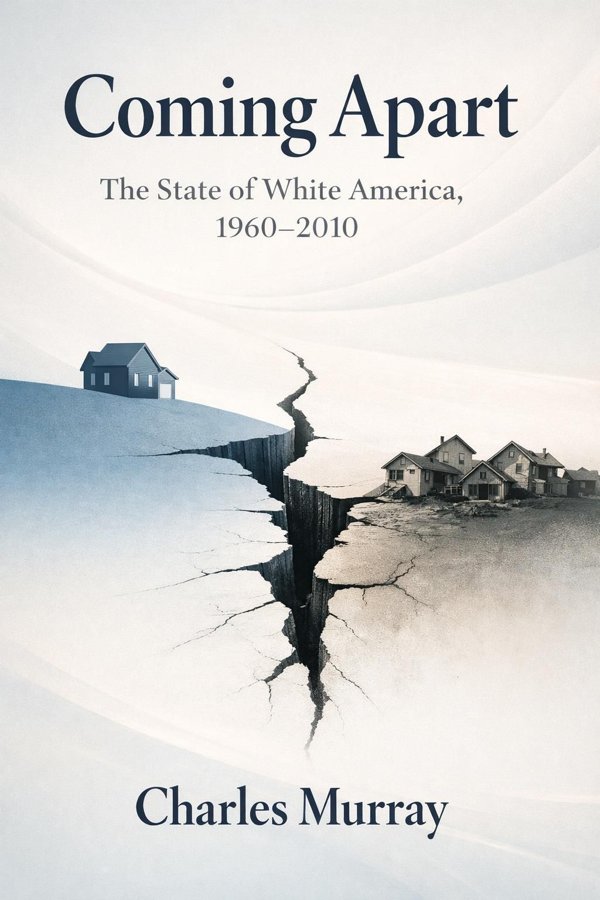
Coming Apart: The State of White America, 1960–2010: Summary & Key Insights
 10 min10 chaptersAudio available
Key Takeaways from Coming Apart: The State of White America, 1960–2010
A society can become divided long before its members realize they no longer inhabit the same social world.
Social decline rarely begins with one dramatic collapse; it more often unfolds through many small losses that gradually become normal.
A nation’s strength depends not only on laws and markets, but on ordinary virtues that people practice without being forced.
Few social changes are more important than the quiet transformation of marriage from a broad norm into a class marker.
When people stop seeing work as a moral obligation, the damage spreads far beyond the paycheck.
What Is Coming Apart: The State of White America, 1960–2010 About?
Coming Apart: The State of White America, 1960–2010 by Charles Murray is a sociology book spanning 10 pages. What happens when a nation’s people still share a flag, a language, and a history, yet increasingly live by different norms, expectations, and life scripts? In Coming Apart, Charles Murray argues that this is exactly what happened to white America between 1960 and 2010. His central claim is not simply that inequality grew, but that a deep cultural separation emerged between an educated upper class and a struggling working class. The divide shows up in marriage, work, religion, civic participation, and community life. Murray focuses on white Americans to isolate class changes from the effects of race and immigration, asking a harder question: what changed within the country’s historic majority population itself? Using demographic data, social indicators, and vivid portraits of two symbolic communities—Belmont and Fishtown—he traces how shared civic habits weakened and how elite America became increasingly insulated from the conditions facing everyone else. Whether you agree with Murray’s conclusions or challenge them, the book matters because it reframes debates about class around culture as much as economics. It is a provocative, data-heavy work that forces readers to think about what binds a society together when its moral foundations begin to diverge.
This FizzRead summary covers all 10 key chapters of Coming Apart: The State of White America, 1960–2010 in approximately 10 minutes, distilling the most important ideas, arguments, and takeaways from Charles Murray's work. Also available as an audio summary and Key Quotes Podcast.
Coming Apart: The State of White America, 1960–2010
What happens when a nation’s people still share a flag, a language, and a history, yet increasingly live by different norms, expectations, and life scripts? In Coming Apart, Charles Murray argues that this is exactly what happened to white America between 1960 and 2010. His central claim is not simply that inequality grew, but that a deep cultural separation emerged between an educated upper class and a struggling working class. The divide shows up in marriage, work, religion, civic participation, and community life.
Murray focuses on white Americans to isolate class changes from the effects of race and immigration, asking a harder question: what changed within the country’s historic majority population itself? Using demographic data, social indicators, and vivid portraits of two symbolic communities—Belmont and Fishtown—he traces how shared civic habits weakened and how elite America became increasingly insulated from the conditions facing everyone else.
Whether you agree with Murray’s conclusions or challenge them, the book matters because it reframes debates about class around culture as much as economics. It is a provocative, data-heavy work that forces readers to think about what binds a society together when its moral foundations begin to diverge.
Who Should Read Coming Apart: The State of White America, 1960–2010?
This book is perfect for anyone interested in sociology and looking to gain actionable insights in a short read. Whether you're a student, professional, or lifelong learner, the key ideas from Coming Apart: The State of White America, 1960–2010 by Charles Murray will help you think differently.
- ✓Readers who enjoy sociology and want practical takeaways
- ✓Professionals looking to apply new ideas to their work and life
- ✓Anyone who wants the core insights of Coming Apart: The State of White America, 1960–2010 in just 10 minutes
Want the full summary?
Get instant access to this book summary and 100K+ more with Fizz Moment.
Get Free SummaryAvailable on App Store • Free to download
Key Chapters
A society can become divided long before its members realize they no longer inhabit the same social world. Murray’s first major insight is that America’s upper class is no longer defined only by money. It is defined by education, marriage patterns, professional norms, parenting styles, neighborhood selection, and a growing ability to shield itself from disorder. By the early twenty-first century, a highly educated elite had clustered in selective universities, knowledge industries, affluent zip codes, and professional networks that reinforced its own values and opportunities.
This new upper class still often speaks in the language of openness and equality, but Murray argues that it increasingly lives apart from the rest of the country. Its members tend to marry one another, invest heavily in their children, avoid crime, maintain stable family structures, and often practice the very virtues they publicly hesitate to moralize about. In other words, they benefit from strong social norms while often resisting the idea that such norms should be defended explicitly.
A practical example is assortative mating: college-educated people increasingly marry other college-educated people, combining income, stability, and social capital in one household. Another example is neighborhood sorting, where the professional class lives in places with safer streets, stronger schools, and institutions that reward long-term planning.
Murray’s point is not that the upper class is evil or uniformly selfish. It is that successful people can become detached from the mechanisms that produced their success. The actionable takeaway is simple: if you want to understand class today, look beyond income and ask how education, marriage, community, and self-segregation create entirely different lived realities.
Social decline rarely begins with one dramatic collapse; it more often unfolds through many small losses that gradually become normal. Murray argues that among working-class whites, the problem was not only wage pressure or disappearing jobs, though those mattered. It was also the weakening of social norms that once organized daily life: marrying before having children, working steadily, participating in community institutions, and maintaining a sense of personal responsibility.
He describes a new lower class not simply as poor, but as increasingly disconnected from the habits that sustain stable communities. In earlier generations, even modest-income neighborhoods often maintained strong expectations around family formation, work discipline, and civic conduct. Over time, those expectations eroded. The result was not merely lower earnings, but greater family instability, reduced labor-force attachment, rising disorder, and a shrinking capacity for collective self-governance.
Murray’s interpretation is controversial because it resists explanations based purely on structural economics. He believes cultural disintegration became a key independent force. For example, two neighborhoods may both experience industrial decline, yet the one that preserves norms around marriage, work, and neighborly trust tends to remain more resilient. Conversely, when those norms weaken, economic setbacks become much more damaging.
In practical terms, this idea helps explain why policy interventions aimed only at income often fail to restore community health. If fewer men work steadily, fewer couples marry; if fewer households are stable, children grow up with weaker routines and lower trust; if trust falls, civic life thins out further.
The actionable takeaway is to evaluate social problems in full context: when diagnosing inequality, ask not only what resources people lack, but which stabilizing norms and institutions have also disappeared.
A nation’s strength depends not only on laws and markets, but on ordinary virtues that people practice without being forced. Murray organizes much of the book around four “founding virtues”: marriage, industriousness, honesty, and religiosity. These are not presented as abstract moral slogans. He treats them as measurable social behaviors that helped sustain American life for generations and whose uneven decline now marks the class divide.
Marriage stabilizes households, channels parental investment, and links adults to long-term obligations. Industriousness reflects more than employment; it includes the habit of showing up, contributing, and accepting responsibility. Honesty extends into civic trust, law-abiding behavior, and willingness to cooperate with neighbors and institutions. Religiosity, in Murray’s framework, does not merely mean private belief. It often anchors moral expectations, mutual aid, and participation in community life.
The power of this framework lies in its simplicity. Instead of discussing social decay in vague terms, Murray asks readers to track whether these four virtues remain widely practiced. If they erode first among one class and remain strong among another, then inequality becomes cultural as well as economic.
A practical application is to use these virtues as diagnostic lenses. When examining a town, school system, or even a family trajectory, ask: Are stable marriages common? Do adults maintain strong work routines? Is trust high enough that people cooperate without fear? Do shared institutions still create moral accountability? You need not share Murray’s politics to find the framework clarifying.
The actionable takeaway is to measure social health by behavior, not rhetoric. Communities become stronger when they intentionally support institutions and norms that reinforce commitment, work, trust, and meaning.
Few social changes are more important than the quiet transformation of marriage from a broad norm into a class marker. Murray shows that marriage did not collapse evenly across white America. Among the educated upper class, it remained strong and even became more central to childrearing and household stability. Among the working class, by contrast, marriage rates fell sharply, nonmarital births increased, and family instability became far more common.
This matters because marriage is not just a private arrangement between two adults. It affects child outcomes, household economics, neighborhood order, and the ability of communities to reproduce stable expectations across generations. Murray argues that elite Americans often continued to live according to a marriage-centered model while becoming less willing to defend it as a social ideal for everyone else.
The class split in marriage helps explain why inequality persists even when some economic conditions improve. A child raised in a stable two-parent home usually benefits from more supervision, more predictable routines, and stronger emotional and financial support. Multiply that pattern across neighborhoods, and marriage becomes a major engine of class reproduction.
A practical example can be seen in school performance. Two children may attend similar public schools, but the one in a more stable household is often better positioned to meet expectations. Likewise, communities with higher marriage rates usually have more adult supervision and lower levels of everyday disorder.
Murray’s analysis can be debated, but his warning is clear: family structure is not a side issue. The actionable takeaway is to treat stable family formation as a serious public concern, whether through personal choices, local mentoring, faith institutions, or policies that reduce penalties against commitment and long-term partnership.
When people stop seeing work as a moral obligation, the damage spreads far beyond the paycheck. Murray uses the term industriousness to describe a core American expectation: able-bodied adults should contribute, exert effort, and orient themselves around purposeful activity. He argues that this ethic weakened significantly in working-class white communities, especially among men, and that the decline cannot be explained by job availability alone.
This is one of the book’s more challenging claims. Murray does not deny that economic restructuring, automation, and deindustrialization hurt many communities. But he insists those forces do not fully explain the withdrawal from work. In his view, the deeper issue is cultural: the fading stigma attached to idleness, dependence, and drifting adulthood. Once a community stops expecting steady work, nonwork becomes easier to rationalize and harder to reverse.
Industriousness matters because it structures daily life. Work creates routine, self-respect, social ties, and accountability. A neighborhood where adults leave for work regularly tends to have different rhythms and norms from one where labor-force detachment is common. Children notice the difference. So do employers, teachers, and local institutions.
A practical application is to distinguish unemployment from disengagement. A laid-off worker still committed to finding work and preserving routine is in a very different moral and social position from someone who has stopped identifying with work entirely. Programs that focus only on benefits or placement may miss this distinction.
The actionable takeaway is to strengthen the culture of contribution wherever possible: celebrate reliability, create pathways into meaningful work, and rebuild expectations that adulthood includes disciplined effort, even when the labor market is difficult.
A free society depends on millions of small acts of trustworthiness that rarely make headlines. Murray’s discussion of honesty extends well beyond telling the truth. He includes law-abiding behavior, responsibility toward others, and the kind of civic reliability that allows neighbors, businesses, schools, and public institutions to function without constant coercion. When honesty declines, communities become more suspicious, fragmented, and expensive to maintain.
Murray points to rising crime, reduced civic participation, and weakening trust as symptoms of this erosion, especially in working-class communities. In a high-trust environment, people assume others will follow basic rules, return what they borrow, and respect shared spaces. In a low-trust environment, people become defensive. They withdraw, monitor one another, and rely more heavily on formal enforcement. The social atmosphere changes completely.
This idea has practical implications. Consider a neighborhood association, a school fundraiser, or a local volunteer effort. These activities depend on confidence that others will do their part. If enough people break commitments or exploit common goods, participation falls. Over time, the whole culture becomes more passive and cynical. Honesty, then, is not a private virtue alone; it is social infrastructure.
Murray also suggests that elites often underestimate how crucial trust is because they inhabit institutions already protected by screening, credentials, and legal safeguards. Working-class communities, by contrast, feel the erosion directly in everyday life.
The actionable takeaway is to treat trust as something you help build through ordinary conduct. Keep promises, respect shared rules, and contribute to local organizations. Civic renewal starts when enough people act as if mutual responsibility is still possible.
Even for people who are not devout, religion can play a powerful civic role by giving communities a shared language of obligation. Murray argues that religiosity historically supported American life not only through belief in God, but through participation in churches and related institutions that encouraged service, restraint, charity, marriage, and accountability. As religiosity declined, especially in some working-class communities, one of the major carriers of moral order weakened as well.
His point is sociological more than theological. Churches provided regular gathering places, intergenerational ties, volunteer networks, and a moral framework that connected individual choices to communal standards. People who drifted morally or socially were not left entirely alone; they remained visible to others who knew them. Once these structures weakened, isolation increased and norms became less enforceable.
A practical example is how congregations often help people through unemployment, illness, addiction, or family crisis. They offer not just material help, but expectations: show up, stay accountable, repair your life. Secular institutions can perform some of these functions, but Murray believes religious communities historically did so at scale and with unusual depth.
This does not mean every religious community is healthy or that secular people cannot build strong moral cultures. It means that when a major institution of belonging declines, something substantial must replace it or social fragmentation grows. Many communities have not found an adequate substitute.
The actionable takeaway is to invest in institutions that create moral community. Whether religious or secular, they should gather people regularly, reinforce responsibility, and connect personal behavior to the well-being of others.
Big national trends become easier to understand when you can picture how they shape real places. To make the class divide concrete, Murray introduces two symbolic communities: Belmont, representing affluent, educated America, and Fishtown, representing the white working class. These are not simply rich and poor neighborhoods. They are social ecosystems with distinct norms, expectations, and outcomes.
In Belmont, adults are highly educated, marriage is common, children are raised in stable homes, crime is relatively low, and institutions function smoothly. The future is planned, not improvised. In Fishtown, the patterns are less stable: marriage has weakened, labor-force attachment is more fragile, social disorder is more visible, and institutions have less authority. The contrast is intended to show how class now shapes everyday life at the level of routine behavior, not just annual income.
What makes this comparison effective is that it moves the discussion away from ideology and toward lived experience. A person in Belmont may sincerely believe America remains broadly meritocratic because everyone in their orbit is working hard, marrying late but solidly, and investing in children. A person in Fishtown encounters a different reality, where instability is common and long-term planning is harder to sustain.
The framework also highlights elite isolation. If those in Belmont rarely interact deeply with Fishtown, they may misunderstand the scale and nature of social breakdown. Conversely, Fishtown may come to view elite moral language as distant and hypocritical.
The actionable takeaway is to examine your own social bubble. If you want to understand class divisions honestly, seek firsthand exposure to communities with different norms and constraints rather than relying only on statistics or stereotypes.
A republic becomes fragile when its classes no longer share not just resources, but a common way of life. Murray’s broader warning is that the divergence between upper-class and working-class white Americans weakens the social glue necessary for democratic stability. If one class enjoys order, marriage, industriousness, and institutional trust while another experiences fragmentation, the country ceases to feel like a unified civic project.
This matters politically and culturally. The upper class may continue to dominate leadership institutions—media, law, universities, corporations, government—while growing less able to represent or even understand those beneath it. At the same time, the lower class may lose trust in institutions that seem remote, moralizing, and indifferent to everyday decline. Polarization then becomes more than disagreement over policy; it becomes a conflict between groups living according to different moral realities.
Murray argues that the American creed once assumed a broad middle sharing key norms, even when wealth differed. As those norms became class-specific, upward mobility grew harder and mutual sympathy weaker. The result is resentment from below and complacency from above.
A practical example is how debates over education, family, crime, or welfare often turn sterile because participants are not arguing from a common lived baseline. Policies designed by Belmont may fail in Fishtown because they overlook the role of local norms, while Fishtown’s frustrations may be dismissed as ignorance instead of treated as evidence of real social breakdown.
The actionable takeaway is to see cohesion itself as a public good. Any serious reform agenda must ask not only how to raise incomes, but how to rebuild shared institutions, expectations, and moral language across class lines.
Some social problems can be eased by funding, regulation, or program design, but Murray insists that culture resists purely administrative solutions. One of his strongest claims is that no policy toolkit can fully restore a society if its underlying norms have decayed. Governments can alter incentives, provide assistance, and reduce barriers, yet they cannot easily manufacture marriage, trust, industriousness, or meaning from above.
This argument does not amount to fatalism. Rather, Murray wants readers to stop treating social disintegration as if it were just a technical problem awaiting a clever intervention. For example, if a community experiences low employment, fractured families, addiction, and weak civic participation, job subsidies alone may not reverse the trend. Likewise, income transfers may relieve hardship without rebuilding responsibility or belonging.
At the same time, the book suggests that elites bear responsibility because they often design policy while insulating themselves from the consequences of cultural decline. They may continue to live by strong norms in private while promoting public attitudes that treat all norms as optional or oppressive. Murray sees this as a dangerous contradiction.
The practical lesson is to broaden what counts as a solution. Cultural repair may require local leadership, religious and civic renewal, public moral confidence, mentoring, stronger family expectations, and institutions that reward disciplined adulthood. Policy can support these efforts, but cannot substitute for them.
The actionable takeaway is to think in layers: use policy to remove obstacles and reduce perverse incentives, but invest equal seriousness in rebuilding the norms, relationships, and local institutions that make good lives sustainable.
All Chapters in Coming Apart: The State of White America, 1960–2010
About the Author
Charles Murray is an American author, political scientist, and social analyst known for his influential and often controversial work on class, public policy, and American society. Born in 1943, he studied history at Harvard and later earned a doctorate in political science from the Massachusetts Institute of Technology. Over the course of his career, he has written several widely discussed books, including Losing Ground, The Bell Curve, and Coming Apart. Murray’s writing often combines statistical analysis with large claims about culture, institutions, and human behavior, making him a major figure in debates about inequality and social structure. Though frequently criticized, he remains an important voice in public discussion because his work consistently challenges conventional explanations and forces readers to confront uncomfortable questions about the foundations of social order.
Get This Summary in Your Preferred Format
Read or listen to the Coming Apart: The State of White America, 1960–2010 summary by Charles Murray anytime, anywhere. FizzRead offers multiple formats so you can learn on your terms — all free.
Available formats: App · Audio · PDF · EPUB — All included free with FizzRead
Download Coming Apart: The State of White America, 1960–2010 PDF and EPUB Summary
Key Quotes from Coming Apart: The State of White America, 1960–2010
“A society can become divided long before its members realize they no longer inhabit the same social world.”
“Social decline rarely begins with one dramatic collapse; it more often unfolds through many small losses that gradually become normal.”
“A nation’s strength depends not only on laws and markets, but on ordinary virtues that people practice without being forced.”
“Few social changes are more important than the quiet transformation of marriage from a broad norm into a class marker.”
“When people stop seeing work as a moral obligation, the damage spreads far beyond the paycheck.”
Frequently Asked Questions about Coming Apart: The State of White America, 1960–2010
Coming Apart: The State of White America, 1960–2010 by Charles Murray is a sociology book that explores key ideas across 10 chapters. What happens when a nation’s people still share a flag, a language, and a history, yet increasingly live by different norms, expectations, and life scripts? In Coming Apart, Charles Murray argues that this is exactly what happened to white America between 1960 and 2010. His central claim is not simply that inequality grew, but that a deep cultural separation emerged between an educated upper class and a struggling working class. The divide shows up in marriage, work, religion, civic participation, and community life. Murray focuses on white Americans to isolate class changes from the effects of race and immigration, asking a harder question: what changed within the country’s historic majority population itself? Using demographic data, social indicators, and vivid portraits of two symbolic communities—Belmont and Fishtown—he traces how shared civic habits weakened and how elite America became increasingly insulated from the conditions facing everyone else. Whether you agree with Murray’s conclusions or challenge them, the book matters because it reframes debates about class around culture as much as economics. It is a provocative, data-heavy work that forces readers to think about what binds a society together when its moral foundations begin to diverge.
More by Charles Murray
You Might Also Like

Between the World and Me
Ta-Nehisi Coates
10 min
Half the Sky
Nicholas D. Kristof, Sheryl WuDunn
10 min
Men Explain Things To Me
Rebecca Solnit
10 min
Rational Ritual
Michael Suk-Young Chwe
10 min
The New Jim Crow
Michelle Alexander
10 min
Beyond Culture
Edward T. Hall
10 minBrowse by Category
Ready to read Coming Apart: The State of White America, 1960–2010?
Get the full summary and 100K+ more books with Fizz Moment.