
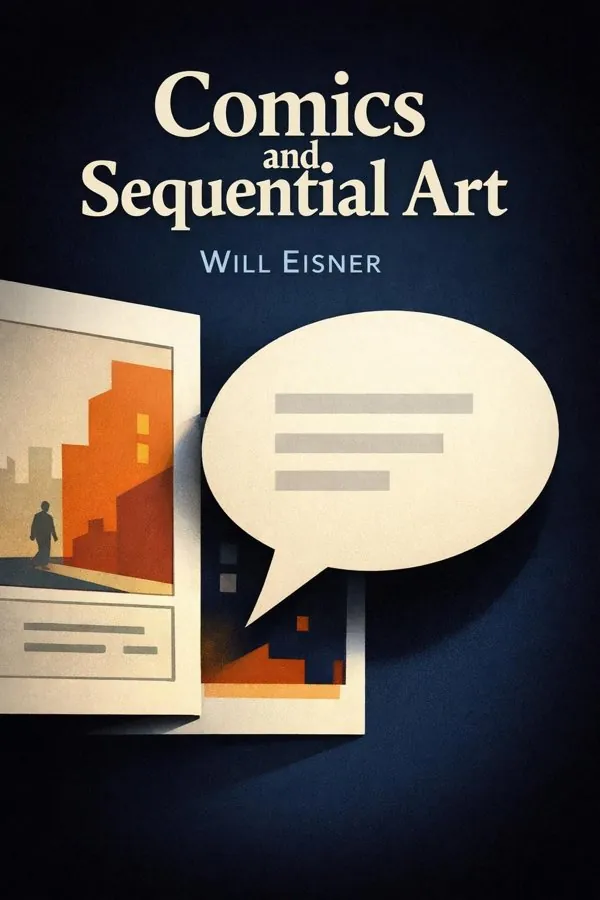
Comics and Sequential Art: Principles and Practices from the Legendary Cartoonist: Summary & Key Insights
by Will Eisner
 10 min10 chaptersAudio available
What Is Comics and Sequential Art: Principles and Practices from the Legendary Cartoonist About?
Comics and Sequential Art: Principles and Practices from the Legendary Cartoonist by Will Eisner is a design book spanning 10 pages. Comics and Sequential Art es una obra fundamental escrita por Will Eisner que explora los principios del arte secuencial, la narrativa visual y la estructura del cómic como medio de comunicación. El libro analiza cómo las imágenes y el texto interactúan para crear significado, ofreciendo una guía teórica y práctica para artistas y narradores gráficos.
This FizzRead summary covers all 10 key chapters of Comics and Sequential Art: Principles and Practices from the Legendary Cartoonist in approximately 10 minutes, distilling the most important ideas, arguments, and takeaways from Will Eisner's work. Also available as an audio summary and Key Quotes Podcast.
Comics and Sequential Art: Principles and Practices from the Legendary Cartoonist
Comics and Sequential Art es una obra fundamental escrita por Will Eisner que explora los principios del arte secuencial, la narrativa visual y la estructura del cómic como medio de comunicación. El libro analiza cómo las imágenes y el texto interactúan para crear significado, ofreciendo una guía teórica y práctica para artistas y narradores gráficos.
Who Should Read Comics and Sequential Art: Principles and Practices from the Legendary Cartoonist?
This book is perfect for anyone interested in design and looking to gain actionable insights in a short read. Whether you're a student, professional, or lifelong learner, the key ideas from Comics and Sequential Art: Principles and Practices from the Legendary Cartoonist by Will Eisner will help you think differently.
- ✓Readers who enjoy design and want practical takeaways
- ✓Professionals looking to apply new ideas to their work and life
- ✓Anyone who wants the core insights of Comics and Sequential Art: Principles and Practices from the Legendary Cartoonist in just 10 minutes
Want the full summary?
Get instant access to this book summary and 100K+ more with Fizz Moment.
Get Free SummaryAvailable on App Store • Free to download
Key Chapters
When I define comics as sequential art, I am emphasizing the idea of sequence—images arranged in deliberate order to convey information or produce an aesthetic response. Unlike single illustrations, which capture a frozen moment, sequential art depends upon progression. Each panel connects to the next, and the reader's imagination bridges the spaces between them. Those voids—what I often call the 'gutter'—are where the magic happens, for there lies the reader's act of synthesis.
In comparing comics to film and literature, I underscore both relationships and distinctions. Like film, comics use framing and visual rhythm. Like literature, they rely on symbolic language and narration. Yet the comic page remains a static surface where time and sequence are represented through visual placement rather than motion. This dual nature gives comics their unique elasticity: the reader controls the pace, reinterprets the rhythm, and experiences both image and text simultaneously.
Understanding comics as a language compels the artist to think about grammar and syntax—not of words, but of images. Decisions about where to place a figure, how to crop an action, or when to shift perspective are equivalent to linguistic choices that shape meaning. Just as a writer employs commas and paragraphs, the cartoonist orchestrates panels and page composition to control understanding. Sequential art thus demands a deliberate design of flow, where every visual element has purpose and narrative consequence.
Seeing comics as communication rather than mere drawing transforms how the artist approaches the work. Craftsmanship becomes storytelling; aesthetics serve communication. This realization marked the turning point of my own approach, and it remains the foundation of every lesson in this book.
A central principle of sequential art is the interaction between image and word. Neither alone conveys the full meaning of the comic form. The picture supplies context, mood, and action; the word directs interpretation, clarifies intent, and can even provide counterpoint.
In my own stories, I’ve experimented with this relationship. At times, text and picture act symphonically, blending seamlessly. At other times, they oppose each other, creating irony or tension. A word balloon might state confidence while the face shows doubt. This interplay expands the expressive range of the medium.
The artist must recognize that every word on the page occupies visual as well as verbal space. A caption box or dialogue balloon becomes an element of composition; its shape, placement, and flow affect rhythm. When text overwhelms image, the drawing loses voice; when image alone carries the message, a vital layer of interpretation may be missing. Achieving harmony between the two is not formulaic—it is the heart of craft.
One guiding conviction in my teaching is that comics should be read visually. Even text must be designed to be seen before it is read. Type choice, size, and placement evoke tone—whisper, shout, pause—and help create pacing. Thus, integrating the word into the visual design is essential to sustaining continuity and emotional resonance across panels.
+ 8 more chapters — available in the FizzRead app
All Chapters in Comics and Sequential Art: Principles and Practices from the Legendary Cartoonist
About the Author
Will Eisner (1917–2005) fue un pionero del cómic estadounidense, conocido por su innovador trabajo en The Spirit y por ser uno de los primeros en promover el concepto de la novela gráfica. Su influencia en la narrativa visual y la educación artística ha sido reconocida mundialmente.
Get This Summary in Your Preferred Format
Read or listen to the Comics and Sequential Art: Principles and Practices from the Legendary Cartoonist summary by Will Eisner anytime, anywhere. FizzRead offers multiple formats so you can learn on your terms — all free.
Available formats: App · Audio · PDF · EPUB — All included free with FizzRead
Download Comics and Sequential Art: Principles and Practices from the Legendary Cartoonist PDF and EPUB Summary
Key Quotes from Comics and Sequential Art: Principles and Practices from the Legendary Cartoonist
“When I define comics as sequential art, I am emphasizing the idea of sequence—images arranged in deliberate order to convey information or produce an aesthetic response.”
“A central principle of sequential art is the interaction between image and word.”
Frequently Asked Questions about Comics and Sequential Art: Principles and Practices from the Legendary Cartoonist
Comics and Sequential Art: Principles and Practices from the Legendary Cartoonist by Will Eisner is a design book that explores key ideas across 10 chapters. Comics and Sequential Art es una obra fundamental escrita por Will Eisner que explora los principios del arte secuencial, la narrativa visual y la estructura del cómic como medio de comunicación. El libro analiza cómo las imágenes y el texto interactúan para crear significado, ofreciendo una guía teórica y práctica para artistas y narradores gráficos.
More by Will Eisner
You Might Also Like

The Design of Everyday Things
Don Norman
10 min
The Better Angels of Our Nature
Steven Pinker
10 min
A Designer's Art
Paul Rand
10 min
Architects' Sketchbooks
Various Editors
10 min
Architectural Graphic Standards
The American Institute of Architects
10 min
Design Is Storytelling
Ellen Lupton
10 minFeatured In
Browse by Category
Ready to read Comics and Sequential Art: Principles and Practices from the Legendary Cartoonist?
Get the full summary and 100K+ more books with Fizz Moment.