
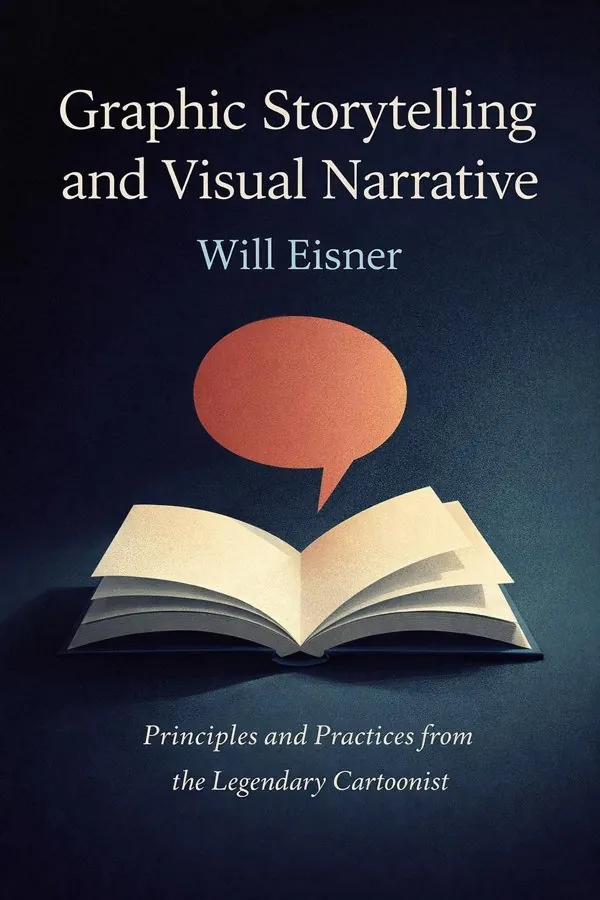
Graphic Storytelling and Visual Narrative: Principles and Practices from the Legendary Cartoonist: Summary & Key Insights
by Will Eisner
 10 min8 chaptersAudio available
Key Takeaways from Graphic Storytelling and Visual Narrative: Principles and Practices from the Legendary Cartoonist
A powerful visual story begins when words stop competing with images and start completing them.
In visual narrative, time is invisible until the storyteller makes the reader feel it.
Readers do not simply look at a page; they are led through it.
Long before a reader analyzes plot, they respond to human feeling.
A background is never just a background.
What Is Graphic Storytelling and Visual Narrative: Principles and Practices from the Legendary Cartoonist About?
Graphic Storytelling and Visual Narrative: Principles and Practices from the Legendary Cartoonist by Will Eisner is a design book spanning 11 pages. Will Eisner’s Graphic Storytelling and Visual Narrative is a masterclass in how stories can be built through images, sequence, rhythm, and design. More than a technical guide to comics, the book explains how visual narrative works as a language of its own—one that blends words, pictures, pacing, gesture, and composition into a unified storytelling experience. Eisner shows that every line, panel, facial expression, and page layout can shape meaning and emotion. The book matters because visual communication has become central to modern culture, from graphic novels and storyboards to interfaces, advertising, and digital media. Eisner treats comics not as a minor entertainment form, but as a sophisticated narrative medium with principles that apply far beyond the page. He examines how readers infer motion from still images, how environments carry dramatic weight, and how storytellers control attention through design. Eisner writes with rare authority. As one of the most influential cartoonists and teachers in comics history, he helped define the graphic novel and spent decades refining the craft. This book distills that lifetime of practice into practical, enduring lessons for artists, writers, designers, educators, and anyone interested in how visual stories move people.
This FizzRead summary covers all 8 key chapters of Graphic Storytelling and Visual Narrative: Principles and Practices from the Legendary Cartoonist in approximately 10 minutes, distilling the most important ideas, arguments, and takeaways from Will Eisner's work. Also available as an audio summary and Key Quotes Podcast.
Graphic Storytelling and Visual Narrative: Principles and Practices from the Legendary Cartoonist
Will Eisner’s Graphic Storytelling and Visual Narrative is a masterclass in how stories can be built through images, sequence, rhythm, and design. More than a technical guide to comics, the book explains how visual narrative works as a language of its own—one that blends words, pictures, pacing, gesture, and composition into a unified storytelling experience. Eisner shows that every line, panel, facial expression, and page layout can shape meaning and emotion.
The book matters because visual communication has become central to modern culture, from graphic novels and storyboards to interfaces, advertising, and digital media. Eisner treats comics not as a minor entertainment form, but as a sophisticated narrative medium with principles that apply far beyond the page. He examines how readers infer motion from still images, how environments carry dramatic weight, and how storytellers control attention through design.
Eisner writes with rare authority. As one of the most influential cartoonists and teachers in comics history, he helped define the graphic novel and spent decades refining the craft. This book distills that lifetime of practice into practical, enduring lessons for artists, writers, designers, educators, and anyone interested in how visual stories move people.
Who Should Read Graphic Storytelling and Visual Narrative: Principles and Practices from the Legendary Cartoonist?
This book is perfect for anyone interested in design and looking to gain actionable insights in a short read. Whether you're a student, professional, or lifelong learner, the key ideas from Graphic Storytelling and Visual Narrative: Principles and Practices from the Legendary Cartoonist by Will Eisner will help you think differently.
- ✓Readers who enjoy design and want practical takeaways
- ✓Professionals looking to apply new ideas to their work and life
- ✓Anyone who wants the core insights of Graphic Storytelling and Visual Narrative: Principles and Practices from the Legendary Cartoonist in just 10 minutes
Want the full summary?
Get instant access to this book summary and 100K+ more with Fizz Moment.
Get Free SummaryAvailable on App Store • Free to download
Key Chapters
A powerful visual story begins when words stop competing with images and start completing them. Eisner argues that comics and graphic narrative are not illustrated prose, nor are they silent pictures with captions attached. They are a hybrid form in which text and image share responsibility for meaning. If the dialogue merely repeats what the drawing already shows, the page becomes redundant. If the image ignores the emotional or informational work of the words, the story feels disconnected. The most effective storytelling happens when each element contributes something the other cannot fully express alone.
This partnership can take many forms. A facial expression may communicate fear more instantly than a sentence ever could, while a short line of dialogue can reveal irony that changes how we read the image. Lettering style, balloon shape, and placement also matter. A shaky word balloon can suggest panic. A heavy caption can slow the reader and add reflection. Even silence is part of the system; removing words can intensify a moment and force the image to carry emotional weight.
For creators, this means every page should be examined for balance. Ask what the art is doing, what the text is doing, and whether they are reinforcing, contrasting, or overexplaining one another. In education or design, the same principle applies: visual and verbal information should be integrated, not layered carelessly.
Actionable takeaway: Review a page or scene and cut any text that merely describes what the image already makes obvious, then strengthen the image so it can do more narrative work.
In visual narrative, time is invisible until the storyteller makes the reader feel it. Eisner explains that each panel is static, yet readers experience movement, duration, and rhythm by mentally connecting one image to the next. This is one of comics’ defining powers: the illusion of time created through sequence. A narrow series of quick panels can accelerate action. A large silent panel can make a moment linger. The gap between panels invites the reader’s imagination to participate in constructing what happened.
Timing is therefore not accidental; it is designed. The number of panels, their size, their shape, and the amount of detail inside them all influence reading speed. A chase scene may use broken-up beats and diagonal compositions to create urgency. A quiet emotional exchange may rely on repeated close-ups, subtle changes in expression, and more open space. Eisner shows that rhythm in comics is as essential as rhythm in music or film, but it must be controlled with still images rather than sound or motion.
This insight applies beyond comics. Storyboards, slide presentations, product walkthroughs, and educational visuals all depend on sequencing information in digestible units. Readers need guidance on when to pause, when to move, and when to absorb.
Actionable takeaway: When designing a scene, sketch the pacing before refining the artwork—decide where the reader should slow down, speed up, or stop, and let panel count and size control that experience.
Readers do not simply look at a page; they are led through it. Eisner emphasizes that composition and framing are not decorative choices but narrative tools. Every panel, angle, and arrangement of shapes influences what the reader notices first, how information is prioritized, and what emotional tone is established. Good composition quietly guides attention. Poor composition creates confusion, weakens dramatic emphasis, and interrupts the flow of story.
A storyteller can direct the eye through contrast, line, perspective, character placement, and page structure. A dark figure against a light background immediately commands attention. A strong diagonal can create momentum. A close-up can force intimacy, while a distant shot can emphasize loneliness or scale. Framing also determines what is omitted. Showing only a hand on a doorknob can create suspense more effectively than revealing the entire room. Eisner treats these choices as equivalent to a writer choosing where to begin a sentence or a director selecting a camera angle.
The page itself is part of the meaning. A cluttered layout can express chaos, while a symmetrical one can suggest control, ritual, or emotional restraint. Designers in advertising, interface design, and instructional graphics face the same challenge: arrange elements so understanding feels natural rather than forced.
Actionable takeaway: Before finalizing a page, test whether a reader can identify the intended focal point in each panel within a second; if not, simplify the composition and strengthen visual hierarchy.
Long before a reader analyzes plot, they respond to human feeling. Eisner insists that character is communicated not only through written personality but through posture, expression, movement, and physical presence on the page. In visual storytelling, emotion must be embodied. A slumped shoulder, a clenched jaw, or a hesitant hand can reveal inner conflict faster and more convincingly than exposition.
This is why gesture matters so deeply. Eisner treats the body as a narrative instrument. Characters should not stand as mannequins delivering lines; they should act, react, and occupy space in ways that reflect their motives and emotional states. Exaggeration can help when clarity is needed, especially in stylized work, but exaggeration must remain truthful to the feeling being conveyed. The reader reads the body instinctively. Even small differences in angle, tension, or spacing between characters can suggest affection, dominance, anxiety, or distrust.
Character design also contributes to narrative identity. Shape, costume, silhouette, and habitual movement all signal who a person is. A rigid, upright figure may imply discipline or repression. A loose, asymmetrical silhouette may suggest unpredictability. These visual decisions support memory and emotional connection.
For anyone creating stories, this means writing dialogue is only half the task. The visual performance of the character must carry equal weight. In teaching, animation, film, and product mascots, the same principle holds: people believe what the body says.
Actionable takeaway: Redraw a scene with the dialogue removed and check whether the characters’ emotions and relationships are still understandable through gesture and expression alone.
A background is never just a background. Eisner shows that environment is an active storytelling force that shapes mood, reveals social reality, and deepens character. Streets, rooms, weather, architecture, and objects all communicate information before a character speaks. A cramped apartment can suggest financial pressure. A decaying alley can create danger and moral ambiguity. A vast empty landscape can amplify isolation. Setting frames the emotional and cultural logic of the story.
In graphic storytelling, environment can also perform structural work. It can orient the reader, clarify action, and create continuity between scenes. Repeated landmarks help readers understand where events are unfolding. Changes in light, season, or spatial arrangement can mark shifts in time or emotional tone. Eisner often treats cities and interiors almost like characters, because they influence behavior and carry memory. A staircase, window, or doorway can become symbolic if used repeatedly at key moments.
This principle is especially useful for creators who tend to focus only on people. Without a meaningful environment, scenes become abstract and interchangeable. With a well-designed setting, even a simple exchange gains texture and significance. The same logic extends to game design, film production design, and brand environments: context changes interpretation.
Actionable takeaway: For each major scene, define one environmental feature that reflects the emotional stakes—such as weather, clutter, scale, or architecture—and make it visible enough to shape the reader’s interpretation.
A story is only as strong as the reader’s ability to move through it without breaking attention. Eisner highlights transitions and continuity as the connective tissue of visual narrative. The challenge is not merely creating compelling individual images, but arranging them so the reader understands what changed, what remained stable, and why the next moment follows from the last. Continuity gives sequence coherence; transitions give it momentum.
Panel-to-panel movement can indicate action, reaction, shifts in place, changes in time, or jumps in perspective. But unless these changes are clearly signaled, the reader must stop and decode basic logistics instead of engaging the story emotionally. Eisner emphasizes consistency in character placement, direction of movement, spatial cues, and visual anchors. If a character exits to the right in one panel and appears entering from the left in the next, the choice should support orientation rather than confuse it. Transitions can also be expressive. A hard cut from noise to silence, or from a crowded city panel to an empty room, can create emotional contrast and thematic resonance.
Creators in many fields confront this issue. Instructional diagrams, explainer videos, and product flows all depend on transitions that feel intuitive. Continuity is not a limitation on creativity; it is what allows creativity to be legible.
Actionable takeaway: After laying out a sequence, cover the text and trace the action path panel by panel to ensure space, direction, and time remain understandable without verbal explanation.
The most memorable visual stories often say more than their literal events. Eisner explains that themes become powerful when they are embodied in recurring symbols, motifs, and visual metaphors. A story about loneliness may repeatedly frame characters through windows. A story about pressure may use narrowing corridors or oppressive shadows. These devices allow the page to operate on both narrative and symbolic levels at once.
Visual metaphor is especially potent because it works quickly and emotionally. Readers do not need an essay to feel what an image implies. Rain can externalize grief. Distorted perspective can represent fear. Broken objects can suggest fractured relationships. Symbols gain force through repetition and variation. An object introduced casually early in the story may return later with transformed meaning, giving the narrative cohesion and emotional payoff.
Eisner’s point is not that every page should be packed with abstract symbolism. Rather, visual storytelling becomes richer when creators think beyond surface depiction. Theme should not be confined to dialogue or plot summary. It should be built into the visual language of the work. This is equally true in branding, editorial illustration, and film titles, where symbolic consistency creates identity and resonance.
Actionable takeaway: Identify your story’s central theme, then choose one recurring visual motif—such as light, weather, architecture, or an object—and use it in at least three different scenes to reinforce meaning without explicit explanation.
Technique alone does not make a great visual storyteller; judgment does. Eisner closes the loop between craft, communication, and responsibility by arguing that graphic storytelling is both an artistic discipline and a social act. The storyteller is shaping perception, emotion, and understanding. Because comics combine immediacy with accessibility, they can educate, persuade, entertain, and influence cultural memory. That power requires skill, but also awareness.
Eisner draws heavily from practice. He treats examples, revision, observation, and experimentation as essential to mastery. Artists learn not just by studying anatomy or perspective, but by studying how people behave, how scenes unfold, and how readers interpret images. Every solution on the page is a communication choice. What do you simplify? What do you exaggerate? What assumptions do you encode? These questions matter in fiction as much as in educational or journalistic work.
He also points toward the evolving future of the medium. Graphic storytelling is not fixed to newspaper strips or comic books; its principles extend into visual education, digital storytelling, interface design, and multimedia communication. That makes the storyteller’s role even broader. The creator must think not only about style, but about clarity, ethics, audience, and effect.
Actionable takeaway: Build a regular practice of analyzing real scenes and revising your own pages with the reader in mind, asking not just whether the work looks good, but whether it communicates honestly, clearly, and purposefully.
All Chapters in Graphic Storytelling and Visual Narrative: Principles and Practices from the Legendary Cartoonist
About the Author
Will Eisner (1917–2005) was an American cartoonist, writer, and educator whose influence on comics is hard to overstate. He first rose to prominence with The Spirit, a groundbreaking series celebrated for its cinematic layouts, expressive storytelling, and formal innovation. Over time, Eisner became one of the leading advocates for comics as a serious literary and artistic medium, helping popularize the concept of the graphic novel through works such as A Contract with God. He was also a major teacher of visual narrative, and his instructional books on sequential art became essential reading for artists, writers, and designers. Revered for both his craft and his critical thinking, Eisner helped define how modern creators understand comics, storytelling, and the communicative power of images.
Get This Summary in Your Preferred Format
Read or listen to the Graphic Storytelling and Visual Narrative: Principles and Practices from the Legendary Cartoonist summary by Will Eisner anytime, anywhere. FizzRead offers multiple formats so you can learn on your terms — all free.
Available formats: App · Audio · PDF · EPUB — All included free with FizzRead
Download Graphic Storytelling and Visual Narrative: Principles and Practices from the Legendary Cartoonist PDF and EPUB Summary
Key Quotes from Graphic Storytelling and Visual Narrative: Principles and Practices from the Legendary Cartoonist
“A powerful visual story begins when words stop competing with images and start completing them.”
“In visual narrative, time is invisible until the storyteller makes the reader feel it.”
“Readers do not simply look at a page; they are led through it.”
“Long before a reader analyzes plot, they respond to human feeling.”
“A background is never just a background.”
Frequently Asked Questions about Graphic Storytelling and Visual Narrative: Principles and Practices from the Legendary Cartoonist
Graphic Storytelling and Visual Narrative: Principles and Practices from the Legendary Cartoonist by Will Eisner is a design book that explores key ideas across 8 chapters. Will Eisner’s Graphic Storytelling and Visual Narrative is a masterclass in how stories can be built through images, sequence, rhythm, and design. More than a technical guide to comics, the book explains how visual narrative works as a language of its own—one that blends words, pictures, pacing, gesture, and composition into a unified storytelling experience. Eisner shows that every line, panel, facial expression, and page layout can shape meaning and emotion. The book matters because visual communication has become central to modern culture, from graphic novels and storyboards to interfaces, advertising, and digital media. Eisner treats comics not as a minor entertainment form, but as a sophisticated narrative medium with principles that apply far beyond the page. He examines how readers infer motion from still images, how environments carry dramatic weight, and how storytellers control attention through design. Eisner writes with rare authority. As one of the most influential cartoonists and teachers in comics history, he helped define the graphic novel and spent decades refining the craft. This book distills that lifetime of practice into practical, enduring lessons for artists, writers, designers, educators, and anyone interested in how visual stories move people.
More by Will Eisner
You Might Also Like

The Design of Everyday Things
Don Norman
10 min
The Better Angels of Our Nature
Steven Pinker
10 min
A Designer's Art
Paul Rand
10 min
Architects' Sketchbooks
Various Editors
10 min
Architectural Graphic Standards
The American Institute of Architects
10 min
Design Is Storytelling
Ellen Lupton
10 minBrowse by Category
Ready to read Graphic Storytelling and Visual Narrative: Principles and Practices from the Legendary Cartoonist?
Get the full summary and 100K+ more books with Fizz Moment.