
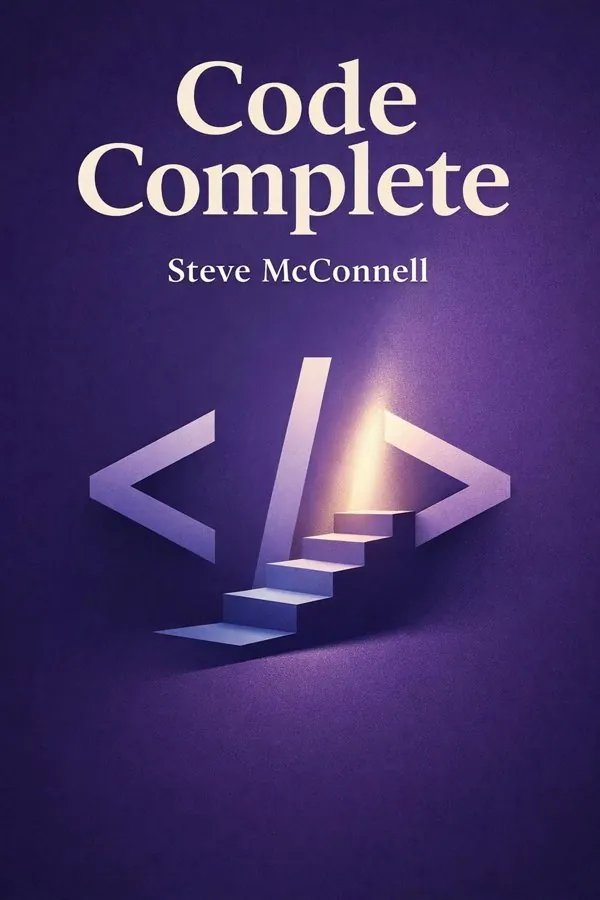
Code Complete: A Practical Handbook of Software Construction: Summary & Key Insights
 10 min9 chaptersAudio available
Key Takeaways from Code Complete: A Practical Handbook of Software Construction
Most software problems are not dramatic failures of intelligence; they are accumulations of small quality compromises.
Complexity is the true enemy of software development because it multiplies mistakes faster than teams can fix them.
Unreadable code is expensive code.
Programs become fragile when their basic building blocks are used carelessly.
Many software disasters begin not with dramatic crashes, but with incorrect assumptions that go unchallenged.
What Is Code Complete: A Practical Handbook of Software Construction About?
Code Complete: A Practical Handbook of Software Construction by Steve McConnell is a programming book spanning 5 pages. Software rarely fails because developers do not know enough syntax. It fails because teams underestimate complexity, make rushed design decisions, skip disciplined construction practices, and treat code quality as optional rather than foundational. In Code Complete, Steve McConnell offers a practical, deeply researched handbook for writing software that is not only functional, but readable, maintainable, reliable, and professional. Rather than focusing on a single language or trendy framework, the book distills universal principles of software construction: how to name things clearly, structure logic sensibly, prevent defects early, debug effectively, and work in ways that make future change safer and cheaper. What makes this book matter decades after publication is its blend of evidence and experience. McConnell draws from software engineering research, real-world project lessons, and industry best practices to show that excellent code is not the result of genius alone, but of disciplined habits. As the founder of Construx Software and one of the most respected voices in software engineering, McConnell writes with authority and practicality. For developers, team leads, and serious learners, Code Complete remains one of the most valuable guides to the craft of programming.
This FizzRead summary covers all 9 key chapters of Code Complete: A Practical Handbook of Software Construction in approximately 10 minutes, distilling the most important ideas, arguments, and takeaways from Steve McConnell's work. Also available as an audio summary and Key Quotes Podcast.
Code Complete: A Practical Handbook of Software Construction
Software rarely fails because developers do not know enough syntax. It fails because teams underestimate complexity, make rushed design decisions, skip disciplined construction practices, and treat code quality as optional rather than foundational. In Code Complete, Steve McConnell offers a practical, deeply researched handbook for writing software that is not only functional, but readable, maintainable, reliable, and professional. Rather than focusing on a single language or trendy framework, the book distills universal principles of software construction: how to name things clearly, structure logic sensibly, prevent defects early, debug effectively, and work in ways that make future change safer and cheaper.
What makes this book matter decades after publication is its blend of evidence and experience. McConnell draws from software engineering research, real-world project lessons, and industry best practices to show that excellent code is not the result of genius alone, but of disciplined habits. As the founder of Construx Software and one of the most respected voices in software engineering, McConnell writes with authority and practicality. For developers, team leads, and serious learners, Code Complete remains one of the most valuable guides to the craft of programming.
Who Should Read Code Complete: A Practical Handbook of Software Construction?
This book is perfect for anyone interested in programming and looking to gain actionable insights in a short read. Whether you're a student, professional, or lifelong learner, the key ideas from Code Complete: A Practical Handbook of Software Construction by Steve McConnell will help you think differently.
- ✓Readers who enjoy programming and want practical takeaways
- ✓Professionals looking to apply new ideas to their work and life
- ✓Anyone who wants the core insights of Code Complete: A Practical Handbook of Software Construction in just 10 minutes
Want the full summary?
Get instant access to this book summary and 100K+ more with Fizz Moment.
Get Free SummaryAvailable on App Store • Free to download
Key Chapters
Most software problems are not dramatic failures of intelligence; they are accumulations of small quality compromises. McConnell argues that software construction is not a minor implementation phase tucked between design and testing. It is the core activity where ideas become reality, where defects are introduced or prevented, and where long-term maintainability is either created or destroyed. High-quality code reduces bugs, accelerates onboarding, lowers maintenance cost, and makes future features easier to add. Poor-quality code does the opposite, turning even simple changes into risky operations.
A central insight of the book is that programmers should stop thinking of code as something written only for the computer. Code is also communication for other developers, including your future self. A program that "works" but is obscure, brittle, and inconsistent is unfinished in an important sense. Construction quality affects every downstream activity: testing becomes harder when code is tangled, debugging slows when logic is unclear, and estimates become unreliable when technical debt grows unnoticed.
Consider two teams building the same feature. One writes clear methods, meaningful variable names, and small, cohesive modules. The other rushes through with duplicated logic and unclear conditions. Both may ship at first, but six months later the difference becomes enormous. The first team can extend the system confidently; the second is trapped in fear-driven maintenance.
McConnell’s broader point is that craftsmanship is not decorative. It is economic. Better code saves time, money, and attention across the life of a system. The discipline of construction is therefore not separate from project success; it is one of its strongest predictors.
Actionable takeaway: Treat code quality as a business asset by writing every function and class so it is easy to understand, verify, and safely change later.
Complexity is the true enemy of software development because it multiplies mistakes faster than teams can fix them. McConnell emphasizes that good construction begins long before individual lines of code are written. It starts with design choices that control complexity, isolate responsibilities, and reduce the mental load required to understand a system. The goal of design is not perfection; it is making the software easier to reason about.
One of the book’s most practical ideas is that developers should break systems into manageable parts with clear interfaces and cohesive responsibilities. A well-designed module does one thing well and reveals only what other parts need to know. When modules leak implementation details or mix unrelated concerns, every future change ripples outward. That is when simple work turns into unpredictable work.
For example, imagine a billing component that calculates totals, formats invoices, stores database records, and sends emails. It may function, but it combines too many responsibilities. A change to tax rules could unexpectedly affect output formatting or delivery logic. By separating calculation, persistence, and communication, each part becomes simpler to test and modify.
McConnell also challenges the common assumption that coding quickly means skipping design. In reality, a little thoughtful design often prevents weeks of confusion later. He encourages developers to explore alternatives, compare trade-offs, and choose structures that fit the problem rather than forcing everything into familiar patterns.
Good design does not eliminate complexity completely. Instead, it contains it. That containment is what allows teams to build larger systems without losing clarity.
Actionable takeaway: Before implementing a feature, identify its core responsibilities and separate them into small, cohesive units with clear boundaries.
Unreadable code is expensive code. One of McConnell’s enduring lessons is that naming is not a cosmetic decision but a central act of design. Developers constantly make micro-decisions about variables, functions, classes, constants, and files, and weak names accumulate into a system that feels confusing even when the logic is technically correct. Good names reduce the need for explanation because they reveal intent directly.
A vague variable like data or temp forces the reader to infer meaning from context. A specific name like customerEmailAddress or retryDelaySeconds removes guesswork. Similarly, a function named process() says almost nothing, while calculateMonthlyInterest() tells both purpose and scope. McConnell argues that precision in naming improves communication, lowers cognitive friction, and reduces errors during modification.
The same principle applies to code structure. Self-explanatory code often comes from decomposing large routines into smaller ones with intent-revealing names. Instead of placing a long block of nested conditions in one method, a programmer might extract logic into methods like isValidOrder(), applyDiscountRules(), and generateShipmentRequest(). The resulting code reads more like a clear argument than a puzzle.
Comments still matter, but McConnell warns against using them to compensate for unnecessarily obscure code. The best comment is often the one you no longer need because the code itself is clear. Comments should explain why, assumptions, and non-obvious decisions, not merely restate what the code already says.
Readable software is not about elegance for its own sake. It is a practical strategy for reducing defects and making collaboration easier. Every naming choice either clarifies or obscures the system.
Actionable takeaway: Review your next commit specifically for naming quality, and rename any identifier that would confuse a new teammate reading it for the first time.
Programs become fragile when their basic building blocks are used carelessly. McConnell pays close attention to the everyday mechanics of software construction: variables, constants, expressions, conditionals, loops, and routines. These low-level elements may seem mundane, but they determine whether code remains understandable under pressure. Small structural improvements often prevent large logical mistakes.
He encourages programmers to choose data representations deliberately. A poor data model spreads confusion across an entire codebase. For instance, using raw strings for status values like "paid," "pending," and "failed" might work initially, but it invites typos and inconsistency. Replacing them with a constrained type such as an enum or validated object makes the program safer and easier to reason about. In the same way, limiting variable scope, favoring constants where appropriate, and initializing data carefully all reduce opportunities for bugs.
Control flow deserves the same discipline. Deep nesting, complex boolean expressions, and loop bodies that do too much make code harder to test and debug. McConnell recommends writing straightforward logic, simplifying conditions, and using routines to express intent. A complex if statement can often be replaced with a well-named helper function. A large loop can often be split into preparation, processing, and cleanup phases.
For example, instead of one method that validates input, transforms records, logs failures, updates a database, and sends notifications, a clearer implementation would separate those concerns into distinct routines with obvious purposes. This does not just improve style; it makes behavior easier to verify.
McConnell’s message is that structure creates reliability. Better control and data choices improve readability, correctness, and maintainability all at once.
Actionable takeaway: Refactor one overly complex conditional or loop this week into smaller routines and safer data representations.
Many software disasters begin not with dramatic crashes, but with incorrect assumptions that go unchallenged. McConnell presents defensive programming as the habit of writing code that anticipates misuse, invalid input, impossible states, and integration surprises. The idea is not paranoia for its own sake. It is a recognition that real systems interact with imperfect users, changing requirements, and fallible developers.
Defensive programming starts with clarifying assumptions. What inputs are allowed? What conditions must hold before a method runs? What outputs can callers rely on? When these expectations remain implicit, systems fail in confusing ways. McConnell recommends expressing assumptions through assertions, input validation, error handling, and clear interfaces. This helps defects surface early, closer to their source.
Imagine an API endpoint that expects a positive quantity and a valid product ID. If the code silently accepts bad values and continues, the resulting errors may appear later in billing or inventory. If the code validates inputs immediately and reports precise failures, debugging becomes far easier. Similarly, if a method assumes a configuration object is never null, an assertion documents that expectation and catches violations during development.
McConnell also distinguishes between robust handling and clutter. Defensive code should support clarity, not bury logic under unnecessary checks. The aim is to create systems that fail predictably and diagnostically rather than mysteriously.
This chapter connects strongly to professional humility. Defensive programmers do not assume they are infallible. They design software that helps them detect mistakes quickly, contain damage, and recover gracefully where possible. That mindset is a mark of engineering maturity.
Actionable takeaway: For every public method or interface you write, define and enforce its assumptions through validation, assertions, and explicit error behavior.
Debugging is not just what happens after coding goes wrong; it is part of disciplined construction. McConnell argues that excellent developers do not treat testing and debugging as separate rescue operations performed at the end of a project. Instead, they build software in ways that make defects easier to detect, isolate, and eliminate throughout development. This shift in mindset leads to faster feedback and fewer expensive surprises.
A major insight in the book is that the cheapest bug is the one you prevent, and the second cheapest is the one you detect early. Code that is modular, readable, and loosely coupled is easier to test. Small routines can be exercised in isolation. Clear interfaces expose misuse faster. Consistent naming and structure make suspicious behavior easier to trace.
When debugging, McConnell favors a methodical approach over random tinkering. Reproduce the defect reliably, narrow the conditions that trigger it, inspect assumptions, and change one thing at a time. For example, if a report generator sometimes omits transactions, the disciplined developer first identifies whether the fault lies in filtering, aggregation, formatting, or data retrieval. Guessing and patching blindly may hide the symptom while preserving the cause.
He also emphasizes personal process improvement. Developers should learn from recurring mistakes. If a programmer repeatedly introduces off-by-one errors, data mutation bugs, or weak null handling, those patterns should shape future checklists and review habits.
Testing and debugging are therefore not signs of failure. They are core practices of software construction, deeply connected to design and code quality. The better the construction process, the easier correction becomes.
Actionable takeaway: Adopt a repeatable debugging routine: reproduce, isolate, hypothesize, verify, and record the root cause so you can prevent similar defects later.
Large software failures often come from a dangerous fantasy: that complex systems can be built correctly in one grand sweep. McConnell strongly favors incremental development, where software evolves through small, reviewable, testable steps. This approach reduces risk, exposes misunderstandings earlier, and makes progress more visible. It also protects teams from the chaos that comes when too much is changed at once.
Incremental development is practical because it aligns with how humans actually solve problems. We rarely understand every detail of a feature before implementation begins. As we code, edge cases emerge, user expectations shift, and hidden dependencies appear. Small iterations allow teams to adjust without destabilizing the entire system. They also create natural checkpoints for design reconsideration, code review, and testing.
For instance, instead of building an entire user account system in one pass, a team might first implement registration, then authentication, then password reset, then audit logging. Each increment can be validated independently. If a flaw appears in the data model, it is cheaper to correct after the first slice than after a sprawling full-stack rollout.
McConnell contrasts this with heroic programming, where individual brilliance and late-night effort are expected to overcome weak process. Heroics may occasionally produce short-term wins, but they are unreliable and hard to scale. Sustainable software comes from repeatable methods, not emergency performance.
This principle is especially relevant to modern teams working with continuous delivery, feature flags, and iterative product development. The tools have evolved, but the underlying logic remains the same: smaller steps create better feedback and fewer catastrophic errors.
Actionable takeaway: Break your next feature into the smallest meaningful increments and validate each one before expanding scope.
Programming is often imagined as a solitary activity, but McConnell shows that software quality improves dramatically when construction becomes visible and shared. Code reviews, design inspections, and coding standards are not bureaucratic rituals if used correctly. They are quality mechanisms that catch defects, spread knowledge, and build consistency across a team.
A useful coding standard does not exist to enforce personal taste. It reduces unnecessary variation so developers can focus their attention on substance rather than style confusion. If every file uses different naming conventions, formatting, error handling patterns, and control structures, reading the codebase becomes mentally exhausting. A common standard creates familiarity and lowers friction.
Reviews add another layer of protection. A second set of eyes often catches what the author overlooks, especially in logic, assumptions, and edge cases. More importantly, reviews are educational. Junior developers learn design judgment from senior comments, while senior developers gain visibility into implementation realities. Over time, this improves the technical culture of the team.
Consider a payment service where one developer introduces duplicated validation logic and another spots it during review. The issue is not only fixed; the team can discuss a shared helper or design improvement that prevents similar duplication elsewhere. In that sense, reviews are opportunities for system-level improvement, not just line-by-line correction.
McConnell also notes that collaborative construction supports maintainability. Code written to a common standard and shaped through review is easier for anyone on the team to modify later. That lowers dependency on individual memory and reduces operational risk.
Actionable takeaway: Establish lightweight code review criteria focused on clarity, correctness, duplication, and maintainability rather than personal preference.
The difference between average and exceptional programmers is rarely raw intelligence alone. McConnell’s deeper message is that software development is a craft, and like any craft, it improves through deliberate practice, reflection, and disciplined habits. Professional mastery means moving beyond simply making code run. It means caring how it is built, how others will work with it, and how your own process can keep improving.
A mature developer studies mistakes rather than repeating them. If estimates are consistently wrong, that becomes a process issue to examine. If certain kinds of defects appear repeatedly, they should inform checklists, review focus, and design habits. McConnell encourages developers to be empirical: observe outcomes, refine methods, and seek evidence about what works instead of relying on habit or ego.
This mindset also changes how one views tools and techniques. No language, framework, or methodology automatically produces excellent software. Quality comes from thoughtful application. A sophisticated tool in the hands of an undisciplined team still produces confusing systems. Conversely, a careful team using modest tools can produce reliable, maintainable software through sound construction practices.
Professionalism also includes responsibility to teammates and future maintainers. Writing clear code, documenting assumptions, and reducing unnecessary cleverness are acts of respect. They acknowledge that software is built within organizations, not in isolation.
Code Complete ultimately treats programming as engineering informed by judgment. Technical excellence is not accidental. It grows from consistent standards, reflection, humility, and the willingness to improve one small decision at a time.
Actionable takeaway: Create a personal improvement loop by tracking your recurring coding mistakes and turning them into a checklist for design, coding, and review.
All Chapters in Code Complete: A Practical Handbook of Software Construction
About the Author
Steve McConnell is an American software engineer, author, and consultant widely recognized for his influence on software development practices. He is the founder and former CEO of Construx Software, a company focused on improving software engineering performance through consulting, training, and research. McConnell became especially well known for writing Code Complete, one of the most respected books on software construction, as well as Rapid Development and other works on project management and technical leadership. His writing stands out for combining practical programming advice with findings from software engineering research. Over the course of his career, he has helped shape how developers and organizations think about code quality, productivity, and professional discipline in software development.
Get This Summary in Your Preferred Format
Read or listen to the Code Complete: A Practical Handbook of Software Construction summary by Steve McConnell anytime, anywhere. FizzRead offers multiple formats so you can learn on your terms — all free.
Available formats: App · Audio · PDF · EPUB — All included free with FizzRead
Download Code Complete: A Practical Handbook of Software Construction PDF and EPUB Summary
Key Quotes from Code Complete: A Practical Handbook of Software Construction
“Most software problems are not dramatic failures of intelligence; they are accumulations of small quality compromises.”
“Complexity is the true enemy of software development because it multiplies mistakes faster than teams can fix them.”
“One of McConnell’s enduring lessons is that naming is not a cosmetic decision but a central act of design.”
“Programs become fragile when their basic building blocks are used carelessly.”
“Many software disasters begin not with dramatic crashes, but with incorrect assumptions that go unchallenged.”
Frequently Asked Questions about Code Complete: A Practical Handbook of Software Construction
Code Complete: A Practical Handbook of Software Construction by Steve McConnell is a programming book that explores key ideas across 9 chapters. Software rarely fails because developers do not know enough syntax. It fails because teams underestimate complexity, make rushed design decisions, skip disciplined construction practices, and treat code quality as optional rather than foundational. In Code Complete, Steve McConnell offers a practical, deeply researched handbook for writing software that is not only functional, but readable, maintainable, reliable, and professional. Rather than focusing on a single language or trendy framework, the book distills universal principles of software construction: how to name things clearly, structure logic sensibly, prevent defects early, debug effectively, and work in ways that make future change safer and cheaper. What makes this book matter decades after publication is its blend of evidence and experience. McConnell draws from software engineering research, real-world project lessons, and industry best practices to show that excellent code is not the result of genius alone, but of disciplined habits. As the founder of Construx Software and one of the most respected voices in software engineering, McConnell writes with authority and practicality. For developers, team leads, and serious learners, Code Complete remains one of the most valuable guides to the craft of programming.
You Might Also Like
ANSI Common Lisp
Paul Graham
10 min
Automate the Boring Stuff with Python: Practical Programming for Total Beginners
Al Sweigart
10 min
Black Hat Python: Python Programming for Hackers and Pentesters
Justin Seitz
10 min
Building Microservices: Designing Fine-Grained Systems
Sam Newman
10 min
C++ Primer
Stanley B. Lippman, Josée Lajoie, Barbara E. Moo
10 min
Clean Code: A Handbook of Agile Software Craftsmanship
Robert C. Martin
10 minBrowse by Category
Ready to read Code Complete: A Practical Handbook of Software Construction?
Get the full summary and 100K+ more books with Fizz Moment.