
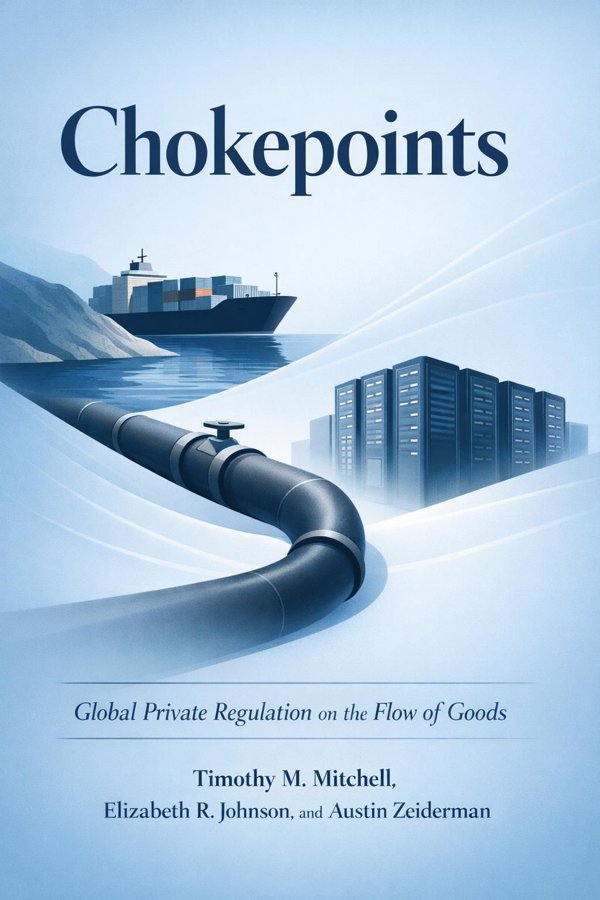
Chokepoints: Global Private Regulation on the Flow of Goods: Summary & Key Insights
by Timothy M. Mitchell, Elizabeth R. Johnson, and Austin Zeiderman
 10 min9 chaptersAudio available
What Is Chokepoints: Global Private Regulation on the Flow of Goods About?
Chokepoints: Global Private Regulation on the Flow of Goods by Timothy M. Mitchell, Elizabeth R. Johnson, and Austin Zeiderman is a politics book spanning 9 pages. Chokepoints explores how private actors—corporations, logistics firms, and financial institutions—control the global circulation of goods through critical nodes such as ports, pipelines, and data centers. The book examines the political and economic implications of these control points, revealing how they shape global trade, labor, and environmental governance.
This FizzRead summary covers all 9 key chapters of Chokepoints: Global Private Regulation on the Flow of Goods in approximately 10 minutes, distilling the most important ideas, arguments, and takeaways from Timothy M. Mitchell, Elizabeth R. Johnson, and Austin Zeiderman's work. Also available as an audio summary and Key Quotes Podcast.
Chokepoints: Global Private Regulation on the Flow of Goods
Chokepoints explores how private actors—corporations, logistics firms, and financial institutions—control the global circulation of goods through critical nodes such as ports, pipelines, and data centers. The book examines the political and economic implications of these control points, revealing how they shape global trade, labor, and environmental governance.
Who Should Read Chokepoints: Global Private Regulation on the Flow of Goods?
This book is perfect for anyone interested in politics and looking to gain actionable insights in a short read. Whether you're a student, professional, or lifelong learner, the key ideas from Chokepoints: Global Private Regulation on the Flow of Goods by Timothy M. Mitchell, Elizabeth R. Johnson, and Austin Zeiderman will help you think differently.
- ✓Readers who enjoy politics and want practical takeaways
- ✓Professionals looking to apply new ideas to their work and life
- ✓Anyone who wants the core insights of Chokepoints: Global Private Regulation on the Flow of Goods in just 10 minutes
Want the full summary?
Get instant access to this book summary and 100K+ more with Fizz Moment.
Get Free SummaryAvailable on App Store • Free to download
Key Chapters
The modern world of circulation did not arise spontaneously. It is the product of centuries of political engineering, technological innovation, and economic control. Historically, empires created chokepoints to manage trade routes, ensuring control over scarce goods and colonial extraction. The Suez Canal, the Panama Canal, and multiple port cities across Asia and Europe became more than infrastructures—they were embodiments of geopolitical order.
We trace the lineage from colonial maritime empires to the logistics revolution of the late twentieth century. The standardized shipping container transformed not only transport efficiency but also the spatial politics of globalization. Ports were redesigned for scale and speed, workers were fragmented through casualization, and entire countries reorganized their economies around positions within global supply chains. These critical infrastructures produced zones of governance where state sovereignty blurred into private management.
By uncovering these historical transitions, we reveal that chokepoints are where institutions of control evolve. What starts as an engineering solution becomes a political instrument. Pipelines that traverse continents are not only conduits for oil—they are templates for the regulation of energy, the projection of security, and the management of environmental risk. In this evolution, chokepoints embody the intimate connection between material flow and political authority.
One of the defining shifts in the contemporary era is the retreat of the public state and the advancing oversight of private entities. Ports today are operated by multinational corporations whose decisions about access, tariffs, or security influence global trade patterns more than government policies. Logistics companies manage the invisible choreography of supply chains—where goods move, how swiftly, and at what cost.
This chapter dissects how private governance works through ownership and management of chokepoints. Corporations, through concessions or outright possession, assume regulatory powers. They define standards for efficiency, oversee compliance, and enforce security norms. In many ways, they perform functions once reserved for states: taxation through fees, customs through data-driven inspection, and even law enforcement via surveillance technologies.
Yet corporate regulation does not aim at public welfare. It follows the imperatives of capital optimization. This means chokepoints become arenas of asymmetrical power—large firms like Maersk or DP World possess authority over the logistics that sustain everyday life, from food distribution to digital connectivity. Through these privatized infrastructures, governance migrates from parliaments to boardrooms, shifting accountability and shaping the contours of global inequality.
+ 7 more chapters — available in the FizzRead app
All Chapters in Chokepoints: Global Private Regulation on the Flow of Goods
About the Authors
Timothy M. Mitchell is a political theorist and historian known for his work on the political economy of the Middle East. Elizabeth R. Johnson is a geographer specializing in global logistics and infrastructure. Austin Zeiderman is an anthropologist focusing on urban governance and risk in Latin America.
Get This Summary in Your Preferred Format
Read or listen to the Chokepoints: Global Private Regulation on the Flow of Goods summary by Timothy M. Mitchell, Elizabeth R. Johnson, and Austin Zeiderman anytime, anywhere. FizzRead offers multiple formats so you can learn on your terms — all free.
Available formats: App · Audio · PDF · EPUB — All included free with FizzRead
Download Chokepoints: Global Private Regulation on the Flow of Goods PDF and EPUB Summary
Key Quotes from Chokepoints: Global Private Regulation on the Flow of Goods
“The modern world of circulation did not arise spontaneously.”
“One of the defining shifts in the contemporary era is the retreat of the public state and the advancing oversight of private entities.”
Frequently Asked Questions about Chokepoints: Global Private Regulation on the Flow of Goods
Chokepoints: Global Private Regulation on the Flow of Goods by Timothy M. Mitchell, Elizabeth R. Johnson, and Austin Zeiderman is a politics book that explores key ideas across 9 chapters. Chokepoints explores how private actors—corporations, logistics firms, and financial institutions—control the global circulation of goods through critical nodes such as ports, pipelines, and data centers. The book examines the political and economic implications of these control points, revealing how they shape global trade, labor, and environmental governance.
You Might Also Like
Antifa: The Anti-Fascist Handbook
Mark Bray
10 min
Attack from Within: How Disinformation Is Sabotaging America
Barbara McQuade
10 min
Coercion, Capital, and European States, AD 990–1992
Charles Tilly
10 min
Digital Democracy: Concepts, Methodologies, Tools, and Applications
Various Authors
10 min
Fascism
Stanley G. Payne
10 min
Fire And Fury: Inside The Trump White House
Michael Wolff
10 minBrowse by Category
Ready to read Chokepoints: Global Private Regulation on the Flow of Goods?
Get the full summary and 100K+ more books with Fizz Moment.