
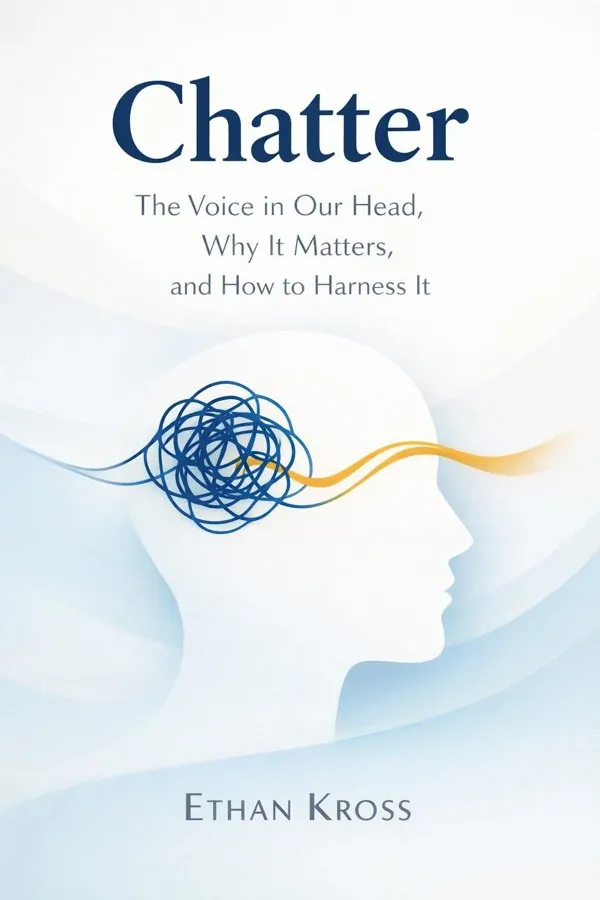
Chatter: The Voice in Our Head, Why It Matters, and How to Harness It: Summary & Key Insights
by Ethan Kross
 10 min5 chaptersAudio available
What Is Chatter: The Voice in Our Head, Why It Matters, and How to Harness It About?
Chatter: The Voice in Our Head, Why It Matters, and How to Harness It by Ethan Kross is a psychology book spanning 5 pages. In this book, psychologist Ethan Kross explores the science of our inner voice—the silent conversations we have with ourselves—and how they shape our lives. Drawing on decades of research in psychology and neuroscience, Kross explains how this internal dialogue can both help and harm us, offering practical strategies to transform negative self-talk into a powerful tool for emotional resilience, decision-making, and well-being.
This FizzRead summary covers all 5 key chapters of Chatter: The Voice in Our Head, Why It Matters, and How to Harness It in approximately 10 minutes, distilling the most important ideas, arguments, and takeaways from Ethan Kross's work. Also available as an audio summary and Key Quotes Podcast.
Chatter: The Voice in Our Head, Why It Matters, and How to Harness It
In this book, psychologist Ethan Kross explores the science of our inner voice—the silent conversations we have with ourselves—and how they shape our lives. Drawing on decades of research in psychology and neuroscience, Kross explains how this internal dialogue can both help and harm us, offering practical strategies to transform negative self-talk into a powerful tool for emotional resilience, decision-making, and well-being.
Who Should Read Chatter: The Voice in Our Head, Why It Matters, and How to Harness It?
This book is perfect for anyone interested in psychology and looking to gain actionable insights in a short read. Whether you're a student, professional, or lifelong learner, the key ideas from Chatter: The Voice in Our Head, Why It Matters, and How to Harness It by Ethan Kross will help you think differently.
- ✓Readers who enjoy psychology and want practical takeaways
- ✓Professionals looking to apply new ideas to their work and life
- ✓Anyone who wants the core insights of Chatter: The Voice in Our Head, Why It Matters, and How to Harness It in just 10 minutes
Want the full summary?
Get instant access to this book summary and 100K+ more with Fizz Moment.
Get Free SummaryAvailable on App Store • Free to download
Key Chapters
Our inner voice is one of the most sophisticated tools evolution has given us. Neuroscientific research shows that regions like the prefrontal cortex and Broca’s area enable internal speech—the same mechanisms we use for talking aloud are engaged when we silently converse with ourselves. This internal monologue functions as an internal counselor: it helps us plan, remember, imagine, and rehearse. When functioning properly, it allows us to learn from past experiences and forecast future events with impressive precision.
Yet the same capacity that allows for productive self-reflection can also collapse into distress. When I use the term 'chatter,' I mean the kind of inner talk that fixates on problems instead of solving them. It’s the rumination loop that keeps you anchored in negative emotions—anxiety about what might go wrong, shame over what already did, or anger that can’t let go. This pattern distorts memory, magnifies emotions, and sabotages performance. Through fMRI studies and experimental observation, we see that chronic chatter activates stress pathways, impairing the hippocampus’s memory regulation and heightening amygdala reactivity. In simpler terms, it makes you less able to think clearly exactly when you need clarity most.
The insight I share is that awareness is the first step toward liberation. Recognizing chatter as a physiological and cognitive process means we can intervene deliberately. We can stop viewing this inner voice as our enemy and start treating it as a system that requires tuning. Understanding its dual nature lays the foundation for that transformation.
When chatter takes over internally, its reach extends outward. You might think it’s confined to your own thoughts, but it bleeds into interactions, decisions, and relationships. One powerful finding I discuss is how internal distress spreads socially. When you ruminate excessively, you broadcast cues—tone, body language, micro-behaviors—that others pick up. This can destabilize communication, leading loved ones or colleagues to feel the same tension you’re trying to contain.
In relationships, chatter often masquerades as concern or caution. You replay arguments, mentally prepare defenses, or overanalyze another’s motives—trying to tidy chaos through thought—but you end up deepening it. This chronic inner noise can erode empathy itself. Neuroscience confirms this: when our self-referential networks dominate, we lose capacity to take others’ perspectives. Chatter narrows the lens of the mind.
At work, the cost shows in attention and decision-making. When you’re caught in negative self-talk, cognitive bandwidth shrinks; creativity, strategic thinking, and team collaboration suffer. Similarly, ongoing mental noise undermines physical health. Studies link sustained rumination with cortisol elevations, weakened immunity, and cardiovascular strain.
But there’s good news—when we retrain this voice, social and physical well-being flourish. Real-life experiments show that reframing internal dialogue—turning self-criticism into curiosity, for instance—improves emotional regulation and connection. By detoxifying our inner conversations, we don’t just quiet the mind; we cultivate the ground for thriving relationships and healthier bodies.
+ 3 more chapters — available in the FizzRead app
All Chapters in Chatter: The Voice in Our Head, Why It Matters, and How to Harness It
About the Author
Ethan Kross is an experimental psychologist and neuroscientist at the University of Michigan, where he directs the Emotion & Self Control Laboratory. His research focuses on how people can harness their inner voice to improve their mental health and performance. He has published widely in scientific journals and is recognized for his contributions to understanding self-control and emotion regulation.
Get This Summary in Your Preferred Format
Read or listen to the Chatter: The Voice in Our Head, Why It Matters, and How to Harness It summary by Ethan Kross anytime, anywhere. FizzRead offers multiple formats so you can learn on your terms — all free.
Available formats: App · Audio · PDF · EPUB — All included free with FizzRead
Download Chatter: The Voice in Our Head, Why It Matters, and How to Harness It PDF and EPUB Summary
Key Quotes from Chatter: The Voice in Our Head, Why It Matters, and How to Harness It
“Our inner voice is one of the most sophisticated tools evolution has given us.”
“When chatter takes over internally, its reach extends outward.”
Frequently Asked Questions about Chatter: The Voice in Our Head, Why It Matters, and How to Harness It
Chatter: The Voice in Our Head, Why It Matters, and How to Harness It by Ethan Kross is a psychology book that explores key ideas across 5 chapters. In this book, psychologist Ethan Kross explores the science of our inner voice—the silent conversations we have with ourselves—and how they shape our lives. Drawing on decades of research in psychology and neuroscience, Kross explains how this internal dialogue can both help and harm us, offering practical strategies to transform negative self-talk into a powerful tool for emotional resilience, decision-making, and well-being.
More by Ethan Kross
You Might Also Like
The Body Keeps the Score
Bessel van der Kolk
10 min
Surrounded by Idiots
Thomas Erikson
10 min
Emotional Intelligence
Daniel Goleman
10 min
Attached
Amir Levine
10 min
Why Does He Do That
Lundy Bancroft
10 min
Women Who Run with the Wolves
Clarissa Pinkola Estés
10 minBrowse by Category
Ready to read Chatter: The Voice in Our Head, Why It Matters, and How to Harness It?
Get the full summary and 100K+ more books with Fizz Moment.