
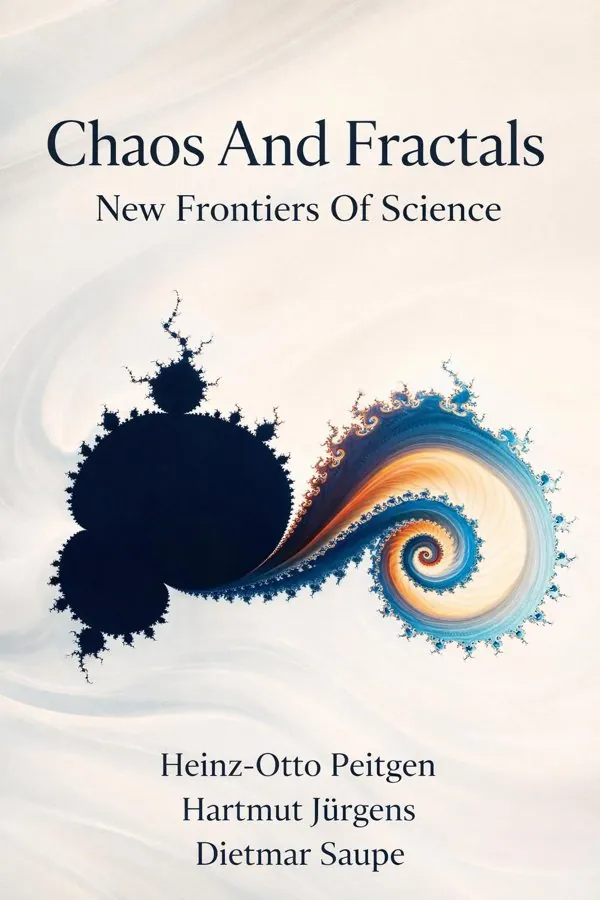
Chaos And Fractals: New Frontiers Of Science: Summary & Key Insights
by Heinz-Otto Peitgen, Hartmut Jürgens, Dietmar Saupe
 10 min9 chaptersAudio available
What Is Chaos And Fractals: New Frontiers Of Science About?
Chaos And Fractals: New Frontiers Of Science by Heinz-Otto Peitgen, Hartmut Jürgens, Dietmar Saupe is a popular_sci book spanning 9 pages. Dieses Buch bietet eine umfassende Einführung in die Theorie des Chaos und der Fraktale. Es behandelt grundlegende Konzepte wie den Mandelbrot-Mengen, Julia-Mengen, Attraktoren und dynamische Systeme. Die Autoren zeigen, wie einfache nichtlineare Gleichungen komplexe und schöne Strukturen erzeugen können, und erläutern die Anwendungen dieser Ideen in Naturwissenschaften, Technik und Kunst.
This FizzRead summary covers all 9 key chapters of Chaos And Fractals: New Frontiers Of Science in approximately 10 minutes, distilling the most important ideas, arguments, and takeaways from Heinz-Otto Peitgen, Hartmut Jürgens, Dietmar Saupe's work. Also available as an audio summary and Key Quotes Podcast.
Chaos And Fractals: New Frontiers Of Science
Dieses Buch bietet eine umfassende Einführung in die Theorie des Chaos und der Fraktale. Es behandelt grundlegende Konzepte wie den Mandelbrot-Mengen, Julia-Mengen, Attraktoren und dynamische Systeme. Die Autoren zeigen, wie einfache nichtlineare Gleichungen komplexe und schöne Strukturen erzeugen können, und erläutern die Anwendungen dieser Ideen in Naturwissenschaften, Technik und Kunst.
Who Should Read Chaos And Fractals: New Frontiers Of Science?
This book is perfect for anyone interested in popular_sci and looking to gain actionable insights in a short read. Whether you're a student, professional, or lifelong learner, the key ideas from Chaos And Fractals: New Frontiers Of Science by Heinz-Otto Peitgen, Hartmut Jürgens, Dietmar Saupe will help you think differently.
- ✓Readers who enjoy popular_sci and want practical takeaways
- ✓Professionals looking to apply new ideas to their work and life
- ✓Anyone who wants the core insights of Chaos And Fractals: New Frontiers Of Science in just 10 minutes
Want the full summary?
Get instant access to this book summary and 100K+ more with Fizz Moment.
Get Free SummaryAvailable on App Store • Free to download
Key Chapters
Let us begin with the essence: the mystery of how complexity arises from simplicity. In the classical view of science, cause and effect were neat, linear, and predictable. If one knew the initial conditions and the laws, one could foresee the future. But nature often refuses to submit to linear reasoning. Clouds, weather, heartbeat rhythms, population growths — small changes in starting conditions can lead to dramatically different outcomes.
This is where nonlinear systems come into play. A nonlinear equation is one in which the output doesn’t double when the input doubles; instead, it twists and folds back on itself. When we analyze such systems, we discover that their trajectories can evolve into shapes of bewildering intricacy: spirals, folds, loops, and strange attractors. They are deterministic — but unpredictable beyond a short horizon.
The charm of fractal geometry arises from this same theme. When Benoît Mandelbrot first examined the roughness of natural shapes — coastlines, mountains, clouds — he realized that traditional geometry could not capture their essence. Fractals provide a new language: shapes that repeat their structure at every scale. They are infinite in detail, self-similar, and often produced by recursive rules. What thrills us is that both chaos and fractals grow from simplicity; a few simple rules, when iterated, unfold into boundless complexity.
Every revolution in science begins with a question that defies the old assumptions. For chaos theory and fractal geometry, that question was born over a century ago, when Henri Poincaré studied the three-body problem — three masses interacting under gravity. He discovered that even the simplest nonlinear system could behave unpredictably. The seeds of chaos were planted.
Fast forward to the twentieth century: Edward Lorenz, a meteorologist, trying to model the weather with a few equations, uncovered the now-famous 'Lorenz attractor.' He found that rounding off a number slightly changed the entire trajectory of his simulated weather. From then on, the notion that small changes lead to big consequences became a core truth of chaos theory — the butterfly effect.
Then came Benoît Mandelbrot, whose fascination with roughness — from the jaggedness of coastlines to the fluctuations of markets — led to the conception of fractal geometry. Mandelbrot unified many scattered mathematical phenomena and gave them a shape, a visual form that everyone could see: the Mandelbrot set, a shape infinitely rich, self-similar, and beautiful.
Our journey in *Chaos and Fractals* continues this heritage — uniting the insights of Poincaré, Lorenz, and Mandelbrot into a visual and computational framework that allows us not only to understand chaos intellectually but to see and create it.
+ 7 more chapters — available in the FizzRead app
All Chapters in Chaos And Fractals: New Frontiers Of Science
About the Authors
Heinz-Otto Peitgen war ein deutscher Mathematiker, bekannt für seine Arbeiten zur Chaos-Theorie und Fraktalgeometrie. Hartmut Jürgens und Dietmar Saupe sind ebenfalls Mathematiker, die sich auf Computergrafik und dynamische Systeme spezialisiert haben.
Get This Summary in Your Preferred Format
Read or listen to the Chaos And Fractals: New Frontiers Of Science summary by Heinz-Otto Peitgen, Hartmut Jürgens, Dietmar Saupe anytime, anywhere. FizzRead offers multiple formats so you can learn on your terms — all free.
Available formats: App · Audio · PDF · EPUB — All included free with FizzRead
Download Chaos And Fractals: New Frontiers Of Science PDF and EPUB Summary
Key Quotes from Chaos And Fractals: New Frontiers Of Science
“Let us begin with the essence: the mystery of how complexity arises from simplicity.”
“Every revolution in science begins with a question that defies the old assumptions.”
Frequently Asked Questions about Chaos And Fractals: New Frontiers Of Science
Chaos And Fractals: New Frontiers Of Science by Heinz-Otto Peitgen, Hartmut Jürgens, Dietmar Saupe is a popular_sci book that explores key ideas across 9 chapters. Dieses Buch bietet eine umfassende Einführung in die Theorie des Chaos und der Fraktale. Es behandelt grundlegende Konzepte wie den Mandelbrot-Mengen, Julia-Mengen, Attraktoren und dynamische Systeme. Die Autoren zeigen, wie einfache nichtlineare Gleichungen komplexe und schöne Strukturen erzeugen können, und erläutern die Anwendungen dieser Ideen in Naturwissenschaften, Technik und Kunst.
You Might Also Like

Structures: Or Why Things Don"t Fall Down
J.E. Gordon
10 min
The Road to Wigan Pier
George Orwell
10 min
Bonk: The Curious Coupling of Science and Sex
Mary Roach
10 min
First Bite: How We Learn to Eat
Bee Wilson
10 min
In Pursuit Of The Unknown: 17 Equations That Changed The World
Ian Stewart
10 min
Napoleon's Buttons: 17 Molecules That Changed History
Penny Le Couteur and Jay Burreson
10 minBrowse by Category
Ready to read Chaos And Fractals: New Frontiers Of Science?
Get the full summary and 100K+ more books with Fizz Moment.