
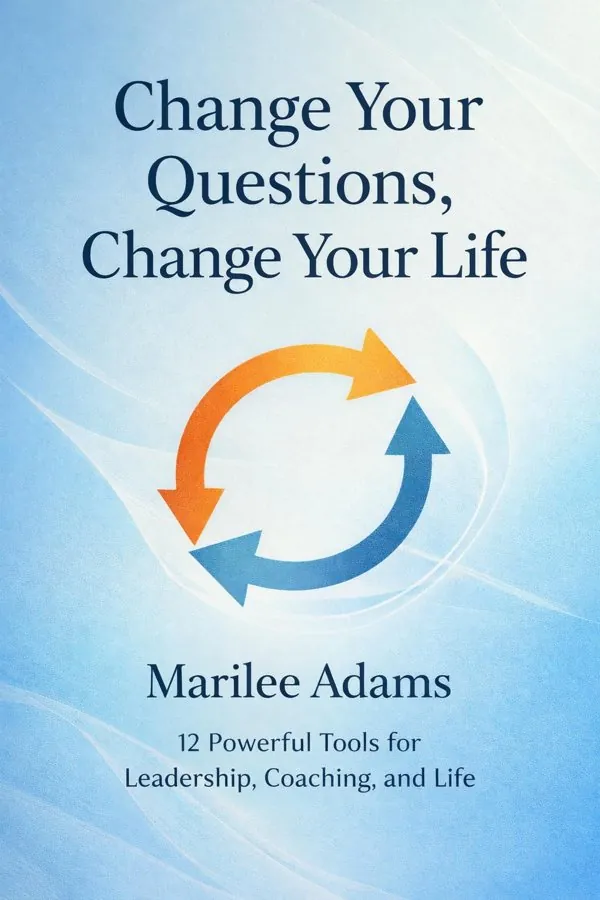
Change Your Questions, Change Your Life: 12 Powerful Tools for Leadership, Coaching, and Life: Summary & Key Insights
 10 min8 chaptersAudio available
Key Takeaways from Change Your Questions, Change Your Life: 12 Powerful Tools for Leadership, Coaching, and Life
Transformation often begins not with a grand insight, but with a moment of discomfort we can no longer ignore.
In difficult moments, we usually think we are reacting to reality, when in fact we are reacting to the questions our minds are asking.
A better life rarely starts with better answers; it starts with better questions.
Every leader teaches people how to think, not only through decisions, but through the questions they normalize.
Most conversations that shape our lives happen before we say a word to anyone else.
What Is Change Your Questions, Change Your Life: 12 Powerful Tools for Leadership, Coaching, and Life About?
Change Your Questions, Change Your Life: 12 Powerful Tools for Leadership, Coaching, and Life by Marilee Adams is a leadership book spanning 7 pages. What if the biggest factor shaping your leadership, relationships, and results is not what happens to you, but the questions you automatically ask yourself about it? In Change Your Questions, Change Your Life, Marilee Adams argues that the quality of our inner and outer questions determines whether we react with blame, defensiveness, and fear, or respond with curiosity, clarity, and purpose. Through a story-driven format centered on a stressed manager named Ben, Adams introduces “Question Thinking,” a practical framework for recognizing unhelpful mental habits and replacing them with better questions. This book matters because it turns self-awareness into a repeatable skill. Rather than offering abstract inspiration, Adams provides concrete tools leaders, coaches, teams, and families can use immediately to improve communication, decision-making, and emotional intelligence. Her core insight is simple but powerful: when we shift from judgment to learning, we open the door to better choices and better outcomes. As an executive coach, consultant, and founder of the Inquiry Institute, Adams brings deep expertise to this work, making the book both credible and highly actionable.
This FizzRead summary covers all 8 key chapters of Change Your Questions, Change Your Life: 12 Powerful Tools for Leadership, Coaching, and Life in approximately 10 minutes, distilling the most important ideas, arguments, and takeaways from Marilee Adams's work. Also available as an audio summary and Key Quotes Podcast.
Change Your Questions, Change Your Life: 12 Powerful Tools for Leadership, Coaching, and Life
What if the biggest factor shaping your leadership, relationships, and results is not what happens to you, but the questions you automatically ask yourself about it? In Change Your Questions, Change Your Life, Marilee Adams argues that the quality of our inner and outer questions determines whether we react with blame, defensiveness, and fear, or respond with curiosity, clarity, and purpose. Through a story-driven format centered on a stressed manager named Ben, Adams introduces “Question Thinking,” a practical framework for recognizing unhelpful mental habits and replacing them with better questions.
This book matters because it turns self-awareness into a repeatable skill. Rather than offering abstract inspiration, Adams provides concrete tools leaders, coaches, teams, and families can use immediately to improve communication, decision-making, and emotional intelligence. Her core insight is simple but powerful: when we shift from judgment to learning, we open the door to better choices and better outcomes. As an executive coach, consultant, and founder of the Inquiry Institute, Adams brings deep expertise to this work, making the book both credible and highly actionable.
Who Should Read Change Your Questions, Change Your Life: 12 Powerful Tools for Leadership, Coaching, and Life?
This book is perfect for anyone interested in leadership and looking to gain actionable insights in a short read. Whether you're a student, professional, or lifelong learner, the key ideas from Change Your Questions, Change Your Life: 12 Powerful Tools for Leadership, Coaching, and Life by Marilee Adams will help you think differently.
- ✓Readers who enjoy leadership and want practical takeaways
- ✓Professionals looking to apply new ideas to their work and life
- ✓Anyone who wants the core insights of Change Your Questions, Change Your Life: 12 Powerful Tools for Leadership, Coaching, and Life in just 10 minutes
Want the full summary?
Get instant access to this book summary and 100K+ more with Fizz Moment.
Get Free SummaryAvailable on App Store • Free to download
Key Chapters
Transformation often begins not with a grand insight, but with a moment of discomfort we can no longer ignore. Adams opens the book with Ben, a capable manager whose life appears successful on the surface, yet feels increasingly strained underneath. His team is disengaged, his boss is dissatisfied, and tension is spilling into his home life. Ben believes the problem lies with other people: they are too difficult, too uncommitted, too critical. But the real issue is less about his circumstances than about the way he is interpreting them.
Ben’s story matters because it mirrors a common leadership trap. When pressure rises, many people default to blame, defensiveness, and certainty. They assume they already know who is wrong and what the problem is. This reaction can feel rational, yet it narrows perception and reduces options. Adams uses Ben’s experience to reveal a foundational truth: before we can change our behavior, we must notice the questions we are already asking. Questions such as “Who messed this up?” or “Why does this always happen to me?” generate frustration and helplessness. Different questions produce different emotions and choices.
In practical terms, this means conflict at work or home is often intensified by our internal narrative. A manager who asks, “Why can’t my team just do what they’re told?” will act differently from one who asks, “What expectations may be unclear?” A spouse who asks, “Why am I not appreciated?” will communicate differently from one who asks, “What conversation needs to happen?”
The takeaway is simple: the first step toward change is awareness. Listen to your self-talk during stress and identify the hidden questions driving your reactions.
In difficult moments, we usually think we are reacting to reality, when in fact we are reacting to the questions our minds are asking. Adams captures this dynamic with the Choice Map, one of the book’s most useful tools. The map shows two distinct mental pathways: the Judger path and the Learner path. Judger is the mindset of blame, defensiveness, fear, and assumptions. Learner is the mindset of curiosity, responsibility, openness, and possibility.
The power of the Choice Map is that it makes invisible thinking visible. Instead of being swept away by emotion, we can pause and ask: Which path am I on right now? On the Judger path, we ask questions like, “Whose fault is this?” “How can I prove I’m right?” or “What’s wrong with them?” These questions escalate conflict and reduce insight. On the Learner path, the questions change: “What happened?” “What can I learn?” “What matters most now?” “What are my choices?” These questions create space for wiser action.
This framework is especially useful in leadership and team settings. Imagine a project failure. A Judger response might focus on assigning blame and protecting status. A Learner response examines causes, clarifies lessons, and aligns people around solutions. The same principle applies personally. After criticism, a Judger mindset may ask, “How dare they?” while a Learner mindset asks, “Is there anything useful here?”
The Choice Map does not tell us to suppress emotions or become passive. It helps us notice that we always have a choice in how we process experience. That choice affects our tone, relationships, and results.
The actionable takeaway: when tension rises, pause and identify your path. Ask yourself, “Am I in Judger or Learner right now?” Then deliberately choose one Learner question before responding.
A better life rarely starts with better answers; it starts with better questions. Adams introduces the practice of “switching questions,” the skill of converting reactive, judgmental questions into constructive, learning-oriented ones. This is the practical heart of Question Thinking. Instead of trying to force ourselves to think positively, we redirect our minds through inquiry.
The logic is straightforward. Questions focus attention. If you ask, “Why am I failing?” your mind scans for evidence of inadequacy. If you ask, “What is one useful next step?” your mind begins generating options. Switching questions is not denial or empty optimism. It is disciplined mental leadership. It helps people move from emotional reactivity to purposeful action.
Adams offers many examples of this shift. “Who’s to blame?” can become “What led to this outcome?” “How can I prove I’m right?” can become “What am I missing?” “Why are they so difficult?” can become “What might they be concerned about?” In coaching, this technique helps clients move beyond stuck stories. In management, it turns criticism into collaboration. In families, it reduces escalation by replacing accusation with curiosity.
This approach is especially valuable because it can be used in real time. During a tense meeting, before sending an angry email, or after receiving bad news, a switched question can alter the entire trajectory of the interaction. Over time, this practice becomes a habit. We become less captive to impulse and more capable of conscious response.
The key is not perfection but interruption. You do not have to eliminate every judgmental thought. You only need to notice it early enough to ask a better question.
Actionable takeaway: write down three Judger questions you commonly ask under stress, and create Learner replacements you can use immediately when those patterns appear.
Every leader teaches people how to think, not only through decisions, but through the questions they normalize. Adams shows that questioning style is a powerful force in workplace culture. Leaders who operate from Judger create fear, silence, and compliance. Leaders who operate from Learner create engagement, accountability, and shared problem-solving.
This matters because teams often mirror the emotional habits of their leaders. If a manager responds to mistakes with “Who caused this?” employees become risk-averse and secretive. If the response is “What happened, and what can we improve?” employees are more likely to surface problems early, take ownership, and contribute ideas. Learner questions support psychological safety without lowering standards. In fact, they often improve standards because people can focus on learning instead of self-protection.
Adams also highlights the role of questions in meetings, feedback, and change management. A leader can ask, “Why aren’t people on board?” or instead ask, “What concerns have we not addressed?” A coach can ask, “What’s wrong with your performance?” or “What conditions help you do your best work?” These questions communicate respect and stimulate reflection.
The concept extends beyond formal authority. Peer relationships improve when people ask clarifying questions rather than making assumptions. Cross-functional collaboration improves when teams ask, “What does success look like from your perspective?” instead of defending turf. Even performance reviews become more effective when they include inquiry about goals, obstacles, and support needs.
The broader lesson is that culture is built one conversation at a time. Questions direct attention, define safety, and influence whether people feel attacked or invited.
Actionable takeaway: in your next meeting, replace one blame-oriented question with a learning-oriented one, and observe how it changes the tone, candor, and quality of discussion.
Most conversations that shape our lives happen before we say a word to anyone else. Adams emphasizes that our internal dialogue is constantly generating emotions, assumptions, and reactions. We do not simply experience events; we interpret them through questions. Those questions influence whether we feel threatened, resentful, hopeful, or capable.
This idea is crucial because many people treat emotions as automatic facts rather than as signals shaped by interpretation. If your inner questions are “What’s wrong with me?” “Why don’t they respect me?” or “How am I going to survive this?” your body and mind prepare for danger. You become tense, defensive, and narrow in your thinking. But if you ask, “What is actually happening?” “What do I want here?” or “What can I influence?” your emotional state often becomes more grounded and resourceful.
Adams does not suggest that feelings are invalid. Instead, she shows that inquiry can help us work with feelings intelligently. For example, before a difficult presentation, an anxious professional might ask, “What if I embarrass myself?” Switching to, “How can I prepare well and stay present?” changes both emotional tone and behavior. In personal relationships, asking, “Why are they pulling away?” may intensify fear, while asking, “What conversation could build understanding?” opens a path forward.
This inner practice is powerful because it can be done privately and repeatedly. It helps interrupt spirals of rumination and creates room for intentional action. Over time, our emotional resilience grows because we become less controlled by unconscious assumptions.
The actionable takeaway: when you feel a strong emotion, pause and ask, “What question am I asking myself right now?” Then test whether a more honest and useful question would change your next move.
Insight is valuable, but only repeated practice turns insight into character. As Ben begins to apply Question Thinking, Adams shows that transformation is not a one-time breakthrough. It is the gradual integration of a Learner mindset into everyday moments. This includes work conversations, decision-making, conflict, self-reflection, and even routine inconveniences.
The Learner mindset is not about being naive, agreeable, or endlessly analytical. It is about staying open enough to see more clearly and act more effectively. A Learner is willing to be curious, to examine assumptions, to own their part, and to seek understanding before judgment. That posture builds trust because it reduces defensiveness. It also improves performance because it keeps attention on learning and solutions.
Adams illustrates how this mindset changes relationships. Ben becomes a better listener because he is less busy proving himself right. He handles conflict more constructively because he asks what can be learned instead of who should be blamed. At home, he becomes more present and less reactive. This is an important reminder that leadership is not confined to the workplace; the habits we practice in one area affect all the others.
Living as a Learner also requires humility. People often slip back into Judger, especially under stress. The goal is not perfection but recovery. Each time we notice ourselves blaming, assuming, or defending, we have another chance to choose curiosity.
The actionable takeaway: build a daily reflection habit by asking at day’s end, “When was I in Judger today? When was I in Learner? What helped me shift?” This turns Question Thinking into an ongoing discipline.
Lasting change usually requires more than one insight; it requires a toolkit. Adams strengthens her core framework by offering twelve practical tools that support the discipline of Question Thinking. While the specific tools vary in focus, their shared purpose is to help people notice unhelpful thought patterns, shift to Learner questions, and act in ways that align with their values and goals.
What makes these tools effective is their usability. They are not abstract theories reserved for coaches or consultants. They are prompts, maps, and practices that can be used in conversations, meetings, journaling, conflict resolution, and self-management. The Choice Map is one tool. Switching questions is another. Others help clarify intention, deepen listening, check assumptions, and refocus attention on responsibility and possibilities.
The broader message is that change becomes sustainable when it is supported by structure. In the middle of stress, people rarely rise to their ideals automatically. They fall back on habits. Tools make better habits easier to access. A team might post Learner questions in a meeting room. A manager might begin one-on-ones by asking, “What’s most important for us to explore today?” An individual might keep a written list of go-to switching questions near their desk.
These tools are especially useful for coaches, teachers, and leaders because they create a shared language. When people can say, “I think we’re on the Judger path,” they gain a non-defensive way to reset a conversation. That shared language strengthens accountability and learning.
The actionable takeaway: choose one Question Thinking tool to practice for a full week, rather than trying to apply everything at once. Consistency with one tool often creates momentum for broader change.
One of the book’s most important lessons is that responsibility is less about self-blame and more about reclaiming agency. Adams repeatedly contrasts victim-oriented questions with responsibility-oriented ones. When we ask, “Why is this happening to me?” or “Why are they making my life difficult?” we reinforce powerlessness. When we ask, “What is my part in this?” or “What can I do now?” we step back into influence.
This shift is subtle but profound. It does not deny unfairness, difficulty, or the reality that other people can behave badly. Instead, it separates what we cannot control from what we can. That distinction is essential in leadership, coaching, and personal growth. Leaders cannot control every market condition or every employee reaction, but they can influence clarity, communication, and culture. Individuals cannot control criticism, but they can control how they interpret and respond to it.
Responsibility-oriented inquiry also improves problem-solving. A sales team facing missed targets can spend weeks complaining about the economy, or it can ask, “What patterns are we seeing?” “What is within our control?” and “What experiments should we try next?” A couple stuck in recurring arguments can ask, “What roles are we each playing?” instead of “Who started it?” These questions create movement.
Perhaps most importantly, responsibility questions build dignity. They remind us that even in hard circumstances, we are not merely reactors. We remain choosers.
The actionable takeaway: the next time you catch yourself complaining, convert the complaint into a responsibility question by asking, “What is one thing I can influence here?”
All Chapters in Change Your Questions, Change Your Life: 12 Powerful Tools for Leadership, Coaching, and Life
About the Author
Marilee Adams, Ph.D., is an author, executive coach, consultant, and the founder of the Inquiry Institute. She is widely recognized for developing the concept of Question Thinking, an approach that explores how the questions people ask influence leadership, communication, emotional intelligence, and organizational learning. Her work has been used by leaders, teams, educators, and coaches seeking more constructive ways to think, relate, and solve problems. Adams is known for translating deep behavioral insights into practical tools that people can apply in real conversations and decisions. In Change Your Questions, Change Your Life, she combines her coaching expertise and organizational experience to offer a clear framework for shifting from blame and defensiveness toward curiosity, accountability, and growth.
Get This Summary in Your Preferred Format
Read or listen to the Change Your Questions, Change Your Life: 12 Powerful Tools for Leadership, Coaching, and Life summary by Marilee Adams anytime, anywhere. FizzRead offers multiple formats so you can learn on your terms — all free.
Available formats: App · Audio · PDF · EPUB — All included free with FizzRead
Download Change Your Questions, Change Your Life: 12 Powerful Tools for Leadership, Coaching, and Life PDF and EPUB Summary
Key Quotes from Change Your Questions, Change Your Life: 12 Powerful Tools for Leadership, Coaching, and Life
“Transformation often begins not with a grand insight, but with a moment of discomfort we can no longer ignore.”
“In difficult moments, we usually think we are reacting to reality, when in fact we are reacting to the questions our minds are asking.”
“A better life rarely starts with better answers; it starts with better questions.”
“Every leader teaches people how to think, not only through decisions, but through the questions they normalize.”
“Most conversations that shape our lives happen before we say a word to anyone else.”
Frequently Asked Questions about Change Your Questions, Change Your Life: 12 Powerful Tools for Leadership, Coaching, and Life
Change Your Questions, Change Your Life: 12 Powerful Tools for Leadership, Coaching, and Life by Marilee Adams is a leadership book that explores key ideas across 8 chapters. What if the biggest factor shaping your leadership, relationships, and results is not what happens to you, but the questions you automatically ask yourself about it? In Change Your Questions, Change Your Life, Marilee Adams argues that the quality of our inner and outer questions determines whether we react with blame, defensiveness, and fear, or respond with curiosity, clarity, and purpose. Through a story-driven format centered on a stressed manager named Ben, Adams introduces “Question Thinking,” a practical framework for recognizing unhelpful mental habits and replacing them with better questions. This book matters because it turns self-awareness into a repeatable skill. Rather than offering abstract inspiration, Adams provides concrete tools leaders, coaches, teams, and families can use immediately to improve communication, decision-making, and emotional intelligence. Her core insight is simple but powerful: when we shift from judgment to learning, we open the door to better choices and better outcomes. As an executive coach, consultant, and founder of the Inquiry Institute, Adams brings deep expertise to this work, making the book both credible and highly actionable.
You Might Also Like

Extreme Ownership
Jocko Willink
10 min
Dare to Lead
Brene Brown
10 min
Leaders Eat Last
Simon Sinek
10 min
The 21 Irrefutable Laws of Leadership
John Maxwell
10 min
Start With Why
Simon Sinek
10 min
How to Lead When You're Not in Charge
Clay Scroggins
10 minBrowse by Category
Ready to read Change Your Questions, Change Your Life: 12 Powerful Tools for Leadership, Coaching, and Life?
Get the full summary and 100K+ more books with Fizz Moment.