
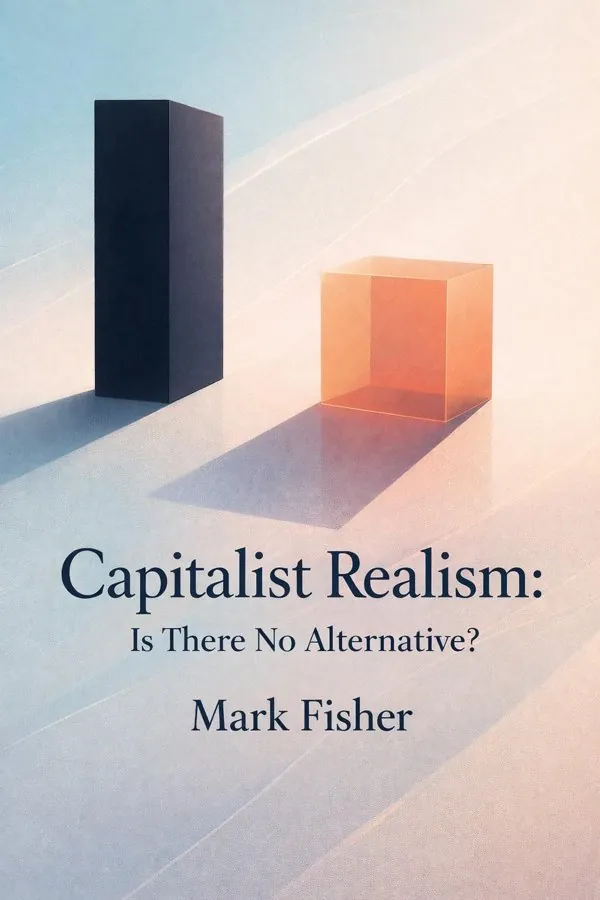
Capitalist Realism: Is There No Alternative?: Summary & Key Insights
by Mark Fisher
 10 min10 chaptersAudio available
Key Takeaways from Capitalist Realism: Is There No Alternative?
The most powerful ideologies do not announce themselves as ideologies at all; they present themselves as simple common sense.
A system is especially resilient when it can absorb criticism and turn it into style.
What we repeatedly see and hear shapes what we believe is possible.
One of Fisher’s sharpest insights is that neoliberalism transforms institutions not only through cuts or privatization, but through bureaucracy.
Private suffering is often treated as a personal failure, but Fisher insists that many psychological struggles are inseparable from social conditions.
What Is Capitalist Realism: Is There No Alternative? About?
Capitalist Realism: Is There No Alternative? by Mark Fisher is a politics book spanning 10 pages. Mark Fisher’s Capitalist Realism: Is There No Alternative? is a short but explosive work of political and cultural theory that explains why capitalism today often feels less like an economic system and more like the natural order of reality itself. First published in 2009, the book examines how neoliberal capitalism shapes not only markets and institutions, but also our imagination, our emotional lives, and our sense of what is politically possible. Fisher argues that one of capitalism’s greatest victories has been convincing people that no credible alternative can exist. What makes this book so enduring is its clarity. Fisher connects high theory with everyday experience: workplace stress, school bureaucracy, media cynicism, depression, consumer culture, and political resignation. He shows how these are not isolated problems, but expressions of a wider social logic. Drawing on philosophy, pop culture, psychoanalysis, and Marxist critique, he gives readers a language for feelings many already have but struggle to name. Fisher was uniquely qualified to write this book. As a critic, lecturer, and author of the influential k-punk blog, he brought together academic rigor and cultural insight. The result is a compact, penetrating analysis of why modern life feels trapped—and where cracks in that trap might still be found.
This FizzRead summary covers all 10 key chapters of Capitalist Realism: Is There No Alternative? in approximately 10 minutes, distilling the most important ideas, arguments, and takeaways from Mark Fisher's work. Also available as an audio summary and Key Quotes Podcast.
Capitalist Realism: Is There No Alternative?
Mark Fisher’s Capitalist Realism: Is There No Alternative? is a short but explosive work of political and cultural theory that explains why capitalism today often feels less like an economic system and more like the natural order of reality itself. First published in 2009, the book examines how neoliberal capitalism shapes not only markets and institutions, but also our imagination, our emotional lives, and our sense of what is politically possible. Fisher argues that one of capitalism’s greatest victories has been convincing people that no credible alternative can exist.
What makes this book so enduring is its clarity. Fisher connects high theory with everyday experience: workplace stress, school bureaucracy, media cynicism, depression, consumer culture, and political resignation. He shows how these are not isolated problems, but expressions of a wider social logic. Drawing on philosophy, pop culture, psychoanalysis, and Marxist critique, he gives readers a language for feelings many already have but struggle to name.
Fisher was uniquely qualified to write this book. As a critic, lecturer, and author of the influential k-punk blog, he brought together academic rigor and cultural insight. The result is a compact, penetrating analysis of why modern life feels trapped—and where cracks in that trap might still be found.
Who Should Read Capitalist Realism: Is There No Alternative??
This book is perfect for anyone interested in politics and looking to gain actionable insights in a short read. Whether you're a student, professional, or lifelong learner, the key ideas from Capitalist Realism: Is There No Alternative? by Mark Fisher will help you think differently.
- ✓Readers who enjoy politics and want practical takeaways
- ✓Professionals looking to apply new ideas to their work and life
- ✓Anyone who wants the core insights of Capitalist Realism: Is There No Alternative? in just 10 minutes
Want the full summary?
Get instant access to this book summary and 100K+ more with Fizz Moment.
Get Free SummaryAvailable on App Store • Free to download
Key Chapters
The most powerful ideologies do not announce themselves as ideologies at all; they present themselves as simple common sense. This is the starting point of Fisher’s idea of capitalist realism. He argues that capitalism has become so culturally dominant that it is no longer experienced by many people as one historical system among others. Instead, it appears as the only realistic framework for organizing society. Even those who dislike inequality, environmental destruction, or precarious work often assume that these are unfortunate side effects of a system that cannot truly be replaced.
Fisher captures this through a famous intuition: it has become easier to imagine the end of the world than the end of capitalism. Films, television, and news media are full of apocalyptic scenarios, yet serious depictions of a post-capitalist future remain rare. That asymmetry matters. When imagination narrows, politics narrows with it. Reform becomes technical management, and radical change seems childish or dangerous.
This idea helps explain why many social debates remain trapped inside market assumptions. Public services are judged as if they were businesses. Education is measured through performance indicators. Healthcare is discussed in terms of efficiency and competition. Individuals are encouraged to adapt rather than question the system producing the pressure.
In practical life, capitalist realism shows up whenever people say, “Of course it’s unfair, but there’s no alternative.” Fisher wants us to notice that this sentence is not a neutral observation. It is a sign that imagination has been politically colonized.
Actionable takeaway: When you hear a policy or practice defended as “just realistic,” ask what assumptions about work, value, and human life are being smuggled in—and what alternatives are being ruled out before the conversation even begins.
A system is especially resilient when it can absorb criticism and turn it into style. Fisher argues that contemporary culture does not simply suppress opposition; it often commercializes it. Rebellion becomes an aesthetic. Anti-establishment gestures are packaged into music, fashion, film, and advertising, allowing capitalism to feed on the very energy that might once have challenged it.
This means that cultural products can appear edgy, ironic, or politically aware while leaving the underlying social order untouched. A brand might use the language of empowerment, individuality, or anti-authoritarianism to sell products. A television show may satirize corporations while being funded by corporate structures. A pop star may embody transgression in highly marketable form. The result is a culture in which critique circulates constantly but rarely accumulates into transformation.
Fisher is not saying that art is meaningless. Rather, he is showing how difficult it has become for culture to sustain genuine opposition when everything is quickly converted into content, trend, or commodity. Irony itself becomes politically ambiguous. Instead of opening space for resistance, it can become a defense mechanism that allows people to recognize problems without feeling responsible for changing them.
You can see this in social media, where outrage, dissent, and subversion are often rapidly monetized. Radical slogans become merchandise. Structural problems become personal brands. The appearance of critique can create the comforting illusion that critique has already been enacted.
Actionable takeaway: Pay attention not only to whether a cultural product looks rebellious, but to what it actually does. Ask whether it changes perception, builds solidarity, or simply sells the feeling of resistance back to consumers.
What we repeatedly see and hear shapes what we believe is possible. Fisher emphasizes that capitalist realism works through representation: the stories, images, narratives, and assumptions that present the market as natural, inevitable, and neutral. The economy is framed not as a human arrangement built through policy and power, but as an external force like weather. Governments do not choose; they merely “respond to markets.” Workers do not organize life collectively; they “adapt to economic realities.”
This way of speaking matters because it hides agency. If markets are treated like nature, then inequality appears unfortunate but unavoidable. Privatization seems sensible. Austerity becomes necessary discipline. Political choices are depoliticized and rebranded as technical inevitabilities.
Mainstream media often reinforces this logic. Economic reporting frequently centers investor confidence, growth metrics, and business sentiment, while treating labor precarity, unpaid care work, or public well-being as secondary concerns. Entertainment does something similar by repeatedly portraying competition, entrepreneurialism, and individualized success as universal human truths.
Fisher’s point is not that representation alone creates ideology, but that representation stabilizes it. It creates an emotional and cognitive environment in which alternatives appear implausible or unserious. Once that happens, even people harmed by the system can struggle to describe what they are experiencing.
A useful everyday example is the language used in workplaces and schools: people are called stakeholders, units, performers, or human capital. Such terms subtly reshape how institutions imagine human beings.
Actionable takeaway: Notice economic language in media and everyday life. Whenever systems are described as natural or unavoidable, rephrase the issue in human terms: who decided, who benefits, who loses, and what other arrangements could be made.
One of Fisher’s sharpest insights is that neoliberalism transforms institutions not only through cuts or privatization, but through bureaucracy. Education is a major example. Schools and universities increasingly operate according to business principles: audit culture, targets, inspections, league tables, market competition, branding, and measurable outputs. In this model, the appearance of accountability often replaces the substance of education.
Fisher describes how teachers and students become trapped in systems of performance management. Instead of asking what forms of study produce curiosity, independence, and deep understanding, institutions prioritize metrics that can be easily monitored. Learning becomes fragmented into outcomes. Teaching becomes compliance. Administrators demand documentation, evaluation, and evidence at every turn, often producing more stress without improving intellectual life.
This does not simply create inconvenience. It alters subjectivity. Students come to see themselves as consumers purchasing credentials, while teachers are pressured to act as service providers. The educational environment becomes saturated with anxiety, instrumentalism, and low-level surveillance. In such a setting, thought itself can become harder, because genuine thinking requires time, risk, uncertainty, and freedom from constant measurement.
The lesson extends beyond schools. Many workplaces now mirror this same structure: endless reporting, self-assessment, and procedural oversight that claim to improve performance while actually undermining morale and meaningful work.
Fisher shows that bureaucracy under neoliberalism is not the opposite of market logic. It often accompanies and enforces it. Far from liberating institutions, marketization tends to produce a dense administrative layer focused on proving efficiency rather than enabling value.
Actionable takeaway: In any learning or work environment, distinguish between tasks that create real value and tasks that merely document it. Protect time for unmeasured thinking, dialogue, and reflection whenever possible.
Private suffering is often treated as a personal failure, but Fisher insists that many psychological struggles are inseparable from social conditions. One of the book’s most influential arguments is that the rise of anxiety, depression, exhaustion, and attention problems cannot be understood purely at the level of individual pathology. In a society organized around competition, insecurity, self-marketing, and permanent performance, distress is not an exception. It is a predictable outcome.
Fisher writes with unusual force on this issue because he rejects the idea that mental health can be meaningfully discussed while ignoring precarity, overwork, debt, and the destruction of solidarity. Under capitalist realism, individuals are taught to internalize systemic pressures. If you are overwhelmed, you are told to become more resilient. If you cannot cope, the problem is framed as your inability to manage stress. Structural causes disappear into therapeutic language focused on adjustment.
This does not mean individual treatment is useless. Fisher is not dismissing therapy or medication. His point is that care becomes limited when it asks people only to adapt to sick conditions. A workplace that produces burnout may offer mindfulness seminars instead of reducing overload. A school that damages students through pressure may expand counseling services without challenging the system generating distress.
The practical importance of this insight is enormous. It allows people to reinterpret shame. Feeling exhausted in an exploitative environment is not necessarily a sign of personal inadequacy; it may be evidence of realism about intolerable conditions.
Actionable takeaway: When confronting stress, burnout, or depression, ask not only “What is wrong with me?” but also “What in my environment is producing this?” Pair personal care with collective conversations about workload, support, and structural change.
Work no longer ends when the shift ends. Fisher examines how post-Fordist capitalism blurs the line between labor and life, producing a culture of constant availability, self-management, and diffuse insecurity. In older industrial models, exploitation often centered on the factory and the fixed working day. In contemporary capitalism, especially in service, creative, and knowledge sectors, labor becomes more flexible but also more invasive. Email follows workers home. Freelancers must constantly network. Employees are expected to display enthusiasm, adaptability, and emotional intelligence as part of the job.
This transformation is often sold as freedom. Flexible schedules, flat hierarchies, and project-based work sound liberating compared with rigid industrial discipline. But Fisher shows that flexibility can mask intensified control. When workers must always remain employable, responsive, and self-optimizing, pressure becomes internalized. You are not simply managed by a boss; you learn to manage yourself according to market demands.
This dynamic is visible in gig work, academic labor, creative industries, and corporate office culture alike. People are expected to build personal brands, accept instability as normal, and treat unpaid self-promotion as an investment in future opportunity. The line between personality and productivity erodes.
The result is a chronic atmosphere of low-level panic. Since evaluation is continuous and competition is everywhere, rest itself can feel guilty. Even leisure is often reorganized as recovery for more work or as content for self-presentation.
Fisher’s analysis helps explain why modern labor can feel exhausting even when it appears less visibly brutal than older forms of work.
Actionable takeaway: Set deliberate boundaries around time, communication, and self-exposure. Whenever possible, resist the demand to make every aspect of your identity and attention available for economic use.
People often know the system is broken, yet act as though nothing can be done. Fisher identifies this as one of capitalist realism’s most effective mechanisms. The problem is not simple belief. Many people are cynical about politics, distrustful of corporations, and aware of injustice. But this awareness does not necessarily produce resistance. Instead, it can coexist with passivity. We know, but we continue.
This is what makes capitalist realism more sophisticated than crude propaganda. It does not require sincere faith in capitalism. It only requires widespread resignation. A population that assumes all alternatives will fail, be corrupted, or never arrive can remain politically immobilized even while criticizing the status quo.
Popular culture often reinforces this mood through recurring narratives of compromised institutions, corrupt leaders, and failed collective action. Such representations can feel truthful, but they also train expectation. If every attempt at change is depicted as naïve, doomed, or co-opted, then cynicism becomes a kind of realism.
In everyday politics, this appears in statements like, “All politicians are the same,” or “Nothing ever really changes.” These may contain truth, but when generalized into an absolute worldview they become disabling. They prevent distinctions, discourage organizing, and convert disappointment into habit.
Fisher’s intervention is subtle but vital: cynicism is not the opposite of ideology. It can be one of ideology’s strongest supports. A society can remain stable not because people believe in it, but because they cannot imagine acting otherwise.
Actionable takeaway: Treat generalized cynicism as a warning sign, not a mark of sophistication. Replace abstract despair with concrete questions: What specific institution could be changed, with whom, and by what collective strategy?
Even in a culture saturated by commodification, art can still do something important: it can make the present feel contingent rather than inevitable. Fisher is deeply interested in music, film, literature, and popular culture because they shape political feeling. While culture is often captured by capitalism, it can also register discontent, expose contradictions, and preserve desires that the dominant order cannot fully absorb.
For Fisher, the political role of art is not limited to explicit slogans or propaganda. Sometimes art matters because it interrupts the smooth repetition of capitalist time. It can show forms of collective life that no longer seem visible, give language to alienation, or create moods that resist cheerful market optimism. A song, novel, or film can help people recognize that what they experience as private unease is widely shared.
This is especially important in periods when formal politics feels blocked. Cultural works may not overthrow systems, but they can keep imagination alive. They can reveal absences: the futures that were promised and never delivered, the solidarities that have eroded, the public worlds replaced by competition and consumption.
At the same time, Fisher remains alert to the danger of nostalgia. Art is not politically useful simply because it mourns a lost past. Its critical force lies in reactivating possibility, not retreating into sentiment.
Readers can apply this insight by engaging with culture more actively. Instead of consuming passively, ask what a work reveals about labor, desire, time, institutions, and social limits. What does it normalize, and what does it make newly visible?
Actionable takeaway: Seek out art that enlarges perception rather than merely distracting you. Use cultural experiences as starting points for discussion about the kind of world they assume, critique, or imagine.
What feels natural is often historical, and theory gives us tools to recognize that fact. Fisher draws on thinkers such as Marx, Althusser, Deleuze and Guattari, Žižek, and others not to show off intellectual range, but to sharpen diagnosis. Their concepts help explain why capitalism survives crises, why people participate in systems they dislike, and how power operates through habits, institutions, and desire rather than simple coercion.
One reason this matters is that capitalist realism thrives on vagueness. People sense that something is wrong, but without concepts the experience remains individualized and fragmented. Theory can connect scattered frustrations into a larger picture. It helps reveal that workplace anxiety, bureaucratic absurdity, media cynicism, and cultural repetition may be linked expressions of a broader social order.
Fisher’s writing is valuable precisely because he translates difficult ideas into vivid observations. He does not treat theory as an academic exercise detached from life. Instead, he uses it to make ordinary experience legible. Why does efficiency produce more paperwork? Why does freedom feel exhausting? Why does criticism so often become marketable? Theory helps answer these questions.
In practical terms, conceptual language can be empowering. Once people can name a pattern, they are less likely to mistake it for personal failure or isolated bad luck. Naming does not solve a problem by itself, but it weakens the spell of inevitability.
This is one reason the book has had such a lasting impact. It gave readers a vocabulary for feelings they already had but had not yet articulated.
Actionable takeaway: When a social pattern feels oppressive but hard to describe, seek concepts rather than just opinions. Good theory is useful when it clarifies lived experience and opens paths for collective action.
A system that presents itself as inevitable becomes vulnerable when it visibly fails on its own terms. Fisher argues that capitalism is full of contradictions: it celebrates freedom while producing compulsion, praises efficiency while generating wasteful bureaucracy, and promises innovation while endlessly reproducing inequality and cultural repetition. Crises bring these tensions into view.
Financial collapse is one obvious example. When markets crash, the myth that capitalism is a self-correcting natural order is disrupted. States suddenly intervene at enormous scale, revealing that governments can in fact act decisively when elite interests are threatened. This creates a political opening. If massive intervention is possible to save banks, why is it supposedly impossible to fund housing, healthcare, education, or green infrastructure?
Yet Fisher is careful not to romanticize crisis. Contradictions do not automatically produce emancipatory outcomes. A failing system can respond by deepening control, intensifying nationalism, or shifting blame onto individuals and marginalized groups. The collapse of legitimacy only creates possibility; it does not determine its direction.
That is why alternatives must be prepared in advance, intellectually and organizationally. Without them, crisis may simply lead to renewed resignation. The task is to use moments of breakdown to expose hidden assumptions and expand what people consider politically feasible.
This lesson applies beyond macroeconomics. Everyday disruptions—a strike, a public scandal, institutional failure, or a collective refusal—can also reveal that supposedly fixed arrangements are in fact contingent and contested.
Actionable takeaway: In moments when institutions fail or contradictions become obvious, resist the urge to return immediately to “normal.” Ask what the breakdown has revealed, and use that insight to argue for concrete alternatives rather than temporary fixes.
All Chapters in Capitalist Realism: Is There No Alternative?
About the Author
Mark Fisher (1968–2017) was a British writer, lecturer, and cultural theorist whose work reshaped contemporary discussions of neoliberalism, media, and mental health. He became widely known through his influential blog k-punk, where he wrote with striking intelligence about music, film, politics, philosophy, and everyday life under capitalism. Fisher studied philosophy and taught in further and higher education, experiences that deeply informed his writing on bureaucracy, precarity, and institutional life. His style combined academic rigor with unusual accessibility, allowing him to connect complex theory to ordinary experience. In addition to Capitalist Realism, his major works include Ghosts of My Life and The Weird and the Eerie. Fisher remains one of the most significant and widely cited cultural critics of his generation.
Get This Summary in Your Preferred Format
Read or listen to the Capitalist Realism: Is There No Alternative? summary by Mark Fisher anytime, anywhere. FizzRead offers multiple formats so you can learn on your terms — all free.
Available formats: App · Audio · PDF · EPUB — All included free with FizzRead
Download Capitalist Realism: Is There No Alternative? PDF and EPUB Summary
Key Quotes from Capitalist Realism: Is There No Alternative?
“The most powerful ideologies do not announce themselves as ideologies at all; they present themselves as simple common sense.”
“A system is especially resilient when it can absorb criticism and turn it into style.”
“What we repeatedly see and hear shapes what we believe is possible.”
“One of Fisher’s sharpest insights is that neoliberalism transforms institutions not only through cuts or privatization, but through bureaucracy.”
“Private suffering is often treated as a personal failure, but Fisher insists that many psychological struggles are inseparable from social conditions.”
Frequently Asked Questions about Capitalist Realism: Is There No Alternative?
Capitalist Realism: Is There No Alternative? by Mark Fisher is a politics book that explores key ideas across 10 chapters. Mark Fisher’s Capitalist Realism: Is There No Alternative? is a short but explosive work of political and cultural theory that explains why capitalism today often feels less like an economic system and more like the natural order of reality itself. First published in 2009, the book examines how neoliberal capitalism shapes not only markets and institutions, but also our imagination, our emotional lives, and our sense of what is politically possible. Fisher argues that one of capitalism’s greatest victories has been convincing people that no credible alternative can exist. What makes this book so enduring is its clarity. Fisher connects high theory with everyday experience: workplace stress, school bureaucracy, media cynicism, depression, consumer culture, and political resignation. He shows how these are not isolated problems, but expressions of a wider social logic. Drawing on philosophy, pop culture, psychoanalysis, and Marxist critique, he gives readers a language for feelings many already have but struggle to name. Fisher was uniquely qualified to write this book. As a critic, lecturer, and author of the influential k-punk blog, he brought together academic rigor and cultural insight. The result is a compact, penetrating analysis of why modern life feels trapped—and where cracks in that trap might still be found.
You Might Also Like

Antifa: The Anti-Fascist Handbook
Mark Bray
10 min
Attack from Within: How Disinformation Is Sabotaging America
Barbara McQuade
10 min
Coercion, Capital, and European States, AD 990–1992
Charles Tilly
10 min
Digital Democracy: Concepts, Methodologies, Tools, and Applications
Various Authors
10 min
Fascism
Stanley G. Payne
10 min
Fire And Fury: Inside The Trump White House
Michael Wolff
10 minBrowse by Category
Ready to read Capitalist Realism: Is There No Alternative??
Get the full summary and 100K+ more books with Fizz Moment.