
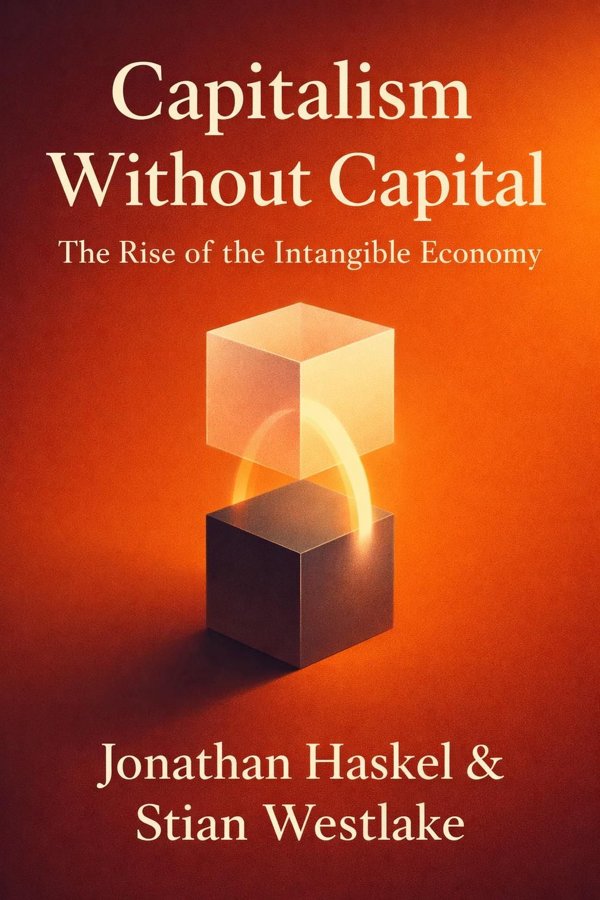
Capitalism Without Capital: The Rise of the Intangible Economy: Summary & Key Insights
by Jonathan Haskel, Stian Westlake
 10 min9 chaptersAudio available
Key Takeaways from Capitalism Without Capital: The Rise of the Intangible Economy
A quiet revolution has changed what businesses invest in.
Not all capital behaves the same, and intangibles follow very different rules.
What gets measured gets managed, and one of the book’s most important warnings is that the modern economy is often mismeasured.
One of the strangest features of recent decades is that economies seem full of innovation, yet productivity growth has often disappointed.
The intangible economy does not reward everyone equally.
What Is Capitalism Without Capital: The Rise of the Intangible Economy About?
Capitalism Without Capital: The Rise of the Intangible Economy by Jonathan Haskel & Stian Westlake is a economics book spanning 9 pages. What if the most valuable assets in the economy are the ones you cannot see? In Capitalism Without Capital, Jonathan Haskel and Stian Westlake argue that modern prosperity is increasingly built not on factories, machines, and warehouses, but on software, data, design, branding, organizational know-how, and research. These intangible assets now drive competitive advantage across industries, from technology and pharmaceuticals to retail, finance, and media. Yet many of the assumptions behind accounting, finance, management, and public policy were designed for a world dominated by physical capital. That mismatch helps explain puzzles such as weak productivity growth, rising inequality, superstar firms, and regional divergence. Haskel, a leading economist, and Westlake, a prominent thinker on innovation and institutions, bring together economic history, business analysis, and policy insight to show why this shift matters so deeply. Their book is both a diagnosis and a guide: it explains how the rise of intangibles is changing capitalism itself, and why governments, investors, business leaders, and workers need a new mental model for the economy we now inhabit.
This FizzRead summary covers all 9 key chapters of Capitalism Without Capital: The Rise of the Intangible Economy in approximately 10 minutes, distilling the most important ideas, arguments, and takeaways from Jonathan Haskel & Stian Westlake's work. Also available as an audio summary and Key Quotes Podcast.
Capitalism Without Capital: The Rise of the Intangible Economy
What if the most valuable assets in the economy are the ones you cannot see? In Capitalism Without Capital, Jonathan Haskel and Stian Westlake argue that modern prosperity is increasingly built not on factories, machines, and warehouses, but on software, data, design, branding, organizational know-how, and research. These intangible assets now drive competitive advantage across industries, from technology and pharmaceuticals to retail, finance, and media. Yet many of the assumptions behind accounting, finance, management, and public policy were designed for a world dominated by physical capital. That mismatch helps explain puzzles such as weak productivity growth, rising inequality, superstar firms, and regional divergence. Haskel, a leading economist, and Westlake, a prominent thinker on innovation and institutions, bring together economic history, business analysis, and policy insight to show why this shift matters so deeply. Their book is both a diagnosis and a guide: it explains how the rise of intangibles is changing capitalism itself, and why governments, investors, business leaders, and workers need a new mental model for the economy we now inhabit.
Who Should Read Capitalism Without Capital: The Rise of the Intangible Economy?
This book is perfect for anyone interested in economics and looking to gain actionable insights in a short read. Whether you're a student, professional, or lifelong learner, the key ideas from Capitalism Without Capital: The Rise of the Intangible Economy by Jonathan Haskel & Stian Westlake will help you think differently.
- ✓Readers who enjoy economics and want practical takeaways
- ✓Professionals looking to apply new ideas to their work and life
- ✓Anyone who wants the core insights of Capitalism Without Capital: The Rise of the Intangible Economy in just 10 minutes
Want the full summary?
Get instant access to this book summary and 100K+ more with Fizz Moment.
Get Free SummaryAvailable on App Store • Free to download
Key Chapters
A quiet revolution has changed what businesses invest in. In the past, economic power usually came from physical assets: railroads, blast furnaces, assembly lines, office towers, and fleets of trucks. Today, a growing share of value comes from assets that cannot be touched but can be immensely powerful: software code, algorithms, patents, product design, customer relationships, business processes, logistics systems, and brand identity. Haskel and Westlake show that in many advanced economies, spending on these intangible assets has risen steadily and in some cases surpassed investment in tangible capital.
This matters because investment shapes how firms grow, how workers create value, and how economies generate prosperity. A company like Microsoft or Google does not need vast amounts of steel or land to expand globally; it needs intellectual property, engineering talent, data infrastructure, and organizational systems. Nike’s edge lies less in owning factories than in design, branding, and supply-chain coordination. Even traditional businesses now depend heavily on intangible capital, from supermarket loyalty systems to airline scheduling software.
The shift also changes how we interpret economic statistics. If conventional measures undercount intangible investment, they may understate business investment and distort our understanding of growth. It changes competition too: the winners are often firms that can create and combine knowledge faster than rivals. For individuals, it changes what skills matter, elevating creativity, adaptability, and problem-solving over routine execution.
Actionable takeaway: when evaluating a company, industry, or career path, look beyond physical assets and ask what intangible capabilities create durable advantage.
Not all capital behaves the same, and intangibles follow very different rules. Haskel and Westlake describe these differences through four defining properties: scalability, sunk costs, spillovers, and synergies. Together, these explain why the intangible economy creates both extraordinary opportunities and serious challenges.
Scalability means an intangible asset can often be used again and again at low marginal cost. Once software is written, it can be distributed to millions of users. Once a drug formula is developed, it can support large-scale sales. Sunk costs mean much of the investment cannot be recovered if the project fails. A custom database, a failed advertising campaign, or years of R&D often have little resale value. Spillovers occur because ideas leak. Competitors can learn from innovations, employees move between firms, and knowledge diffuses. Synergies arise because intangibles become more valuable when combined. Great design plus strong branding plus efficient data systems can produce more value together than separately.
These properties help explain why intangible-heavy firms can scale quickly, why financing them is difficult, and why successful clusters like Silicon Valley emerge. They also explain why competition can become winner-take-most. A scalable product with strong synergies can dominate a market once it gains traction.
In practical terms, business leaders should design strategies around these properties. Protect spillovers where possible through contracts, culture, and legal tools, but also cultivate synergies across teams and products. Investors should expect uneven outcomes: many sunk investments fail, but a few scaled successes can drive enormous returns.
Actionable takeaway: use the Four S’s as a checklist whenever you assess a business model built on ideas, software, data, or brand.
What gets measured gets managed, and one of the book’s most important warnings is that the modern economy is often mismeasured. Traditional accounting systems were built for a world where investment meant buying equipment, constructing buildings, or acquiring inventory. Intangible spending, by contrast, is frequently treated as a current expense rather than as the creation of a long-lived asset. That means a firm’s investment in software, design, training, or process innovation may disappear into the income statement instead of appearing on the balance sheet.
This creates multiple problems. At the firm level, it can make innovative businesses look less profitable in the short term because investments are expensed immediately. At the macroeconomic level, it can make entire economies appear to invest less than they actually do. It can also confuse policymakers trying to understand weak productivity, sluggish wage growth, or low capital formation.
Consider a retailer that spends millions building a recommendation engine, loyalty platform, and customer data architecture. Those investments may transform future performance, yet accounting rules may not fully recognize them as assets. Similarly, a company that builds a valuable brand over decades may show relatively little on its balance sheet compared with its market valuation.
The authors do not claim that measurement is easy. Some intangibles are hard to value, easy to imitate, or deeply embedded in teams and routines. But they argue that better data and better frameworks are essential if we want more accurate economic analysis.
Actionable takeaway: read financial statements with skepticism and supplement them with questions about R&D, software, design, training, brand strength, and organizational capabilities.
One of the strangest features of recent decades is that economies seem full of innovation, yet productivity growth has often disappointed. Haskel and Westlake use the rise of intangibles to help explain this paradox. Intangible investment can drive major long-term gains, but those gains may arrive slowly, unevenly, and in ways that standard metrics miss.
Unlike installing a machine that immediately boosts output, intangible investments often require complementary changes before they pay off. New software may demand retraining, redesigned workflows, and cultural adaptation. A data strategy is useless without people who know how to interpret and apply the data. A new business model may need years of experimentation before it scales. This means there can be a lag between investment and visible productivity gains.
There is also a distribution issue. Frontier firms may become extremely productive while the rest of the economy lags behind. Digital platforms, pharmaceutical leaders, and highly innovative manufacturers can pull away from average firms, creating aggregate numbers that look weaker than the best examples suggest. Spillovers complicate things further: some benefits of innovation may help consumers and competitors more than the original investor.
For managers, the implication is that buying technology is not enough. Productivity comes from integrating intangible assets into the whole organization. For policymakers, patience matters, but so does diffusion: economies need ways to help innovations spread beyond elite firms and regions.
Actionable takeaway: treat productivity as a system outcome, not a technology purchase, and invest in the organizational changes that allow intangible assets to generate real growth.
The intangible economy does not reward everyone equally. Because intangible assets are scalable and often produce winner-take-most dynamics, successful firms can pull far ahead of rivals. A superior search engine, operating system, drug portfolio, or global brand can serve vast markets without needing proportionate increases in labor or physical capital. The result is often market concentration, superstar firms, and widening gaps between top and average performers.
This logic extends to workers and regions. Highly skilled employees who can create, manage, or combine intangible assets often command premium wages. A top software engineer, product designer, or biotech researcher may contribute to a product sold worldwide. Meanwhile, many routine roles become less central or easier to automate. Regions with strong universities, venture capital, legal expertise, and dense talent networks attract more intangible investment, while other places struggle to keep up.
The authors do not suggest that concentration is always harmful. Some scale economies are efficient and can generate immense value for consumers. But they warn that when intangibles and network effects reinforce each other, competition policy becomes more complex. A platform may appear efficient while still limiting entry, suppressing rivals, or locking in users.
Practical examples are everywhere: dominant digital platforms, global luxury brands, and pharmaceutical companies with deep patent portfolios. The challenge is to preserve innovation incentives without allowing success to harden into unassailable power.
Actionable takeaway: when thinking about inequality or market dominance, look for the role of scalable intangible assets and ask how institutions can spread opportunity without destroying innovation.
Banks love collateral, and intangible assets often make poor collateral. A factory can be appraised, repossessed, and resold. A failed software project, a demoralized engineering team, or an abandoned brand campaign usually cannot. This creates a financing problem at the heart of the intangible economy: some of the most valuable investments are the hardest to fund through traditional debt.
Haskel and Westlake explain that intangible-heavy firms often rely more on equity, retained earnings, venture capital, and specialized investors. This is not just a matter of preference but of necessity. Because intangible investments are sunk and uncertain, lenders face higher risk and weaker recovery options. As a result, young innovative firms may struggle to access capital even when their ideas are promising.
This helps explain why ecosystems matter. Venture networks, knowledgeable investors, supportive legal systems, and public research funding can all substitute for the limitations of collateral-based finance. It also explains why some countries and regions are better than others at turning ideas into companies. In places with weak financial institutions for intangibles, innovation may remain trapped inside large incumbents or public labs.
For entrepreneurs, this means the funding strategy must match the asset base. Debt may suit inventory and equipment, but software, R&D, or brand building often require patient equity or staged financing. For policymakers, it means fostering capital markets and institutions that understand uncertainty and can evaluate intangible value.
Actionable takeaway: align your financing model with the nature of your assets, and do not expect idea-based businesses to thrive under systems built for property and machinery.
An economy built on intangibles cannot be governed well with policies designed for smokestacks. One of the book’s strongest arguments is that tax systems, competition law, urban policy, education, accounting standards, and financial regulation all need updating. If policymakers continue to rely on industrial-era assumptions, they will misdiagnose problems and prescribe ineffective solutions.
Take tax policy. Intangible assets are mobile: intellectual property can be located across jurisdictions more easily than factories can. That complicates corporate taxation and can intensify global tax competition. Consider infrastructure policy. Roads and ports still matter, but digital infrastructure, research institutions, and high-skill labor markets may matter just as much. Competition policy must also evolve, especially where data advantages, ecosystem lock-in, and platform effects reinforce intangible capital.
There are social policies to rethink as well. If intangible-rich growth disproportionately rewards education, networks, and geography, then governments need stronger approaches to skills, housing, mobility, and regional development. Public support for research, legal protections for intellectual property, and rules for data sharing all become central economic policy tools.
The authors do not advocate a simple pro-business or anti-business stance. Their point is that good policy must reflect how value is actually created. Sometimes that means stronger support for innovation; sometimes it means stronger checks on concentrated power.
Actionable takeaway: whenever a public debate invokes jobs, growth, or competitiveness, ask whether the policy framework reflects an intangible economy rather than a purely industrial one.
The rise of intangible capital is not a passing trend; it is a structural shift in how capitalism works. That is the book’s central warning and its most important insight. Economies built around ideas, software, knowledge, and networks behave differently from economies built around plant and equipment. They produce new forms of growth, but also new forms of fragility, exclusion, and political tension.
In this world, success depends increasingly on learning, experimentation, collaboration, and the ability to recombine knowledge. Firms that treat intangibles as side issues will fall behind competitors that intentionally cultivate intellectual property, culture, brand, design, and data capabilities. Workers who expect stable rewards from routine skills may face pressure, while those who can create, interpret, and coordinate complex knowledge will thrive. Governments that ignore these changes risk weaker growth and stronger backlash.
At the same time, the intangible economy offers immense promise. Scalable ideas can improve lives at extraordinary speed. A breakthrough in software, medicine, clean technology, or logistics can spread globally. Intangible-rich businesses can use fewer physical resources and unlock new kinds of value. But this promise must be matched with institutions that support broad participation, fair competition, and resilient innovation.
The authors invite readers to update their mental model of capitalism. The economy has not become less capital-intensive; it has become capital-intensive in a different way.
Actionable takeaway: rethink strategy, career planning, and public policy around the assets that increasingly matter most: knowledge, systems, relationships, and ideas.
All Chapters in Capitalism Without Capital: The Rise of the Intangible Economy
About the Authors
Jonathan Haskel is a British economist and Professor of Economics at Imperial College Business School, widely known for his research on productivity, innovation, and intangible investment. He has also served on the Bank of England’s Monetary Policy Committee, bringing his economic expertise into major public policy decisions. Stian Westlake is a leading writer and policy thinker on innovation, institutions, and the knowledge economy, and has held senior roles in research and public-interest organizations, including the Royal Statistical Society. Together, Haskel and Westlake combine academic rigor with practical policy insight. Their collaboration in Capitalism Without Capital helped popularize one of the most important ideas in modern economics: that intangible assets such as software, brands, design, and organizational knowledge are reshaping capitalism itself.
Get This Summary in Your Preferred Format
Read or listen to the Capitalism Without Capital: The Rise of the Intangible Economy summary by Jonathan Haskel & Stian Westlake anytime, anywhere. FizzRead offers multiple formats so you can learn on your terms — all free.
Available formats: App · Audio · PDF · EPUB — All included free with FizzRead
Download Capitalism Without Capital: The Rise of the Intangible Economy PDF and EPUB Summary
Key Quotes from Capitalism Without Capital: The Rise of the Intangible Economy
“A quiet revolution has changed what businesses invest in.”
“Not all capital behaves the same, and intangibles follow very different rules.”
“What gets measured gets managed, and one of the book’s most important warnings is that the modern economy is often mismeasured.”
“One of the strangest features of recent decades is that economies seem full of innovation, yet productivity growth has often disappointed.”
“The intangible economy does not reward everyone equally.”
Frequently Asked Questions about Capitalism Without Capital: The Rise of the Intangible Economy
Capitalism Without Capital: The Rise of the Intangible Economy by Jonathan Haskel & Stian Westlake is a economics book that explores key ideas across 9 chapters. What if the most valuable assets in the economy are the ones you cannot see? In Capitalism Without Capital, Jonathan Haskel and Stian Westlake argue that modern prosperity is increasingly built not on factories, machines, and warehouses, but on software, data, design, branding, organizational know-how, and research. These intangible assets now drive competitive advantage across industries, from technology and pharmaceuticals to retail, finance, and media. Yet many of the assumptions behind accounting, finance, management, and public policy were designed for a world dominated by physical capital. That mismatch helps explain puzzles such as weak productivity growth, rising inequality, superstar firms, and regional divergence. Haskel, a leading economist, and Westlake, a prominent thinker on innovation and institutions, bring together economic history, business analysis, and policy insight to show why this shift matters so deeply. Their book is both a diagnosis and a guide: it explains how the rise of intangibles is changing capitalism itself, and why governments, investors, business leaders, and workers need a new mental model for the economy we now inhabit.
You Might Also Like

Business Adventures
John Brooks
10 min
Nudge
Richard H. Thaler, Cass R. Sunstein
10 min
The Hitchhiker"s Guide to the Galaxy
Douglas Adams
10 minThe Muqaddimah
Ibn Khaldun
10 minThe Outsiders
William N. Thorndike
10 min
A Little History of Economics
Niall Kishtainy
10 minBrowse by Category
Ready to read Capitalism Without Capital: The Rise of the Intangible Economy?
Get the full summary and 100K+ more books with Fizz Moment.