
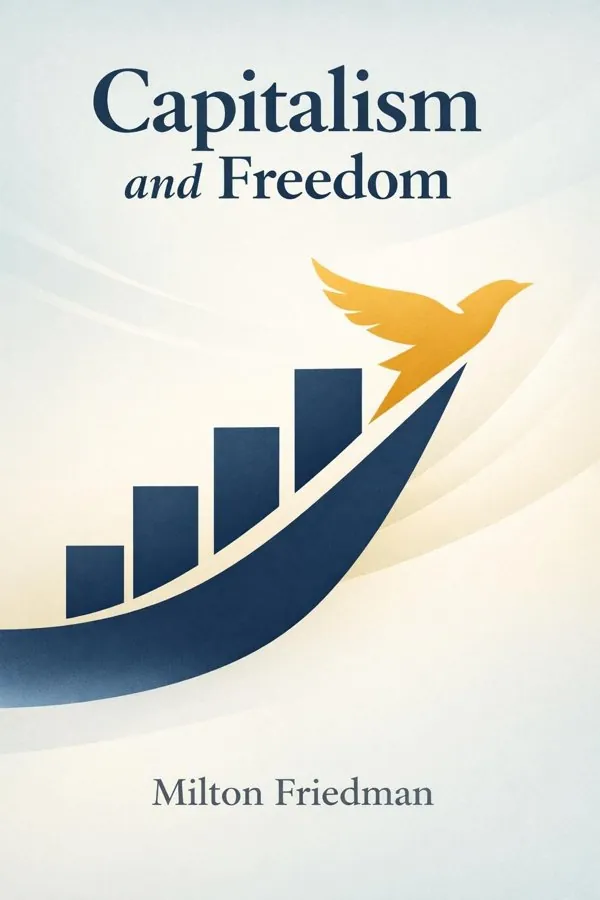
Capitalism and Freedom: Summary & Key Insights
 10 min11 chaptersAudio available
What Is Capitalism and Freedom About?
Capitalism and Freedom by Milton Friedman is a economics book spanning 11 pages. In this influential work, economist Milton Friedman argues that economic freedom is a necessary condition for political freedom. He explores the relationship between capitalism and democracy, advocating for minimal government intervention in the economy and emphasizing the importance of individual choice and free markets. The book presents a strong case for classical liberalism and has shaped modern economic and political thought since its publication.
This FizzRead summary covers all 11 key chapters of Capitalism and Freedom in approximately 10 minutes, distilling the most important ideas, arguments, and takeaways from Milton Friedman's work. Also available as an audio summary and Key Quotes Podcast.
Capitalism and Freedom
In this influential work, economist Milton Friedman argues that economic freedom is a necessary condition for political freedom. He explores the relationship between capitalism and democracy, advocating for minimal government intervention in the economy and emphasizing the importance of individual choice and free markets. The book presents a strong case for classical liberalism and has shaped modern economic and political thought since its publication.
Who Should Read Capitalism and Freedom?
This book is perfect for anyone interested in economics and looking to gain actionable insights in a short read. Whether you're a student, professional, or lifelong learner, the key ideas from Capitalism and Freedom by Milton Friedman will help you think differently.
- ✓Readers who enjoy economics and want practical takeaways
- ✓Professionals looking to apply new ideas to their work and life
- ✓Anyone who wants the core insights of Capitalism and Freedom in just 10 minutes
Want the full summary?
Get instant access to this book summary and 100K+ more with Fizz Moment.
Get Free SummaryAvailable on App Store • Free to download
Key Chapters
Throughout history, societies have struggled to balance the rights of individuals with the demands of collective governance. My central claim is simple yet profound: economic freedom is not just one aspect of freedom—it is its foundation. A person who is not free to engage in voluntary exchange, to sell labor, or to spend income according to personal preference is already stripped of a vital part of liberty.
Consider totalitarian regimes of the twentieth century. Whether Communist or Fascist, each concentrated economic power in the hands of the state, and soon afterward, political oppression followed. This is no coincidence. When the state directs production and employment, individuals are forced into dependency, and dissent becomes impossible because livelihoods are controlled from above.
In a free-market system, by contrast, power is dispersed. An individual who disagrees with an employer, or even the entire community, can still find alternative opportunities through the market. The freedom to make contracts, pursue different jobs, and buy from competing producers means that no single authority can dictate life’s basic conditions. Economic freedom thus creates spaces for political diversity and independent thought.
I also emphasize that voluntary exchange is a moral relationship—it respects the dignity of choice. When we engage in trade, both sides expect to benefit. This mutual benefit forms the social basis for peace and tolerance. Centralized economic systems, in trying to impose equality, only succeed in destroying the equality of opportunity that markets naturally provide. True equality must flow from voluntary action, not from decree. That is why economic freedom underpins democracy itself.
The proper role of government is a theme that dominates modern debate. I hold that government is essential—but only within a definite and narrow scope. Its purpose is to maintain the rules of the game, not play the game itself. In a free society, legitimate functions of the state include national defense, law enforcement, and the protection of property rights. These are the pillars that allow individuals to act and cooperate safely.
When government ventures beyond this limited sphere, it substitutes coercion for voluntary cooperation. Intervention in economic affairs—price controls, production mandates, or arbitrary subsidies—distorts the signals that markets provide. These signals are vital because they represent the collective choices of millions, condensed into prices that guide efficient resource use. A bureaucratic directive, no matter how well‑intentioned, cannot replicate this organic coordination.
In my analysis, even social goals like poverty alleviation and education need to be approached through mechanisms that preserve choice. The danger lies in allowing temporary measures to solidify into permanent government control. Once power is centralized, it rarely returns to the people.
There will always be those who argue that freedom must be curtailed in pursuit of security or equality. My counterargument is that safety and fairness are not produced by restriction but by clear and consistent rules. The government’s task is to define those rules and enforce them impartially. A free society thrives when the state serves as referee, not participant, ensuring that no one cheats but letting individuals play their own game.
+ 9 more chapters — available in the FizzRead app
All Chapters in Capitalism and Freedom
About the Author
Milton Friedman (1912–2006) was an American economist and statistician who received the 1976 Nobel Memorial Prize in Economic Sciences. A leading figure in the Chicago School of Economics, he was known for his research on consumption analysis, monetary history and theory, and the complexity of stabilization policy. His advocacy for free markets and limited government profoundly influenced global economic policy.
Get This Summary in Your Preferred Format
Read or listen to the Capitalism and Freedom summary by Milton Friedman anytime, anywhere. FizzRead offers multiple formats so you can learn on your terms — all free.
Available formats: App · Audio · PDF · EPUB — All included free with FizzRead
Download Capitalism and Freedom PDF and EPUB Summary
Key Quotes from Capitalism and Freedom
“Throughout history, societies have struggled to balance the rights of individuals with the demands of collective governance.”
“The proper role of government is a theme that dominates modern debate.”
Frequently Asked Questions about Capitalism and Freedom
Capitalism and Freedom by Milton Friedman is a economics book that explores key ideas across 11 chapters. In this influential work, economist Milton Friedman argues that economic freedom is a necessary condition for political freedom. He explores the relationship between capitalism and democracy, advocating for minimal government intervention in the economy and emphasizing the importance of individual choice and free markets. The book presents a strong case for classical liberalism and has shaped modern economic and political thought since its publication.
More by Milton Friedman
You Might Also Like
Business Adventures
John Brooks
10 min
Nudge
Richard H. Thaler, Cass R. Sunstein
10 min
The Hitchhiker"s Guide to the Galaxy
Douglas Adams
10 minThe Muqaddimah
Ibn Khaldun
10 minThe Outsiders
William N. Thorndike
10 min
A Little History of Economics
Niall Kishtainy
10 minBrowse by Category
Ready to read Capitalism and Freedom?
Get the full summary and 100K+ more books with Fizz Moment.