
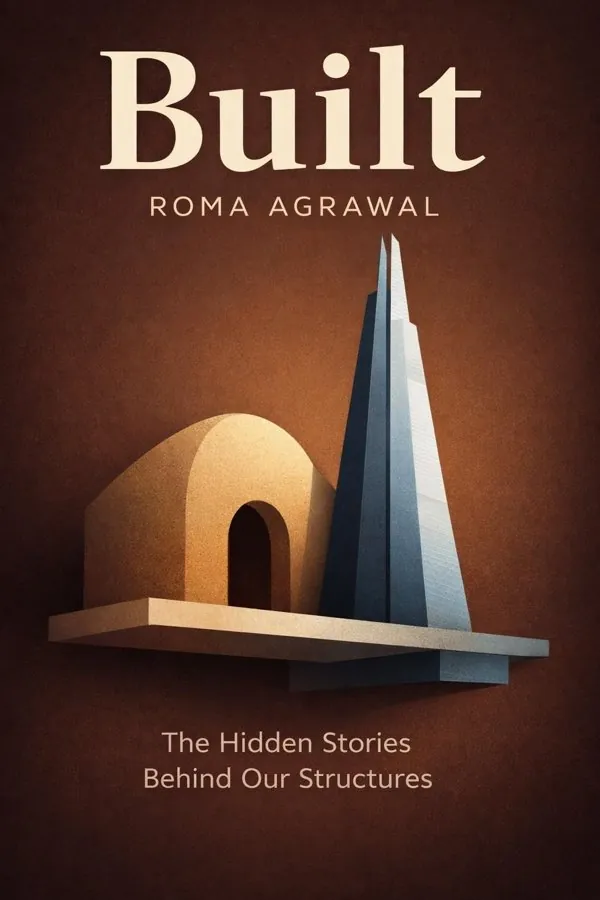
Built: The Hidden Stories Behind Our Structures: Summary & Key Insights
by Roma Agrawal
 10 min10 chaptersAudio available
What Is Built: The Hidden Stories Behind Our Structures About?
Built: The Hidden Stories Behind Our Structures by Roma Agrawal is a popular_sci book spanning 10 pages. Built is a fascinating exploration of structural engineering written by Roma Agrawal, the engineer behind London’s skyscraper The Shard. The book reveals how materials and ideas have evolved from mud huts to modern skyscrapers, uncovering the human and scientific stories behind the constructions that shape our world.
This FizzRead summary covers all 10 key chapters of Built: The Hidden Stories Behind Our Structures in approximately 10 minutes, distilling the most important ideas, arguments, and takeaways from Roma Agrawal's work. Also available as an audio summary and Key Quotes Podcast.
Built: The Hidden Stories Behind Our Structures
Built is a fascinating exploration of structural engineering written by Roma Agrawal, the engineer behind London’s skyscraper The Shard. The book reveals how materials and ideas have evolved from mud huts to modern skyscrapers, uncovering the human and scientific stories behind the constructions that shape our world.
Who Should Read Built: The Hidden Stories Behind Our Structures?
This book is perfect for anyone interested in popular_sci and looking to gain actionable insights in a short read. Whether you're a student, professional, or lifelong learner, the key ideas from Built: The Hidden Stories Behind Our Structures by Roma Agrawal will help you think differently.
- ✓Readers who enjoy popular_sci and want practical takeaways
- ✓Professionals looking to apply new ideas to their work and life
- ✓Anyone who wants the core insights of Built: The Hidden Stories Behind Our Structures in just 10 minutes
Want the full summary?
Get instant access to this book summary and 100K+ more with Fizz Moment.
Get Free SummaryAvailable on App Store • Free to download
Key Chapters
Every structure begins where it meets the earth. When I stand at the base of a skyscraper or stroll past a centuries-old cathedral, I’m always reminded that the hidden part of the building—the foundation—is the real hero. The first humans who built shelters faced one simple but critical challenge: stability. They needed their structures to resist the pull of gravity and the push of weather. Mud huts represented early victories in that quest, brilliantly simple yet full of scientific intuition. Builders learned by observing natural formations and experimenting with materials until their homes could stand firm against the elements.
As civilization grew, so did ambition. Ancient Egyptians embedded massive stones into carefully leveled beds, while Romans perfected the art of dense foundation work using concrete-like mixtures. These advances weren’t just about strength; they were about trust. A foundation is the promise that the rest of the structure will stand the test of time. When we designed The Shard, our deepest consideration was its foundation—metres upon metres of reinforced concrete, precisely calculated to distribute the load across London’s varied soil. It was a modern echo of those ancient experiments, each layer of history teaching us that every great building begins in humility—buried and unseen but absolutely essential.
The story of structural engineering is, in essence, the story of materials. We have always reached for what nature offered—wood, mud, stone—and then dared to make something greater. In *Built*, I trace that evolutionary arc: from the warmth of natural materials to the precision of man-made wonders.
Wood was our first companion, flexible and abundant. Stone gave permanence, allowing civilizations to dream in centuries rather than seasons. But the invention of steel and concrete changed everything. In the nineteenth century, engineers learned how to manipulate these materials on a scale that reshaped cities. Steel gave us strength without bulk. Concrete offered adaptability—a fluid that could become anything, from the Egyptian-like pyramidal forms to the flowing shapes of modernist architecture.
I have always been fascinated by how materials carry the memory of their makers. Each innovation came from curiosity. Why does this rock behave differently when heat is applied? What happens when we combine iron with carbon? These are scientific questions, but also profoundly human ones. Our ability to transform raw matter into meaning—stone into shelter, steel into skyline—is what binds us to our ancestors. In today’s design, we strive for sustainability, asking not only what materials can do but what impact they have. The evolution continues: recycled steel, self-healing concrete, and new composites are changing what ‘strong’ and ‘safe’ mean for future generations.
+ 8 more chapters — available in the FizzRead app
All Chapters in Built: The Hidden Stories Behind Our Structures
About the Author
Roma Agrawal is a British structural engineer recognized for her work on The Shard and her advocacy for engineering and architecture outreach. She has received multiple awards for promoting women's participation in engineering.
Get This Summary in Your Preferred Format
Read or listen to the Built: The Hidden Stories Behind Our Structures summary by Roma Agrawal anytime, anywhere. FizzRead offers multiple formats so you can learn on your terms — all free.
Available formats: App · Audio · PDF · EPUB — All included free with FizzRead
Download Built: The Hidden Stories Behind Our Structures PDF and EPUB Summary
Key Quotes from Built: The Hidden Stories Behind Our Structures
“Every structure begins where it meets the earth.”
“The story of structural engineering is, in essence, the story of materials.”
Frequently Asked Questions about Built: The Hidden Stories Behind Our Structures
Built: The Hidden Stories Behind Our Structures by Roma Agrawal is a popular_sci book that explores key ideas across 10 chapters. Built is a fascinating exploration of structural engineering written by Roma Agrawal, the engineer behind London’s skyscraper The Shard. The book reveals how materials and ideas have evolved from mud huts to modern skyscrapers, uncovering the human and scientific stories behind the constructions that shape our world.
You Might Also Like
Structures: Or Why Things Don"t Fall Down
J.E. Gordon
10 min
The Road to Wigan Pier
George Orwell
10 min
Bonk: The Curious Coupling of Science and Sex
Mary Roach
10 min
First Bite: How We Learn to Eat
Bee Wilson
10 min
In Pursuit Of The Unknown: 17 Equations That Changed The World
Ian Stewart
10 min
Napoleon's Buttons: 17 Molecules That Changed History
Penny Le Couteur and Jay Burreson
10 minBrowse by Category
Ready to read Built: The Hidden Stories Behind Our Structures?
Get the full summary and 100K+ more books with Fizz Moment.