
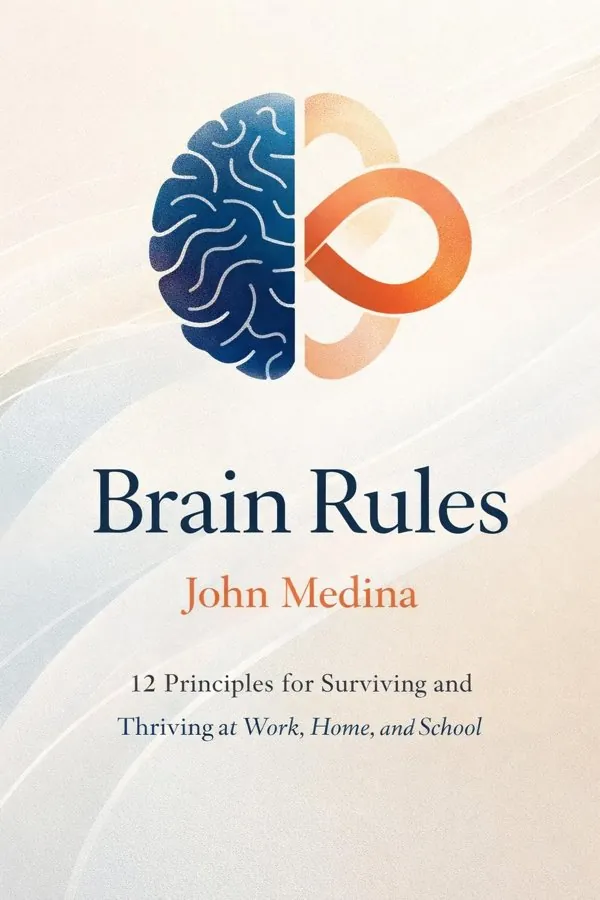
Brain Rules: 12 Principles for Surviving and Thriving at Work, Home, and School: Summary & Key Insights
by John Medina
 10 min12 chaptersAudio available
What Is Brain Rules: 12 Principles for Surviving and Thriving at Work, Home, and School About?
Brain Rules: 12 Principles for Surviving and Thriving at Work, Home, and School by John Medina is a popular_sci book spanning 12 pages. Brain Rules es un libro de divulgación científica que explora cómo el cerebro humano realmente funciona y cómo aplicar ese conocimiento para mejorar el aprendizaje, la productividad y la vida cotidiana. John Medina, biólogo molecular del desarrollo, presenta doce reglas basadas en investigaciones científicas sobre el sueño, el ejercicio, la memoria, la atención y otros aspectos del funcionamiento cerebral, ofreciendo consejos prácticos para optimizar el rendimiento mental en el trabajo, la escuela y el hogar.
This FizzRead summary covers all 12 key chapters of Brain Rules: 12 Principles for Surviving and Thriving at Work, Home, and School in approximately 10 minutes, distilling the most important ideas, arguments, and takeaways from John Medina's work. Also available as an audio summary and Key Quotes Podcast.
Brain Rules: 12 Principles for Surviving and Thriving at Work, Home, and School
Brain Rules es un libro de divulgación científica que explora cómo el cerebro humano realmente funciona y cómo aplicar ese conocimiento para mejorar el aprendizaje, la productividad y la vida cotidiana. John Medina, biólogo molecular del desarrollo, presenta doce reglas basadas en investigaciones científicas sobre el sueño, el ejercicio, la memoria, la atención y otros aspectos del funcionamiento cerebral, ofreciendo consejos prácticos para optimizar el rendimiento mental en el trabajo, la escuela y el hogar.
Who Should Read Brain Rules: 12 Principles for Surviving and Thriving at Work, Home, and School?
This book is perfect for anyone interested in popular_sci and looking to gain actionable insights in a short read. Whether you're a student, professional, or lifelong learner, the key ideas from Brain Rules: 12 Principles for Surviving and Thriving at Work, Home, and School by John Medina will help you think differently.
- ✓Readers who enjoy popular_sci and want practical takeaways
- ✓Professionals looking to apply new ideas to their work and life
- ✓Anyone who wants the core insights of Brain Rules: 12 Principles for Surviving and Thriving at Work, Home, and School in just 10 minutes
Want the full summary?
Get instant access to this book summary and 100K+ more with Fizz Moment.
Get Free SummaryAvailable on App Store • Free to download
Key Chapters
If evolution had designed a learning environment, it would look nothing like a classroom. It would look more like what our ancestors experienced: constant movement, a dynamic landscape that demanded endurance and adaptability. Exercise, far from being just good for the body, is one of the best things you can do for your brain. Regular physical activity boosts cognitive performance, improves executive function, and enhances the brain’s ability to learn and recall information.
When you move, blood flow to the brain increases, delivering more oxygen and nutrients that neurons require to function. Exercise stimulates the production of BDNF—brain-derived neurotrophic factor—which I often refer to as 'Miracle-Gro for the brain.' This chemical encourages the growth and survival of neuronal connections, particularly in the hippocampus, the region essential for memory.
I have seen this validated in numerous studies: older adults who walk several times a week show improved cognitive scores compared to sedentary counterparts. Children who exercise before class demonstrate better impulse control and focus. Bottom line: movement improves thinking. Our ancestors didn’t sit still; their survival depended on activity, and our brains still expect that environment.
So if you want a sharper, more agile brain, start with simple motion. Walk, climb stairs, engage in moderate aerobic activity—your neurons will thank you.
The human brain is a problem-solving machine, honed over millions of years in response to survival challenges. Our ancestors faced a volatile, unpredictable world, and those who could adapt, cooperate, and innovate survived. The modern brain still carries this evolutionary imprint. Our survival-based brain thrives on exploration and pattern recognition; it craves challenge.
We weren’t designed for the sedentary comfort of cubicles or for repetitive tasks devoid of meaningful context. The brain that successfully navigated the African savannas loves novelty and complexity. It relies on relationships, too—social interaction has always been a cornerstone of survival. Humans evolved as cooperative creatures, and our brains mirror this heritage: when we solve problems together, neural networks for empathy, communication, and reasoning activate in powerful ways.
I argue that honoring our evolutionary wiring means creating environments that mirror those ancient conditions—engaging curiosity, supporting teamwork, and leaving room for improvisation. Too many modern systems, from classrooms to boardrooms, stifle these natural strengths. When we reclaim our evolutionary design, we tap directly into the same capacities that once kept our ancestors alive.
+ 10 more chapters — available in the FizzRead app
All Chapters in Brain Rules: 12 Principles for Surviving and Thriving at Work, Home, and School
About the Author
John Medina es un biólogo molecular del desarrollo y profesor afiliado en la Universidad de Washington. Es conocido por su trabajo en neurociencia aplicada y por su capacidad para traducir complejos hallazgos científicos en consejos prácticos para la vida diaria. Además de Brain Rules, ha escrito otros libros sobre el cerebro y el desarrollo infantil.
Get This Summary in Your Preferred Format
Read or listen to the Brain Rules: 12 Principles for Surviving and Thriving at Work, Home, and School summary by John Medina anytime, anywhere. FizzRead offers multiple formats so you can learn on your terms — all free.
Available formats: App · Audio · PDF · EPUB — All included free with FizzRead
Download Brain Rules: 12 Principles for Surviving and Thriving at Work, Home, and School PDF and EPUB Summary
Key Quotes from Brain Rules: 12 Principles for Surviving and Thriving at Work, Home, and School
“If evolution had designed a learning environment, it would look nothing like a classroom.”
“The human brain is a problem-solving machine, honed over millions of years in response to survival challenges.”
Frequently Asked Questions about Brain Rules: 12 Principles for Surviving and Thriving at Work, Home, and School
Brain Rules: 12 Principles for Surviving and Thriving at Work, Home, and School by John Medina is a popular_sci book that explores key ideas across 12 chapters. Brain Rules es un libro de divulgación científica que explora cómo el cerebro humano realmente funciona y cómo aplicar ese conocimiento para mejorar el aprendizaje, la productividad y la vida cotidiana. John Medina, biólogo molecular del desarrollo, presenta doce reglas basadas en investigaciones científicas sobre el sueño, el ejercicio, la memoria, la atención y otros aspectos del funcionamiento cerebral, ofreciendo consejos prácticos para optimizar el rendimiento mental en el trabajo, la escuela y el hogar.
You Might Also Like

Structures: Or Why Things Don"t Fall Down
J.E. Gordon
10 min
The Road to Wigan Pier
George Orwell
10 min
Bonk: The Curious Coupling of Science and Sex
Mary Roach
10 min
First Bite: How We Learn to Eat
Bee Wilson
10 min
In Pursuit Of The Unknown: 17 Equations That Changed The World
Ian Stewart
10 min
Napoleon's Buttons: 17 Molecules That Changed History
Penny Le Couteur and Jay Burreson
10 minBrowse by Category
Ready to read Brain Rules: 12 Principles for Surviving and Thriving at Work, Home, and School?
Get the full summary and 100K+ more books with Fizz Moment.