
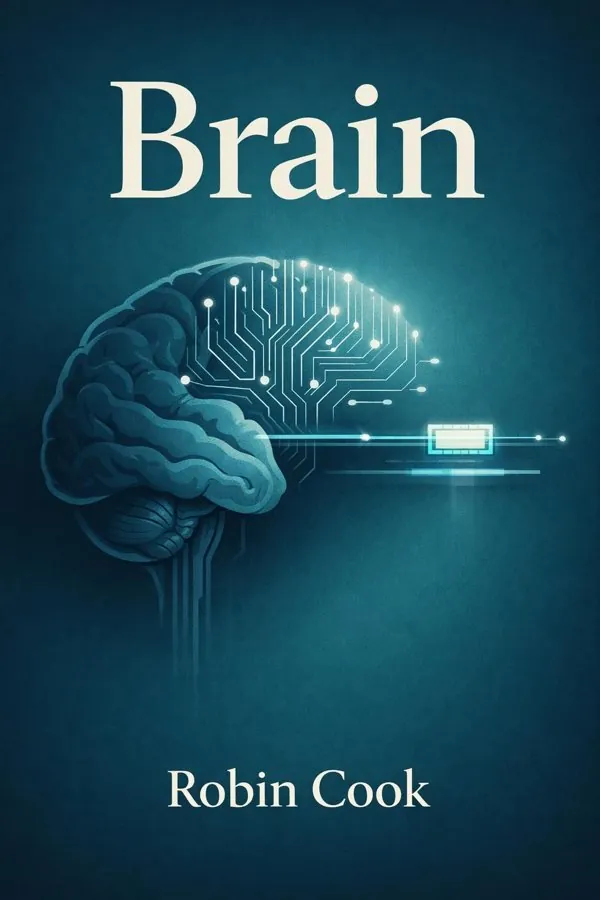
Brain: Summary & Key Insights
by Robin Cook
 10 min8 chapters
Key Takeaways from Brain
The most dangerous systems often reveal themselves not through dramatic failures but through details that do not quite fit.
One of the novel’s sharpest warnings is that prestige is not proof of integrity.
Every mystery deepens when the search for answers reveals not one secret but an entire concealed system.
Technology itself is rarely the villain; the real danger lies in what people decide to do with it.
A society reveals its moral limits by how it treats people in the name of progress.
What Is Brain About?
Brain by Robin Cook is a mystery book spanning 4 pages. What makes Brain so gripping is that its central nightmare feels only one scientific breakthrough away from reality. Robin Cook’s novel begins as a medical mystery and quickly expands into a chilling exploration of what can happen when advanced neuroscience, institutional secrecy, and human ambition collide. The story follows Dr. Martin Philips, a young physician working in a prestigious medical environment, who becomes alarmed when patients he has referred for routine neurological testing seem to disappear. What starts as professional unease turns into a dangerous investigation involving hidden research, vulnerable patients, and experiments that blur the line between treatment and exploitation. The novel matters because it is not merely interested in suspense for its own sake. Cook uses the machinery of a thriller to ask hard questions about scientific progress: Who decides what is ethically acceptable in research? How easily can patients become raw material when technology promises extraordinary results? And what happens when medicine’s duty to heal is replaced by the desire to control life itself? As both a physician and a bestselling novelist, Robin Cook writes with unusual authority, translating complex medical ideas into a tense, accessible story that remains unsettlingly relevant.
This FizzRead summary covers all 8 key chapters of Brain in approximately 10 minutes, distilling the most important ideas, arguments, and takeaways from Robin Cook's work.
Brain
What makes Brain so gripping is that its central nightmare feels only one scientific breakthrough away from reality. Robin Cook’s novel begins as a medical mystery and quickly expands into a chilling exploration of what can happen when advanced neuroscience, institutional secrecy, and human ambition collide. The story follows Dr. Martin Philips, a young physician working in a prestigious medical environment, who becomes alarmed when patients he has referred for routine neurological testing seem to disappear. What starts as professional unease turns into a dangerous investigation involving hidden research, vulnerable patients, and experiments that blur the line between treatment and exploitation.
The novel matters because it is not merely interested in suspense for its own sake. Cook uses the machinery of a thriller to ask hard questions about scientific progress: Who decides what is ethically acceptable in research? How easily can patients become raw material when technology promises extraordinary results? And what happens when medicine’s duty to heal is replaced by the desire to control life itself? As both a physician and a bestselling novelist, Robin Cook writes with unusual authority, translating complex medical ideas into a tense, accessible story that remains unsettlingly relevant.
Who Should Read Brain?
This book is perfect for anyone interested in mystery and looking to gain actionable insights in a short read. Whether you're a student, professional, or lifelong learner, the key ideas from Brain by Robin Cook will help you think differently.
- ✓Readers who enjoy mystery and want practical takeaways
- ✓Professionals looking to apply new ideas to their work and life
- ✓Anyone who wants the core insights of Brain in just 10 minutes
Want the full summary?
Get instant access to this book summary and 100K+ more with Fizz Moment.
Get Free SummaryAvailable on App Store • Free to download
Key Chapters
The most dangerous systems often reveal themselves not through dramatic failures but through details that do not quite fit. In Brain, Dr. Martin Philips works in a highly respected hospital where efficiency, hierarchy, and technical excellence create an aura of trust. Yet that trust starts to crack when several young female patients he has referred for brain scans seem to vanish from normal follow-up channels. No one around him appears especially concerned. Records are vague, explanations are evasive, and the institution’s confidence pressures him to doubt his own instincts.
This is one of the novel’s most powerful ideas: suspicion often begins as professional discomfort. Martin is not reacting to obvious criminality at first. He is responding to missing continuity, unexplained transfers, and the subtle sense that the official story has too many blank spaces. Cook shows how large organizations can normalize abnormalities simply because questioning them is inconvenient. If everyone assumes someone else is responsible, vulnerable people can disappear in plain sight.
The insight extends beyond hospitals. In workplaces, schools, financial systems, or public agencies, serious wrongdoing often hides inside routine processes. A missing report, an irregular handoff, or a pattern no one wants to investigate may be the first sign that something deeper is wrong. The lesson is not to become paranoid, but to respect evidence when it unsettles accepted assumptions.
Martin’s growing unease also highlights the moral difference between competence and conscience. A skilled professional who ignores anomalies can still become part of a harmful system. Real responsibility begins when expertise is joined to vigilance.
Actionable takeaway: when repeated inconsistencies appear in any high-trust environment, document them, ask direct questions, and do not let institutional confidence override your own informed judgment.
One of the novel’s sharpest warnings is that prestige is not proof of integrity. The hospital in Brain is advanced, admired, and staffed by accomplished specialists. It represents the best face of modern medicine: polished equipment, elite credentials, and a culture of apparent rigor. Yet that same prestige becomes a shield behind which secrecy can thrive. Because the institution looks authoritative, its actions are less likely to be challenged. Because its leaders are successful, their motives are more easily assumed to be noble.
Cook uses this setting to expose a broader truth: people often confuse excellence in one domain with trustworthiness in all others. A brilliant surgeon may still be ethically compromised. A celebrated research center may still exploit patients. An institution known for innovation may also become dangerous if oversight weakens and ambition outruns restraint.
In practical terms, this dynamic exists wherever authority is concentrated. Investors overlook red flags at famous firms. Citizens excuse misconduct by admired officials. Employees remain silent because they assume a respected organization must know what it is doing. Brain reminds readers that status can reduce scrutiny precisely when scrutiny is most needed.
The novel also suggests that corruption within prestigious systems rarely presents itself as villainy. It often speaks the language of progress, necessity, and exceptional outcomes. Harmful decisions are framed as difficult but visionary. That moral reframing allows people to participate without feeling monstrous.
By placing horror inside a top-tier medical environment, Cook makes the story more unsettling. Evil does not arrive from outside civilization; it can emerge from its most advanced institutions when no one insists on accountability.
Actionable takeaway: never treat reputation, credentials, or institutional prestige as substitutes for transparency, consent, and independent ethical review.
Technology itself is rarely the villain; the real danger lies in what people decide to do with it. In Brain, the fusion of neuroscience and computing creates the novel’s central terror. The possibility of linking human brains with machines is presented not as fantasy, but as a seductive scientific frontier. Such a breakthrough promises astonishing gains: deeper understanding of consciousness, new forms of treatment, perhaps even ways to preserve or extend mental function. Yet as Cook makes clear, the same tools that could heal can also dominate, manipulate, and dehumanize.
This is what gives the novel lasting relevance. Every era invents technologies that expand human power faster than human wisdom. Brain dramatizes the moment when technical capability outruns ethical maturity. The people behind the experiment are not motivated solely by cruelty; they are driven by ambition, curiosity, and the intoxicating belief that unprecedented results justify unprecedented methods. That is often how ethical collapse begins.
The idea applies far beyond medical research. Artificial intelligence, genetic engineering, surveillance systems, neural interfaces, and predictive algorithms all raise the same question: does our ability to build something mean we should? A brain-computer system might restore communication for a disabled patient in one setting and become a tool of exploitation in another. The moral meaning of technology depends on governance, consent, and purpose.
Cook’s deeper point is that innovation does not erase human nature. Vanity, greed, fear, and competition enter every laboratory. Without ethical discipline, powerful tools amplify not only human potential but also human blindness.
Readers can apply this insight by evaluating new technologies with two lenses at once: what problem do they solve, and what abuses do they enable? Admiration for innovation should never cancel careful moral inquiry.
Actionable takeaway: judge emerging technologies not just by their promise, but by the incentives, safeguards, and power structures surrounding their use.
A society reveals its moral limits by how it treats people in the name of progress. One of Brain’s central concerns is human experimentation and the terrifying ease with which vulnerable individuals can be recast as necessary sacrifices for a greater scientific goal. The novel forces readers to confront a brutal question: when researchers become obsessed with discovery, how quickly can patients stop being persons and become specimens?
Cook frames this issue through medical authority. The victims are not harmed by obvious sadists operating outside the system. They are endangered by experts who can rationalize invasive procedures as contributions to knowledge. That is precisely what makes the novel unsettling. The language of research, innovation, and clinical advancement can conceal moral violence when consent is compromised or absent.
The problem is not research itself. Ethical experimentation has transformed medicine, improved survival, and relieved suffering. Brain does not argue against science; it argues against science detached from moral accountability. Informed consent, independent review, patient dignity, and the right to refuse are not bureaucratic obstacles. They are the safeguards that distinguish healing from exploitation.
This theme remains urgently practical. Modern readers encounter similar debates in drug trials, gene editing, reproductive medicine, data harvesting, and neurological interventions. The pressure to move quickly can be immense, especially when the potential benefit appears revolutionary. Yet history repeatedly shows that when oversight is weakened, the vulnerable pay the price.
The novel also highlights an uncomfortable truth: ethical failure often begins with language. If doctors start speaking of subjects instead of patients, outcomes instead of lives, and acceptable losses instead of irreversible harm, conscience is already being eroded.
Actionable takeaway: in any field involving human risk, insist that consent, dignity, and independent ethical review remain non-negotiable, no matter how extraordinary the promised results may be.
Moral courage rarely feels dramatic in the moment; more often, it feels lonely, inconvenient, and professionally dangerous. As Martin gets closer to the truth in Brain, he is not rewarded for his persistence. He becomes increasingly isolated, doubted, and threatened by the very system in which he works. This is a crucial insight of the novel: doing the right thing inside a powerful institution often requires standing apart from colleagues, superiors, and accepted procedures.
Cook captures the psychology of whistleblowing before the term became so culturally prominent. Martin is not simply solving a puzzle. He is deciding whether his duty as a physician is to protect his position or protect his patients. The pressure to remain silent is immense because institutions are skilled at making dissent look irrational, disloyal, or self-destructive. People who raise ethical objections are often asked for impossible levels of proof while those in authority continue operating under assumptions of legitimacy.
This pattern is familiar in many professions. Employees notice accounting irregularities, engineers spot safety shortcuts, teachers see systemic neglect, and clinicians recognize questionable practices. Yet many remain silent because the personal cost of speaking can be severe. Brain shows that silence is not neutrality; it often serves the stronger party.
The novel also reminds readers that courage does not require certainty about every detail. Martin acts because the risk of inaction has become morally intolerable. Waiting for perfect evidence in the face of mounting harm can itself become a form of complicity.
Practical courage often includes documentation, trusted allies, and strategic escalation rather than reckless confrontation. Persistence matters as much as bravery.
Actionable takeaway: if your role gives you visibility into possible harm, do not ignore it—gather facts, seek support, and take responsible action before the system’s inertia turns suspicion into preventable tragedy.
One of Brain’s most unsettling philosophical questions is whether human consciousness can be treated as something mechanical. The novel’s scientific premise invites readers to imagine the brain as circuitry: measurable, transferable, perhaps even controllable through technological means. That framing drives the plot, but Cook uses it to raise a deeper issue. If the mind is reduced entirely to function, what happens to personhood, autonomy, and identity?
This is where the thriller becomes intellectually richer than a simple chase narrative. The experiments in the novel suggest a view of the human being as an object that can be optimized, preserved, or repurposed. Such thinking is seductive in medicine because it promises mastery over suffering. If the brain is only a machine, then perhaps every limitation is ultimately an engineering problem. But the story resists that simplification by showing the moral horror that follows when technical control replaces respect for the self.
This tension is highly relevant today. Neuroscience, AI, and cognitive technologies increasingly map, model, and influence mental processes. These tools can bring extraordinary benefits, from treating epilepsy to helping paralyzed patients communicate. Yet they also tempt us to think that what is measurable is all that matters. Brain warns against collapsing the full human person into neural data.
In practical life, this insight can change how we approach health, education, and technology. We should welcome scientific understanding of the brain without forgetting that people are not merely systems to be managed. Emotional life, dignity, memory, relationships, and freedom cannot be adequately handled by purely mechanical thinking.
Cook does not reject science. He rejects the arrogance that mistakes technical description for total understanding.
Actionable takeaway: embrace scientific advances in understanding the brain, but resist any framework that reduces human identity to data, circuitry, or experimental utility.
In thrillers, uncovering the truth is often treated as a clean victory. Brain offers a harsher and more realistic view: revelation may stop further harm, but it cannot erase what has already been done. As the conspiracy comes into focus and the hidden program is exposed, the emotional impact extends beyond the excitement of solved mystery. Patients have suffered, trust has been shattered, and the institutions meant to protect life have been implicated in violating it.
This final movement of the novel matters because it prevents the story from becoming morally simplistic. The defeat of a secret operation does not magically restore innocence. Martin’s discovery forces a reckoning with the aftermath of unethical science: trauma for victims, complicity for bystanders, and disillusionment for anyone who believed elite medicine was automatically humane.
Cook uses this aftermath to underline a key theme: accountability is necessary, but prevention is better. Once harm has been done in secret, no amount of exposure can fully reverse it. That insight applies widely. A company may apologize after a data breach, a hospital may discipline staff after misconduct, and a government may investigate abuse after public outrage. Yet the original violation still leaves scars. Systems must be designed to prevent abuse before heroics become necessary.
The novel’s ending also reminds readers that truth has responsibilities attached to it. Exposing wrongdoing is only the first step; rebuilding trust requires transparency, reform, and sustained vigilance.
This has personal relevance as well. In everyday life, whether in families, organizations, or institutions, confronting hard truths should aim not only at blame but at creating structures that make repetition less likely.
Actionable takeaway: when wrongdoing is revealed, push beyond exposure toward accountability, reform, and safeguards that protect others from the same harm in the future.
All Chapters in Brain
About the Author
Robin Cook is an American physician and novelist widely credited with popularizing the modern medical thriller. Born in 1940, he trained in medicine and used his clinical background to bring realism, urgency, and technical credibility to his fiction. His novels often explore the darker side of hospitals, biotechnology, research culture, and the ethical dilemmas created by rapid scientific progress. Cook became especially well known for blending accessible medical detail with high-stakes suspense, helping readers see how advances meant to heal can also be misused. Bestselling works such as Coma established his reputation, and books like Brain continued his exploration of the tension between innovation and morality. His fiction remains influential because it turns complex medical anxieties into compelling, thought-provoking stories.
Get This Summary in Your Preferred Format
Read or listen to the Brain summary by Robin Cook anytime, anywhere. FizzRead offers multiple formats so you can learn on your terms — all free.
Available formats: App · Audio · PDF · EPUB — All included free with FizzRead
Download Brain PDF and EPUB Summary
Key Quotes from Brain
“The most dangerous systems often reveal themselves not through dramatic failures but through details that do not quite fit.”
“One of the novel’s sharpest warnings is that prestige is not proof of integrity.”
“Every mystery deepens when the search for answers reveals not one secret but an entire concealed system.”
“Technology itself is rarely the villain; the real danger lies in what people decide to do with it.”
“A society reveals its moral limits by how it treats people in the name of progress.”
Frequently Asked Questions about Brain
Brain by Robin Cook is a mystery book that explores key ideas across 8 chapters. What makes Brain so gripping is that its central nightmare feels only one scientific breakthrough away from reality. Robin Cook’s novel begins as a medical mystery and quickly expands into a chilling exploration of what can happen when advanced neuroscience, institutional secrecy, and human ambition collide. The story follows Dr. Martin Philips, a young physician working in a prestigious medical environment, who becomes alarmed when patients he has referred for routine neurological testing seem to disappear. What starts as professional unease turns into a dangerous investigation involving hidden research, vulnerable patients, and experiments that blur the line between treatment and exploitation. The novel matters because it is not merely interested in suspense for its own sake. Cook uses the machinery of a thriller to ask hard questions about scientific progress: Who decides what is ethically acceptable in research? How easily can patients become raw material when technology promises extraordinary results? And what happens when medicine’s duty to heal is replaced by the desire to control life itself? As both a physician and a bestselling novelist, Robin Cook writes with unusual authority, translating complex medical ideas into a tense, accessible story that remains unsettlingly relevant.
You Might Also Like





Browse by Category
Ready to read Brain?
Get the full summary and 100K+ more books with Fizz Moment.