
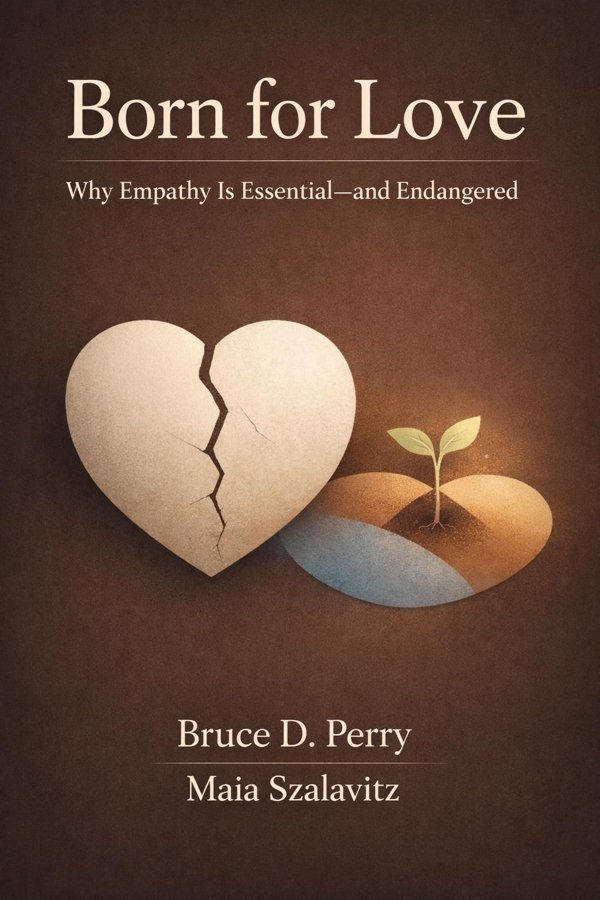
Born for Love: Why Empathy Is Essential—and Endangered: Summary & Key Insights
by Bruce D. Perry, Maia Szalavitz
 10 min11 chaptersAudio available
What Is Born for Love: Why Empathy Is Essential—and Endangered About?
Born for Love: Why Empathy Is Essential—and Endangered by Bruce D. Perry, Maia Szalavitz is a neuroscience book spanning 11 pages. This book explores the science of empathy and its crucial role in human development, relationships, and society. Drawing on neuroscience, psychology, and real-life case studies, Bruce D. Perry and Maia Szalavitz explain how empathy develops in childhood, how it can be nurtured or damaged, and why modern life may be eroding our capacity for compassion. The authors argue that empathy is not just a moral virtue but a biological necessity for human survival and well-being.
This FizzRead summary covers all 11 key chapters of Born for Love: Why Empathy Is Essential—and Endangered in approximately 10 minutes, distilling the most important ideas, arguments, and takeaways from Bruce D. Perry, Maia Szalavitz's work. Also available as an audio summary and Key Quotes Podcast.
Born for Love: Why Empathy Is Essential—and Endangered
This book explores the science of empathy and its crucial role in human development, relationships, and society. Drawing on neuroscience, psychology, and real-life case studies, Bruce D. Perry and Maia Szalavitz explain how empathy develops in childhood, how it can be nurtured or damaged, and why modern life may be eroding our capacity for compassion. The authors argue that empathy is not just a moral virtue but a biological necessity for human survival and well-being.
Who Should Read Born for Love: Why Empathy Is Essential—and Endangered?
This book is perfect for anyone interested in neuroscience and looking to gain actionable insights in a short read. Whether you're a student, professional, or lifelong learner, the key ideas from Born for Love: Why Empathy Is Essential—and Endangered by Bruce D. Perry, Maia Szalavitz will help you think differently.
- ✓Readers who enjoy neuroscience and want practical takeaways
- ✓Professionals looking to apply new ideas to their work and life
- ✓Anyone who wants the core insights of Born for Love: Why Empathy Is Essential—and Endangered in just 10 minutes
Want the full summary?
Get instant access to this book summary and 100K+ more with Fizz Moment.
Get Free SummaryAvailable on App Store • Free to download
Key Chapters
We begin here, with the most fundamental truth: empathy is embedded in the architecture of the human brain. Long before a child can speak, mirror neurons fire when she sees another person smile or cry, allowing her tiny nervous system to simulate the feelings of others. This neural resonance creates a foundation for connection. Evolution shaped us this way because cooperation, not competition alone, enhanced survival. Mothers who sensed their infants’ distress and responded appropriately raised offspring who thrived; communities that prioritized mutual care endured hardship more effectively.
In my clinical work, I’ve seen how our biology is designed to link stress response systems between individuals. When an infant’s cry triggers a caregiver’s attention, the adult’s calm presence literally regulates the child’s physiological state: heart rate slows, cortisol drops, safety is felt. This co-regulation is the precursor to self-regulation. In that mirroring and calming dance, empathy is born.
Neuroscience also reveals how fragile these circuits are. Chronic stress—especially when unbuffered by supportive relationships—disrupts the development of oxytocin and dopamine pathways that underlie bonding and reward. When a baby’s early environment is chaotic or unresponsive, her brain learns that connection is unreliable, and the neural networks supporting empathy become underdeveloped. Biology thus binds empathy to context: it is natural, but it must also be nurtured.
Empathy begins with touch, gaze, and tone. In the first year of life, the way a caregiver responds to a baby’s cues literally sculpts the brain. A securely attached infant—whose cries bring comfort, whose smiles are mirrored—learns that other people are predictable sources of safety and pleasure. This forms what I call an internal ‘template of trust.’ It tells the child: feelings are acceptable, needs will be met, connection is good.
But when caregivers are emotionally unavailable, inconsistent, or frightened themselves, that template becomes distorted. The child learns that feelings may provoke rejection or danger, and empathy for others becomes complicated by self-protection. In working with neglected infants, we’ve seen how quickly their development reverses once consistent, warm caregiving is restored—proof that the seeds of empathy remain dormant until conditions allow them to grow.
The early years are not just sensitive; they are formative. Human brains are experience-dependent organs. When love and responsive care are abundant, the architecture of empathy becomes sturdy and flexible. When deprivation rules, defensive circuits dominate. That’s why early nurturing is the most powerful form of education: it teaches the language of the heart before words ever appear.
+ 9 more chapters — available in the FizzRead app
All Chapters in Born for Love: Why Empathy Is Essential—and Endangered
About the Authors
Bruce D. Perry is a psychiatrist and senior fellow at the ChildTrauma Academy in Houston, known for his research on child trauma and brain development. Maia Szalavitz is an award-winning journalist specializing in neuroscience and addiction, and coauthor of several books on psychology and mental health.
Get This Summary in Your Preferred Format
Read or listen to the Born for Love: Why Empathy Is Essential—and Endangered summary by Bruce D. Perry, Maia Szalavitz anytime, anywhere. FizzRead offers multiple formats so you can learn on your terms — all free.
Available formats: App · Audio · PDF · EPUB — All included free with FizzRead
Download Born for Love: Why Empathy Is Essential—and Endangered PDF and EPUB Summary
Key Quotes from Born for Love: Why Empathy Is Essential—and Endangered
“We begin here, with the most fundamental truth: empathy is embedded in the architecture of the human brain.”
“Empathy begins with touch, gaze, and tone.”
Frequently Asked Questions about Born for Love: Why Empathy Is Essential—and Endangered
Born for Love: Why Empathy Is Essential—and Endangered by Bruce D. Perry, Maia Szalavitz is a neuroscience book that explores key ideas across 11 chapters. This book explores the science of empathy and its crucial role in human development, relationships, and society. Drawing on neuroscience, psychology, and real-life case studies, Bruce D. Perry and Maia Szalavitz explain how empathy develops in childhood, how it can be nurtured or damaged, and why modern life may be eroding our capacity for compassion. The authors argue that empathy is not just a moral virtue but a biological necessity for human survival and well-being.
You Might Also Like
Anxious
Joseph LeDoux
10 min
Hallucinations
Oliver Sacks
10 min
The Biological Mind: How Brain, Body, and Environment Collaborate to Make Us Who We Are
Alan Jasanoff
10 min
The Feeling of Life Itself: Why Consciousness Is Widespread but Can't Be Computed
Christof Koch
10 min
The No-Nonsense Meditation Book
Steven Laureys
10 min
A General Theory of Love
Thomas Lewis, Fari Amini, Richard Lannon
10 minBrowse by Category
Ready to read Born for Love: Why Empathy Is Essential—and Endangered?
Get the full summary and 100K+ more books with Fizz Moment.