
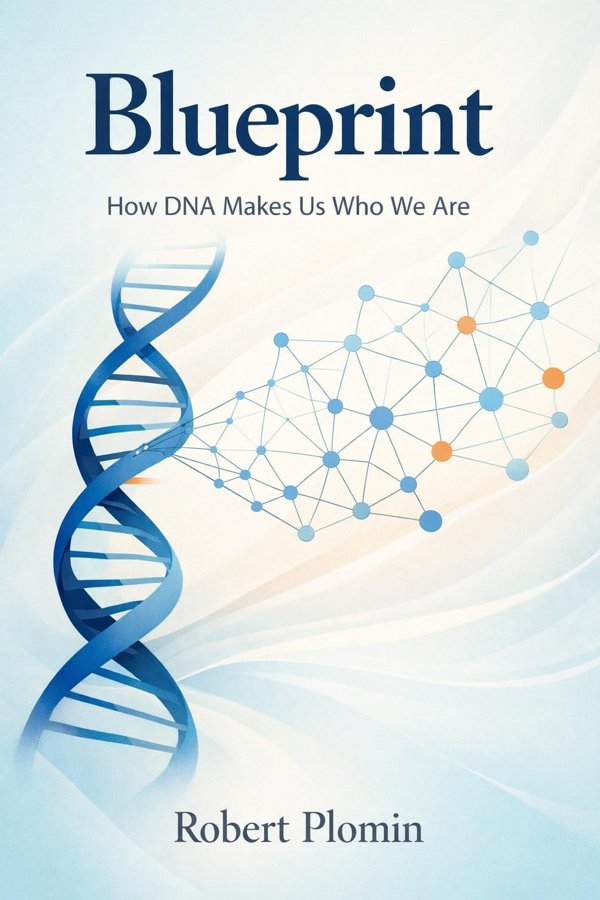
Blueprint: How DNA Makes Us Who We Are: Summary & Key Insights
 10 min10 chaptersAudio available
What Is Blueprint: How DNA Makes Us Who We Are About?
Blueprint: How DNA Makes Us Who We Are by Robert Plomin is a popular_sci book spanning 10 pages. Blueprint: How DNA Makes Us Who We Are is a popular science book by behavioral geneticist Robert Plomin. The author argues that genetics plays a fundamental role in shaping personality, intelligence, and individual differences, beyond environmental influences. Drawing on decades of research, Plomin explains how advances in genomics allow for the prediction of psychological and educational traits, and he reflects on the ethical and social implications of these discoveries.
This FizzRead summary covers all 10 key chapters of Blueprint: How DNA Makes Us Who We Are in approximately 10 minutes, distilling the most important ideas, arguments, and takeaways from Robert Plomin's work. Also available as an audio summary and Key Quotes Podcast.
Blueprint: How DNA Makes Us Who We Are
Blueprint: How DNA Makes Us Who We Are is a popular science book by behavioral geneticist Robert Plomin. The author argues that genetics plays a fundamental role in shaping personality, intelligence, and individual differences, beyond environmental influences. Drawing on decades of research, Plomin explains how advances in genomics allow for the prediction of psychological and educational traits, and he reflects on the ethical and social implications of these discoveries.
Who Should Read Blueprint: How DNA Makes Us Who We Are?
This book is perfect for anyone interested in popular_sci and looking to gain actionable insights in a short read. Whether you're a student, professional, or lifelong learner, the key ideas from Blueprint: How DNA Makes Us Who We Are by Robert Plomin will help you think differently.
- ✓Readers who enjoy popular_sci and want practical takeaways
- ✓Professionals looking to apply new ideas to their work and life
- ✓Anyone who wants the core insights of Blueprint: How DNA Makes Us Who We Are in just 10 minutes
Want the full summary?
Get instant access to this book summary and 100K+ more with Fizz Moment.
Get Free SummaryAvailable on App Store • Free to download
Key Chapters
When I first stepped into behavioral genetics in the 1970s, the field was still controversial, its legitimacy questioned. The core question was simple: why are people psychologically different from one another? But the answers were firmed up through decades of twin and adoption studies. We compared identical twins, who share virtually 100 percent of their DNA, with fraternal twins, who share about half. If identical twins resemble each other more strongly in intelligence, personality, or interests than fraternal twins do, the difference can only come from genetics.
Over time, such studies—across thousands of families and data sets—showed an unmistakable pattern. All psychological traits, without exception, showed substantial heritability, typically around 40 to 50 percent. That means roughly half the differences between people on average come from inherited DNA differences. Adoption studies confirmed this by showing that adopted children’s outcomes correlate more strongly with those of their biological parents than their adoptive ones.
These findings challenged a long-dominant environmental mindset in psychology. The notion that parenting styles, schooling, or social class were the primary molders of the mind simply could not explain the data. It was an intellectual shift akin to discovering that the Earth revolves around the Sun: simple in outline, disruptive in implication. The resistance was fierce, but evidence has a way of silencing belief.
As I recount in the book, these early decades of behavioral genetics laid not just an empirical foundation, but a conceptual one. They proved that DNA, invisible though it seemed then, must be operating as the systematic source of stability in who we are.
Few terms in behavioral science provoke more confusion than heritability. In *Blueprint*, I make it a central task to clear that confusion. Heritability is not about how much of an individual’s personality or intelligence is caused by genes. Rather, it describes how much of the variation among people in a population can be attributed to genetic differences.
Think of height: if everyone lived in perfect nutritional conditions, height differences across people would mainly reflect genetics, making heritability high. If nutrition varied drastically, environmental influences would be greater, reducing heritability. Thus, heritability is not a fixed property—it changes with circumstances.
One of the most surprising discoveries I explain is that heritability tends to increase, not decrease, as people mature. Children’s outcomes are more influenced by shared family environments, but as they grow older, they select, modify, and even create environments that suit their inborn tendencies. A child genetically inclined toward reading finds herself drawn to books, which in turn deepen her ability and enjoyment of reading—a perfect feedback loop between genes and choice.
Understanding heritability helps us interpret one of science’s clearest messages: environmental effects are often broad and unsystematic, whereas genetic influences are consistent and predictable. This is why identical twins reared apart are as similar in personality and intelligence as those raised together. Shared family environments, surprisingly, matter much less than we all used to think. Heritability is not destiny; it is the reliable pattern in the fabric of human variation.
+ 8 more chapters — available in the FizzRead app
All Chapters in Blueprint: How DNA Makes Us Who We Are
About the Author
Robert Plomin is a British-American behavioral geneticist and professor at King's College London. He is recognized for his pioneering work on the genetics of intelligence and personality and has been a key figure in the development of modern behavioral genetics.
Get This Summary in Your Preferred Format
Read or listen to the Blueprint: How DNA Makes Us Who We Are summary by Robert Plomin anytime, anywhere. FizzRead offers multiple formats so you can learn on your terms — all free.
Available formats: App · Audio · PDF · EPUB — All included free with FizzRead
Download Blueprint: How DNA Makes Us Who We Are PDF and EPUB Summary
Key Quotes from Blueprint: How DNA Makes Us Who We Are
“When I first stepped into behavioral genetics in the 1970s, the field was still controversial, its legitimacy questioned.”
“Few terms in behavioral science provoke more confusion than heritability.”
Frequently Asked Questions about Blueprint: How DNA Makes Us Who We Are
Blueprint: How DNA Makes Us Who We Are by Robert Plomin is a popular_sci book that explores key ideas across 10 chapters. Blueprint: How DNA Makes Us Who We Are is a popular science book by behavioral geneticist Robert Plomin. The author argues that genetics plays a fundamental role in shaping personality, intelligence, and individual differences, beyond environmental influences. Drawing on decades of research, Plomin explains how advances in genomics allow for the prediction of psychological and educational traits, and he reflects on the ethical and social implications of these discoveries.
You Might Also Like

Structures: Or Why Things Don"t Fall Down
J.E. Gordon
10 min
The Road to Wigan Pier
George Orwell
10 min
Bonk: The Curious Coupling of Science and Sex
Mary Roach
10 min
First Bite: How We Learn to Eat
Bee Wilson
10 min
In Pursuit Of The Unknown: 17 Equations That Changed The World
Ian Stewart
10 min
Napoleon's Buttons: 17 Molecules That Changed History
Penny Le Couteur and Jay Burreson
10 minBrowse by Category
Ready to read Blueprint: How DNA Makes Us Who We Are?
Get the full summary and 100K+ more books with Fizz Moment.