
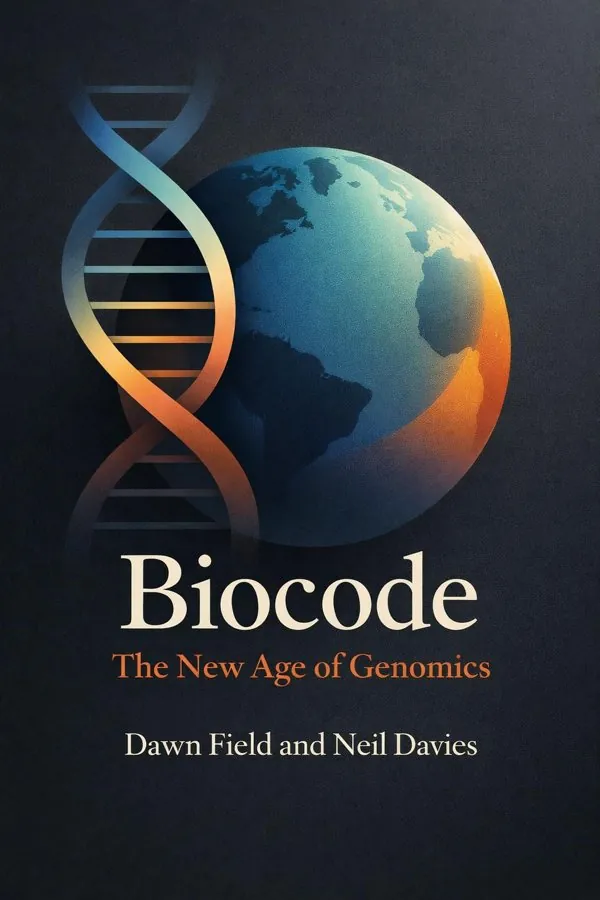
Biocode: The New Age of Genomics: Summary & Key Insights
 10 min4 chaptersAudio available
What Is Biocode: The New Age of Genomics About?
Biocode: The New Age of Genomics by Dawn Field and Neil Davies is a life_science book spanning 4 pages. Biocode: The New Age of Genomics explores the emerging field of genomics and the global effort to read, map, and understand the DNA of all living things. The authors describe how advances in sequencing technology are transforming biology, ecology, and medicine, and how the concept of a 'biocode'—the sum of all DNA on Earth—offers a new way to view life and biodiversity.
This FizzRead summary covers all 4 key chapters of Biocode: The New Age of Genomics in approximately 10 minutes, distilling the most important ideas, arguments, and takeaways from Dawn Field and Neil Davies's work. Also available as an audio summary and Key Quotes Podcast.
Biocode: The New Age of Genomics
Biocode: The New Age of Genomics explores the emerging field of genomics and the global effort to read, map, and understand the DNA of all living things. The authors describe how advances in sequencing technology are transforming biology, ecology, and medicine, and how the concept of a 'biocode'—the sum of all DNA on Earth—offers a new way to view life and biodiversity.
Who Should Read Biocode: The New Age of Genomics?
This book is perfect for anyone interested in life_science and looking to gain actionable insights in a short read. Whether you're a student, professional, or lifelong learner, the key ideas from Biocode: The New Age of Genomics by Dawn Field and Neil Davies will help you think differently.
- ✓Readers who enjoy life_science and want practical takeaways
- ✓Professionals looking to apply new ideas to their work and life
- ✓Anyone who wants the core insights of Biocode: The New Age of Genomics in just 10 minutes
Want the full summary?
Get instant access to this book summary and 100K+ more with Fizz Moment.
Get Free SummaryAvailable on App Store • Free to download
Key Chapters
Every revolution begins with a simple idea. For biology, that idea was that life’s secret lies in molecules. The story starts in the mid-20th century when James Watson and Francis Crick unveiled DNA’s double-helical structure, revealing how information could be passed on from generation to generation. In those days, biology was descriptive. Species were classified by morphology and behavior. The genetic code was invisible.
Then came the first sequencing methods in the 1970s, pioneered by Frederick Sanger. Suddenly, we could read bits of that molecular script. The Human Genome Project, launched in the 1990s, was a bold declaration that humanity would map its entire genetic text. It was a grand collaborative endeavor, involving thousands of scientists and billions of dollars, spanning continents. When the project concluded in 2003, it offered far more than a human reference genome—it provided a proof of principle: that life could be digitized.
The journey from single genes to full genomes redefined biology. We could now see not just what made one organism unique, but how all organisms were genetically connected. The genome became a unit of meaning, and with it came the possibility of a new bioinformatics-infused science, one in which biology met computation.
I remember how, almost overnight, sequencing became cheaper, faster, and more efficient. The technological curve was exponential—a genomic Moore’s Law. Where scientists had once struggled to decode a single gene, we could now sequence an entire ecosystem’s worth of DNA in days. This was the transformation that made the biocode possible: the transition from reading a few letters to reading the book of life in its entirety.
The human genome was only the beginning. Once we could read human DNA, a natural next step was to ask: what about the countless nonhuman lives that share this planet? Here the field of environmental genomics emerged. Instead of isolating and culturing individual species, we began extracting DNA directly from soil, water, or air. This technique, called metagenomics, revealed entire communities of microbes that no one had ever seen or described. These invisible ecosystems form the basis of every natural process—nutrient cycling, climate regulation, and disease dynamics among them.
At the UK Centre for Ecology & Hydrology, where I spent many years studying microbial genomics, I saw firsthand how sequencing transformed ecology into a data-rich discipline. A tablespoon of mud could yield more genetic information than an entire library. The microbial world was suddenly coming alive in databases, offering a new kind of map—one made of molecules instead of topographies. Neil’s work at Moorea, in French Polynesia, extended this vision to the coral reefs and tropical forests, showing how genomic analysis could reveal the hidden balance between land and sea.
These environmental genomes form the backbone of what we call the planetary biocode. Each newly sequenced genome adds a thread to this great biological fabric, allowing us to trace how ecosystems function and how they respond to human pressures. In doing so, genomics offers a powerful tool for conservation. We are no longer guessing about biodiversity—we are measuring it with molecular precision.
+ 2 more chapters — available in the FizzRead app
All Chapters in Biocode: The New Age of Genomics
About the Authors
Dawn Field was a molecular biologist and senior researcher at the UK Centre for Ecology & Hydrology, known for her work on environmental genomics. Neil Davies is the Director of the University of California, Berkeley’s Gump South Pacific Research Station in Moorea, French Polynesia, focusing on biodiversity and ecosystem research.
Get This Summary in Your Preferred Format
Read or listen to the Biocode: The New Age of Genomics summary by Dawn Field and Neil Davies anytime, anywhere. FizzRead offers multiple formats so you can learn on your terms — all free.
Available formats: App · Audio · PDF · EPUB — All included free with FizzRead
Download Biocode: The New Age of Genomics PDF and EPUB Summary
Key Quotes from Biocode: The New Age of Genomics
“Every revolution begins with a simple idea.”
“The human genome was only the beginning.”
Frequently Asked Questions about Biocode: The New Age of Genomics
Biocode: The New Age of Genomics by Dawn Field and Neil Davies is a life_science book that explores key ideas across 4 chapters. Biocode: The New Age of Genomics explores the emerging field of genomics and the global effort to read, map, and understand the DNA of all living things. The authors describe how advances in sequencing technology are transforming biology, ecology, and medicine, and how the concept of a 'biocode'—the sum of all DNA on Earth—offers a new way to view life and biodiversity.
You Might Also Like
The Selfish Gene
Richard Dawkins
10 min
Awakenings
Oliver Sacks
10 min
Parasite Rex: Inside the Bizarre World of Nature's Most Dangerous Creatures
Carl Zimmer
10 min
The Atlas of Life on Earth
Various
10 min
The Book of Humans: The Story of How We Became Us
Adam Rutherford
10 min
The Horse
Wendy Williams
10 minBrowse by Category
Ready to read Biocode: The New Age of Genomics?
Get the full summary and 100K+ more books with Fizz Moment.