
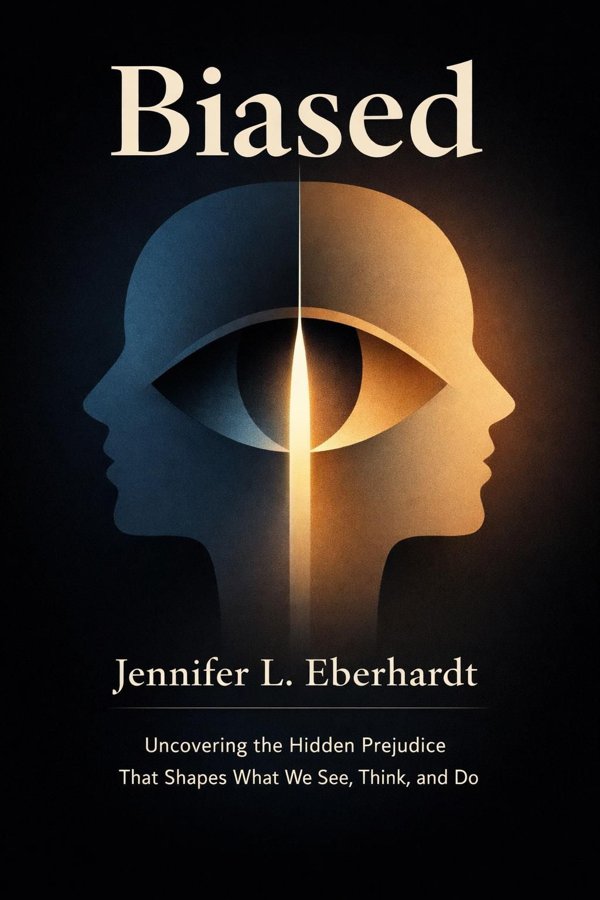
Biased: Uncovering the Hidden Prejudice That Shapes What We See, Think, and Do: Summary & Key Insights
 10 min10 chaptersAudio available
What Is Biased: Uncovering the Hidden Prejudice That Shapes What We See, Think, and Do About?
Biased: Uncovering the Hidden Prejudice That Shapes What We See, Think, and Do by Jennifer L. Eberhardt is a sociology book spanning 10 pages. In this groundbreaking work, social psychologist Jennifer L. Eberhardt explores the science of implicit bias and how unconscious prejudices shape our perceptions, decisions, and interactions. Drawing on decades of research and real-world examples—from law enforcement to education and everyday life—Eberhardt reveals how bias operates beneath awareness and offers strategies to mitigate its effects, fostering greater understanding and equity.
This FizzRead summary covers all 10 key chapters of Biased: Uncovering the Hidden Prejudice That Shapes What We See, Think, and Do in approximately 10 minutes, distilling the most important ideas, arguments, and takeaways from Jennifer L. Eberhardt's work. Also available as an audio summary and Key Quotes Podcast.
Biased: Uncovering the Hidden Prejudice That Shapes What We See, Think, and Do
In this groundbreaking work, social psychologist Jennifer L. Eberhardt explores the science of implicit bias and how unconscious prejudices shape our perceptions, decisions, and interactions. Drawing on decades of research and real-world examples—from law enforcement to education and everyday life—Eberhardt reveals how bias operates beneath awareness and offers strategies to mitigate its effects, fostering greater understanding and equity.
Who Should Read Biased: Uncovering the Hidden Prejudice That Shapes What We See, Think, and Do?
This book is perfect for anyone interested in sociology and looking to gain actionable insights in a short read. Whether you're a student, professional, or lifelong learner, the key ideas from Biased: Uncovering the Hidden Prejudice That Shapes What We See, Think, and Do by Jennifer L. Eberhardt will help you think differently.
- ✓Readers who enjoy sociology and want practical takeaways
- ✓Professionals looking to apply new ideas to their work and life
- ✓Anyone who wants the core insights of Biased: Uncovering the Hidden Prejudice That Shapes What We See, Think, and Do in just 10 minutes
Want the full summary?
Get instant access to this book summary and 100K+ more with Fizz Moment.
Get Free SummaryAvailable on App Store • Free to download
Key Chapters
Bias begins not with hatred but with categorization. Our brains are wired to make sense of an overwhelming flood of information. We sort things into patterns quickly, unconsciously, and automatically. This ability—to tell safe from dangerous, friend from foe—once helped our ancestors survive. But when applied to people, those snap judgments can lead us astray.
In experiments I describe, subjects looking at ambiguous images or hearing neutral words often had their perceptions nudged by subtle racial cues. The amygdala, a brain region involved in emotional processing, lights up more strongly when white participants view Black faces compared to white ones, even in the absence of conscious animus. This is implicit bias: mental shortcuts that infiltrate how we see, feel, and act without our realizing it.
Social psychologists have long known that stereotypes embed themselves in memory through repeated pairing—Blackness with crime in news stories, femaleness with nurturing in media portrayals. These associations persist even among people who consciously reject prejudice. My own research has shown that bias can even shape visual attention: the mere presence of a Black face primes viewers to detect objects as weapons more quickly. This isn’t about blame—it’s about biology meeting culture. Once we understand that perception itself can be contaminated by stereotype, we can begin to devise ways to reduce that contamination in contexts like policing, education, and hiring.
Bias, then, is not a defect of a few bigoted souls but a systematic tendency of all human cognition. It can be amplified or muted by context. The point is not to shame but to illuminate, because only by recognizing our automatic associations can we begin to loosen their grip.
We like to think we see the world as it is, yet vision itself is subject to bias. When I show police officers quick flashes of ambiguous objects—sometimes weapons, sometimes harmless tools—the speed and accuracy of their responses change depending on whether a Black or white face appears beforehand. A Black prime increases the likelihood of mistaking a phone or wallet for a gun.
This effect does not stem from hatred but from deep cultural conditioning. Our visual system hasn’t evolved in isolation; it’s trained on social meaning. Race functions as a cue that signals danger, status, or belonging based on shared narratives that have persisted for centuries. From childhood onward, we learn to 'see' through those stories. This is why cross-race facial recognition errors are so common: we process in-group faces more holistically and out-group faces more superficially.
But perception can be reshaped. When police departments incorporate counter-stereotypical training materials—images of Black doctors or white criminals—the automatic association between Blackness and threat weakens. Simply bringing awareness to visual bias can slow down decision making, preventing tragic errors. The act of seeing more fully, of noticing the individuality behind racial categories, becomes a moral practice as much as a perceptual one.
+ 8 more chapters — available in the FizzRead app
All Chapters in Biased: Uncovering the Hidden Prejudice That Shapes What We See, Think, and Do
About the Author
Jennifer L. Eberhardt is a professor of psychology at Stanford University and a recipient of a MacArthur 'Genius' Grant. Her research focuses on racial bias, social cognition, and the ways in which stereotypes influence behavior and decision-making. She is recognized internationally for her contributions to understanding implicit bias and promoting social justice.
Get This Summary in Your Preferred Format
Read or listen to the Biased: Uncovering the Hidden Prejudice That Shapes What We See, Think, and Do summary by Jennifer L. Eberhardt anytime, anywhere. FizzRead offers multiple formats so you can learn on your terms — all free.
Available formats: App · Audio · PDF · EPUB — All included free with FizzRead
Download Biased: Uncovering the Hidden Prejudice That Shapes What We See, Think, and Do PDF and EPUB Summary
Key Quotes from Biased: Uncovering the Hidden Prejudice That Shapes What We See, Think, and Do
“Bias begins not with hatred but with categorization.”
“We like to think we see the world as it is, yet vision itself is subject to bias.”
Frequently Asked Questions about Biased: Uncovering the Hidden Prejudice That Shapes What We See, Think, and Do
Biased: Uncovering the Hidden Prejudice That Shapes What We See, Think, and Do by Jennifer L. Eberhardt is a sociology book that explores key ideas across 10 chapters. In this groundbreaking work, social psychologist Jennifer L. Eberhardt explores the science of implicit bias and how unconscious prejudices shape our perceptions, decisions, and interactions. Drawing on decades of research and real-world examples—from law enforcement to education and everyday life—Eberhardt reveals how bias operates beneath awareness and offers strategies to mitigate its effects, fostering greater understanding and equity.
You Might Also Like

Between the World and Me
Ta-Nehisi Coates
10 min
Half the Sky
Nicholas D. Kristof, Sheryl WuDunn
10 min
Men Explain Things To Me
Rebecca Solnit
10 min
Rational Ritual
Michael Suk-Young Chwe
10 min
The New Jim Crow
Michelle Alexander
10 min
Beyond Culture
Edward T. Hall
10 minBrowse by Category
Ready to read Biased: Uncovering the Hidden Prejudice That Shapes What We See, Think, and Do?
Get the full summary and 100K+ more books with Fizz Moment.