
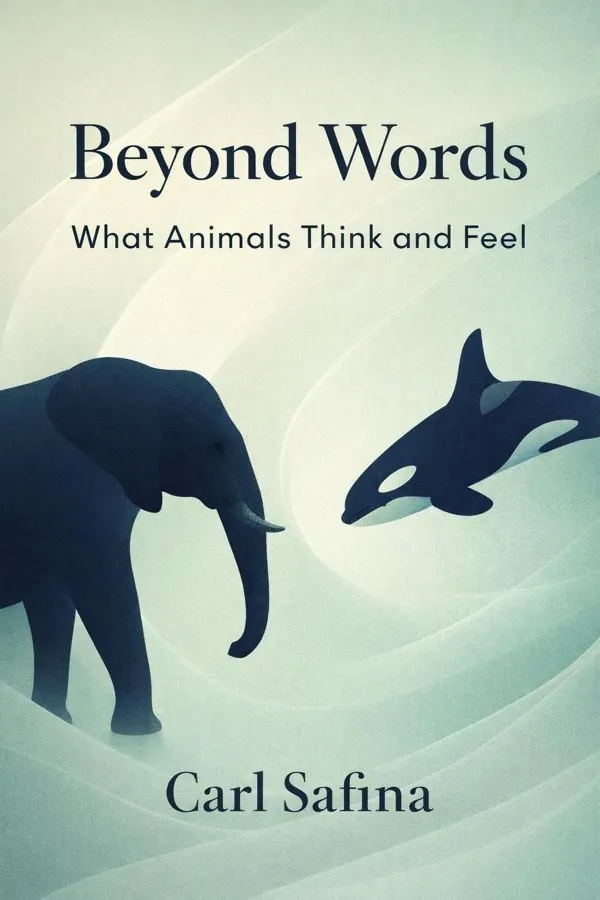
Beyond Words: What Animals Think and Feel: Summary & Key Insights
by Carl Safina
 10 min10 chaptersAudio available
What Is Beyond Words: What Animals Think and Feel About?
Beyond Words: What Animals Think and Feel by Carl Safina is a life_science book spanning 10 pages. In this groundbreaking work, Carl Safina explores the emotional and cognitive lives of animals, challenging the traditional boundaries between humans and nonhuman beings. Drawing on decades of field research and scientific insights, Safina reveals how elephants, wolves, and orcas experience thought, feeling, and social connection. The book invites readers to reconsider what it means to be conscious and empathetic in a shared world.
This FizzRead summary covers all 10 key chapters of Beyond Words: What Animals Think and Feel in approximately 10 minutes, distilling the most important ideas, arguments, and takeaways from Carl Safina's work. Also available as an audio summary and Key Quotes Podcast.
Beyond Words: What Animals Think and Feel
In this groundbreaking work, Carl Safina explores the emotional and cognitive lives of animals, challenging the traditional boundaries between humans and nonhuman beings. Drawing on decades of field research and scientific insights, Safina reveals how elephants, wolves, and orcas experience thought, feeling, and social connection. The book invites readers to reconsider what it means to be conscious and empathetic in a shared world.
Who Should Read Beyond Words: What Animals Think and Feel?
This book is perfect for anyone interested in life_science and looking to gain actionable insights in a short read. Whether you're a student, professional, or lifelong learner, the key ideas from Beyond Words: What Animals Think and Feel by Carl Safina will help you think differently.
- ✓Readers who enjoy life_science and want practical takeaways
- ✓Professionals looking to apply new ideas to their work and life
- ✓Anyone who wants the core insights of Beyond Words: What Animals Think and Feel in just 10 minutes
Want the full summary?
Get instant access to this book summary and 100K+ more with Fizz Moment.
Get Free SummaryAvailable on App Store • Free to download
Key Chapters
Every inquiry into animal consciousness begins with the ancient question of what the mind is and where it comes from. In our evolution, the human brain did not emerge from nothing—it was built upon structures shared across the animal lineage. Modern neuroscience confirms that parts of our emotional brain are not uniquely human but deeply conserved, appearing in mammals and even birds. This continuity means consciousness did not suddenly ignite in us; it gradually unfolded through millions of years of social life, survival, and communication.
When I consider elephants feeling grief or wolves planning a hunt, I am reminded that thought and emotion have biological purposes. They are tools for navigating relationships, predicting danger, fostering cooperation. To deny these faculties to animals is not only incorrect; it is an act of arrogance. Consciousness is graded, not categorical. Intelligence manifests through context—what matters is not how well one uses language, but how one adapts, perceives, and makes choices.
Empathy, too, is not an invention of humankind. It is an evolutionary strategy. The shared emotional signals between mother and infant, the soothing gestures between herd members, even the comfort a dog offers a grieving owner—all these are echoes of the same ancient inheritance. When we begin to see emotion and intelligence as overlapping fields of evolutionary continuity, the question shifts: not whether animals are conscious, but how their consciousness differs from ours. Once we cross that threshold of curiosity, the world grows infinitely more alive.
+ 8 more chapters — available in the FizzRead app
All Chapters in Beyond Words: What Animals Think and Feel
About the Author
Carl Safina is an American ecologist and author known for his lyrical writing on the relationship between humans and the natural world. He is the founding president of the Safina Center and has received numerous awards for his contributions to science communication and conservation.
Get This Summary in Your Preferred Format
Read or listen to the Beyond Words: What Animals Think and Feel summary by Carl Safina anytime, anywhere. FizzRead offers multiple formats so you can learn on your terms — all free.
Available formats: App · Audio · PDF · EPUB — All included free with FizzRead
Download Beyond Words: What Animals Think and Feel PDF and EPUB Summary
Key Quotes from Beyond Words: What Animals Think and Feel
“Every inquiry into animal consciousness begins with the ancient question of what the mind is and where it comes from.”
“On the plains of Kenya, among herds moving with deliberate grace, I began to understand that elephants are families bound by memory and loss.”
Frequently Asked Questions about Beyond Words: What Animals Think and Feel
Beyond Words: What Animals Think and Feel by Carl Safina is a life_science book that explores key ideas across 10 chapters. In this groundbreaking work, Carl Safina explores the emotional and cognitive lives of animals, challenging the traditional boundaries between humans and nonhuman beings. Drawing on decades of field research and scientific insights, Safina reveals how elephants, wolves, and orcas experience thought, feeling, and social connection. The book invites readers to reconsider what it means to be conscious and empathetic in a shared world.
You Might Also Like

The Selfish Gene
Richard Dawkins
10 min
Awakenings
Oliver Sacks
10 min
Parasite Rex: Inside the Bizarre World of Nature's Most Dangerous Creatures
Carl Zimmer
10 min
The Atlas of Life on Earth
Various
10 min
The Book of Humans: The Story of How We Became Us
Adam Rutherford
10 min
The Horse
Wendy Williams
10 minBrowse by Category
Ready to read Beyond Words: What Animals Think and Feel?
Get the full summary and 100K+ more books with Fizz Moment.