
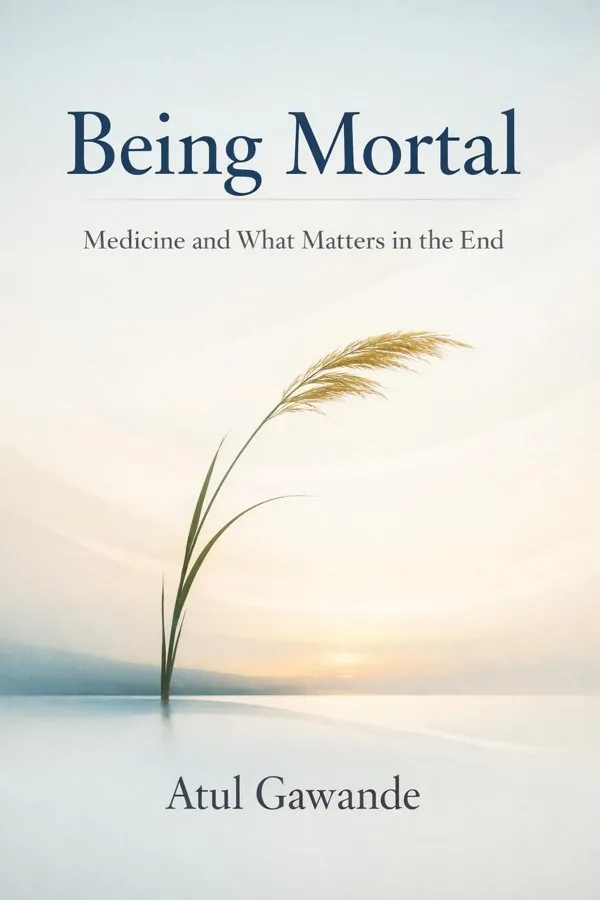
Being Mortal: Medicine and What Matters in the End: Summary & Key Insights
by Atul Gawande
 10 min8 chaptersAudio available
What Is Being Mortal: Medicine and What Matters in the End About?
Being Mortal: Medicine and What Matters in the End by Atul Gawande is a health_med book spanning 8 pages. In this profound exploration of aging, medicine, and mortality, Atul Gawande examines how modern medicine often fails to address the realities of death and dying. Drawing on research, personal stories, and his experience as a surgeon, Gawande argues for a more humane approach that prioritizes quality of life, dignity, and personal choice at the end of life.
This FizzRead summary covers all 8 key chapters of Being Mortal: Medicine and What Matters in the End in approximately 10 minutes, distilling the most important ideas, arguments, and takeaways from Atul Gawande's work. Also available as an audio summary and Key Quotes Podcast.
Being Mortal: Medicine and What Matters in the End
In this profound exploration of aging, medicine, and mortality, Atul Gawande examines how modern medicine often fails to address the realities of death and dying. Drawing on research, personal stories, and his experience as a surgeon, Gawande argues for a more humane approach that prioritizes quality of life, dignity, and personal choice at the end of life.
Who Should Read Being Mortal: Medicine and What Matters in the End?
This book is perfect for anyone interested in health_med and looking to gain actionable insights in a short read. Whether you're a student, professional, or lifelong learner, the key ideas from Being Mortal: Medicine and What Matters in the End by Atul Gawande will help you think differently.
- ✓Readers who enjoy health_med and want practical takeaways
- ✓Professionals looking to apply new ideas to their work and life
- ✓Anyone who wants the core insights of Being Mortal: Medicine and What Matters in the End in just 10 minutes
Want the full summary?
Get instant access to this book summary and 100K+ more with Fizz Moment.
Get Free SummaryAvailable on App Store • Free to download
Key Chapters
In our current age, we have medicalized what it means to grow old. We treat aging as a disease to be managed, rather than a stage of life to be embraced. When I began observing elderly patients, I realized how our healthcare system applies the same logic to their decline as it does to acute illness: every symptom is something to fix, every loss of ability a pathology to be reversed. Yet aging, by its very nature, is a process of gradual loss that no amount of medicine can ultimately stop.
Early in my career, I confronted the paradox of this medical attitude. I would often see older patients come in for one problem, only to leave with a dozen prescriptions and a diminished sense of control. This approach can extend life, yes—but what kind of life? I began to wonder whether our emphasis on medical intervention masks a deep discomfort with our own mortality.
Medicine’s progress has given us remarkable tools, but it has also reinforced an illusion of domination over nature. As a result, many people now enter old age inside institutions rather than among loved ones, their days dictated by safety protocols rather than their own desires. In trying to protect them from harm, we inadvertently deny them the very freedom that makes living worthwhile. Understanding this irony is the first step to recognizing that the goal of medicine in old age should not be merely survival, but the preservation of purpose and autonomy.
Throughout history, doctors have fought to conquer disease—and with good reason. But somewhere along the way, we confused preserving life with preserving the meaning of life. In hospitals, we fight with extraordinary skill against death, often without stopping to ask whether the person in the bed wants that fight.
I recall a patient whose cancer had metastasized beyond cure. The medical reflex was to keep escalating interventions—from another round of chemo to a ventilator if necessary. Yet when I sat with her long enough to hear her priorities, she told me she wanted simply to spend her remaining days at home with her family. Our default system would have denied her that wish. I saw, again and again, how medicine’s focus on extending existence can actively undermine the possibility of a good end.
I came to realize that our task as physicians is not always to do more, but to have the courage to stop. We must ask not what the matter is with the patient, but what matters to the patient. Sometimes the best care we can offer is not curative but palliative—helping people live better within the constraints of their condition.
The limits of medicine are not technological—they are moral and existential. The sooner we acknowledge that, the sooner we can redefine what compassionate care looks like.
+ 6 more chapters — available in the FizzRead app
All Chapters in Being Mortal: Medicine and What Matters in the End
About the Author
Atul Gawande is an American surgeon, writer, and public health researcher. He is a staff writer for The New Yorker and a professor at Harvard Medical School and the Harvard T.H. Chan School of Public Health. His work focuses on medicine, ethics, and the improvement of healthcare systems.
Get This Summary in Your Preferred Format
Read or listen to the Being Mortal: Medicine and What Matters in the End summary by Atul Gawande anytime, anywhere. FizzRead offers multiple formats so you can learn on your terms — all free.
Available formats: App · Audio · PDF · EPUB — All included free with FizzRead
Download Being Mortal: Medicine and What Matters in the End PDF and EPUB Summary
Key Quotes from Being Mortal: Medicine and What Matters in the End
“In our current age, we have medicalized what it means to grow old.”
“Throughout history, doctors have fought to conquer disease—and with good reason.”
Frequently Asked Questions about Being Mortal: Medicine and What Matters in the End
Being Mortal: Medicine and What Matters in the End by Atul Gawande is a health_med book that explores key ideas across 8 chapters. In this profound exploration of aging, medicine, and mortality, Atul Gawande examines how modern medicine often fails to address the realities of death and dying. Drawing on research, personal stories, and his experience as a surgeon, Gawande argues for a more humane approach that prioritizes quality of life, dignity, and personal choice at the end of life.
More by Atul Gawande
You Might Also Like
On Immunity
Eula Biss
10 min
The Three-Body Problem
Liu Cixin
10 min
Community Health Volunteer Toolkit: Training and Practical Activities
World Health Organization
10 min
Healing Back Pain: The Mind-Body Connection
John E. Sarno
10 min
Health Literacy for All: Practical Guides to Communicate Health Information (Compilations)
World Health Organization
10 min
The Complete Guide to Sports Supplements: An Evidence-Based Review
Anita Bean
10 minBrowse by Category
Ready to read Being Mortal: Medicine and What Matters in the End?
Get the full summary and 100K+ more books with Fizz Moment.