
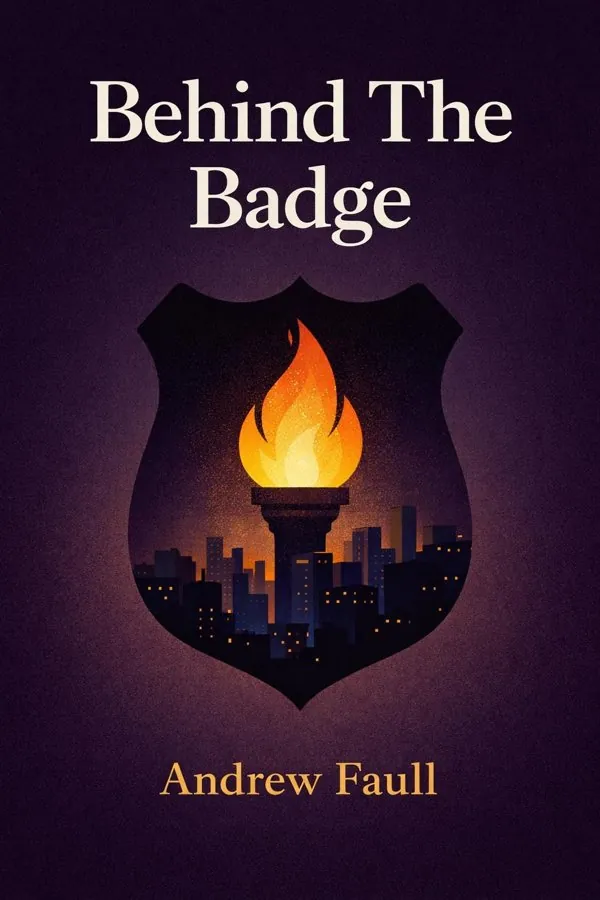
Behind The Badge: Summary & Key Insights
by Andrew Faull
 10 min9 chaptersAudio available
What Is Behind The Badge About?
Behind The Badge by Andrew Faull is a sociology book spanning 9 pages. Behind the Badge explores the inner workings of policing in South Africa, drawing on interviews and fieldwork to reveal the challenges, motivations, and moral dilemmas faced by police officers. The book examines how officers navigate issues of crime, corruption, and community relations in a society marked by inequality and violence.
This FizzRead summary covers all 9 key chapters of Behind The Badge in approximately 10 minutes, distilling the most important ideas, arguments, and takeaways from Andrew Faull's work. Also available as an audio summary and Key Quotes Podcast.
Behind The Badge
Behind the Badge explores the inner workings of policing in South Africa, drawing on interviews and fieldwork to reveal the challenges, motivations, and moral dilemmas faced by police officers. The book examines how officers navigate issues of crime, corruption, and community relations in a society marked by inequality and violence.
Who Should Read Behind The Badge?
This book is perfect for anyone interested in sociology and looking to gain actionable insights in a short read. Whether you're a student, professional, or lifelong learner, the key ideas from Behind The Badge by Andrew Faull will help you think differently.
- ✓Readers who enjoy sociology and want practical takeaways
- ✓Professionals looking to apply new ideas to their work and life
- ✓Anyone who wants the core insights of Behind The Badge in just 10 minutes
Want the full summary?
Get instant access to this book summary and 100K+ more with Fizz Moment.
Get Free SummaryAvailable on App Store • Free to download
Key Chapters
To understand the contemporary police officer in South Africa, one must first understand the institution’s lineage. Apartheid policing was never meant to serve the people—it was designed to control them. The police functioned as a political instrument of suppression, enforcing racial segregation and crushing dissent. Every baton, every arrest, every checkpoint was a tool of the state’s violence.
After 1994, the newly democratic government inherited this force with the challenge of transformation. New laws and policies were enacted to redefine the police as servants of democracy, not protectors of tyranny. Yet the remnants of the past persisted. Training philosophies, organizational mentalities, and everyday practices carried traces of militarism and alienation. The result was a hybrid identity—a police service that aspired to reform yet remained shackled by the ghosts of its origins.
Through conversations with officers, I found that many still bear psychological and institutional memories of those years. Older members recall enforcing laws they now regard as morally indefensible, while younger recruits wrestle with public hostility born of decades of mistrust. Communities most affected by apartheid often continue to see the police as an occupying force rather than a partner in safety.
This historical backdrop is essential because it explains the contradictions within contemporary policing. Reform, while necessary, is not merely policy—it must penetrate culture, identity, and emotion. Until officers can reconcile the moral dissonance of their institutional history, true transformation will remain elusive.
Stepping into the police academy marks the beginning of a profound transformation. Recruits arrive with diverse motivations: some seek stability, others crave authority, and many simply desire to make a difference in communities ravaged by crime. Yet the institution quickly reshapes them.
Training, in theory, teaches discipline and legality; in practice, it often instills hierarchy and obedience. In my fieldwork, I observed how recruits are socialized into a sense of duty that sometimes borders on blind loyalty. They learn to value the collective—‘the Service’—above the individual. The uniform becomes not just clothing but a symbolic armor that defines who belongs and who does not.
Many recruits enter with compassion but leave the academy hardened. They confront a curriculum that rarely prepares them for the ethical dilemmas of policing in unequal societies. Empathy risks being equated with weakness, while aggression earns respect. The contradiction is devastating because officers are then thrust into situations demanding sensitivity, not authority.
And yet, beneath the rigidity, there remains an undercurrent of idealism. Officers I spoke to often described their first patrol as a moment of revelation—the thrill of responsibility and the burden of expectation colliding. For some, that moment sustains them through years of hardship. For others, it seeds disillusionment when the system itself undermines their sense of purpose.
Recruitment and training thus form the crucible in which identity is forged. The police are not simply taught how to enforce the law; they are trained to embody a particular vision of order—and therein lies both their strength and their tragedy.
+ 7 more chapters — available in the FizzRead app
All Chapters in Behind The Badge
About the Author
Andrew Faull is a South African criminologist and researcher specializing in policing, crime, and justice reform. He has worked with the Institute for Security Studies and has published widely on police culture and accountability in South Africa.
Get This Summary in Your Preferred Format
Read or listen to the Behind The Badge summary by Andrew Faull anytime, anywhere. FizzRead offers multiple formats so you can learn on your terms — all free.
Available formats: App · Audio · PDF · EPUB — All included free with FizzRead
Download Behind The Badge PDF and EPUB Summary
Key Quotes from Behind The Badge
“To understand the contemporary police officer in South Africa, one must first understand the institution’s lineage.”
“Stepping into the police academy marks the beginning of a profound transformation.”
Frequently Asked Questions about Behind The Badge
Behind The Badge by Andrew Faull is a sociology book that explores key ideas across 9 chapters. Behind the Badge explores the inner workings of policing in South Africa, drawing on interviews and fieldwork to reveal the challenges, motivations, and moral dilemmas faced by police officers. The book examines how officers navigate issues of crime, corruption, and community relations in a society marked by inequality and violence.
You Might Also Like
Between the World and Me
Ta-Nehisi Coates
10 min
Half the Sky
Nicholas D. Kristof, Sheryl WuDunn
10 min
Men Explain Things To Me
Rebecca Solnit
10 min
Rational Ritual
Michael Suk-Young Chwe
10 min
The New Jim Crow
Michelle Alexander
10 min
Beyond Culture
Edward T. Hall
10 minBrowse by Category
Ready to read Behind The Badge?
Get the full summary and 100K+ more books with Fizz Moment.